Wednesday, December 1, 2010

All Things Herring: Crudo, Pickled, Meunière, Smoked, Salted


I've been having a lot of fun with herring since I swung by Halvorson Fisheries in Cornucopia, Wisconsin, on the South Shore of Lake Superior, on the way home from Bide-A-Wee on Monday. Well, sort of on the way home. I mean, I did start out at Bide-A-Wee, and wind up home in Saint Paul--which is basically a home-to-home trip now--but the stop in Corny required a little detour, roughly five hours of driving. The roundaboutness of my route started to sink in as I crossed the towering bridge over the Saint Louis River from Superior to Duluth, and I thought, "Hmm, you know, when the quickest way back to Saint Paul is via Duluth, you've gone just a little out of your way...".

And then when the mild afternoon turned into a bit of a blizzardy evening and I was still just past Pine City, a good 60 miles to home, and the lane markers on I-35 disappeared, traffic was crawling along, the headlights showed a white-out, snowflakes the size of handkerchiefs, and I pondered, "If this doesn't let up I'm not going to make it home tonight, I'm going to have to find a place to stay, with two dogs, and a cooler full of fish...", and I looked at the trip odometer, which showed 160.2 miles, and then I looked at it again, what seemed like an hour later, and it read 163.4, well, at that point it didn't seem like such a swell idea, my little detour.


But as I continued on south I hit the rain/snow line, the white turned to wet, I could see the road again, and we made it home safe and sound. As I walked in the door I smelled this amazing smell, and there was Mary taking a tray of fresh, hot gouda gougères out of the oven, those fabulous little choux paste cheese puffs, and I'm thinking, "Shower, martini, gougères, fresh fish...", and I'm thinking, "My wife: I think I'll keep her."

That's all prologue to a week of much herring. Here we go:


Pickled herring, for which I adapted a recipe from Hugh Fearnley-Whittingstall of River Cottage fame. I wasn't looking to pinch someone else's recipe, was just seeking a general method, but when I saw that he uses apple cider and cider vinegar, I wound up following the recipe pretty straight. It's still evolving, just two days in the jar, but it has a much more delicate texture and subtler flavor than any of the commercial versions I've had.


It was in the process of making the pickled herring that I came upon the inspiration for the dish above, herring crudo with cider mustard cream and frizzled leeks. See, the first step in preparing the pickled fish is brining it, soaking it in salt water for a couple of hours. Once I had done that (I lightened Hugh's brine, which seemed really salty), I tasted just a sliver of the raw fish, to see how salty it had become. What I tasted was this brilliantly fresh fish, just mildly salty, with a fantastic texture, yieldingly firm it was, to coin an oxymoron; it tasted, in brief, how I always hope the fish at sushi joints will, though it rarely does.

I knew I had to come up with a dish to show it off, and I thought of the honey-mustard sauces you often get with gravlax, and that thought led to this reduction of cream, sweet cider, cider vinegar, with some yellow mustard seeds and a little Dijon mustard. The frizzled leek looks pretty and adds a crisp contrast to the softness of the fish, the richness of the sauce. Crunchy gray sea salt brings more texture and...salt. This is rather a cheffy dish, to be sure, such as I rarely attempt anymore, but it's really not difficult. It all depends on the freshness of the fish, of course. You could make it with any "sashimi-grade" fish from a reputable fish monger. I've since learned (Thanks, Google!) that lightly salt-cured, essentially raw herring is practically a national dish in the Netherlands. (I undertook this research after the fact, to see if there were any health concerns to be aware of, like, Of course no one eats raw herring, because of the deadly herring worm that eats your intestines from one end to the other! If the Dutch thrive on raw herring, I'm much comforted. They've always seemed a particularly vigourous, ruddy sort of folk.)


That was our first course last night, and we followed it with herring milkweed à la meunière, skinless fillets lightly seasoned, dusted in flour, fried in an oil-butter mix. La meunière is the miller's wife; she brings the flour, I guess, a small but important contribution to the dish. For the sauce you cook good butter--maybe three tablespoons for two people--over a medium flame, and as it starts to brown--to turn noisette, hazelnut color--you toss in capers, traditionally, but I used my little pickled milkweed pods. I added also a couple teaspoons of the pickling brine, and a good squeeze of lemon juice, and you're good to go. Very, very good. Everyone tends to think of herring as an oily, rather heavy fish, but in a preparation like this, and with the freshest fish--and skinless, at that--that's the furthest thing from the case. This fish was notably light in texture--fluffy even came to mind--under the crisp flour jacket.


We drank some of our own cider, the 2009. Talk about a happy meal. Somewhere along the way it occured to me that the heart of this meal was wild foods. The milkweed, another small but vital component, I picked on our land this summer, and of course the herring swim free, and apparently still thrive, in Superior's "ice-water mansions." I mention this because, with all the attention paid these days to the trendy aspects of wild foods, we tend to forget that all food was originally wild. All of our cultivated vegetables and fruits and grains are manipulated versions of something Great Nature first made. My point here is a little fuzzy even to me, but I was just surprised to realize that herring with milkweed pickles was wild food--the herring came from a fish market (albeit one that sits on the shore of Lake Superior) and the milkweed pickles from a jar in my fridge. There are also jars of pickled ramps in there, and fiddleheads, and chanterelles, and jams and jellies from blackberries, wild plums, etc. In our house, wild food is not a separate category of food; it's just food. And I think that's good.


I bought some smoked lake trout and whitefish at Halvorson's, but I decided to try my hand at smoking my own herring. I used my standard brine, a half cup each of salt and brown sugar to a quart of water, brined it for around ten hours, and now I'm smoking it hot, trying to keep the temp around 220. That should take three hours or so. I have an idea about a dish that will involve the smoked herring and all things apple--some kind of reduction of sweet and hard cider, cider vinegar, fresh or perhaps dried apples. Of course I'm using apple wood to smoke it.


Finally, salted herring. I have no idea what I'll do with that--well, I have fleeting notions, a fish pie, pasty, empanada-type thing has occured to me. The fillets we used for the meunière dish were big, so I took off the tail ends and tossed them in salt, left them in the fridge overnight. Now I'm letting them dry a bit, and I'll probably freeze them. We will probably see them again some time in February....


I guess it could go without saying, at this point, that I find it inspiring to have ingredients of this quality to work with--and I also have frozen burbot (eelpout), and beautiful butterflied smelts in the freezer, brought back on this trip. But being by Superior at the end of November has a melancholy, elegaic quality to it, as well. Part of it was that marbled gray sky, the flat gray lake, and the out-of-season feeling of a summer place sliding into winter. Part of it is the sense that commercial fishing on Lake Superior is itself rather a marginal, vestigial activity, so few are left that ply this trade. Without descending into the maudlin, I still have to wonder, five years from now, ten, will I still have the chance to make an impetuous detour, load my cooler up with blindingly fresh herring, whitefish, or lake trout?

A few shots through the car window, traveling west on Wisconsin 13 from Cornucopia toward Superior:


Text and photos copyright 2010 by Brett Laidlaw

Tuesday, November 30, 2010

Provencal Sunshine


I tend to think of the golden, garlicky glory that is aioli as a summer dish--a glistening bowl of it surrounded by raw or crisp-blanched vegetables straight from the garden, or a pungent spoonful melting over a piece of grilled chicken. But when I whipped up a batch recently, and served it with root vegetable oven frites (parsnip, celery root, carrot, potato), then with roast beets and sliced red onion, a sprinkling of toasted walnuts, I found a whole new appreciation for that grand emulsion.


Indeed, mixed-root oven fries with aioli is my new favorite dish. With summer vegetables, the bright flavors of aioli are almost redundant. But with the deep, caramelized, earthy, both sweet and savory flavors of the roasted roots, the aioli is a perfect match and counterpoint. With the beets, something similar occured, though less profound. There the garlic and the lemon tartness mellowed the dirt flavor of the beets, and tempered the sweetness. I owe the inspiration for that salad to our friend Tata, whose Russian version uses grated beets mixed with loads of oil, mayonnaise, chopped garlic and walnuts.


That steak wasn't bad, either, nice pan-roasted porterhouse with a red wine-shallot sauce, and when the sauce bled into the aioli on the plate, well, that was something rather special, too.

And maybe it seems silly to pay homage to a single egg yolk, but I do believe that the Blue Gentian Farm egg that went into that aioli made it one of the best I've ever made. That, and the wonderfully sharp, sweet garlic that we got from a young farmer named Evan (didn't get his last name) near Turtle Lake.

Beets, Menomonie Farmers Market, red onion from Morgan and Ben, walnuts, well, probably from California. We're local, but we're not dogmatic. I really like walnuts.

And in parting, let me offer a couple of aioli-mayo tips, recently discovered though I've been whipping together oil and eggs for years. I use 3/4 cup of oil to one egg yolk, and I like the oil to be 1/2 cup canola, 1/4 cup extra virgin olive. I whisk the egg yolk with a scant teaspoon of Dijon mustard, then start adding the oil. Instead of pouring the oil at the beginning, dip a spoon into the oil, straight up and down, and then just let whatever oil clings to the spoon drip off into the egg yolk as you whisk. Do that a few times until you see the emulsion starting to form. Then you can start pouring in the oil in a slow, steady stream as you whisk. I add lemon juice partway through the whisking, for flavor and to lighten the mix. I add the very finely chopped garlic--at least one very large clove--and salt at the end. Adding a bit of salt to the garlic as you chop it helps to break it down so you can produce a virtual puree of garlic.

Oh, and this time I made my aioli in one of our 8-quart stainless steel mixing bowls, and when I was finished I did not have to spend a half hour cleaning spattered oil from counter, walls, and myself. Ya lives some and ya learns some. Whisk on, friends.


Text and photos copyright 2010 by Brett Laidlaw

Friday, November 26, 2010

Thankful


A quiet post-Thanksgiving day of house cleaning, cupboard clearing, no shopping at all--unless you count buying in to the future of some of our favorite non-profit organizations--is that much more enjoyable if it starts with a good breakfast, in this case beautiful local ham, cheese, and egg atop homemade sourdough.

Not that we were ravenous this Black Friday morning, having been fed very well, feted, in fact, at the home of friends on Turkey Day. But by mid-morning we were a bit peckish, so I sliced that sturdy loaf (made with flour from Whole Grain Milling and Natural Way Mills) toasted a couple slices and spread them with Hope Creamery butter, then a shmear of mustard our friend Mala (the crepe diva of Midtown Farmers Market) made, and atop that some fried Grass Run Farm ham, and then an over-easy egg from Blue Gentian Farm, out towards Bide-A-Wee, and then...phew, we're getting there...some grated Roth Kase gruyère. And ran it under the broiler.


I hope this doesn't seem like just a lot of name-dropping, but we're thankful this weekend, and throughout the year, for these wonderful local food products, the people who make them, and who make them available to us--our friend Renée Bartz and her family at Bolen Vale Cheese, everyone at the marvelous Seward Co-op, the farmers market vendors, and many more.

We wish you peace, love, and sanity throughout the mad-cap holiday season ahead, and, of course, many happy repasts with family and friends. Thanks for being friends of Trout Caviar. We truly appreciate it.

Brett, Mary, Annabel & Lily
Saint Paul, Minnesota & Bide-A-Wee Station, Wisconsin


__________________________________


Oh, and any breakfast that includes pickles is good by me. I made the pickles, little cornichons from our own garden cukes in our own apple cider vinegar.

Tuesday, November 23, 2010

Unfussy Fowl (from "Favorite Recipes of Minnesota Meats")


There's no other week of the year during which over-sized poultry products receive as much riveted attention as Thanksgiving week, of course, much of it reaching near-existential levels of agonized scrutiny: To brine or not to brine? Baste? When, with what, butter, stock, orange juice, Dr Pepper? Whole bird or separate the parts? Stuffing in or out (and if it's out, how can it be stuffing...?)? Heirloom or Butterball? Follow Jean-Georges, or Grandma Jeanne? Chuck it all, and go out for pho?

It all gets a bit fraught, to be sure, calling for help-lines, stacks of magazines all taunting the harried cook with images of the perfect bronzen bird, and that big bottle of wine you thought would last through dinner--oops, it didn't make it past the crab dip....

As a bit of an antidote--and not that I think this is going to cause anyone to alter their Turkey Day menus--I offer this elemental preparation, chicken baked with cream and onions. A bit of flour, salt, and water are the only other ingredients.

I brought home this little pamphlet-style cookbook after helping my mom sort through stuff during her recent move:


The moment I laid eyes on this recipe, I knew I had to make it:


The simplicity of the ingredients is compelling; the confidence in the instructions inspires confidence in the cook. And, what the hell, you stick it in the oven for a good while, take it out: Supper. It's the sort of recipe, too, that starts the cook thinking of variations--sure, you could use white wine or cider instead of water; slice some mushrooms to bake along with the chicken, or other vegetables; throw in a couple of sprigs of thyme. But I doubt, really, that you would get something better than this. Get really good, local, natural chicken, certainly (Kadejan is great, always available at our coop); and for us the cream is always Cedar Summit.


The only variations we made to the recipe were these: We used thighs only, instead of a cut-up bird. I salted the chicken, then rolled it in the flour, instead of mixing flour and salt. We baked it at 375 for about an hour and a half--I would have tried Mrs Hecht's long cooking at 350, but we were running a bit late, didn't want to be having dinner in front of the ten o'clock news.... Oh, and I basted it a few times in the course of the cooking.

Alongside we just had a tasty little gratin of butternut squash, a piece of bread, and a glass of cider. We gave thanks.

I love these sorts of old-timey themed cookbooks--I've got another around here somewhere, "Dishes Men Like," I think it's called, put out by the Lea & Perrins folks, and yes, every single recipe calls for Worcestershire sauce. As for the Minnesota meats book, published in 1966, it presents a really fascinating snapshot of where the Midwestern kitchen was headed at the time. For while some recipes show the brilliant simplicity and respect for ingredients of Mrs Hecht's, and others go right back to the farm (a head cheese recipe calls, indeed, for a hog's head, tongue, and heart), plenty of others show convenience foods creeping into recipes--a chicken recipe on the same page as Mrs Hecht's calls not just for two cans of "cream" soup, but for a half-pack of dried soup mix, too.

The section entitled "Foreign Favorites" is a hoot, containing recipes for "Creole Pork Chops (Hawaii)"; "Porcupine Meat Ball Sauce (Italy)"; three preparations of "Meat Balls (Sweden)," two for "Good Meat Balls (Sweden)", and, naturally, just one for "Best Meat Balls (Sweden)".

Flipping through books like this is as much (maybe more) an anthropological as a culinary activity. I find it a bit nostalgic (coming across a recipe very like my mom's sweet & sour spareribs), a bit appalling (the number of cans that get opened), a bit disheartening (I won't name names, but a "recipe" calling for nothing but hamburger, frozen french fries, and cream of mushroom soup, can only mean: "I just don't give a damn; it's food, and if you're hungry, you'll eat it..."), and extremely entertaining, for those reasons and more.

All the recipes, of course, are attributed to women, and almost every one a missus (including one Mrs. Walter F. Mondale, Wife of U.S. Senator from Minnesota, for Minnesota Wild Rice Casserole; if you grew up around here, you've eaten this dish, and you probably liked it just fine. My mom put water chestnuts in hers...).

Favorite Recipes of Minnesota Meats Edition, copyright MCMLXVI, Favorite Recipes Press, Inc., Louisville, Kentucky.

Sunday, November 21, 2010

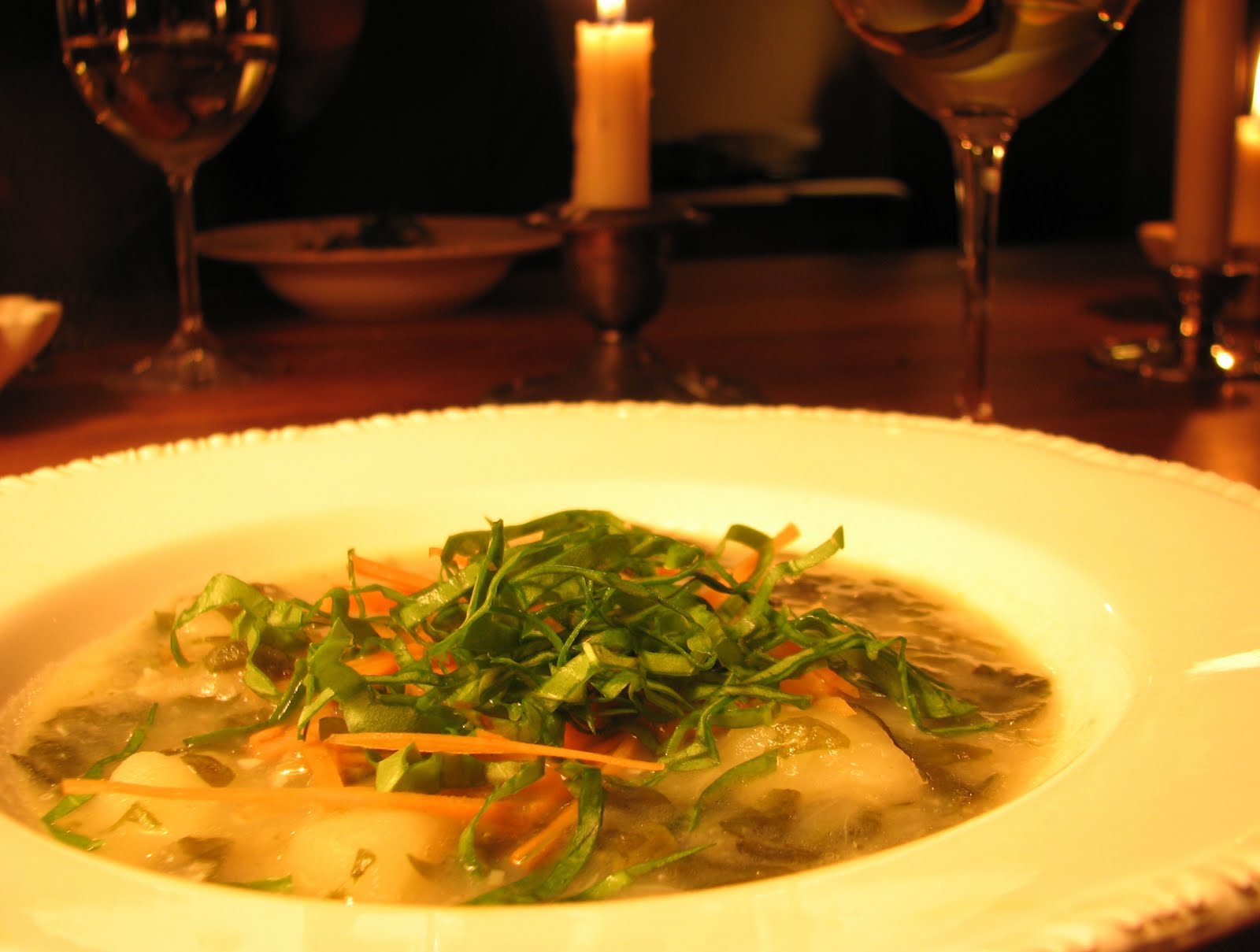
Seasonal Soupage: Potato-Shallot-Sorrel


I "tweeted" recently that I was a-fixin' ta put some fine fresh root vegetables, picked up from some of our Bide-A-Wee neighbors, together in a soup with "snow-kissed" sorrel from our garden. When I came to examine the sorrel bed, I found that I was guilty of a bit of food-blogger poetic license. "Snow-kissed" turned out to be more a case of "glacially-encased." I pried back the lid of crusted snow to reveal the beautiful bed of green above. What about that does not make one think of spring--except the snow, I mean...? In fact sorrel, a hardy perennial related to rhubarb, is at its best in early spring and late fall. It's one of the first plants to emerge in the spring, and then its young leaves add delightful zing to salads.

Through the summer it grows tall and leggy, bolts at a sidewise glance. I cut back the flower heads when I think of it, but that's a purely cosmetic operation. Whether you deadhead or not, when the cold weather comes in, sorrel comes back in style. It's a classic in rich sauces for fish, like this one I made with brown trout. It's also lovely paired with starchy things in soup. After a few frosts the leaves of sorrel become more tender, and also more tart, it seems to me, its lemony quality pronounced. Yet it's a delicate, vegetal acidity these autumn leaves impart. I'm not even sure if you can find sorrel reliably in the stores. This would be another gardener's dish, or friend-of-the-gardener's. Ask around if you don't grow it and can't find it. It grows abundantly, and a little goes a long way, and any sorrel aficionado you find will surely be eager to share.

You could substitute watercress for the sorrel--a different, but kindred taste and concept.

Oh, and the source of all the great roots we picked up last weekend--carrots, parsnips, and potatoes from Kay and Ric in Prairie Farm, shallots, fingerling potatoes, and garlic from Evan near Turtle Lake, gorgeous braids of shallots and onions, and more potatoes, from Morgan and Ben, west of Ridgeland--we found these folks (some of whom it turned out we already knew)through the Hay River Transition Initiative, a fantastic group of people keeping the western Wisconsin countryside alive and lively. As part-time rural residents, we haven't done much with this group yet, but we're really looking forward to getting more involved in the future. It's the sort of grass-roots effort that really gives one hope.

A delicious bowl of soup is another thing that bucks me up:


Sorrel-Shallot-Potato Soup
Serves two

2 shallots, each the size of a small egg, chopped fine
2 large cloves garlic, sliced thin
12 ounces waxy potatoes (two medium), peeled, quartered, sliced 1/2-inch thick
2 Tbsp (1 oz.) unsalted butter
2 cups unsalted chicken stock, preferably homemade
1 whole clove
1 small allspice berry
1 small bay leaf
6 whole black peppercorns
salt
1 small bunch sorrel leaves (about 3 oucnes), thick stems removed, chopped (about 2 cups chopped)—hold back a few leaves to chiffonade for garnish
1 small carrot, shredded very fine or grated, for garnish, optional

In a medium saucepan, melt the butter over low heat, and add the chopped shallots and a pinch of salt. Cook gently, without browning, until they shrink and become translucent, about 5 minutes. Add the garlic and cook for 3 minutes more. Add the stock, the sliced potatoes, the spices, and 1/8 teaspoon salt. Bring to a boil over medium heat, and simmer gently for 30 minutes, until the potatoes are very tender—falling apart somewhat, not totally disintegrated.

The soup can be made to this point several days in advance. Just before serving, bring the soup to the simmer, add the chopped sorrel, and simmer for 10 minutes. Taste for salt. Serve garnished with the reserved sorrel chiffonade, and the carrots if you like.

Note: Mary didn't care for the raw carrot garnish, but I did.

This kind of soup often gets a creamy finish, and a swirl of heavy cream, dollop of sour cream or creme fraiche certainly wouldn't hurt. But this au naturel version would be my preference when you've got really good potatoes and homemade stock.

Wednesday, November 17, 2010

The Best Breakfast Ever...

...according to Mary, anyway, was this here:


Wonderfully fresh and flavorful eggs from a local farm (thanks Don and Joni for passing them along!), delicious gouda with mustard seeds, Marieke, and the main delicacy, in her view, a mixed-root pancake. Her contention: We don't get enough vegetables at breakfast. This is a preparation to right that wrong.

This went from dinner the night before--accompanied by a sort of "ranchy" sauce, preceded by a roasted cauliflower salad--to breakfast the next morning. It became something of a theme of that snowy weekend to keep one meal segueing into the next....


Quite simple, extremely tasty. I've dubbed them pancakes, but they're definitely more in the latke style pancake than the batter-y sort of usual breakfast 'cakes. The eggs and flours just barely hold the vegetables shreds together. You could call them flat fritters, I guess, but that does not seem so appealing... Careful not to grate your knuckles into the mix.

Root Veg Pancakes

1 large potato
1 large parsnip
1 carrot
1/2 small celery root
1 small onion
1 small leek

Peel and grate the first five; slice the leek very thin and add to the grated veg. Add:

2 eggs
2 Tbsp each all-purpose flour and cornmeal
salt and pepper to taste

Mix and let sit for at least 30 minutes.

Heat a heavy fry pan--cast iron is excellent--and add 1/8 inch fat--we used duck fat and a little canola. Stir up the mixture and spoon out 1/2-cup portions into the pan, pressing down with a spatula (alternately, you could make one big, full-pan-sized cake, and cut it into portions, though this will be more difficult to flip). Cook over medium heat for five minutes, then flip over. Continue to cook for a total of, say, 18 minutes, turning often so the insides will cook through without burning the outside--lots of natural sugar in the mix, so be careful of that.

Serve for breakfast just as is, or with a dollop of sour cream; at dinner we mixed a bit of mayo, half & half, cider vinegar, chopped red onion and minced garlic, salt and pepper, for that "ranchy" sauce. Could be a side dish to grilled meat, roast chicken.


Text and photos copyright 2010 by Brett Laidlaw

Tuesday, November 16, 2010

Snow Soup Story


Saturday, 13 November, 2010

The first snow of the season came in last night, continuing through the morning in fits and starts, and on into the afternoon. It's extremely heavy snow, carrying twice as much moisture as an average snowfall--heart attack snow, its grisly nickname from the extra exertion required to shovel it. The kind of snow that also takes out tree limbs, hence power lines, and we heard on our battery-powered radio that thousands of homes were without power in the Twin Cities. We are at Bide-A-Wee, and so have no worries about losing power, as no wires connect us to the grid here. But we had our own concerns.


The original predictions said we’d only get an inch or two here, so I la-di-dahed it and didn’t bother moving the car to the top of our very steep driveway last night. Looking out in the morning, then, it was a rude awakening to see a good three or four inches of this very wet, slushy stuff turning the gravel drive into a quagmire. By that time it was nearly too late; fortunately I can stress the nearly. It took a good twenty minutes of up and downing it in the front-wheel-drive Jetta, strategic snow removal and gravel placement, and finally just gritting my teeth, gripping the wheel for dear life, and gunning it until the car surmounted the steepest pitch and I made it to the top.


With the snow rarely ceasing all day, we might have been there till spring.... Well, we didn’t really have anywhere we needed to be, but we were nearly out of candles, our main source of light, and also a friend had called to say he had some fresh eggs for us. I was eager to get those, so I did drive out in the afternoon, and only our town road was at all treacherous by then, the main roads clear. I got the eggs and had a cup of tea with Don, then proceeded into the town of Bloomer, about a 20-minute drive from the cabin. Bloomer has a couple of full-size grocery stores, but those stores yielded all of five white tapers, or tapers of any color, for that matter. I could have stocked up on scented jar candles, however.

With our oil lamp, a propane camp lantern, and strategically placed tea lights we’re sitting in romantically rustic lighting, a picture from more than a century back in technology, except that I am writing this on an Asus netbook, and Mary is reading Huckleberry Finn on her brand new Kindle, the electronic reader.

At least dinner will be a decidedly low-tech affair. Soup on the Haggis, our very basic woodstove, is on the menu, with some Wisconsin cheese and homemade levain bread. I took a downright peasant approach to the soup, and I hope it won’t offend any real peasants out there to learn that I didn’t even start with a clean pot. Last night I cooked up a batch of sauerkraut--choucroute, to give it a tonier Alsatian turn--that made a bed for legs of duck confit. I put some bacon rind in with the fermented cabbage, some carrot, onion, garlic, thyme, and we steamed some potatoes in there, too.


We ate pretty much all of it, but in the morning I saw that there were some odd bits of carrot, scraps of cabbage, and a couple pieces of potato left in the pot, along with the squares of bacon rind. Though we moved the pot to the side of the stove, it started to sizzle once I’d stoked the Haggis, and it smelled so good, well, I just couldn’t bear to toss the remnants out. In China there’s a tradition of master stocks, broth pots that are never emptied but merely added to in perpetuity. Our dutch oven didn’t have that sort of provenance, but I figured reusing that carried-over patina of ‘kraut and bacon fat would get my soup off to a running start.


So as the afternoon light faded, which never had glowed very brightly all day, a leaden November sky right through, we put some more sticks on the fire, gathered an armload of vegetables from the cooler and larder, and slid the soup pot back on the heat. The bacon rind began to sizzle again, and I added another strip of rind and a fat rasher diced. Then carrot, onion, leek, celery root tops and some of the root itself; kale, tomato, garlic, a dried red chili, and a couple of good forkfuls of ‘kraut straight from the jar, unrinsed. A splash of dry vermouth, water, salt and pepper, and last, a few slices of acorn squash.


And there it simmers, while the woodstove chimney ticks, the dogs doze, and sleety snow now and then scrapes at the windows. The radio just turned itself off; it was tuned to Mountain Stage, an excellent music variety show from West Virginia that we listen to on WOJB radio 88.9, “Woodland Community Radio” from the Lac Court Oreilles Ojibway reservation in Reserve, Wisconsin.


So that’s been our day, the first white one of the winter. Oh, add in a nice walk around the newly snow-draped hills, during which our young dog, Lily, covered a hundred times as much ground as the rest of us; senior griff Annabel, now 12, was also rejuvenated by the snow day. That soup, it won’t be any sort of culinary triumph, except that I know it will be perfectly delicious, and exactly what we want to eat. Great food doesn’t have to be complicated, or require too much thought or effort--that's the beauty of wonderful, seasonal ingredients. Sometimes, it doesn’t even have to start with a clean pot....


Text and photos copyright 2010 by Brett Laidlaw