I've harbored the desire to move to the country for well over a decade now. It's a fantasy shared by many, I know--that dream of getting back to the land, finding a simpler life in harmony with nature's rhythms, yada yada yada.... On a mild spring morning with the apple trees in bloom and abuzz with bees and hummingbirds, it seems like the most appealing of existences. How could you want to live anywhere else? How could you stand to? But then there are those other moments--a pick-up truck with a blown-out muffler comes barreling down the road, someone chucks a Bud Light can out the window, and the truck's radio is blaring some I-got-drunk-&-nasty-again song by Hank Williams Jr. (oh, why does he have to have that name?!?), but what you hear is the opening notes of "Dueling Banjos"....
Which is to say: There's the natural environment, which is easy enough to comprehend, whatever challenges it may present; and then there's the human one, which is, I dare say, considerably more murky and troubling. It was the latter that gave us qualms about moving full time to a rural area, but over the last four years of part-time country life our doubts have almost entirely been laid to rest. One event that really helped seal the deal was the first Traditional and Green Skills Event, put on by the Hay River Transition Initiative last March.
"By harnessing the collective genius of our community members and through principals such as reskilling, open space meetings, and relocalization, we will be a more resilient, vibrant and sustainable community," reads the HRTI's website, and what that translates into, in practical terms, is a bunch of really cool, dedicated, talented people working together to keep their rural community vital and growing. I'll refrain from invidious comparisons, but I already feel more connected to my Wisconsin neighbors, as widely dispersed as they may be (we own 53 acres now, but we're still land-poor by Dunn County standards), than to the Saint Paul neighborhood where we've lived for over 15 years. Out there, neighbors really need and value each other; also, lots of the folks we know in Wisconsin are there on purpose, having relocated from the city for the same reasons we're heading east. They are living very intentional lives, and to me that makes them extremely interesting, enlivening.
Well, this is a typically long-winded way of saying that the second annual HRTI Traditional and Green Skills Event is taking place on Saturday, March 3, from 9:00 a.m. to 3:00 p.m. at the Prairie Farm High School. Seminars include mushroom growing, solar ovens, chainsaw repair, cheese making, rain gardens, backyard chickens, beekeeping, wilderness skills, fruit tree grafting, and much, much more. I'm teaching a class on smoking basics in the first morning session--I'll demonstrate the cool way to open a pack of cigarettes, stylish ways of holding your cancer stick, how to choose a fine stogie, etc.... Yeah, uh, it'll be bacon and trout smoked on an ordinary home grill, smoke roasting chicken and pork--a very basic intro to demystify the smoking process. That's in the 10:00 to 11:20 slot.
The cost for the whole day is ten bucks! That includes coffee and baked goods in the 9:00 to 10:00 wake-up/meet & greet hour, AND a chili and bread lunch! Three stimulating instruction sessions, breakfast, and lunch, for TEN...MEASLY...DOLLARS! $25 for a family of up to five! Are you freakin' kidding me? Well, it's a great deal, and you will learn a lot, and meet wonderful people. You need not be a country bumpkin to attend--furthermore, you aren't even required to register in advance, though the coordinators and instructors would certainly appreciate advance sign-up, if you're able to commit. I will warn you, though--if you attend this event you just might find yourself shopping rural real estate on the way home....
The charming town of Prairie Farm is about an hour and a half's drive from the Twin Cities. I can give directions for the basic or various scenic drives if anyone's interested in coming out to the event.

Thursday, February 23, 2012


Wednesday, February 22, 2012
My Beautiful Choucroute
(With some technical issues resolved, we carry on.... See bottom for details.)

Choucroute garnie, the classic Alsatian dish of simmered sauerkraut topped with smoked meats and sausages, is not the sort of thing I want to eat every week, or maybe even every month. Though its name features the fermented vegetable base (choucroute is French for sauerkraut), it's a rich and meat-heavy meal, delectable when properly prepared with best ingredients, and ideal on a cold winter's evening, preferably after a few hours on the ski trails, or working in the woodlot. We make it with great anticipation, and relish every tangy, porky bite, maybe two to three times each winter. We make a big pot, even just for the two of us--the leftovers are even better than the first round.

Another thing I love about choucroute is that it's an ideal dish to simmer atop a woodstove. The gentle, even heat slowly renders the sauerkraut savory and tender, with still a bit of bite, and perfectly infuses the cabbage with the flavors of the meats that "garnish" it. There's some time involved in the prep, but once it's all assembled and bubbling quietly away, it's ready when you are.
If you've thought ahead to ferment your own 'kraut, choucroute garnie is a suitable reward for your forethought. You rinse the 'kraut in several changes of water to take away some of the sourness and salt, then you squeeze out as much water as you can so the cabbage is fairly dry. In a big heavy pot you've got some chopped leek, onion, and carrot sweating down in excellent bacon fat (best) or duck fat (just as good) or oil (acceptable). To this you add the squeezed-out 'kraut, then some dry white wine and chicken stock--perhaps a cup of each. I toss in a bay leaf, a couple of whole cloves, three or four crushed juniper berries, a few sprigs of thyme, a few grinds of coarse pepper. Nestle a small piece of excellent bacon in the middle of it, and let it cook, covered, for a good hour. That's the basis, and can be prepared days ahead.
Then on choucroute night, I begin by browning my meats. I had a couple of chunks of our home-smoked bacon, of course, and another homemade meat item, rillons. Rillons are succulent cubes of pork belly that have been cooked a long while in pork fat and duck fat, wine and herbs, very much in the manner of rillettes, except that for rillons the belly cubes are browned first, and left whole at the end, rather than shredded as for rillettes. Both rillons and rillettes are particularly associated with the cochonailles of the Loire valley around the towns of Tours, Amboise, Saumur. Cochonailles means things made from pig; I'll have more to say about this in an upcoming post.
The sausage components were purchased--really nice smoked sausage from Pastures A Plenty via Seward co-op ; and kalberwurst from Louie's Finer Meats of Cumberland, Wisconsin, an institution in west central Badgerland.
After browning the meats I cleaned up the pan a bit--I like my choucroute to stay nice and light in color, and if there's too much brown stuff in the bottom of the pot it turns dark; tasty but aesthetically unappealing, to me. So the pre-simmered 'kraut goes back in the pan, perhaps with another slosh of wine, or just a bit of water to keep it moist. Then the meats are tucked in, and it cooks at a very gentle simmer for at least a half hour, or until you're ready to eat. Oh, cook some potatoes ahead, and add them to warm in the last twenty minutes or so.
Crusty bread, a glass of riesling or pinot blanc. There it is, my beautiful choucroute:

Text and photos copyright 2012 by Brett Laidlaw
_____________________________
Re technical issues: When I went into Blogger yesterday to write this post, I found I was unable to type in the main text box. The little twirly daisy symbol, that doohickey that tells you the computer is "thinking", just kept going round and round, never stopped. I could type in the title box, the labels, see a preview--everything but actually type my post. Next day, today, same deal. Fortunately I have a computer genius in the house, and Mary resolved, or circumvented, the problem by installing Google Chrome as my browser. Now all is well, for the time being. Hopefully this will be helpful information if anyone else in blog world encounters this same problem.

Choucroute garnie, the classic Alsatian dish of simmered sauerkraut topped with smoked meats and sausages, is not the sort of thing I want to eat every week, or maybe even every month. Though its name features the fermented vegetable base (choucroute is French for sauerkraut), it's a rich and meat-heavy meal, delectable when properly prepared with best ingredients, and ideal on a cold winter's evening, preferably after a few hours on the ski trails, or working in the woodlot. We make it with great anticipation, and relish every tangy, porky bite, maybe two to three times each winter. We make a big pot, even just for the two of us--the leftovers are even better than the first round.

Another thing I love about choucroute is that it's an ideal dish to simmer atop a woodstove. The gentle, even heat slowly renders the sauerkraut savory and tender, with still a bit of bite, and perfectly infuses the cabbage with the flavors of the meats that "garnish" it. There's some time involved in the prep, but once it's all assembled and bubbling quietly away, it's ready when you are.
If you've thought ahead to ferment your own 'kraut, choucroute garnie is a suitable reward for your forethought. You rinse the 'kraut in several changes of water to take away some of the sourness and salt, then you squeeze out as much water as you can so the cabbage is fairly dry. In a big heavy pot you've got some chopped leek, onion, and carrot sweating down in excellent bacon fat (best) or duck fat (just as good) or oil (acceptable). To this you add the squeezed-out 'kraut, then some dry white wine and chicken stock--perhaps a cup of each. I toss in a bay leaf, a couple of whole cloves, three or four crushed juniper berries, a few sprigs of thyme, a few grinds of coarse pepper. Nestle a small piece of excellent bacon in the middle of it, and let it cook, covered, for a good hour. That's the basis, and can be prepared days ahead.
 |
| Rillons marinating prior to cooking. |
Then on choucroute night, I begin by browning my meats. I had a couple of chunks of our home-smoked bacon, of course, and another homemade meat item, rillons. Rillons are succulent cubes of pork belly that have been cooked a long while in pork fat and duck fat, wine and herbs, very much in the manner of rillettes, except that for rillons the belly cubes are browned first, and left whole at the end, rather than shredded as for rillettes. Both rillons and rillettes are particularly associated with the cochonailles of the Loire valley around the towns of Tours, Amboise, Saumur. Cochonailles means things made from pig; I'll have more to say about this in an upcoming post.
 |
| The golden porky loveliness of finished rillons . |
The sausage components were purchased--really nice smoked sausage from Pastures A Plenty via Seward co-op ; and kalberwurst from Louie's Finer Meats of Cumberland, Wisconsin, an institution in west central Badgerland.
After browning the meats I cleaned up the pan a bit--I like my choucroute to stay nice and light in color, and if there's too much brown stuff in the bottom of the pot it turns dark; tasty but aesthetically unappealing, to me. So the pre-simmered 'kraut goes back in the pan, perhaps with another slosh of wine, or just a bit of water to keep it moist. Then the meats are tucked in, and it cooks at a very gentle simmer for at least a half hour, or until you're ready to eat. Oh, cook some potatoes ahead, and add them to warm in the last twenty minutes or so.
Crusty bread, a glass of riesling or pinot blanc. There it is, my beautiful choucroute:

Text and photos copyright 2012 by Brett Laidlaw
_____________________________
Re technical issues: When I went into Blogger yesterday to write this post, I found I was unable to type in the main text box. The little twirly daisy symbol, that doohickey that tells you the computer is "thinking", just kept going round and round, never stopped. I could type in the title box, the labels, see a preview--everything but actually type my post. Next day, today, same deal. Fortunately I have a computer genius in the house, and Mary resolved, or circumvented, the problem by installing Google Chrome as my browser. Now all is well, for the time being. Hopefully this will be helpful information if anyone else in blog world encounters this same problem.
Wednesday, February 15, 2012
We Bought the Farm

Well, we bought a farm. Sort of a farm. It's definitely farmish--sheds, a pole building, barbed wire fences, a heated cattle watering dealio, and some kind of animal feeding station that looks like a playground carousel. We are as surprised as anyone.
We had been planning a move to the country for some time, but until last November Plan A involved building a house on the Bide-A-Wee land. We had a hilltop site in mind, we had talked to a house designer, then an architect. Things seemed to be coming together until.... Until all of a sudden they didn't seem to be coming together. We weren't thrilled with the designs, we couldn't see the whole picture--it was a vision thing, and a practical thing, a philosophical thing, a money thing. From heights of elation and anticipating ground-breaking in the spring, we were back to zero, or maybe sub-zero. We were bummed.
But late last summer a house had come up for sale, literally a mile down the road from Bide-A-Wee. An old house, several times added-on, with some attractively rustic outbuildings, at the foot of a steep hill. The lower part of the hill was planted in corn or soybeans; higher up it turned to mature hardwood forest. On the west side of the house were tall cottonwood trees, so the place was shaded on hot summer afternoons. The whole set-up seemed extremely pleasant; I had often admired it as we drove by.
 |
| On the deck, evidence of internal destruction, which began the day we bought the house. |
Still, we resisted looking at it. Our goal was to build our own house at Bide-A-Wee, we said; why waste our time, the realtor's time, looking at some house we knew we weren't going to buy. Well, in fact, at one point we made an appointment to see it, then cancelled it. Then a couple of weeks later the realtor--the sister of one of the owners--called us back. If we had any interest in the house, she said, why didn't we just go have a look. By this time all the coming-together-ness had come un-together. We went to see the house the day after Thanksgiving.
 |
| The outbuildings: I see a brick oven in the pole building at right, and gardens adjacent. |
It wasn't love at first sight, but it was definitely like. The main floor rooms--kitchen, living room, bedroom--were spacious (though the decor needed some updating). The upper level was a warren of cozy rooms with slanted walls, dormer windows, painted plank floors--a seaside cottage feel in rural Dunn County. And there were those sheds. Red ones. Two deer stands. A black walnut tree. Plus 33 more acres, 20-plus of mature hardwood forest--oak, maple, cherry.
 |
| Who doesn't love a red shed with a corrugated roof? |
Maybe the clincher was the fact that when we stood on the Bide-A-Wee hill and looked down the valley, what we saw at the end of the valley, that was this property, what I've come to think of as Harlson Hill.
Cutting to the chase: We made an offer in early December, went through a little back and forth, reached a deal. Went through various inspections--for a while there, no one could find the septic tank; troubling. We got it all sorted out on a pretty short timeline, and closed on the place on January 30.
 |
| Griffon heaven. |
We've still got some work to do on the "new" place before moving in. We had a new maple floor laid in the kitchen there, and existing wood floors refinished, this week; at the same time, we were having stairs refinished in Saint Paul--all of which left me exiled, dog-sitting, at Bide-A-Wee, as griffon hair and wet polyurethane are best kept well apart. Not such a dismal fate, but I was eager to get on with...everything. We're still hoping to be installed at the new country estate by the end of this month. There will still be a fair amount of work to do inside the house, and then garden planning, the anticipation of foraging in our new woods--a brave new world, all round!
So now you know why communications in these pages have been a bit sparse of late, and likely will be so for a while. Once things are a bit more settled, there will be much to report.
Saturday, February 4, 2012
A Winter Salad by Any Other Name

What shall we call the shreddy salads of winter, the festive haystacks that make the most of root cellar holdings, long-keeping fruits, and the squashes of our season? Slaw fails the task, too burdened by associations with perfunctory and over-dressed deli/burger/picnic sides. A celeri remoulade is a lovely dish of shredded root, denizen of every traiteur's cold case, but the remoulade refers more to the dressing than to the shards of celeri-rave.
One thing I've found: the more I eat with the season, the more I want to eat with the season. We used to pick up a head of red leaf lettuce on nearly every weekly grocery trip, but eventually our enthusiasm for those often leathery leaves shipped in from warmer climes waned. Local hydroponic greens are a reasonable choice, but one that doesn't excite my palate much, these days. I've become more inclined toward broadened ideas of salad, and the shredded type tops my list. This particular one here, of Benriner-ed squash, celery root, and apple, has become a regular in our shreddy salad rotation.

The squash really is the key, and if you're thinking, "Raw squash...?", well, so was I. Would it taste too squashy, or gluey. Let your dubious heart be comforted--neither is the case. I've made this with kabocha and...something else. A small hubbard type, I think. I think any hard winter squash would work. Butternut, for sure. The drier types, like buttercup, maybe not so much, but I could be wrong. The raw squash really has quite a mild flavor, especially in this combination of more assertive tastes. What it does provide is texture, an al dente quality that is almost more pop than crunch--very intriguing, extremely refreshing.

If you are very, very good with a knife you can do this by hand. I used the medium blade on my Benriner mandoline--every kitchen should have one. But watch your fingers! I shredded up roughly equal amounts of squash, celery root, and apple. I mixed up a dressing of cider vinegar, a little honey, oil, salt and a wee bit of pepper. I've been keeping it really local with my oil choices this winter, too. This is becoming easier since local sunflower oils from small producers have started showing up, like those from Smude and Driftless Organics . I love the Smude oil--it's light in texture, but it has a definite presence, and is excellent in salad dressings. I haven't tried the Driftless Organics product.
There's another local oil, a more specialized product, which I have

mentioned recently, and which is produced over in beautiful west central Wisconsin by a very cool couple of guys, Ken Seguine and Jay Gilbertson--that's Hay River Pumpkin Seed Oil. The salad pictured here was made using that oil. It has a teasingly nutty aroma, a bit like sesame oil, but less in-your-face. Much more on Ken and Jay and their pumpkin seed saga to come.
I don't really miss the leafy salads that were so delightful in the warmer months. Soon now I'll be starting lettuce seeds in flats, and moving them to a sunny window. In this mild winter March will likely provide the first wild green spriglings of dandelion, sheep sorrel, and cress to fill out a salad of lettuce thinnings, and it will only get better from there. Until then I'm going to enjoy my shreddy salads, my root cellar raw spaghetti, whatever you want to call it. But if you've got a better name for it, please do let me know.
Text and photos copyright 2012 by Brett Laidlaw
Sunday, January 29, 2012
Cool News About the Book, and a Couple Local Events
We received some exciting news this weekend: The Trout Caviar book was named a finalist for the 2012 Minnesota Book Awards . It's one of four finalists winnowed down from over 40 nominees in the general non-fiction catergory. Looking at some of the excellent titles that weren't named finalists, I have to say, I feel a bit abashed; but hey, I'll take it, and gratefully. The awards ceremony takes place on April 14.
Also, I've got a couple local signings lined up in the next few weeks:
On Saturday, February 4, from 2:00 to 5:00 p.m., I'll be meeting and greeting and signing books at the Seward Co-op at Franklin Avenue and Riverside in Minneapolis.
Then on Saturday, February 18, I'll be at the River Market co-op on Main Street in Stillwater from noon to 3:00. Valley Bookseller will also take part in this event.
In both cases, there will be snacks prepared from recipes in the book. Hope to see you there.
Tuesday, January 24, 2012
A Tale of Three Tarts

Nothing facilitates culinary creativity like a well-stocked larder. And nothing is more essential to a well-stocked larder than bacon. Cuz where do you think the word larder comes from, anyway? Comes from lard, which is French for bacon. You learned something today, didn't you? You're welcome.
Actually, that derivation just occured to me as I started writing this, but it turns out it's spot on. Here's what my Webster's New Twentieth Century Unabridged has to say: "larder, n., [ME, larder; OFr, lardier, a larder, a tub for bacon; LL. lardarium, a room for meats, from L. lardum, the fat of bacon, lard.]" (Another thing I've just learned is that it's really hard to type and use the mouse with a big honkin' dictionary on your desk.)
I wish I had known that (about the etymology, not the awkward dictionary) when I was writing this essay I recorded for Wisconsin Life on Wisconsin Public Radio,"The Importance of Bacon" (a variation on a chapter in the cookbook). In light of the faddish frenzy that has arisen around bacon in the last couple of years, I'm sort of ambivalent about my role as evangelist of smoked pork belly, but that WILife essay is something of a defense and apology for my position, which I'm happy to expound upon further here.
What disturbs me about the bacon craze is, 1) The seemingly indiscriminate approach, which implies that all bacon is good, without distinguishing greatness from dreck, and 2) The culture of gluttony it seems to promote.
Now, at some level, the appeal of bacon is so great that even the worst bacon is good. But the watery, chemical-laden supermarket bargain bacon, made from pork that comes from who-knows-where, is only good because the sledge-hammer combo of salt, smoke, and fat can disguise many flaws. Set next to really good, natural bacon, from well-raised pigs, it looks like exactly what it is: rubbish. When I'm cutting bacon from one of my home-smoked slabs, I'll often taste a sliver of the "raw" stuff; I don't think you'd be tempted to do that with the $1.89-a-pound product from Bob's Food Barn.
And as for the gluttonous, drooling, stuff-your-face attitude, the bring-on-the-fat, over-the-top, clog-my-arteries, please, approach, well, I feel that's wrong at so many levels, I'm just going to let it go at that.
Pizza night chez Trout Caviar last week perfect illustrates why I glorify bacon, and other rich and wonderful products of our region--they are splendid when used in a balanced approach to cooking and eating. Combined with good bread (the crust), savory vegetable elements (onion, sauerkraut, leek, potato), a delightfully satisfying whole results, in which you can have your tart and eat it, too, literally--one recipe's worth of Bacon Onion Tart (p. 108) provided Mary and me with dinner for two nights, and a happy hour snack, to boot.
The recipe in the book has you divide the dough in half for two tarts; I did mine in thirds. Tart #1 was the traditional tarte flambée or flammekeuche, the Alsatian classic topped with crème fraîche, onions, and bacon.

For tart #2 I rinsed about a cup of sauerkraut (make your own via Trout Caviar, p. 222!), squeezed it quite dry, and sautéed it in a bit of duck fat with a small leek sliced. That mixture was combined with crème fraîche, and got a sprinkling of grated Wisconsin havarti cheese (I'm on a havarti kick recently, thanks to the Stettler Cream Havarti from Decatur Dairy in Brodhead, WI; we get it at Renee's shop in Connorsville ).

And for tart #3, I sliced a small potato as thin as I could; I spread some crème fraîche over the dough; placed the potato slices on top; scattered one thick slice of bacon in fine dice over the top; added a handful of Wisconsin "gruyère" (Roth Kase).

The tarts baked at 525 for, what, five or six minutes. You just watch for the crust to brown and the toppings to bubble. With a salad, a glass of riesling--voilà. Little better on a cold January evening; get in a brisk walk or a turn on the skis as the sun drops down through streaks of gray and pink. Sip a glass of that crisp, tart, fragrant wine as you work on putting your tarts together. Something else that really heightens culinary creativity is knowing whom to steal ideas from, and I raid the Alsatian larder regularly.
And here we are back in the larder: I decided to make this dinner mid-afternoon of the same day, and didn't have to go out for a single thing Bacon, onion, leek, 'kraut, cream, cheese, the dough makings--these are things we almost always have in stock. If I hadn't had those particular cheeses, I'd have used something else, or left it out. If my 'kraut crock was running low, I'd have taken out a packet of blanched, frozen garden kale, and used that. I'm not opposed to recipes, the dear knows, but I prefer to think in terms of methods of preparation, rather than hard and fast rules or lists of ingredients. There aren't many recipes that can't stand a certain amount of substitution or variation--and who knows, by adding your own twist, you might just come up with your new favorite dish. The spud 'za pretty much stole the show in this instance; it will find a place in the regular rotation.
One quick note on crème fraîche: You can buy this product at co-ops and better grocery stores. For the recipe in the book, I suggest just mixing sour cream and heavy cream half and half. If you have more time, you can produce a homemade version by mixing sour cream and heavy cream--a tablespoon or two of the former for each cup of the latter--and setting the mixture in a warm place--your oven with the light turned on, for instance--overnight. The next day it should be nice and thick and tangy.
Text and photos copyright 2012 by Brett Laidlaw
Wednesday, January 18, 2012
Smelt Po'boys with Wild Remoulade Sauce
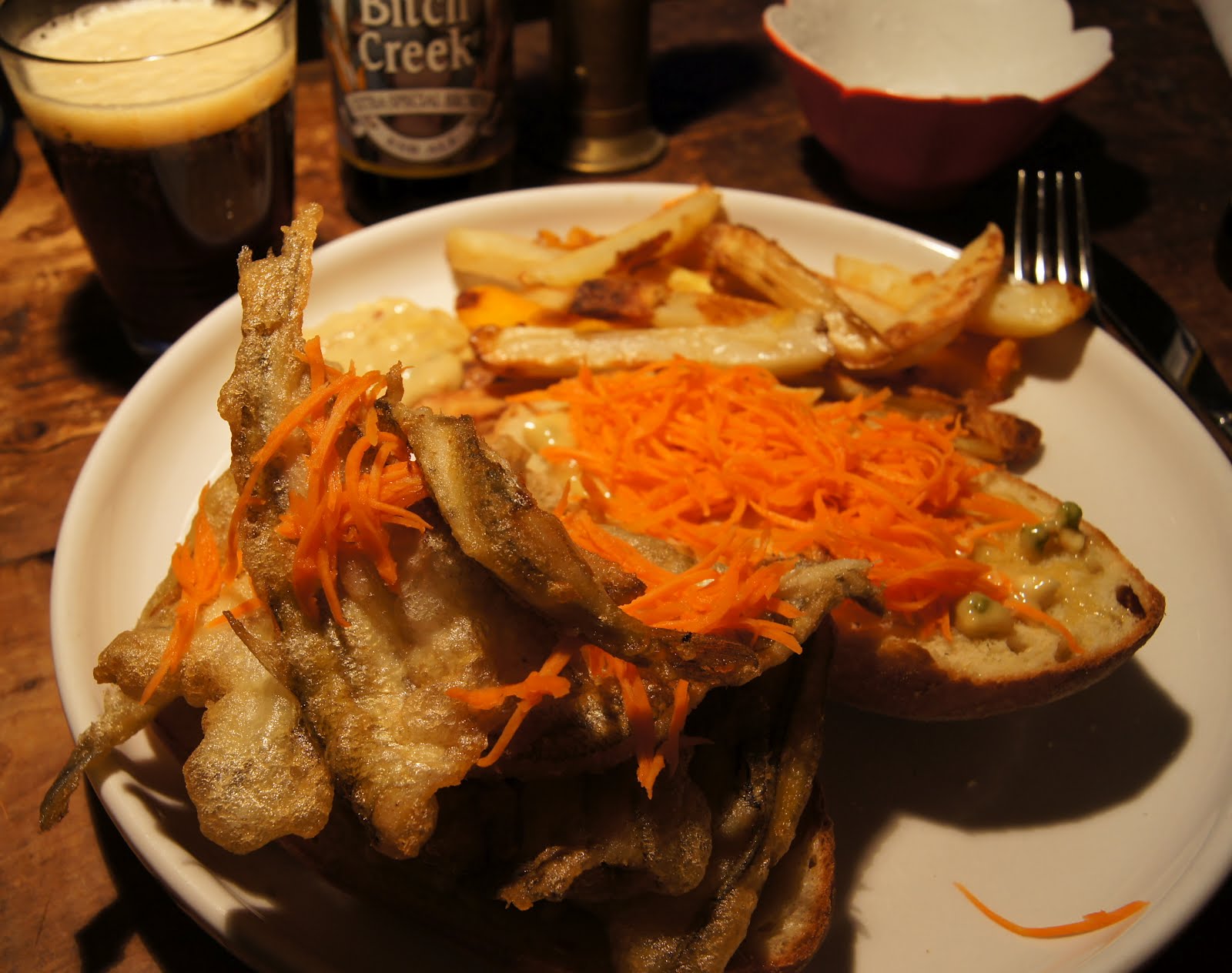
We've been in eat-out-of-the-freezer mode for a couple weeks now. When there's not enough space in the freezer to chill your martini glass, you know something has to be done. I'm not really a hoarder of stuff, in general, but I am something of a pack rat when it comes to food. My refrigerator is a pickle museum; I curate a jam and jelly collection there, as well. Apparently I have a horror of endings, for I keep jars that contain a half-inch of blackberry preserves, one lonely cornichon, some scraps of fermented vegetables. Sometimes I find jars of pickles entirely absent of pickles, nothing left but the brine. And then, frighteningly, I'll return that jar to the fridge, thinking, hmm, there was that pickle brine rye bread recipe someone sent me eight years ago, maybe I'll make that....
As for the freezer, that's more of an archaeological situation when it comes to determining what's in there, scraping back through layers of time, discovering freezer burned trout frames, sacks of berries of dubious provenance. I swear to god, I recently pulled out a zip bag containing a frozen block of something, and in the space where you note the contents, it said "SOUP?" That got tossed.
But there's good stuff in there, too. A lot of the very best fish we eat comes frozen, believe it or not. On our trips to the South Shore of Lake Superior we always stock up on fresh fish at Halvorson Fisheries in Cornucopia. Sometimes the fish is frozen and vacuum-packed there, and sometimes we bring the fresh-off-the-boat lake trout, whitefish, and herring home and freeze what we won't use fresh.

So in our freezer clean-out mode, courtesy of Halvorson's, we've recently had burbot bourguignon (eelpout in red wine, by another name), fish tacos also made with burbot (an intriguing freshwater cod that Amy "Sourtooth" Thielen writes about here ; I'd really like to get up to the Eelpout Fest this year). And our last frozen fish from Corny was a package of smelt that had been in the freezer for at least a year, so I had my doubts as it thawed, but you know what? Here's what: Fish that is packed absolutely fresh, and properly frozen, and kept frozen, is great even a year later. The vacuum-packing provides no opportunity for freezer burn or staling. The smelt had very little "fishiness" to them; rather, they had a cucumber-y, watery scent like some oysters have. Their fate was to be dipped in a light tempura batter, fried, and served on homemade rolls with a remoulade sauce perked up with chopped pickled ramps and salted milkweed bud "capers" on a north-meets-south po'boy. We don't do a lot of deep frying, but a few times each winter we'll fry up fish or shrimp for po'boys or tacos. It makes for a fun and summery meal, most welcome in the depths of January.

It's a joke around our house that writing a cookbook is a rather elaborate way of organizing one's recipes, but damn handy once it's done. There's truth in the gag, too--putting together this meal, I made the buns from the Cornmeal Honey Butter Bun recipe (p. 120), shaping oval buns of about 5 ounces of dough.

The remoulade started with a batch of mayonnaise (p. 219), to which I added some mustard, worchestershire, finely diced celery root, salted milkweed buds, and chopped pickled ramps (p. 224). The tempura batter is in the Walleye Taco recipe (p. 165). And alongside we had Oven-Fried Roots (p. 192)--potato, celery root, and mystery pumpkin (yes, I know, pumpkin is not a root; but it cooks up sort of...rootish).

The beer, Bitch Creek Extra Special Brown, was an impulse buy purchased for all the wrong reasons--because it's from the Grand Teton Brewing Company, and Mary used to live in Jackson Hole, in the shadow of the Tetons; and Bitch Creek is a famous western trout stream, and there's a fly pattern named for it . In spite of that, it was excellent--deep, dark, toasty, and bitter (as I poured out the last few drops to rinse the bottles this morning I got to thinking of beef short ribs braised in Bitch Creek ESP, lots of leeks and onions, maybe a dash of cocoa, some allspice...).

We still haven't made much of a dent in the freezer inventory, and chances are that some day soon I'll get it in my head that I can't go another week without a piece of grilled lake trout, a plate of Herring Milkweed Meunière (p. 171), and I'll hit the road for the South Shore, returning with a cooler full of fish, most of which will go in the freezer.
Hey, I just remembered, there are still some whitefish livers in there. Now, if I can only find them....
Text and photos copyright 2012 by Brett Laidlaw
Subscribe to:
Posts (Atom)