The lucky winners of the Trout Caviar book give-away are:
Sylvie, down in old Virginie, Rappahannock, to be exact, who wrote of blackberry wine, epic canning, drying peaches, pawpaw harvest, and more.
Jeff, who celebrated a surprise morel harvest and butchering the doe he shot on opening weekend of the deer season.
And Gloria, the biggest fan of the pungent ramp, who also enjoyed locally produced preserves, wild mushrooms, and the Saint Paul Farmers Market, particularly the produce from Sor Vang's family.
I really enjoyed reading everyone's favorite food memories of 2011. This was a blind drawing of all who wrote in with their 2011 highlights, one entry per customer. I put each person's name on a slip of paper, dropped them in a bag, and my wife Mary (Pastry Goddess, Plate Licker, Soup Smiler, etc.) drew the names. I was there to see that she had her eyes closed the whole time.
Thanks to everyone who participated, and thanks for reading Trout Caviar. We're going into the fifth year of the blog, hard to believe. I'm feeling as jazzed about this celebration of local, seasonal eating as I ever have--maybe more than when I first started the blog, since I had no idea then what I was doing, or where it would lead. I look forward to sharing my foraging, cooking, eating adventures in 2012, and to hearing about yours. Your participation, your feedback and insights and occasional quibbles (but quibble all you want, really), that is what keeps this interesting.
To the winners of the drawing: Please email me at brettlaidlaw@eckmeier.com to give me a mailing address; I'll sign the books, of course, but also tell me if you'd like yours inscribed with a pithy little message, and if so, to whom. Thanks.
Be back soon with new stuff. Oh, and by the way, I'll be doing a cooking demo tomorrow morning, Saturday, January 7, on KARE 11 television here in the Twin Cities, 9:43 a.m. I haven't been on TV before, and I am, uh, terrified!

Showing posts with label 2011 Highlights. Show all posts
Showing posts with label 2011 Highlights. Show all posts
Friday, January 6, 2012


Friday, December 30, 2011
2011 Highlights: Vite, Vite! The Rest
This is it, the ultimate post for 2011, an eventful year indeed for us. Quicky, quickly, the final list of highlights:

I continued refining my method for micro-batch canning and pickling. The basic brine I describe in the book ( and here ) I put into use to preserve a pint here, a half-pint there--green beans, asparagus, snow peas, ramps, shallots, fiddleheads. Whatever I had a surplus of, I'd just pack into a jar (with perhaps a quick blanching first), make up a little brine (seasoned as I saw fit, garlic always, and a bit of chile, maybe some Sichuan peppercorns, allspice, a couple cloves, a point or two of star anise; herbs like tarragon or thyme), pour it over, cap, stick it in the fridge, check on it in a few days, a few weeks, or perhaps even a few months. At Thanksgiving I had a lovely variety of tart and briny things to put out on the relish tray. As martini garnish, a tip of pickled asparagus is delightful.

The specific dishes that really stayed with me were those where I took a deeply local approach. The ceviche above, from last July, combined raw Lake Superior whitefish with green apple juice and our own cider vinegar, green prickly ash berries (related to Sichuan peppercorns), seeds and chopped leaves of honewort (aka "wild chervil"), and brined milkweed flower buds. It tasted amazing, and unlike anything I've eaten before. It's a direction I fully intend to pursue in the coming year.
Another delightful concoction employing the fruits of our land and the market was the caponata-inspired relish shown below , made with eggplant, apple, cider vinegar, maple syrup, a few aromatics, and a sprinkling of those milkweed bud "capers" again.

Mary and I left the dogs at the East River Road Kennel (aka Mary's mom's house), and spent a weekend on the South Shore of Lake Superior at the end of August. The photos from that trip have disappeared. We enjoyed many excellent meals on the trip, from the fried whitefish livers and broiled fresh lake trout and whitefish at the Village Inn in Cornucopia, to fantastic fish tacos post-bike ride at the Beach Club on Madeline Island, to a lakeside brunch of smoked fish, goat cheese, local apples and rye bread, washed down with the delicious water from the Corny artesian well.

And of course we loaded up with fresh fish from Halvorson Fisheries in the Corny marina. Also into the cooler for the trip back to the cities went a package of fresh whitefish livers. Though we always seek out this local delicacy in South Shore restaurants (I think of them as "South Shore sweetbreads"), I had never cooked with them before. I soaked them in milk, seasoned them well with salt and pepper and sambal, gave them a light breading and fried them up with onions. Served them with something I called "apple marmalade"; I have no memory of how I made that, but the combination was fantastic. Again, from humble ingredients, such a feast. We followed that first course with pan-seared lake trout in red wine sauce with a stew of local shell beans, bacon, and leeks.

The possibilities of ground meat are vast and enticing. While I do love a good cheeseburger, the most memorably delicious meat patty meal was this stew of grilled ground lamb meatballs with beets, eggplants, and subtle middle eastern seasoning:

In late September we roasted a whole lamb over the coals at Bide-A-Wee. Jean-Louis constructed an excellent spit for the occasion, and oversaw the grilling process. The lamb came from our friend Tina, who lives just up the road from Bide-A-Wee (though we joke that she lives in "southern Wisconsin," since she's on the other side of highway 64). It was a much larger animal than I had expected, pretty much filled the cargo compartment of our Jetta wagon when I picked it up at the processor. It easily fed the assembled crowd, and continues giving to this day: I'm simmering some of the leftovers for a lamb, beans, and greens stew that will be our New Year's Day supper.

And just about every day, we realized anew that eating locally and seasonally is not a challenge, but an outright joy. It's a familiar topic in these pages, I know, but one I'm happy to repeat again and again. And I'm not planning to stop.
May your 2012 be filled with great meals, friendship, and fine adventures.
Text and photos copyright 2011 by Brett Laidlaw

I continued refining my method for micro-batch canning and pickling. The basic brine I describe in the book ( and here ) I put into use to preserve a pint here, a half-pint there--green beans, asparagus, snow peas, ramps, shallots, fiddleheads. Whatever I had a surplus of, I'd just pack into a jar (with perhaps a quick blanching first), make up a little brine (seasoned as I saw fit, garlic always, and a bit of chile, maybe some Sichuan peppercorns, allspice, a couple cloves, a point or two of star anise; herbs like tarragon or thyme), pour it over, cap, stick it in the fridge, check on it in a few days, a few weeks, or perhaps even a few months. At Thanksgiving I had a lovely variety of tart and briny things to put out on the relish tray. As martini garnish, a tip of pickled asparagus is delightful.

The specific dishes that really stayed with me were those where I took a deeply local approach. The ceviche above, from last July, combined raw Lake Superior whitefish with green apple juice and our own cider vinegar, green prickly ash berries (related to Sichuan peppercorns), seeds and chopped leaves of honewort (aka "wild chervil"), and brined milkweed flower buds. It tasted amazing, and unlike anything I've eaten before. It's a direction I fully intend to pursue in the coming year.
Another delightful concoction employing the fruits of our land and the market was the caponata-inspired relish shown below , made with eggplant, apple, cider vinegar, maple syrup, a few aromatics, and a sprinkling of those milkweed bud "capers" again.

Mary and I left the dogs at the East River Road Kennel (aka Mary's mom's house), and spent a weekend on the South Shore of Lake Superior at the end of August. The photos from that trip have disappeared. We enjoyed many excellent meals on the trip, from the fried whitefish livers and broiled fresh lake trout and whitefish at the Village Inn in Cornucopia, to fantastic fish tacos post-bike ride at the Beach Club on Madeline Island, to a lakeside brunch of smoked fish, goat cheese, local apples and rye bread, washed down with the delicious water from the Corny artesian well.

And of course we loaded up with fresh fish from Halvorson Fisheries in the Corny marina. Also into the cooler for the trip back to the cities went a package of fresh whitefish livers. Though we always seek out this local delicacy in South Shore restaurants (I think of them as "South Shore sweetbreads"), I had never cooked with them before. I soaked them in milk, seasoned them well with salt and pepper and sambal, gave them a light breading and fried them up with onions. Served them with something I called "apple marmalade"; I have no memory of how I made that, but the combination was fantastic. Again, from humble ingredients, such a feast. We followed that first course with pan-seared lake trout in red wine sauce with a stew of local shell beans, bacon, and leeks.

The possibilities of ground meat are vast and enticing. While I do love a good cheeseburger, the most memorably delicious meat patty meal was this stew of grilled ground lamb meatballs with beets, eggplants, and subtle middle eastern seasoning:

In late September we roasted a whole lamb over the coals at Bide-A-Wee. Jean-Louis constructed an excellent spit for the occasion, and oversaw the grilling process. The lamb came from our friend Tina, who lives just up the road from Bide-A-Wee (though we joke that she lives in "southern Wisconsin," since she's on the other side of highway 64). It was a much larger animal than I had expected, pretty much filled the cargo compartment of our Jetta wagon when I picked it up at the processor. It easily fed the assembled crowd, and continues giving to this day: I'm simmering some of the leftovers for a lamb, beans, and greens stew that will be our New Year's Day supper.

And just about every day, we realized anew that eating locally and seasonally is not a challenge, but an outright joy. It's a familiar topic in these pages, I know, but one I'm happy to repeat again and again. And I'm not planning to stop.
 |
| Bar 5 duck confit with pan-seared squash, apples, and cabbage |
 |
| Lake Superior whitefish, cabbage, leek, chestnut braise, soft polenta with pumpkin seed oil |
Text and photos copyright 2011 by Brett Laidlaw
Wednesday, December 28, 2011
2011 Highlights: My Crock
There's still time to get your entries in for the Trout Caviar book giveaway --leave a comment about one of your 2011 LOCAL! food highlights by January 1; be specific, be evocative, regale and entice us!

I'm finding that my 2011 food highlights consist more of things I did than of things I ate--though I'm sure I'll be able to dredge up a memorable taste sensation or two, as well. Late last winter Mary and I took a drive south from Bide-A-Wee down Wisconsin highway 25 to the river town of Downsville. There we met potter John Thomas and his wife Kathy Ruggles, shared a cup of tea and talked about the tumultuous political situation engulfing the Badger State (it's worth remembering that the whole occupy phenomenon started with anti-Walker protestors flocking to Madison and the state capitol building).
We came home with my very first crock, an earthtone beauty that I filled with vegetables mid-summer; it's been fermenting ever since. Now it's filled with cabbage that has become sweet and sour, crunchy and salty--the basis for a wonderful choucroute garni dinner, on the elaborate end, or fabulous hot dog garnish, at its simplest.
Prior to acquiring this gorgeous vessel I'd always done my fermenting in quart jars, and that works just fine. I use the same recipe, either way: for each pound of shredded vegetables--cabbage, kale, beets, turnips, etc.--I add 2 teaspoons of salt. Rub the salt in well, pack the veg in quart jars, or into the crock with a weight on top. Into a cool dark place, and fermentation will start almost immediately. Your vegetables will be nicely sour in a few days, and will continute to gain character as time goes by. After a couple of weeks I usually refrigerate the jars, and there they will keep indefinitely. My crock is sitting on the kitchen counter, which is probably fine in a cool winter kitchen; but I oughta check on it, I guess.

Bonnie Dehn, the "Herb Lady" from the Minneapolis Farmers Market, mentioned the last time I was on the Fresh & Local Show with her and host Susan Berkson that you can even ferment cabbage in a zip-top bag. Worth a try, though I wouldn't leave the 'kraut in the bag longer than needed to get it sour, for fear of chemicals leaching from the plastic.
Fermenting your own vegetables is one of those age-old means of food preservation that can seem daunting until you try it and see how simple it really is. Trust nature, and your nose. Acquiring a taste for fermented food opens a whole world of gorgeous, pungent variety--some of the most distinctive and delicious foods from around the globe are of the fermented variety.
Text and photos copyright 2011 by Brett Laidlaw

I'm finding that my 2011 food highlights consist more of things I did than of things I ate--though I'm sure I'll be able to dredge up a memorable taste sensation or two, as well. Late last winter Mary and I took a drive south from Bide-A-Wee down Wisconsin highway 25 to the river town of Downsville. There we met potter John Thomas and his wife Kathy Ruggles, shared a cup of tea and talked about the tumultuous political situation engulfing the Badger State (it's worth remembering that the whole occupy phenomenon started with anti-Walker protestors flocking to Madison and the state capitol building).
We came home with my very first crock, an earthtone beauty that I filled with vegetables mid-summer; it's been fermenting ever since. Now it's filled with cabbage that has become sweet and sour, crunchy and salty--the basis for a wonderful choucroute garni dinner, on the elaborate end, or fabulous hot dog garnish, at its simplest.
Prior to acquiring this gorgeous vessel I'd always done my fermenting in quart jars, and that works just fine. I use the same recipe, either way: for each pound of shredded vegetables--cabbage, kale, beets, turnips, etc.--I add 2 teaspoons of salt. Rub the salt in well, pack the veg in quart jars, or into the crock with a weight on top. Into a cool dark place, and fermentation will start almost immediately. Your vegetables will be nicely sour in a few days, and will continute to gain character as time goes by. After a couple of weeks I usually refrigerate the jars, and there they will keep indefinitely. My crock is sitting on the kitchen counter, which is probably fine in a cool winter kitchen; but I oughta check on it, I guess.

Bonnie Dehn, the "Herb Lady" from the Minneapolis Farmers Market, mentioned the last time I was on the Fresh & Local Show with her and host Susan Berkson that you can even ferment cabbage in a zip-top bag. Worth a try, though I wouldn't leave the 'kraut in the bag longer than needed to get it sour, for fear of chemicals leaching from the plastic.
Fermenting your own vegetables is one of those age-old means of food preservation that can seem daunting until you try it and see how simple it really is. Trust nature, and your nose. Acquiring a taste for fermented food opens a whole world of gorgeous, pungent variety--some of the most distinctive and delicious foods from around the globe are of the fermented variety.
Text and photos copyright 2011 by Brett Laidlaw
Friday, December 23, 2011
2011 Highlights: Pumpkin Seed Harvest
Get your entries in for the Trout Caviar book giveaway--leave a comment about one of your 2011 LOCAL! food highlights by January 1; be specific, be evocative, regale and entice us!

One of my local food highlights of 2011 didn’t actually involve any food—well, not directly, at least. Last October Mary and I were driving through the western Wisconsin countryside, and came across an intriguing scene. Off to our right was an unremarkable field in which were growing, it appeared, squashes or pumpkins of some sort. The intriguing part was the odd contraption parked near the side road, around which an group of people were gathered, intent on a mysterious task.

In addition, between the county road we were driving on and the contraption and crew, there were piles of what appeared to be smashed-up pumpkins. We peered intently as we drove past, up a hill and around the bend. A couple hundred yards along, I swung to the shoulder and hung a U-ie. We had to go back and see what was going on.

Once we started down the side road and approached the group of people, I knew what we had come upon: it was harvest time in the fields where the pumpkins that produce Hay River Pumpkin Seed Oil are grown. Ken Seguine was the man in charge, and he was working out the kinks in a newly automated form of pumpkin seed extraction—prior to this year, a dedicated group of volunteers performed the task of smashing open pumpkins and sorting out the seeds by hand.
The new pumpkin seed machine consisted of a sort of conveyor belt/elevator that lifted the pumpkins up, to be dropped into a grinder that busted them into pieces. These pieces fell into a rotating, perforated drum. As the drum went round it further agitated the pieces so that the seeds fell out and dropped through the perforations into a bin below.

The rest of the process from there is a bit of a trade secret, but it involves toasting and then pressing, and the result is a fragrant, dark oil that’s popular in Europe (particularly Austria), but nearly unknown in this country—indeed, Hay River is the first pumpkin seed oil produced in America.

I’ve just gotten a fresh bottle of the oil to experiment with, and will write more about the culinary applications of the oil in the next few weeks—a slaw of raw kabocha squash, celery root, and apple tossed with a pumpkin seed oil, cider vinegar, and honey dressing was a winner. I just love that this kind of thing is going on out in the western Wisconsin countryside.

Text and photos copyright 2011 by Brett Laidlaw
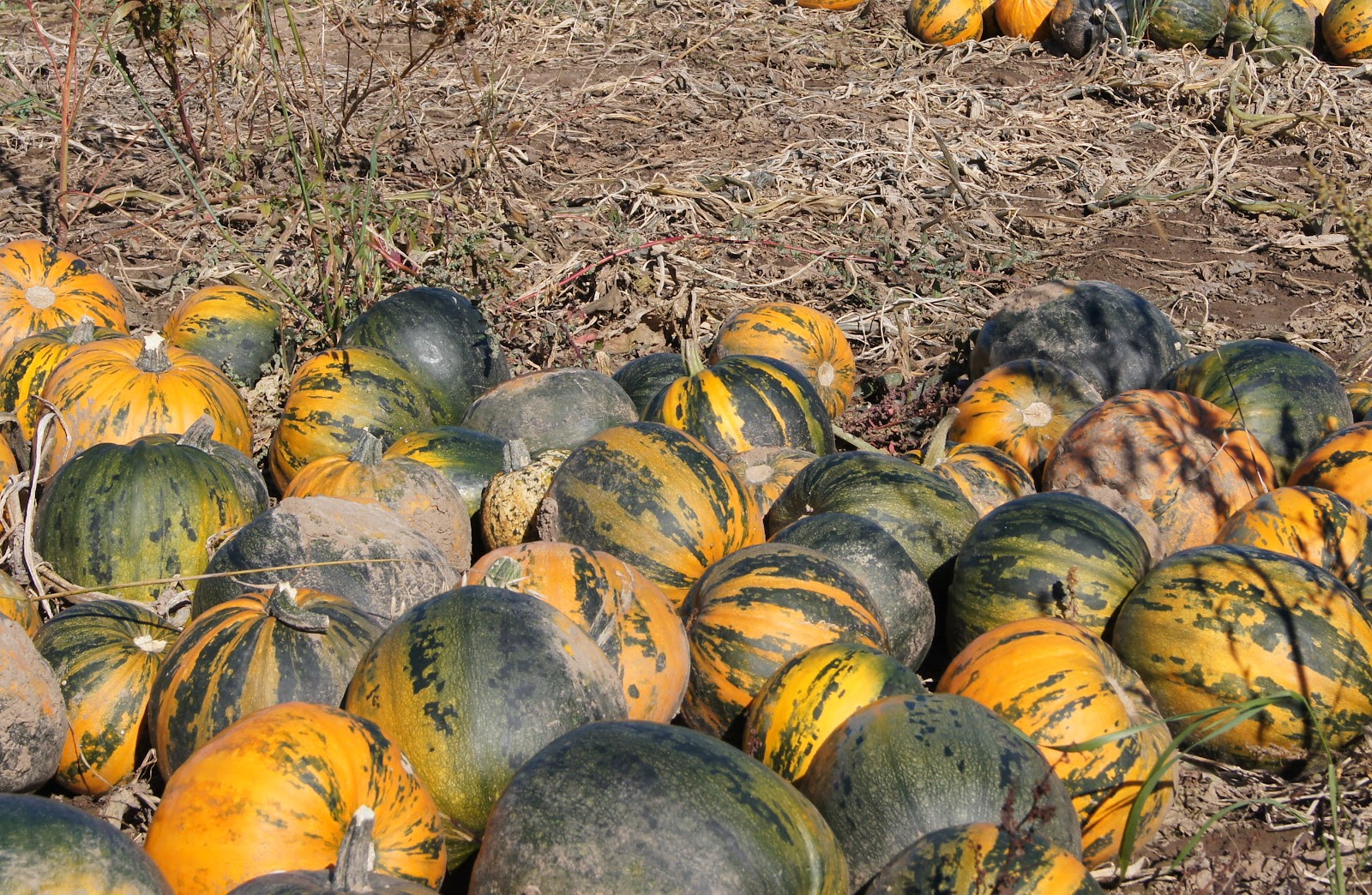
One of my local food highlights of 2011 didn’t actually involve any food—well, not directly, at least. Last October Mary and I were driving through the western Wisconsin countryside, and came across an intriguing scene. Off to our right was an unremarkable field in which were growing, it appeared, squashes or pumpkins of some sort. The intriguing part was the odd contraption parked near the side road, around which an group of people were gathered, intent on a mysterious task.

In addition, between the county road we were driving on and the contraption and crew, there were piles of what appeared to be smashed-up pumpkins. We peered intently as we drove past, up a hill and around the bend. A couple hundred yards along, I swung to the shoulder and hung a U-ie. We had to go back and see what was going on.

Once we started down the side road and approached the group of people, I knew what we had come upon: it was harvest time in the fields where the pumpkins that produce Hay River Pumpkin Seed Oil are grown. Ken Seguine was the man in charge, and he was working out the kinks in a newly automated form of pumpkin seed extraction—prior to this year, a dedicated group of volunteers performed the task of smashing open pumpkins and sorting out the seeds by hand.
The new pumpkin seed machine consisted of a sort of conveyor belt/elevator that lifted the pumpkins up, to be dropped into a grinder that busted them into pieces. These pieces fell into a rotating, perforated drum. As the drum went round it further agitated the pieces so that the seeds fell out and dropped through the perforations into a bin below.

The rest of the process from there is a bit of a trade secret, but it involves toasting and then pressing, and the result is a fragrant, dark oil that’s popular in Europe (particularly Austria), but nearly unknown in this country—indeed, Hay River is the first pumpkin seed oil produced in America.

I’ve just gotten a fresh bottle of the oil to experiment with, and will write more about the culinary applications of the oil in the next few weeks—a slaw of raw kabocha squash, celery root, and apple tossed with a pumpkin seed oil, cider vinegar, and honey dressing was a winner. I just love that this kind of thing is going on out in the western Wisconsin countryside.

Text and photos copyright 2011 by Brett Laidlaw
Subscribe to:
Posts (Atom)