Showing posts with label woodcock. Show all posts

Friday, April 1, 2016

The Saps of Spring, 2016 Edition


March is a difficult month.  It promises spring, but often belongs equally, if not more so, to winter.  It makes you think of gardening, of growing things, but at our latitude all you can really do is pile potting mix into little pots, get the seeds of the earliest, cool season plants going—onions, leeks, lettuce, some herbs.   There are days of warm sun that tempt you to get out and till a plot, but when you turn one clump of frigid, sodden soil, you turn quickly to plan B.  Never mind, there’s always that minefield of winter-weathered dog treasures to clear, a perennial March activity that more or less sums up the spirit of the season….


Maybe this is why a lot of my March days since moving to the country have been spent drilling little holes in trees, gathering the cold, slightly sweet water that weeps out, and cooking it down to incomparable sweetness—tree syrups, both maple and birch, and even a bit of black walnut.  It’s nature’s little consolation prize for enduring these purgatorial weeks, equal parts reward and distraction.  Though sap season comes around every year, it’s always a little bit different.  And this year has been more different than most.

People on Twitter tend to get a little excited, you may have noticed if you frequent that world.  I think it’s the ability to communicate instantaneously with friends, acquaintances, and strangers alike, all across the planet, that tends to heighten reactions exponentially.  This year I saw a slew of ecstatic tweets proclaiming that the weather for the week ahead looked perfect for maple sugaring…in the middle of February.  But the trees weren’t looking at the daily highs and lows to decide how to proceed; no, the trees were still frozen solid.

I forget exactly which March Surprise this was; we had a few....

But it did transpire that warmish weather continued—there were days with record highs, with record high lows—and I did wind up tapping a few maples, as well as the big box elder (a type of maple) in our yard, and our one majestic black walnut tree, on February 21, because what the heck.  And within a few days I did have a little sap, emphasis on the little.  The trees ran sluggishly for about a day, then the weather turned seasonably cold again.  Six trees gave me about one gallon of sap, which didn’t take too long to simmer down on the wood stove into a half cup of syrup; and so began the season of passive, micro-batch syruping, which continues to this day, as I reduce another five gallons of birch sap on the woodstove and then on the range top.  I’m not going to wind up with a vast reserve of syrup, but then, I don’t really need one.  The birch, especially, is sparingly deployed, maybe a tablespoon or so at a time, in salad dressings and marinades, mainly for grilled pork.
 
Birch syrup on the final reduction.

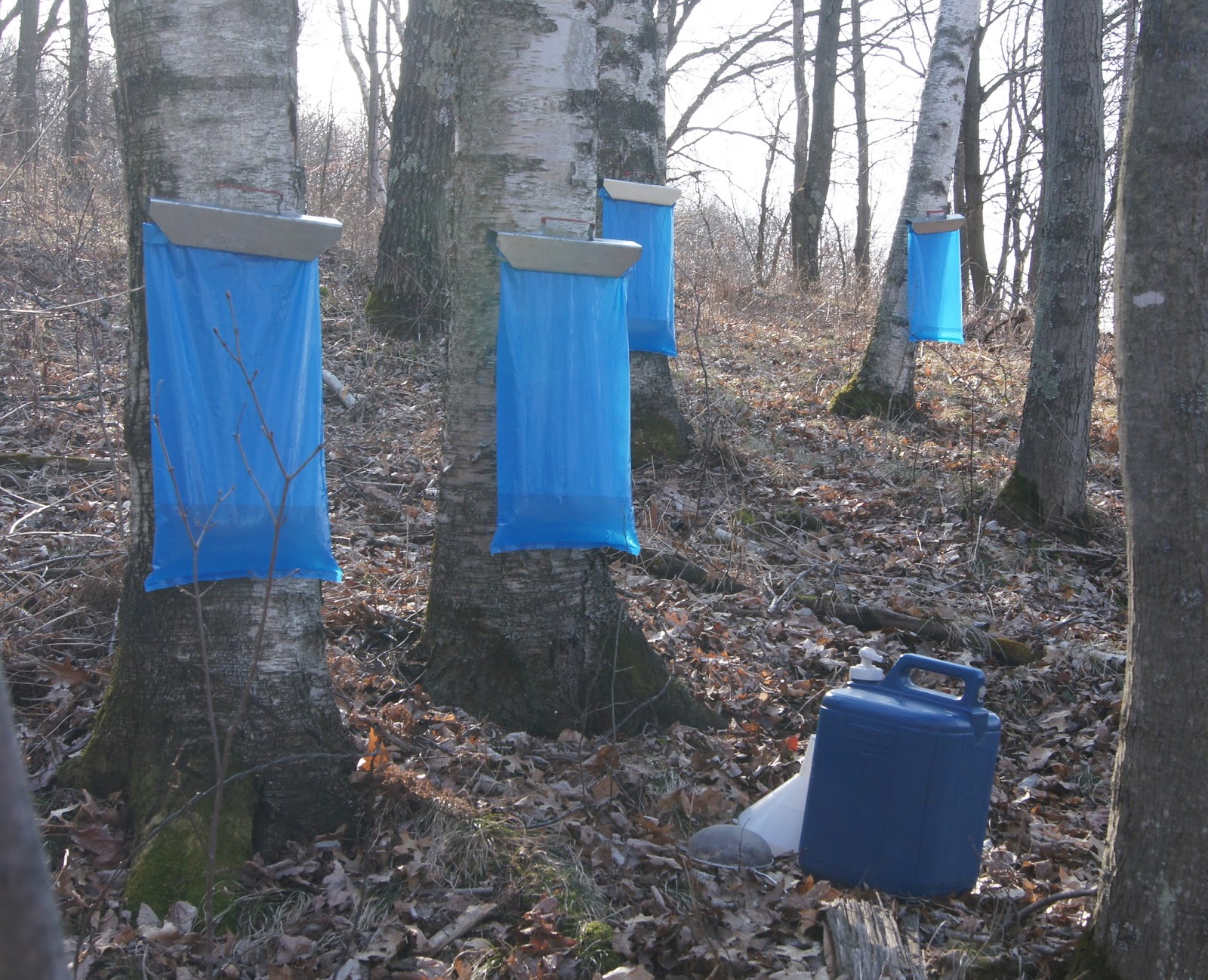
With small amounts of sap—5 to 8 gallons at a time—I didn’t bother firing up the labor-and-smoke-intensive half-assed sap contraption I’ve used in years past.  Instead, since we’re still stoking the woodstove every day, at least in the mornings and evenings, I’ve been setting a hotel pan and our Big Blue Le Creuset dutch oven on the stove and letting the sap slowly reduce to a manageable amount, at which point I boil the dickens out of it on our kitchen range top.  You may wonder, Isn’t that a lot of humidity to be adding to your indoor environment?  Aren’t you producing great clouds of water vapor, steaming the wallpaper off the walls, and covering everything with a sticky film? 

Legitimate concerns, to which the answers are: yes, I guess it’s a fair amount of humidity, but things are generally dry this time of year, so we haven’t noticed any issues; and as we have no wallpaper on our walls, none to steam off!  Finally, no, our walls and ceiling bear no resemblance to a movie theater floor after being deluged with Mountain Dew during the kiddie matinee.  The whole idea, see, is that the sugary part remains in the pot as the water evaporates.  Even if some of the sugar escaped a furiously boiling pot, I don’t think it would go very far, the sugar molecules presumably being a good deal heavier than water vapor. 

The long and short of it is this:  I think it’s a myth, one which I myself may have helped to promulgate in the past, that cooking sap down inside has these undesirable side effects.  When I’m doing the fast, final boiling, I’ve got the vent hood running, a couple of windows cracked, and there’s no noticeable change in our indoor weather.  Also, I’ve kept checking the walls near the stove, the inside of the vent hood, for that legendary sticky film—none to be found.  Now, if I had a hundred, or even 40, 20 gallons to deal with at a time, I probably wouldn’t do it inside.  But with these small batches, it works fine.  It’s also really nice to get double duty out of the woodstove, heat for the home on chilly days, tasty syrups for the kitchen.

The Puddock hard at work, multi-tasking.

It has taken me a while, years, in fact, to start to feel comfortable using the birch syrup.  It’s completely unlike anything else I have in my pantry, so it didn’t slide easily into any particular niche.  People ask me what it’s like, and I can only give vague analogies or general descriptions that don’t capture the essence of the thing.  It’s dark, dark as molasses, and it has some molasses qualities, but it’s not thick—in its body, its “mouth feel,” it’s lighter and thinner than maple syrup.  And banish any thought that it’s like maple syrup just because it’s sugar that comes from a tree.  While maple syrup is composed of sucrose, like plain old granulated sugar, birch syrup is glucose and fructose (I think I’ve got that right).  The flavor of birch syrup is much…edgier.  There’s acidity to it, and often a little intriguing bitterness.  It’s very aromatic, with sweet, menthol, spicy, root beer type notes.  Really, if you’re interested in distinctive foods, particularly distinctive northern foods, you’ve got to try it.

If you have access to a few birch trees, it’s easy enough to get, as long as, you know, nature cooperates.  You tap the trees exactly as you would for maple syrup, drill a little hole about 1 ½” deep, insert a tap, hang a bag, bucket, what have you, or attached food grade tubing to allow the sap to run into a container.  Then when you have a quantity, you cook it down.  And cook it down.  And cook it down….  Because, the thing about birch sap:  it’s generally less than half as concentrated in sugars as maple sap.  So if it typically takes from 30 to 40 gallons of maple sap to produce a gallon of syrup, with birch we’re talking about a roughly 80:1 ration.  Breaking that down into the smaller batches I’ve been doing, 10 gallons of sap gave me one scant pint of syrup.  

Syrup assortment: the small, very light one at center front is black walnut.

I’ve said this before, and I’ll say it again:  you can look at the numbers, even the relatively reasonable maple ratios, and think you get it, but until you actually do it, you can’t possibly understand.  Still, it’s worth it.  I go to a lot of trouble, tapping the trees, hauling the heavy sap down the hill (luckily I do get to haul it down the hill), cooking the sap down and down and down, but at the end I’ve got lovely local products to work with through the rest of the year.

And here’s a handy fact of nature:  the birch trees tend to start running as the maple run is coming to an end.  So if you have access to both kinds of trees, you can move your tapping equipment over to the birches when you’ve had your fill of maple sugaring, and the trees start to break bud, rendering the sap bitter and unusable.  Making syrup, especially birch syrup, is a labor of love, and a rite of the season, a perennial celebration of those immemorial cycles.  A lot of work and time, sure, but hey, it beats picking up dog crap….

Earlier reports from sap season:
 Sapped Out, 2013
The Sweetest Tree, 2013
Sweet Trees X3, 2015
Sweetness, Toil, and Smoke, 2010

How I have used birch syrup:

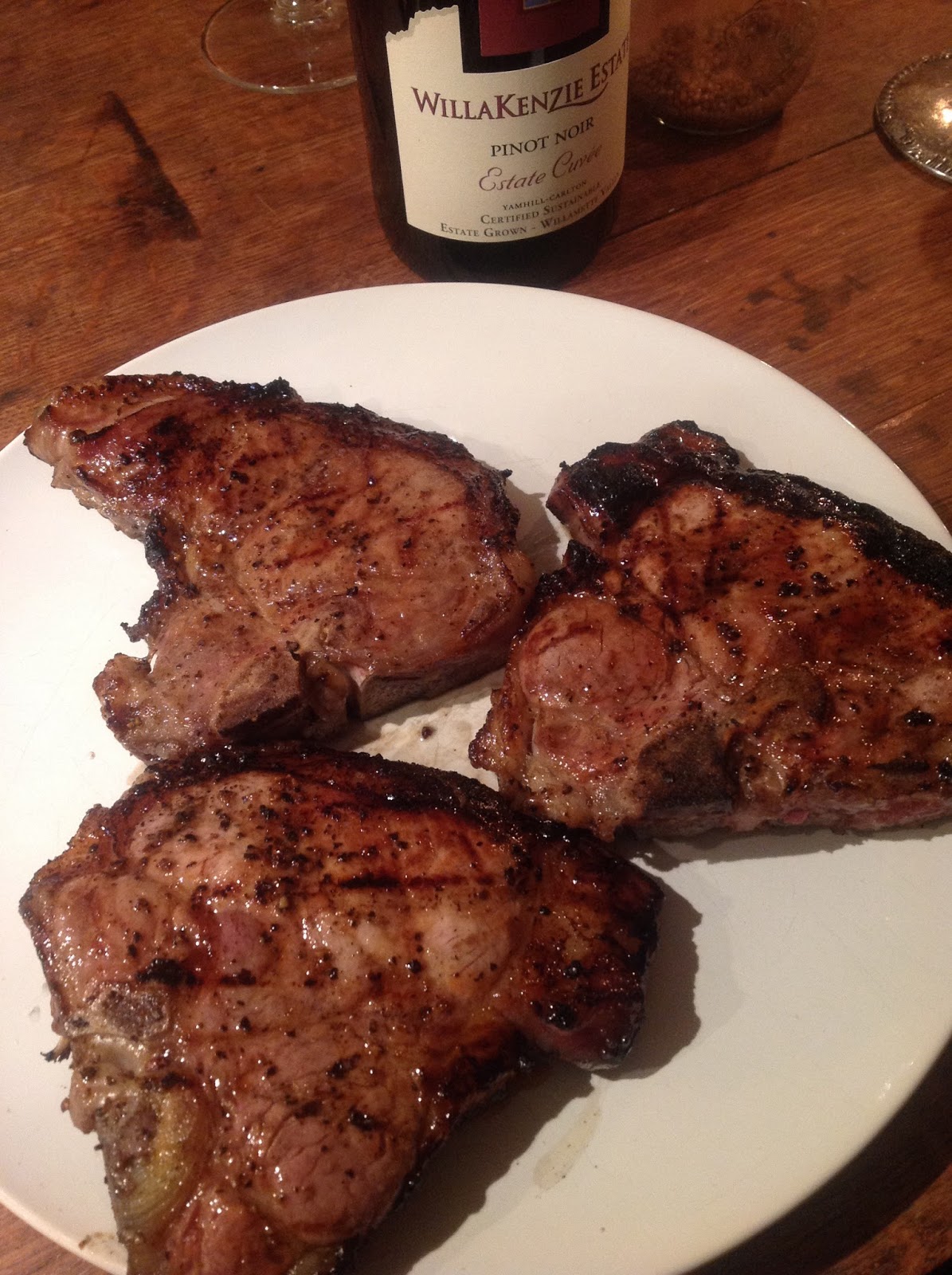
·        *  As a marinade for grilled or smoked meat:  it’s great brushed on a pork chop, which I then season simply with salt and pepper.  For some reason, the birch syrup doesn’t burn on the grill the way maple syrup or honey would.  Perhaps because the sugar composition is different.  I’ve also used it on grilled game birds, particularly woodcock.  And I’ve used it in the cure for smoked duck breast and venison with wonderful results.
Grilled red wattle pork chops in a birch syrup marinade; pork and birch have a delicious affinity.

*  In salad dressings:  just a teaspoon or two in a vinaigrette really makes its presence felt, and brings that distinctive, aromatic birch flavor to any kind of salad.
·         *  In cocktails:  1 teaspoon birch syrup, a few drops of lemon juice, 2 ounces Scotch, bourbon, or rye, stir it up, add ice, garnish with a lemon twist.  Or for the lemon substitute blood oranges in season for a cocktail I’ve dubbed “The Nasty Bruise.”  For a refreshing non-alcoholic drink, stir a couple teaspoons of birch syrup into sparkling water, add ice and perhaps a squeeze of lemon juice.

Those are the main applications I’ve found for birch syrup.  I’m having a decent year with the birch this spring, so I’ll have a good supply to experiment with through the year.  I repeat:  a little goes a long way with birch syrup.


Birch-Mustard Seed Carrot Salad

Two servings.  

1 large or 2 small carrots
2 tablespoons olive oil
2 teaspoons yellow mustard seeds
2 tablespoons lemon juice
1 tablespoon birch syrup
1 small garlic clove sliced very thin
A bit of chiffonade leek or scallion green, optional
Salt and pepper

Peel the carrots and slice them very thin—1/8” or less.   A Benriner mandoline is handy for this—watch your fingers!

Heat the oil over medium low and add the mustard seeds.  Stir them around until they just start to pop, then remove from the heat.  Add the lemon juice, birch syrup, and garlic and stir well.  Pour the dressing over the carrots, add a couple good pinches of salt and a few grinds of pepper, and stir well.  Let the salad sit for at least a half hour or up to several hours before serving.  Sprinkle the optional leek or scallion greens over top just before serving.

Maple syrup variation:  in place of the birch syrup, use 2 teaspoons of maple syrup and ½ teaspoon of Dijon mustard--I haven't actually tried this variation, but I don't see how it could be bad.


Here’s a brief record of weather, phenology, and such since syrup season began at the end of February:

Feb 27 record highs
Feb 29 1st ½ cup maple syrup done
March 1, “brittle and chill” and the trees aren’t producing sap
March 4, 3 inches of snow
March 8 red-winged blackbirds back & a scant half cup of black walnut syrup finished from 56 ounces sap—that’s all for black walnut, it didn’t produce enough sap after that to bother with
3/10 snow’s all gone and Mary notes, looking out the kitchen window, “It’s not winter anymore,” to which I reply, “It’s not spring, either.  It’s mud season.”
3/10 cooked down a tiny bit of box elder syrup, “single source”….
Shrimp on the barbie, definite grilling weather
3/11 picked garlic mustard along the Rush River at Brush Cr Rd; grilled pork chops; summery
3/12 summery; dinner at Tina’s, I wear shorts
3/16? 2” rain, thunder
3/14 woodcock return
3/17 SNOW again, grass covered
3/18 snow gone
3/22 tapped birches and they were running; seemed pretty vigorous, but didn’t get much for a few days
3/23 SNOW again! 3-4”.
3/24 snow gone!
3/27 finished the last maple, moved over to birch
3/28 5 gallons birch mostly cooked down
3/29 another 5 gallons birch gathered, mostly cooked down; sunny and warm, in shorts again
3/30 It didn’t seem that there was much sap flow, but the eight birch gave around four gallons total, which reduced gently on the woodstove overnight
3/31 The house is starting to smell birchy with the sap on the woodstove getting right down there.  It’s raining now, but the forecast is for an inch of snow by the end of the day.  April Fool!

Text and photos copyright 2016 by Brett Laidlaw


Thursday, December 8, 2011

On Woodcock


One of the most fascinating and endearing creatures that inhabits our Wisconsin property is the American woodcock, scolopax minor.  It's a migratory bird that makes epic, apparently solitary journeys from the northern U.S. and southern Canada to more temperate climes--notably the Louisiana bayou country--in autumn, and back again in spring.  Considering that woodcock use their elongated bills to probe soft soils for insects, they return to our region remarkably early, often when there is still snow on the ground, and only the south-facing slopes have melted.  It's a curious strategy, it would seem, that leaves them vulnerable to late snows and cold snaps.  We've sometimes seen the weak, dazed birds staggering along the shoulder of the road, too feeble to fly, after a March or April storm has swept through.  Well, there must be some wisdom in nature's plan, as the species does manage to survive.

Once we've observed the first returnees in  March, we look forward to a spectacle that makes these birds both endearing and thrilling, comic as well as marvelous.  It's the mating behavior of the male woodcock (if you break the name down etymologically, it seems odd that there would be female woodcock, but there you go; I don't think I've ever heard or read the term woodhen).  Almost immediately upon arriving in their northern breeding grounds, the males of the species stake out territory in an open space.  It is here that, each night through the spring--sometimes into early summer--Mr Woodcock does his mating dance.


It's a circular dance, somewhat arduously accomplished in the dry grasses in our fields, the moreso because a woodcock is a rather stout, short-legged creature.  That adds to the comic aspect.  Then there's the peenting.  I didn't make that word up.  Peent is the term that ornithologists have come up with to describe the sound the woodcock makes as he toodles along in his roundabout dance.  It's a nasal utterance somewhere between a quack and a croak--well, just say the word peent, and give it a good Dylanesque twang.  Before we were aware of the source of this odd sound, we often heard it coming from the field on moonlit nights, and invented a mythical Bide-A-Wee beast, the duck-frog, to explain it.

But now for the thrilling part.  At some point in his dancing, peenting frenzy, the woodcock decides it's time for a change of strategy.  He takes flight with the twittering wing-flitter sound familiar to upland bird hunters, and streaks into the dusk; he follows a circling path in his flight, as well, soaring out of sight far up into the darkening sky.  And then he stops; stops at the apex of this climb, almost directly over the spot from which he flew, and descends, fluttering back and forth like a falling leaf, producing yet another sort of sound--what to call it, a sort of undulating whistle, fwoot fweet fwoot fweet fwoot fweet.  And he lands where he started from, and begins again.

Last spring one woodcock established his dancing ground on the hill just above our cabin, and I was able to creep up on him and observe his tottering progress through the grass.  More exciting still, his flight path on his ascent took him directly past the cabin's deck, so we could sit out and see him go past, try to follow his progess up into the evening sky, wait for the sound of the return to earth.  Perhaps I'm easily amused, but I couldn't get enough of it.

This behavior is supposed to stop, I suppose, when the woodcock attracts a mate--that's the whole point of it, after all, unless woodcock enjoy this sort of virtuosity for its own sake; and you know, now having mentioned that, I really hope they do, unlikely though it seems.  Well, our Bide-A-Wee woodcock, it appeared that he was destined to remain a lonely bachelor, for his peenting and dancing, his nightly flights, went on for weeks, both in the evening, and then again in the morning--it's brought on by a certain quality of the dusk and dawn light.  On nights of bright moon, it sometimes continued through the night.  At some point it stopped; whether he did attract a mate, or just felt his chance had passed, we'll never know.

Through the summer we rarely encounter woodcock on our property.  I assume they're still there, hiding back in the impenetrable thickets.  We come across them again in the fall, when the leaves start to drop, the meadow grasses to dry and recede.  And then of course, in the fall, it's hunting season.

We don't hunt birds on our land, though we have woodcock, grouse, the occasional pheasant and transitory turkeys.  We prefer to think of our little plot, just 20 acres, as a gamebird refuge--the partridge and timberdoodles need only deal with their natural enemies, foxes, owls, hawks, and what-have-you.  The flesh of these birds is delectable, but the pleasure of encountering them throughout the year exceeds even the delights of an excellent meal.


But we do hunt them, of course, in the public hunting grounds with which western Wisconsin is amply endowed.  I believe that the birds we find, in much the same cover that ruffed grouse frequent, are migrants.  As the winds turn to the north and temperatures drop, they come through in waves, and though they travel singly, from what I've read, they tend to congregate in liminal terrain at the edges of woods and marshland, or creek bottoms where damp soil provides them the nutrition needed to fatten up for the long flight south.  For a bird whose behavior and movements are famously mysterious, you can come across quite a lot of them in a day of hunting, especially with a pointing dog to assist.

I did not come across a lot of them this year, however.  Various circumstances conspired against my spending much time in the woods before the woodcock season ended in early November.  I shot one woodcock, one.  We made a point to savor it.


I'm a firm believer in the concept of terroir; I believe that the food of a place carries the taste of that place (I almost called this blog Taste of the Place, before switching to the more esoteric title).  And I believe that foods that occupy the same space, even if, say, one is a bird, and one comes from a tree, have a certain simpatico, partake of a sort of sympathetic magic that can create great synergy in the pot and on the plate.  Hence:  grilled woodock glazed with birch syrup.

I'd been trying for a couple of years to make birch syrup, which is produced in exactly the same manner as maple syrup.  In outline, it's simple--tap a tree, gather sap, boil it down, voila, birch syrup.  But birch trees aren't as free with their sap as maples, in my experience, and they run later than maples, too.  The warmer weather can bring problems--bugs in the sap, or spoilage if you don't check the bags frequently.  Last spring I finally gathered enough sap--just a couple of gallons--to boil down for birch syrup.


The sugar in birch sap is less concentrated than maple sap, therefore, more boiling down.  More boiling down means more heat applied to the sugars.  The result is something nearly as dark as molasses, though not so thick.  My entire yield of birch syrup, in two boilings, was probably shy of a cup, but intense stuff it was, once I tasted it.  It's nearly as sweet as maple syrup, but with an appealing, very slight bitterness, as of caramel just starting to burn.  There are also vegetal notes, a slightly spicy tingle, and a hint of menthol. 

I'm so accustomed to the taste of maple syrup, I don't really taste the wildness in it anymore.  But the taste of the wild is pronounced in birch syrup, and that, along with the darkness of it, took my mind's palate to another season, the autumn, bird hunting season, and I imagined the woodcock riding the lashing north winds down from Canada and into our region, finding a respite in our charismatic coverts, the scrappy edges of woods and marsh, among the dogwood, prickly ash, alders and hazel, flanked by islands of tall white pine, oak savannah remnants.  And I thought, if a woodcock or two wound up in my game pouch, that a fitting seasoning would be a brushing of birch syrup, an appropriately northern condiment, and suitably wild, to match the dark, gamy meat of the woodcock.

I do love a recipe with a nicely conceptual, geographical and seasonal basis.  I rarely sit down to write about food without recalling Lévi-Strauss:  Food is not only good to eat, but good to think about, as well.


Getting on to the food, then: the remnants of the  previous night's grouse dinner provided a very nice starter to our woodcock delectation (I can't really call it a feast, since one woodcock provides but a few bites of meat).  I diced up the leftover grouse breast, combined it with what was left of the potatoes and cabbage, added stock: a delicious soup that tasted like anything but leftovers.

To accompany the woodcock I made chestnut mash.  These beautiful chestnuts from Iowa are available at local co-ops now, and I can't get enough of them.  For this dish I:

Roasted, peeled, and coarsely chopped 15 chestnuts;
Sautéed a chopped shallot and 2 tablespoons of finely diced celery root in 1 tablespoon butter until the shallot was translucent;
Added the chestnuts, along with 1 tablespoon dried apple minced, and 1 small potato peeled and diced;
Then 3/4 cup of unsalted chicken stock and a generous pinch of salt.

I simmered that, covered, for around 40 minutes, then removed the lid and cooked it gently until most of the liquid was gone.  I should have a food mill out at Bide-A-Wee--it's a great, non-electric kitchen tool.  But I don't have one there yet, so my "purée" was produced with the back of a fork, leaving an appropriately rustic texture.  You could use a blender or food processer, too.

Then on to the woodcock, which I halved, simply seasoned with salt and pepper, and put on the grill.  It took just a few minutes per side, little bird that it was, and on the final turns I brushed it a couple of times with the birch syrup, which gave the skin an appealing burnish.


And when it came to eating, did it live up to all the forethought and verbiage?  You couldn't taste the birch so much on the breast portion, though it did lend a subtle sweetness.  On the legs, my favorite part of a woodcock, the flavor was more pronouced, and it was wonderful--both sweet and a little bitter, melding wonderfully with the fatty skin and savory meat.  This is the definition of a delicacy, to me.  There's a book out recently detailing the last-dinner-on-earth requests of famous chefs; they didn't ask me, dang it, but this would be mine: a plate of grilled woodcock thighs with birch syrup glaze.

Next time, next year, if all goes well, I'll have another try at this dish.  I would do it pretty much the same way, although I think I would reduce the syrup a bit to make a stronger glaze.  It's nice to have something to look forward to.

Here's a pretty good overview of all things timberdoodle.

Text and photos copyright 2011 by Brett Laidlaw

Tuesday, November 15, 2011

The Birds of November


It’s been a while since I've written anything about hunting here. Simple reason: there has not been much to report. The last really notable outing afield occurred two years ago, when I shot a pheasant, grouse, and woodcock—the three main “upland game birds” of our region—on the same day, at a public hunting ground near Bide-A-Wee. That was a remarkable hunt for a couple of reasons. One, I’d never accomplished that “triple crown” feat before, and it had been a goal of mine. Also, the grouse was pointed in absolutely classic fashion by our young dog, Lily. Previously she had mainly been known for flying heedlessly through woods and field, launching anything avian in her path into the air well out of shotgun range. We knew she could point; we did not know if she would.

She found the bird at least a hundred yards ahead of me and remained staunch in her point for the two minutes or so that it took me to make my way over to her through gnarly terrain. Just as I came up to her rigid,
quivering form, the bird got up, and I dropped it with the first shot. That was a notable achievement for me, too; grouse are very fast flyers, hard to shoot, and I’m frankly not that great a shot. I already had a pheasant in my vest, a bird that I had walked up, shot, and retrieved with no canine assistance whatsoever. The dogs were running around back in an alder swamp. They heard the shot and came running out to find me standing at the edge of the field with a pheasant in my hand. “Hey, look what I found,” I said. “What have you two been up to?” They wagged their tails and sniffed the bird. I think they looked a little shamefaced. It was a classic moment in the field, one I’ll never forget.

The final bird of the day was a woodcock, which I shot over Annabel’s point, again on the first shot. I don’t think we encountered any other birds that day, though my memory on that point is not completely clear. If it’s accurate, this would have been a hunt on which I killed three birds with three shots, and no misses. That’s something that’s unlikely to happen again.

It was an extremely satisfying day afield, and one I had really hoped to build on in 2010, but you know what they say about plans. October last year was ridiculously warm, dreadful hunting weather. I had to make an unexpected trip to deal with family matters at the end of that month, I blew out my shoulder, then it snowed. In all of 2010 I hunted twice, fired the gun four times at two grouse, missing badly on all shots. The one time I hunted alone with Lily, I’m not sure if she was in the same county with me for much of the outing. And Annabel, then 12 years old and game but a little gimpy, and largely deaf—well, I didn’t know if we would ever again put the bell on her orange collar and send her out with a “Hunt ‘em up. Where’s a bird?”

Based on that dismal year, I couldn’t see things going anywhere but up in 2011, but the season did not have a promising start. Another too-hot October, another unanticipated October trip taking a week out of the brief woodcock season. With no real training in the interim, but lots of self-directed “hunts” on our land—home to both grouse and woodcock, and the occasional pheasant—Lily had become an over-stimulated bundle of bad
habits. I didn’t know if we would be able to bring her back. One short outing with Annabel showed me that she could come along on hunts, but only with a chaperone. I was feeling glum about the season, to say the least. I was feeling even glummer about my future as a bird hunter.

Lily is still a couple months shy of her sixth birthday. She’s in her physical prime, and she’s an incredibly athletic dog. There’s no mistaking the sheer, unabashed joy she displays as she catapults up and down the Bide-A-Wee hills. She is also a very sweet girl, eager to please, devastated when she disappoints (our joke about Annabel is that she, too, is eager to please…herself). I had Lily’s temperament going for me when I decided I had to give her a few more tries before reaching any conclusions.

Some memorable hunting and fishing outings are memorable for reasons quite apart from fish in the creel or a bird in the game pouch. Our hunt at a small hunting ground near Bide-A-Wee, just Lily and me, will stick with me for a long time. After several hunts where she seemed to be simply running around in the woods, no sense of purpose about her at all, she suddenly…started…to hunt. Some lightbulb went off for her. Maybe the “chats” we had had on previous outings impressed her. Maybe she just needed to encounter a few more birds in the proper context. The remarkable thing was how sudden the transformation was. From one hunt with absolutely no pointing, or intimation that she even knew how to do so, suddenly she was a pointing machine. Like someone flipped a switch, or switched dogs on me.


We went in to a stand of small aspen.  Lily was working ahead of me to the left. Even before the point I sensed something different in her manner. She was out of sight when her collar started a steady beeping (it’s an electronic collar that beeps every ten seconds or so when she’s running, then every second when she stops). As I came up behind her I could see from her body language that, yes, there was a bird, but maybe not right there. Close, not in front of her nose. I went in ahead of her, circled to right and left. No bird. I told her to hunt and she zipped past me, slalomed through a patch of dogwood. She drew up short, all four feet planted solidly on the ground, and swiveled her head sharply to the right. Then she did not move.

As I approached a woodcock flushed, mere feet from her quivering nose. It veered skyward, over the tops of the aspens, and I had to turn and get the gun up high, and I missed, and I missed again. I cursed, but I recovered from the disappointment quickly. Lily broke her point with the shots, but came to me when I whistled, and I praised her as few dogs have ever been praised in the history of bird hunting. Then we carried on, and in a few minutes she pointed another woodcock (or perhaps the same one), and again my shooting let us down. But again we were SO HAPPY! Finding and missing woodcock is the best game EVER! We had one more bird encounter that day. On the flank of a distinctive little piece of topography, a sort of rocky knoll covered with scrub oak, dogwood, and stunted jack pine, Lily stopped, her head directed downhill, a solid point. The grouse didn’t hold for long, though. It flushed within range of a shot, but entirely out of sight behind a patch of pines. That was it. Three birds found, pointed, nothing in the bag. A great day.


One thing that has been disconcerting this year has been a general scarcity of birds. Often in woodcock season, as the birds are migrating through, I’ll find eight to twelve birds in the best bits of cover. This season I think the most timberdoodles (woodcock have a lot of nicknames) encountered in a day was four. Lily and I hit a fresh piece of terrain on a cool gray morning, just a couple days from the end of woodcock season—pheasant stays open in Wisconsin through December, and grouse to the end of January, though it’s rare that conditions allow comfortable hunting much past the beginning of December. It was great looking cover—scrappy patches of dogwood and alder along a small creek, extensive stands of young aspen, or “popple” as it’s locally known. We didn’t flush a bird. Well, maybe a chickadee. Lily hunted well. She gave me a “false point” once, came to a dead halt and wouldn’t move even when I told her to hunt after I’d circled entirely around her. She was pretty sure there was something there, but there wasn’t. Could be a bird had flushed ahead of us, leaving a strong scent but no feathered evidence. We made our way back toward the car, and I was thinking it was going to be a lost day, but for a pleasant, if somewhat arduous, walk.

We came up out of a ditch and on to the dirt road that dead-ends farther back in the hunting ground. I could see the car in the parking area just ahead, and I broke open my gun—a side-by-side 20-gauge. I had Lily at a heel as we came up on the road, but when I saw the road deserted I let her go, and she immediately left my side and dropped down in the ditch on the other side of the road. I heard the collar start its steady beeping, and assumed she was stopped for a drink of delicious ditch water. But the beeping went on, and I heard no slurping. I realized she was on point.


I found her on a solid point beside a clump of alder. The cover was thick on the road side, more open farther in, and I was fortunate that the woodcock when it flushed did not veer for the road but rather followed the edge of the alders. The flush came as I was just even with Lily, so I didn’t have too much time to think—this is good—and I dropped the bird with the first shot. It fell in the center of another clump of alders, and was an easy find. I saw it before Lily did, but waited for her to come around and track it down. It had hit the ground dead—when I opened it I found that a pellet had gone right through the heart. Lily came up to the bird and sniffed at it, mouthed it a bit. Our dogs haven’t been trained to retrieve, and don’t seem to take to it naturally. I gave her a chance to bring it to me, but didn’t insist. I picked up the bird and put it in my vest with warm words of praise for my dog. First bird of 2011, first bird in two years.

We had another successful outing a couple of days later, the closing day of woodcock season, although we saw no woodcock. At the small hunting ground near Bide-A-Wee where Lily had had her turn-around day, we finally

started to see some grouse. I walked up one bird that Lily had run past, and missed my shot. Farther back in a mature woods with a boggy section I knew grouse frequented, Lily started to get “birdy”—that is, she broke out of her broad crossing runs and began working a smaller area in more detail, her nose close to the ground, her tail going like an airplane propeller. I turned to the left, she turned to the right—my instincts were better, and the grouse flushed in front of me. I took one errant shot before the bird curved out of view in a stand of pine. Lily came barreling back my way, and I told her “Whoa!” She didn’t seem to hear. I told her again, but it still didn’t sink in. Three times is too many times to have to tell a bird dog to freakin’ WHOA! Once I did get her attention, we had another of those “chats.” She promised she would try to do better, and almost immediately, she did.

Not two minutes later, in this same open area of mature oak, elm, and maple, she went on point again. Woods like this are not supposed to be good grouse habitat, but the grouse in these parts apparently didn’t know that (we have the same sort of joke about trout that don’t seem to know that they shouldn’t exist outside of “designated trout streams”). In dry years, and also in mid-winter, I think they seek out the spring seeps in this area for water and for the little green things growing there. This time Lily went on point along a big deadfall, an oak that had tipped over pulling its roots right out of the boggy ground. I came up near that tall root clump; Lily was on point around mid-tree. The grouse flushed, and flew straight away from me barely over head-high. I had to make a quick sidestep to clear the tree, get the gun up, and I would only have a single shot.

I took it; the bird did not drop, but it seemed to dip. I was pretty sure I had hit it. I stopped and quickly replaced the shell I had spent, then started walking briskly in the direction the grouse had gone. Lily passed me and I asked her if maybe it was possible there was a bird on the ground around here. Her answer was immediate: she went into tracking mode; she had found the scent of the running bird, and was following it avidly.

It didn’t take long to find the wing-shot bird. Lily subdued it, I came and took it from her, I broke its neck—not something I relish doing, but we who eat meat have to accept the fact that animals die for our pleasure; this was just a particularly intimate illustration of that fact.

Overall, in terms of the pointing, the adjustment, the shot, the tracking, that was one of the more remarkable bits of dog-and-hunter work I’ve been involved with in my brief hunting career. We had a quiet celebration over the bird that had given its life to make it possible, and made our way back to the car.

A lot of hunters wouldn’t see two birds in two outings as much to write home about. In spite of hopes and anticipation, my woodcock season ended with a single bird in the bag, an appetizer for two. But for me those

outings marked the beginning of my new hunting life with my “new” dog, Lily. It’s tough to leave Annabel behind—but it’s even tougher to hunt with her. I worry constantly that she’ll wander off in the woods, and with her deafness not hear us to find her way back. I worry that when her enthusiasm overcomes her physical limitations, as it always does, she’ll injure herself without even knowing she has done it. More than that, we’ve had a good run together. She brought me into this world which I find as compelling and challenging as anything I’ve ever done. It’s Lily’s turn now, and the education continues.

Next time, bird cookery at Bide-A-Wee.


Text and photos copyright 2011 by Brett Laidlaw