Showing posts with label fish. Show all posts

Tuesday, May 12, 2015

Season of the Ramp


It’s always a lovely thing to make that first foray to southeastern Minnesota trout waters in mid-April, for many reasons.  The drive south is exhilarating, as I cross tiny Hay Creek at the corner of our property and then trace the southward route of its flow that begins in springs just up the valley from us.  It finds its way to the Red Cedar River, and that pours into the broad, meandering Chippewa, a mighty waterway of this region.  The Chipp is wide, and in springtime often muddy and roiling, when it reaches the Mississippi; impressive as the Chippewa can be, it is shown its place by the Father of Waters, moving majestically, escorted by swans, gulls, and eagles, through the grand castellations of limestone bluffs.

Once across the Mighty One and into Minnesota, I now proceed against the flow, up the Whitewater and tributaries thereof, to fish more intimate water.  This modest journey is a compelling reminder of how hydrology and geology shape our lives in these parts, and the circular nature of a raindrop’s path from northern Dunn County to the sea, perhaps one day to be deposited back where it started, is appropriate to the beginning of another cycle of seasons—the beginning as we think of it here, as winter’s cold static grip is broken, and things again begin to flow, and grow.

And then, of course, it is delightful to get the wading boots wet again, string up the rod, tie on a fly, try to catch a fish.  Early season fishing is usually good, except when it’s not.  Or better to say:  the fishing is always good, but the catching may vary.


Something more certain than whether there will be fish in the creel on the homeward trip is the likelihood of taking home tasty greens.  Watercress springs are a pretty sure bet, and even when winter has been annoyingly persistent I’ve always managed to bring home at least a few decent sized ramps on that first outing, usually a few days past tax time.  It will be another couple of weeks, at least, before they’ve reached picking size in my local woods; that hour-plus drive south is a fast-forward through the season, as well.


I first became aware of ramps along a Wisconsin river maybe 20 years ago, and I’ve harvested them every year since.  Some years I’ve become tired of eating them before their season is out; some years I’ve grown jaded by the hype that has come to surround them in foodie circles.  This year, perhaps more than any other, I’ve simply embraced ramps for the seasonal delight that they are, and I’ve been eating them pretty much every day.  I haven’t really come up with any stunning new preparations of what is, really, just a wild onion, but I’ve explored its versatility by treating it as a commonplace, rather than an exotic, ingredient.

Rice bowl with brook trout, ramps, asparagus, pheasant back mushroom.

I’ve put ramps on pizza, into salad dressings, chopped into a soy-based sauce that anointed a rice bowl meal, and stir-fried for the same.  I made my chile-cheddar spread with ramps instead of onion, and slapped my head when it occurred to me I could have done that with the recipe in my book.  The ramp-infused version of that pimiento cheese variation is outstanding.  I’ve added them to a potato soufflé also   laced with chopped wood nettles, and used them to flavor a birch syrup cure for duck breast that I smoked using wild black cherry wood.

Cherry wood smoked duck magret, cured in birch syrup & ramps; bracken fiddleheads.

I made a bearnasie sauce where ramps stood in for the usual shallots, and ramp-roasted brown trout served with schupfnudeln fried with ramps and bacon, and the ramped up remoulade I wrote about recently.  Whole lotta rampin’ goin’ on….

Grilled herring with "rampearnaise;" the sauce was second-day salvage & broke a bit. Still delicious.

And still, I just want to keep eating ramps.  Maybe with age my taste buds are dulling.  I would prefer to think that the great variety of ways I’ve used them is keeping the flavor fresh and intriguing.  I’ve got a bunch in the fridge still, getting a little wilted in the greens, so I think I will pickle the bulbs of those ones.  With the weather having cooled off a bit, their season in our parts should last until the end of May, at least.  We’ll see if my rampish appetite can keep up.  

Wednesday, July 10, 2013

A Midsummer Night's Smørrebrød


You don’t have to be Danish to appreciate smørrebrød, those open-face sandwiches—knife and fork sandwiches—composed upon dense, buttered rye bread, usually containing appropriately Nordic ingredients like pickled herring, beets, and pork paté. If you like bread, and noshy food in that tapas mode, you’ll like smørrebrød. As a summer evening meal it has the additional virtue that most of the toppings can be prepared ahead—or are themselves commercially prepared foods of the very best sort, like cheese, smoked fish, cured meats, etc. Finally, because finishing preparation is so simple, these mini-canvases beg to be decorated to the full extent of your garnishing imagination.


Bready. Noshy. Easy. Pretty. What, I ask, is not to like in that combination?


It’s usually this time of year, when we’ve just slipped past the solstice, and the gardens are really starting to produce, the market stalls are burgeoning as the plants make the most of that vital sunshine, that my appetite turns to smørrebrød. It’s an elegantly rustic (or is it rustically elegant?) kind of meal to enjoy in those long twilights as the strong sun softens on descent, spreading welcome shadows, and the heat of the day begins to mellow.


That pretty well describes the evening last weekend when we prepared a smørrebrød repast at the house and packed it in a cooler for a picnic on the hill. It was a bit warm and muggy in the valley, but we caught a nice breeze as we headed up the hill. I’d been cleaning up a little impromptu sort of dump at the edge of the woods this spring, hauling down old car batteries, car seats, beer cans and bottles, what have you. Then I ran the lawn tractor up there to mow a small picnic area. Among the detritus I’d found a piece of sheet metal and some cinder blocks, and these we turned to better purpose as a makeshift picnic table (pleasantly, though very rustically, reminiscent of a Parisian zinc bar). It was, I dare say, one of the best picnics ever.


We settled in very comfortably (so did the dogs, eventually) to enjoy the view of the green, green hills, mist-shrouded in the distance. The aspen leaves overhead kept up a  calming kerfuffle. There was even a floor show, of sorts, as the neighbor who rents our hayfield came to bale up the last few rows of the oats and grass they cut last week. Urban al fresco dining has its pleasures, but when was the last time you saw a John Deere tractor and baler on the Nicollet Mall?


As we ate our smørrebrød and sipped our pinot gris and watched the sun pass out of sight behind the western hills—though it would still be light for a couple of hours—I had a thought about terroir—you know, that idea that foods and wines can taste distinctly of the place they came from, express some quality of the soils in which they grow, the waters that sustain them, and the human cultures that have nurtured them through time. My idea had something to do with how a cuisine is shaped by the sense of the seasons experienced by the people who create it. And how, for us specifically and for northern peoples in general, our long annual journey from the abyss of winter’s frigid darkness to midsummer’s almost too abundant light and warmth, and back again, how this must have as great an impact on the savor of our food as the molds in the caves of Roquefort, or the chalky soils of Sancerre.


It profoundly affects what we eat, how we eat it, what we want to eat, and how we experience it in the context of the year. A midsummer picnic at 45 degrees north latitude must taste different from the same meal consumed in Florida or southern California; in those places, their own seasonal context would shape their experience of what they eat.  For me, high summer dining has meant that I’ve hardly wanted to look at a piece of red meat—give me vegetables, salads, simply prepared fish, cheese and bread. Oh, and maybe a glass of wine.


I made a small rye loaf that included a little birch syrup. You want a pretty dense bread, with a close crumb--not something like a baguette that's full of holes.  Then top to your heart's desire.  I don't let myself be constrained by any rules, but rather see the smørrebrød concept as the base for using the best of the local and seasonal.  One of my favorite, oft-repeated mantras--Ninety percent of good cooking is good shopping--is on full display here.  That is not to say, of course, that you should hie thee to a high-end supermarket, but rather that best ingredients make for best results.


The Superior shore was well represented in fresh herring from Cornucopia, smoked whitefish from Port Wing, cheese from Bayfield.  The Menomonie farmers market gave us snap peas, onions, beets, turnips, potatoes, and asparagus, and our garden contributed, too, with radishes, chives, and mustard greens.  There was a bit of home-smoked bacon in the potato and asparagus salad, and the yogurt cheese was home-cultured using wonderful fresh milk from just down the road.  Oh, and the mayo, also homemade, using eggs from our neighbor Tina's chickens, and Minnesota sunflower oil Smude.

On Wisconin! was surely the theme of this meal, especially as the sandwiches were literally presented on Wisconsin.  A more thorough description of the various toppin's below.


Smoked whitefish salad combined about four ounces of flaked smoked whitefish with roughly three tablespoons of peas—we shelled some sugar snaps—two ounces of Wisconsin hickory nuts, chopped and lightly toasted in a dry skillet. (The nuts were a generous gift from my buddy Lucas “The Beard” Madsen; hickory trees grow in his part of southeastern Wisconsin, though they’re scarce here. Other local, wild alternatives would be black walnuts or hazelnuts; a good storebought option would be pecans.) To the fish, peas, and nuts I added some sliced red onion and about three tablespoons of mayonnaise—homemade in this case, and for a dinner like this I think it’s really worth the effort. Garnish with a little more red onion and thin slices of sugar snaps.


I was inordinately pleased with my checkboard composition of roasted baby beets and turnips. The base was fresh yogurt cheese (with just a dollop of chevre added in for body, and flavor) mixed with chopped chives and lots of coarsely ground pepper. Lay down a good bed of the cheese mixture, and decorate to your heart’s content. You can leave the vegetables round and create a fish-scale effect. I really liked the geometrical drama of the squares—just cut straight down around the sides of each little beet or turnip, and then slicing across produces squares.


Asparagus and potato salad was originally going to be oyster mushroom and potato sauté, but the little critters had honeycombed my ‘shrooms, so it was Plan B, which was just delightful. The potatoes were preroasted (along with the beets and turnips). Wash and slice the asparagus bite-size.  Dice up some good bacon fairly coarse, begin to render, then add the asparagus. Then add a couple of generous pinches of caraway seeds, about half as much cumin seed, and…mustard seed! About a teaspoon. Add the cut-up potatoes to warm and brown just a bit, and absorb the other flavors. This I served atop a generous spread of that homemade mayo.


Brie and radishes. A study in simplicity and the wonder of felicitous combinations. This one was just delicious. The cheese was one you probably haven’t heard of, but of which I predict you’ll be hearing quite a bit in the near future. It was Happy Hollow Creamery's “Snowy Spring Brie,” which we picked up at Ehler’s store in Cornucopia on the shore recently. Happy Hollow lists a Bayfield, WI address. This cheese, beautifully ripened, was exquisitely flavorful. Not even terribly expensive. If you happen to come across it, just buy it. Their Lazy Daisy raw milk cheddar is also excellent. As I say, I predict you’ll be hearing more about these cheeses and this creamery. For the sandwich: butter, cheese, radish, pepper, boom.


Last but surely not least, grilled Superior herring atop mustardy mustard greens. I’ve said plenty about this superb fish, which never disappoints—we usually get it hours after it’s been caught, so that’s a good start. I’ll have more to say in a future post about the greens preparation, which combines oil, mustard or other strongly flavored greens, more mustard—a good, strong Dijon style—a bit of honey, some vinegar, salt and pepper. This is going to be a standard greens preparation at our house right through the summer and fall. Butter, mustardy mustard greens, a piece of grilled fish, and a radish flower—yep, radish flower, you knew? They’re a bit sweet and a bit peppery at the same time.


Partly what inspired us to climb the hill for supper was a story we heard on  WPR's new show 45 North .  Last week Anne Strainchamps interviewed the British adventurer and writer Alastair Humphreys , who has bicycled around the world, run a marathon in the Sahara, and rowed the Atlantic, and now (maybe because he's tired...) is promoting the idea of "micro-adventures," mini-excursions in one's own backyard.  He's encouraging people just to get outside, and outside one's usual comfort zone--just grab a sleeping bag, a sandwich, and a bottle of wine, and go sleep on a hill, look at the stars, watch the sun come up.  I think it's just a brilliant idea whose simplicity is at the heart of its brilliance, and while we retired down the hill with the last fading light to all the comforts of home, we did feel as if we'd been away for a while, even if our adventure was, literally, in our own back yard.

And the food, if I need to say it, was good to the last pea.


Text and photos copyright 2013 by Brett Laidlaw

Tuesday, July 2, 2013

Poacher's Delight


It’s interesting that “poaching a fish” has those dual meanings. This is the legal, delicious sort of fish poaching, as easy as it is seemingly old-fashioned. It brings to mind whole poached salmon lacquered in aspic on a fancy buffet, silver serving pieces, white linen, and cucumber sandwiches. When you fry or grill, you're adding other flavors to the fish, but poaching gives you pretty much the pure fish flavor, with only a little influence from the seasoning in the poaching liquid. Therefore, I would only recommend poaching when you have utterly fresh, pristine fish. Which in this case was a whitefish fillet from my beloved Halvorson Fisheries in Cornucopia, Wisconsin.


I should like to point out that absolutely fresh doesn't have to mean fresh off the boat.  This fillet was three days old--we picked it up on a trip to the South Shore on Wednesday, and prepared it on Saturday.  But it had not acquired any off or "fishy" odors or flavors in that time.  Freshly caught fish properly cleaned and treated will stay fresh for at least three or four days.  


Makes you wonder how long some of the fish you buy, even from the top-end fish markets, has been sitting around.  You can pay $20+ a pound for Copper River salmon or Pacific halibut, and sometimes I do, but I never wind up with better fish than when we make the trip to the shore and fill a cooler with whitefish, herring, and lake trout for a pittance (might as well carry on with the old-time lingo, since we're talking about a throw-back way of cooking).  Even if you figure in the cost of gas, I think we come out ahead financially, and we absolutely win in terms of taste and pure enjoyment.


A classic sauce is de rigeur with poached fish.  A beurre blanc would be lovely, or a green sauce fragrant with tarragon, parsley, and chervil.  For this midsummer repast we made mayonnaise, and some of it I flavored with garlic--that's aioli--and to the rest I added herbs, tarragon and chives--that's not aioli, but rather herbed mayonnaise.  I sort of have this peeve, you might recall from past rants, about every kind of flavored mayonnaise being called aioli, because while aioli is usually a type of mayonnaise (there are variations that don't use eggs), it is not a synonym for it.  But, as usual, I digress....


The market this past weekend provided a good deal more than radishes and kohlrabi.  Lovely new potatoes, snap peas, asparagus, baby beets and turnips (and strawberries for dessert).


We boiled all the vegetables separately, till just tender--the beets went last, lest our entire meal come dressed in pink.  And for the fish I prepared a court bouillon, which consisted of:

Water, about a quart
White wine--what was left in a bottle of riesling that was hanging around, half a cup, say
The juice of 1/4 lemon, and then I threw the piece of lemon in, too
A couple of bay leaves, broken up
Some cracked black peppercorns

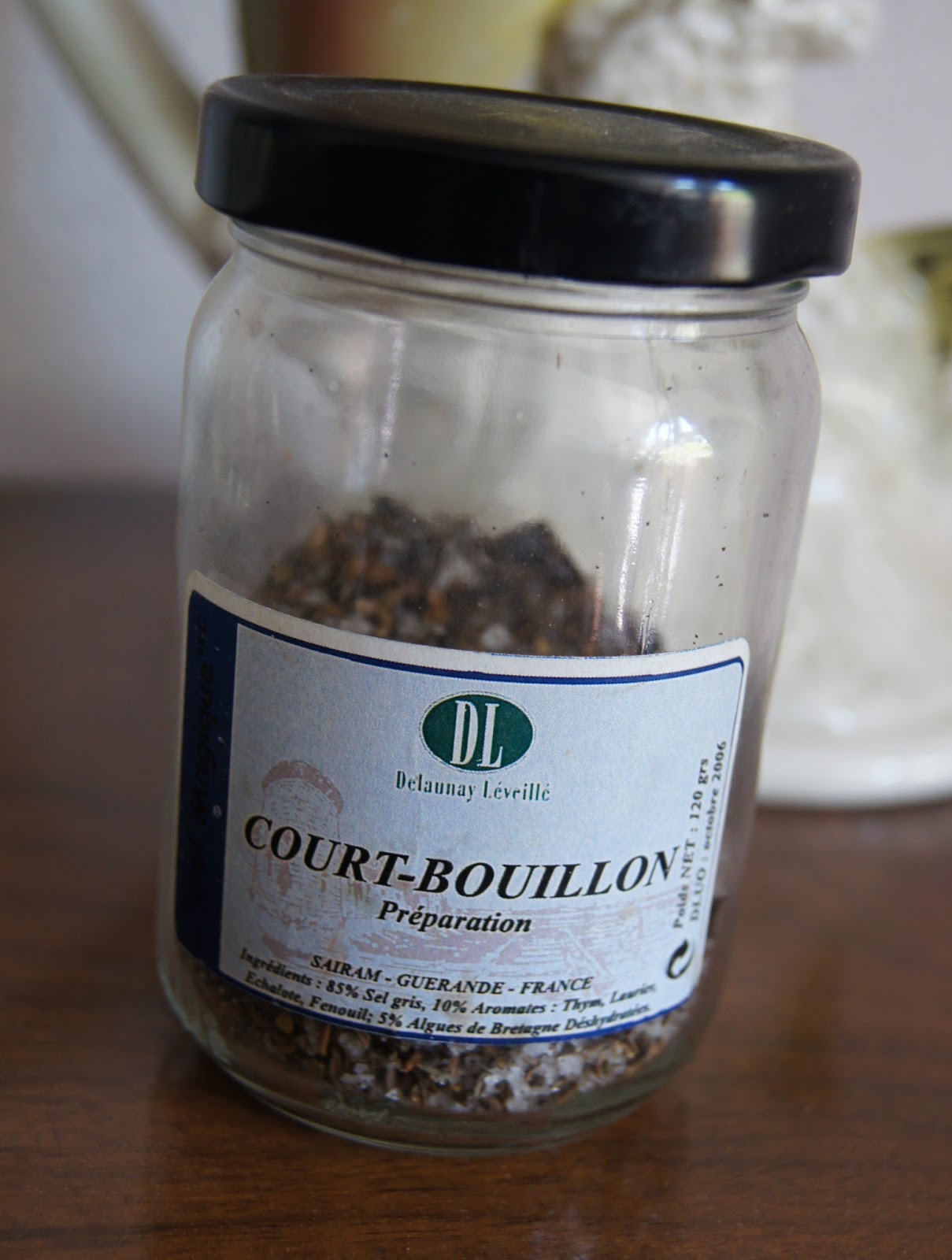
And the secret ingredient, this court-bouillon préparation:


It's mostly gray sea salt, flavored with thyme, bay leaf, dried shallots, fennel seed, and seaweed.  We picked it up in Brittany years ago; it keeps just fine, and it gives the bouillon a decidedly oceanic character.  Whatever sort of thyme is in there is particularly potent, too.  If you don't have something like this, just add the component parts separately.  The seaweed aroma is nice, but not necessary.  Combine everything in a saucepan large enough to hold your fish, bring it to a boil, and simmer for 15 to 20 minutes.  Then turn the heat off, add the fish, cover, and set aside.  The fish was probably cooked through within five minutes, but it didn't hurt it to sit in the bouillon as it cooled, absorbing some of the aromatics.


Service goes family style, the fish with a generous herbal garnish, the aioli and mayonnaise, the lovely vegetables prettily arranged by Mary and Melinda, our guest for the weekend, some crusty bread.  Such a civilized meal, poacher's delight, indeed.

Melinda picked and arranged the flowers, wild meadow bouquets.


Text and photos copyright 2013 by Brett Laidlaw

Thursday, December 13, 2012

A Superior Supper


This was a sort of herring-inspired tapas supper, if you will, or perhaps smorgasbord would be more appropriate to northern provenance of the fish, and the Nordic twist I administered to a classic French preparation, fish quenelles.  Whatever you want to call it, a superior supper, indeed.

Quenelles de brochet, pike dumplings, is a standard in the cuisine of Burgundy and the northern Rhone.  Like most dumplings, it probably had humble origins--a way to use up bits of fish for the dumplings and the bones for the sauce.  But most of the quenelles recipes I'd encountered were from the haute cuisine end of things, exceedingly rich and fussy to make.  In these high-end versions, the fish was there to hold as much butter, cream, and eggs as possible.  The traditional lobster, shrimp, or crayfish sauce that anointed these ethereal pillows of poisson does not scrimp on the fat, either.  Which is okay with me, from time to time, but since we planned to sample a variety of dishes, I didn't want that much richness in the quenelles.


This was a preparation that had intimidated me for a long time--well, until last week, to be honest.  It seemed to have the potential to be phenomenally delicious, but the one time I tasted it in France, the dumplings were kind of rubbery, and fishy tasting, and the one time I tried to make it at home, following a New York Times recipe, was an expensive, extremely messy disaster--turned out the recipe in the paper was wrong, and my email prompted a correction, which was very small consolation, indeed.  I never made the corrected recipe.

I'm not sure what prompted me to try fish quenelles again--perhaps just to test the versatility of my splendidly fresh herring.  In one of Rick Stein's books I found the streamlined quenelle recipe I'd long been looking for.  This one used bread soaked in milk--a "panade"--to hold things together without too much butterfat.  Also, unlike every other quenelle recipe I had encountered, it did not ask you to push the fish paste through a sieve (how appetizing does that sound?!).  Before the days of the food processor, sieving the puree was probably necessary to achieve a smooth texture in the dumplings; modern technology has eliminated the need for that step, but a lot of French recipes have not caught up.  (Madeleine Kammen notes that she could never forget learning to make quenelles, pounding the fish in a mortar and pestle; she was always reminded by the painful bursitis in her shoulder....)

Although rich, most classic quenelle preparations make a dumpling that must be pretty bland.  There is rarely any seasoning besides salt and perhaps a bit of white pepper.  I wanted my dumplings to be flavorful independent of rich sauce, so I gave them strong, northern notes with apple cider vinegar, grain mustard, and shallot (and a nod to Mme Kammen with the pinch of quatre-épices, "confit spice," that I learned from one of her books; I have a tin of that in my spice drawer at all times).

Carrying on the Nordic theme, my chowder sauce is heavy on the hardy roots--rutabaga, parsnip, and celery root.  I toned down the smokiness of the bacon by first water-blanching the meat.  The sour cream and lemon added at the end of cooking gives this sauce a nice acid lift; it would be a bit flat without it.

Do not worry if you don't have herring caviar.  A garnish of chopped herbs would be nice, too--some snipped chives, perhaps, or a little dill.  I think thyme leaves would suit it, too.


While I was roasting my potato slices in duck fat for the caviar canapé, I added the "tails" of the parsnip and rutabaga, sliced in half the long way.  They made for a charismatic, savory garnish, and a very rustic-looking counterpoint to the elegant dumplings and roe.

For the other dishes in our Nordic tapas spread, Mary mixed leftover broiled herring with its homemade chile mayo accompaniment for a lovely canapé served on toast:


I combined smoked whitefish, apple, and roasted beets in a dressing of Smude sunflower oil, cider vinegar, some honey, about a quarter teaspoon of mustard seeds and a generous pinch each of caraway and cumin seeds, some shallot, I think.  A bit of a mess in the plate, but fresh and flavorful:


And then those luxurious rounds of duck-fat-roasted potatoes with sour cream and a liberal topping of the herring roe, home-cured:


I think we're going to start seeing more and more chefs exploring the possibilities of Lake Superior herring.  Anybody out there need a menu consultant?  I'm available....


Herring Quenelles with Nordic Chowder and Caviar

6 ounces skinless, boneless Lake Superior herring
1 tablespoon minced shallots
2 tablespoons unsalted butter
½ cup fresh bread crumbs
1/3 cup whole milk
1 teaspoon grain mustard
1 teaspoon apple cider vinegar
1 egg
3/8 teaspoon salt
A few grinds of black pepper
2 tablespoons sour cream mixed with ¼ cup cream

Melt the butter in a small saucepan and add the shallots.  Just as the butter starts to sizzle, remove the pan from the heat and stir in the bread crumbs, then the milk.  Refrigerate until well chilled.

Cut or scrape away the line of brown-gray fat running down the herring fillets and discard.  Cut the fish into ½-inch cubes and place in the bowl of a food processer with the bread-shallot-milk mixture, the mustard, vinegar, confit spice, egg, salt, and pepper.  Process to a  very smooth puree, about 2 minutes.   Then, with the processor running, add the cream mixture and process just long enough to incorporate.  Refrigerate this mixture until you’re ready to make your quenelles.

Bring a saucepan of water to a simmer.

Using two kitchen tablespoons, shape quenelles, little football shapes, from the fish mixture.  They should be about 2 ½ inches long and just over an inch wide.  Poach the quenelles in the water, adjusting the heat to keep a gentle simmer, for 3 to 4 minutes, until they are firm.  Keep warm in a warm oven until ready to serve.

Root Vegetable Chowder

2 tablespoons each celery root, rutabaga, parsnip, and onion, in very small—less than ¼-inch—dice
1 ounce slab bacon, blanched in boiling water for 2 minutes, drained and minced
1 teaspoon butter or oil
2 teaspoons flour
½ cup fish, chicken, or vegetable stock
½ cup whole milk
Salt and pepper
2 tablespoons sour cream
Lemon juice
Herring caviar

Heat the bacon and butter in a small saucepan over medium heat, and as the bacon begins to render fat, add the vegetables.  Cook for about 3 minutes, until the onion becomes translucent.  Sprinkle the flour over the vegetables, stirring with a wooden spatula.  Combine the stock and milk and slowly add to the pan, scraping with the spatula to deglaze.  Add a couple of good pinches of salt and a few grinds of pepper.  Simmer for 5 minutes, stirring occasionally. 

The chowder can be made two or three days ahead to this stage, and finished just before serving.  When you’re ready to serve, heat the chowder and stir in the sour cream and a squeeze or two of lemon juice, if you like.  Taste for salt and pepper and add more if needed.  Ladle some chowder into shallow soup bowls, place the warm quenelles atop the chowder.  Sprinkle herring caviar here and there on top of the chowder and the quenelles.  Serve.

Text and photos copyright 2012 by Brett Laidlaw

Monday, December 10, 2012

Fresh


Having stooped to the depths of writing about avocadoes in this journal supposedly devoted to northern foods, it was probably in everyone’s best interests that I took a little break. The hiatus was not planned, just happened, as each time I considered a possible topic for a post, my inner editor said, “Meh.” I needed some fresh inspiration, and I got it from a road trip that Mary and I took up to the South Shore of Lake Superior (aka “The Cheesehead Riviera”; I just made that up...), destination Halvorson’s Fisheries in Cornucopia, Wisconsin.


There we watched the herring boats come in on a chill but beautiful afternoon. They had to break through a couple of inches of ice in the harbor—the trip was a preview of things to come, too, as our northward drive took us from the dusting of Dunn County snow to nearly a foot along the shore. We loaded a cooler with fresh off the boat herring—including several whole fish that yielded a pile of roe—along with smoked lake trout and whitefish. 


Lake Superior herring is an under-appreciated, misunderstood fish.  Its reputation suffers, I think, from its being confused with other fish known as herring to which it is not, in fact, closely related. The Lake Superior herring, Coregonus artedii, is more closely related to trout and salmon than it is to the saltwater herrings so well known in northern Europe. It’s a reasonable surmise that Scandinavian and German immigrants in the northland mistook this freshwater fish that schools in vast numbers for the ocean fish they knew from home—there are, indeed, superficial resemblances in size and color. And when you consider that for many people, their main association with herring is with the pickled variety, perhaps of indifferent quality, there’s a general reluctance to embrace the lake herring as the superb and versatile food fish that it is.


 As for the name confusion, lake herring is variously known as cisco, bluefin, and, where it occurs in smaller lakes, tullibee. There have been efforts in some circles to “rebrand” lake herring as cisco, but I doubt that is likely to gain much momentum—especially since I’ve seen smoked herring and smoked cisco resting side by side in the cooler case in lakeside fish shops over the years. There’s little consensus on what to call what, it seems, at least at the local level.  So I don't think the term herring is going away.  We just need to work on spreading the word about what a delightful fish it is to cook with.


Over the past couple of weeks I’ve prepared herring in a half dozen ways, and I’m still not tired of eating it. Last night a herring fillet went into a Sichuan-inspired dish with fermented vegetables and tofu in a hot bean sauce. On the our first night back from Corny, I simply fried fillets in a cornmeal dusting and served them with a crunchy, savory garnish of fried bacon, leek, and jalapeno, with a splash of apple cider beurre blanc. Other nights I fried chunks in a tempura-like batter for the best fish tacos I’ve ever eaten; broiled it and served it with a chile-laced mayonnaise; whizzed it up in the FP to make herring quenelles, fish dumplings that I served in a chowder-inspired sauce; and we snacked on the salted herring roe atop rounds of garden potatoes roasted in duck fat, with a dollop of sour cream.


That roe, by the way, is where the real money is for the Lake Superior commercial fisheries, Maureen Halvorson told me. Completing the ironic herring circle, it is shipped to Scandinavia, where it is considered a delicacy—even though it comes from a fish that does not exist anywhere near those northern European shores.

Here are a few more shots from our quick, fishy trip to Corny:

The beach at Corny, "The Cheesehead Riviera"


Cornmeal-dusted pan-fried lake herring with crunchy garnish, cider beurre blanc

It just occurred to me on this trip that they wear orange jumpsuits so they'll be easy to see if they fall overboard....


This was not the first time the three-hour drive to the South Shore was a time trip--that short distance often takes you to another season on the shore.


Waiting for the herring boats

Ice on the deck


The South Shore herring fishery is thriving; Halvorson's added another boat this year, bringing the fleet to four.

"...in the rooms of her icewater mansions...".


Text and photos copyright 2012 by Brett Laidlaw