Showing posts with label France. Show all posts

Thursday, January 14, 2016

Simply Superior Soup (or "Effing French Cooking Magic")


It’s the last week of December 2015 as I (begin to) write this, 2016 looming just days away, and for cooking options we are decidedly into the winter larder.  On December 6 we were amazed to eat, and very much enjoy, the last garden tomato.  The last leaves of fresh kale were part of a festive Christmas dinner:  seared venison loin (harvested from the Bide-A-Wee property last year) with a rich, savory red wine and port reduction; lima beans simmered with stock and aromatics, then pureed, a surprisingly luxurious result from a humble dried bean; then the kale, braised with chestnuts and garden leek, a splash of our homemade cider vinegar.  Though we haven’t really celebrated Christmas in any traditional way for some years, I’m not going to let an opportunity for a festive dinner go by.  And anyway, we think of it as a continuation of our solstice festivities—especially appropriate here, as Mary’s birthday occurs during the same time.

Once those last leaves of kale vacated the crisper, dinner planning turned a page.  It’s true that there’s still quite a bit of “fresh” produce, from both garden and farmer’s market stock-ups, in our cellar, in the fridge.  But the term fresh doesn’t really mean the same when applied to storage carrots, cabbage, squash, and onions, as it does when describing a handful of beans or a bowl of tender lettuce harvested from the garden to be prepared and served minutes later.  Those winter stand-bys are fresh in the sense of not being frozen, dried, pickled, fermented, etc., but…you know what I mean.  It’s not the same as throwing dew-dappled snap peas in the wok or snipping fragrant dill into a dressing.  Our vocabulary fails us in efficiently denoting that crucial difference:  there’s fresh produce, and then there’s fresh produce

This is not to disparage the stalwart vegetables of winter, not at all.  Like reliable character actors, they show up and fill their roles with unfailing professionalism, year after year, decade after decade, while the fad for arugula fades, or a trendy heirloom cucumber turns out to be just another pickle, after all.  Cabbage, potatoes, carrots, squash, onion, leek, turnip, beets--the roster might at first glance suggest daily supper at the gulag:  bung it all in a kettle, boil until done.  But there’s a saying I like (and as far as I know, I came up with it), goes like this:  There’s meat, and then there’s cooking.  Which is to say:  It’s not always only about the ingredients, but often as much or more about imagination and skill in preparation.  Today’s soup, which we had as a first course on Christmas night, is a perfect example.

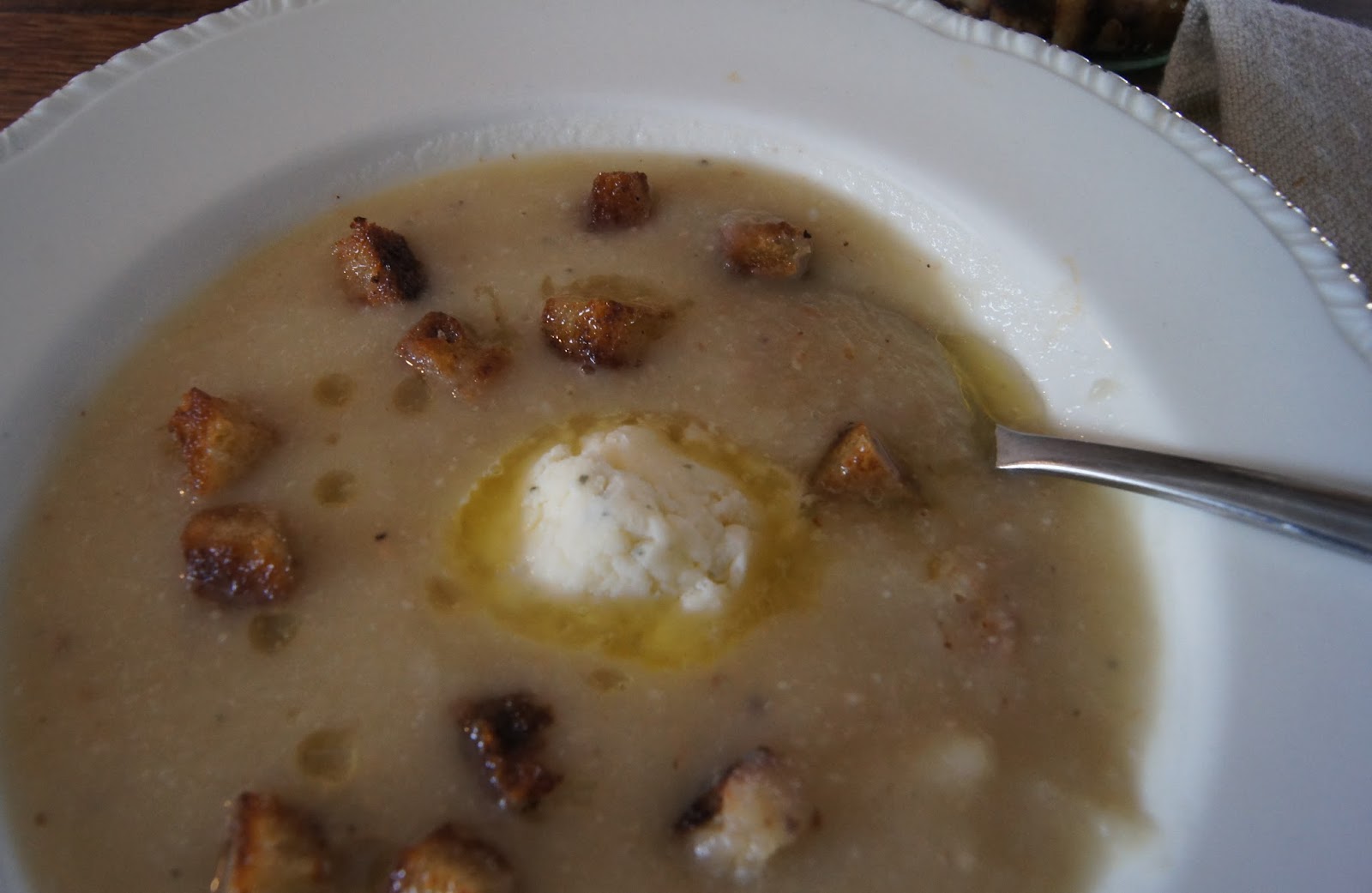
If it hadn’t come with a sexy French name, I might never have tried it.  Puréed cabbage and potato soup sounds, you must admit, a good deal less appealing than Crème de Choux aux Beurre de Roquefort.  The source is Madeleine Kamman’s In Madeleine’s Kitchen.  There are three remarkable and surprising things about this recipe:

1)  In spite of the cream—crème—in the title, there’s no cream in the soup.
2)  In spite of the fancy-sounding title, the list of ingredients is short and plain.
3)  In spite of the short, plain ingredient list, the resulting soup is delicious, even luxurious, the result of “Fucking French cooking magic,” as I described it, enthusiasm overwhelming decorum, in a tweet.


There are a couple of secret ingredients:  walnut oil, and confit fat.  But I think you could do without those if you don’t have them, substituting good butter for the confit fat, olive oil for the walnut oil.  However:  if you haven’t tried French walnut oil, it is well worth seeking out.  A commonly available brand, and the one we always buy, have even brought back from Paris in the past, is J. Leblanc.  It’s pricy, but a little goes a long way.  For me, a salad of fresh tender lettuces straight from the garden, dressed with nothing more than walnut oil and a bit of fleur de sel is one of life’s simple luxuries.  But I’m getting ahead of the season.  Just one more note on the walnut oil:  the French stuff is made from lightly toasted walnuts, so it’s amber in color and has that nutty fragrance and flavor.  The golden walnut oil often sold at “health food stores” and co-ops is not the same.  The French walnut oil should not be used for cooking, only dressings and seasoning.  (NB: the English name is in small print on the bottle, so you’re looking for a bottle labeled “Huile de Noix,” as above.  For Mpls/St Paul readers, Cooks of Crocus Hill carries it, but are currently out of stock in all stores.)


The basis of the soup is potatoes, cabbage, and water.  It gets a smoky depth of flavor from bacon.  Not a lot of bacon, either, less than an ounce per person in Kamman’s recipe (she actually calls for pancetta).  No cream or milk, as noted above.  No stock, just water (you can call it Chateau Sink, as Jacques Pepin sometimes jokes, or perhaps Domaine du Tappe, to French it up).  There’s a bit of garlic, whose presence is felt.  The beurre de Roquefort is simply blue cheese and soft butter mashed together, a few grinds of coarse black pepper—a simple compound butter; it’s worth making extra, for it’s nice to have around, to smear on a burger, say.


And that, my friends, is it, the ingredient list in its entirety.  You gently render off small cubes of the bacon or pancetta, add potatoes and garlic, then the cabbage.  This sweats for a few minutes (“mellows,” in M Kamman’s version), then you add water and simmer until the cabbage is very tender.  The well mellowed vegetables and bacon are then whizzed up in a blender (I used a food processor, carefully spooning out the solids, adding liquid gradually; an FP is really not the best appliance for pureeing soups, I’ve learned from bitter experience).


And get this:  it suffers not at all from being made a day ahead and reheated just before serving.  On Christmas Eve I added a little crunchy garnish, chopped goose skin cracklings—yeah, I happened to have some lying around; don’t hate me because I’m beautiful—from the goose we cooked for our first solstice celebration.  When I made it again for lunch I toasted some small croutons in olive oil—it’s really about the textural contrast, that crunch to perk up the creamy soup.  (See:  "It's all about the garnish".)


Coming back around to my earlier point and seasonal eating and the winter larder:  this is a fabulous dish that you would never make in the summer, but which is perfect for the cold months when, you know, you have a lot of potatoes and cabbage around.  It also reminded me how absolutely lovely and civilized it is to start a meal with a soup, so elegant and yet so comforting.  A fading tradition I hope to start reviving in our house.

My adaptation of Madeleine Kamman’s recipe:

Creamy Bacon, Potato, and Cabbage Soup with Blue Cheese Butter

Serves four as a first course, two to three as a main course—add salad and crusty bread to make it a meal

2 ounces bacon or pancetta, preferably in one chunk
1 tablespoon duck confit fat or butter
1 medium or 2 small potatoes, 6-7 ounces total
1 large or 2 small cloves garlic
¼ of a green cabbage, about 12 ounces
1 tablespoon walnut oil, plus additional for garnish*
Salt and freshly ground black pepper

For the blue cheese butter:
2 ounces unsalted butter at room temperature
2 ounces blue cheese

Croutons or cracklings, optional but highly recommended

In a small bowl, mash the butter and blue cheese together with a fork until well blended.

Cut the bacon or pancetta in small dice, about ¼-inch.  Peel the potatoes and cut them into smallish cubes, about ¾-inch.  Shred the cabbage into ½-inch strips.

Heat a medium saucepan and add the confit fat or butter, then the bacon.  Cook over medium-low heat.  As the bacon renders its fat and begins to brown, add the potatoes, tossing them in the fat, then cook, stirring occasionally, until they become a little bit brown, 4 to 5 minutes (you’re just looking for a golden color, not deeply browned as for hash browns).  Stir in the garlic and cook for another minute or two, then add the cabbage, a couple generous pinches of salt, and several grinds of black pepper.

Turn the heat to low, cover, and let the cabbage sweat (“mellow” is the term M Kamman uses) until well wilted, about 5 minutes.  Add 3 cups water, bring to a boil, turn down to a simmer, and cook partly covered until the cabbage and potatoes are very soft, 15 to 20 minutes.

Let the soup cool for a few minutes before pureeing.  If using a food processor, separate the solid from the liquid parts of the soup and purée the solids first, then gradually add in the liquid.  When everything is in the FP, purée for about a minute.  At the end of the minute, drizzle in the walnut oil.  Return the soup to the saucepan.  Reheat just before serving.  (Note:  Kamman directs you to strain the soup back into the pot after puréeing; I did not bother with this step, finding the soup smooth enough to my taste without straining.  Straining would no doubt produce an even more velvety and elegant purée, if that's what you're after.)

To serve:  heat the soup and taste for salt; you will probably want to add another pinch or two.  Ladle the soup into bowls, and to each add about a tablespoon of the blue cheese butter.  Add croutons or cracklings, as you please, drizzle a small amount of walnut oil over the surface of the soup, and serve.

*If you don’t have/can’t find walnut oil, use a flavorful olive oil—or, perhaps pumpkin seed oil, such as Wisconsin’s own Hay River Pumpkin Seed Oil.  And, how about this—if using pumpkin seed oil, think about substituting butternut squash for all or part of the potatoes, then garnish with toasted pepitas instead of the croutons/cracklings.

Happy soupage!

Tuesday, October 9, 2012

"One Can Dine Very Well on Potatoes"


You travel to France to see the Eiffel Tower and the Arc de Triomphe, to sip an espresso at a sidewalk café and munch on tangy saucisson sec while you quaff a glass of Beaujolais in view of the vineyard from which it sprung.  You travel for the expected sights and pleasures, but of course it's the unexpected encounters that make a trip truly memorable.

I think of our visit to a tourist office in the town of Villefranche, in Beaujolais.  We came in speaking French, Mary in the lead--or perhaps I went first, to make Mary look good by comparison.  The petite, dark-haired woman working there listened to our request for info on restaurants and wineries in the area, and scurried about the office amassing a pile of brochures and pamphlets.  She and Mary chatted while the woman reached into cabinets and leafed through stacks of materials.  The woman seemed distracted, and was becoming more animated, even agitated, all the time.

When finally it appeared that she might burst with excitement, she overcame that deep-seated Gallic reserve which makes it nearly impossible to ask a direct question of a stranger, and dared to ask us where we were from.  We said we were American.  Not French at all?  Not a bit.  Alors.  What had the woman flustered was that she couldn't place Mary's form of French; her accent was so good, she thought she must be French, but....  The implication was that her grammar didn't quite match the accent.  What she finally concluded, she told us, was that Mary must have been a French woman who had moved to America, and forgotten how to speak French! It was probably the most endearingly backhanded compliment the woman could have offered.  And after that dish of quenelles de brochet has faded in memory, and the Delacroix and David and Géricault we admired in the Louvre start to blur together, that's the sort of landmark of a trip that stays with you for years and years.


The title of today's post comes from another such encounter, during our first trip to France in 2001.  We went in early October, less than a month after the September 11 attacks, and shortly after the U.S. invaded Afghanistan.  This was in that honeymoon phase when much of the world drew together in sympathy with America over the shock and horror of those events.  I can't recall how many French people spontaneously mentioned the 9-11 attacks, and expressed their condolences, and incidentally thanked us, retrospectively, for America's role in saving France during World War II.  The French have a longer historical memory than we have (who doesn't?), and it was remarkable to be the recipients of this kind of outpouring of emotion, simply because we were American.

Well, the Frenchman who inspired today's post wasn't quite so sentimental.  We met him about a week into our trip, which started in Brittany and took us down the Atlantic coast to the mouth of the Loire, then up that splendid river into the Touraine, the area around the city of Tours.  We wound up staying a few days near Chaumont sur Loire, home to a lesser chateau, which at any rate we were only able to view from behind the locked gates, à cause de la grève--"because of the strike," the public workers' rolling strike over...I don't recall what. A cause de la grève we couldn't visit the chateaux, à cause de la grève we couldn't get into the Rodin museum. etc.  It became the tagline to our trip, not that we were much put out.


But with the chateau in Chaumont closed, we were looking for amusement, so we went to the tourist office in town--which also served as baguette depot on days when the boulangerie was closed.  There we met M. Guérand, in his early 30s I'd guess, longish dirty blonde hair and a three-day beard, cowl-neck sweater--so very French looking.  If he didn't have a Gauloise perched on his lower lip at all times, he should have.  Typical he was, in appearance at least, but not your typical tourist office worker in almost every other respect.  He wasn't from the area and didn't really know it very well.  He was from Paris, a graphic designer, unemployed, and they'd shipped him out here to the boondocks to fill a vacancy at the tourism office.  Waving at the rack of brochures was about as helpful as he could be in helping us find lodging for the night.  And as for sights worth seeing, well, in his view, one thing was as good as another. Merci, bien.


But we got to talking, about...just about everything.  He was pretty bored, so little tourist traffic in the area, since it was the off season, and à cause de la grève.  And probably Mary and I were just a wee bit sick of each other's exclusive company after many days on the road.  We spoke mostly in French, as his English was poor, and we covered 9-11 and its immediate aftermath, the Afghanistan invasion, the American media and its lack of intellectual depth (when we got home I sent him a package of the "better" U.S. current affairs magazines, to show him there was some intelligent life in America, and never got a reply).  It got philosophical at some point, as we pondered together why so many people spent their lives chasing after money, and never stopping to realize that money is just a medium, not an end in itself, and if you thought it was an end in itself, you could never have enough to be satisfied.  Deep stuff.  He also confided to us that he really could see no point to existence itself.  Shrug.  Fire up a Gauloise....

Eventually we came back around to our immediate needs:  a place to sleep that night, somewhere to eat.  By sheer luck we pulled a brochure that led us to a very odd but perfectly wonderful auberge, Chateau de la Haute Borde.  As for dinner, well, there were some restaurants in town, but this was Monday, and most were closed.  Furthermore, he wasn't really supposed to recommend specific restaurants, and anyway, he didn't eat out much.  He didn't care about food, himself, and seemed slightly exasperated with his countrymen and -women for their obsession with this trivial chore, feeding oneself.  To top it off, here in the land of charcuterie, in a sea of rillettes and rillons and foie gras, he was a vegetarian.  It was a healthier and more humane sort of existence.

Pause.

"I find that one can dine very well on potatoes."


He must have said it in French, but I have no idea how to construct that sentence.  We understood, we nodded.  We thanked him and said how much we had enjoyed our conversation, and made our way out into a gorgeous October afternoon in the storied Val de la Loire.  After checking in to La Haute Borde and confirming that their restaurant was closed, we drove into the city of Amboise and enjoyed a splendid dinner at a restaurant called La Comédie, where local young people came for pizza, and we ate sausage, duck, rabbit, as well as gratin dauphinoise--so yes, we dined very well on potatoes, among other regional delights.

Another thing you learn from travel, a cliché perhaps, but not a dreary one, is that sometimes it's the destination that delights, but often it's more about the journey.  An old verity appropriate to this shaggy dog story (histoire drôle sans queue ni tête!) about a dinner inspired by pommes de terre, though not composed exclusively of them.


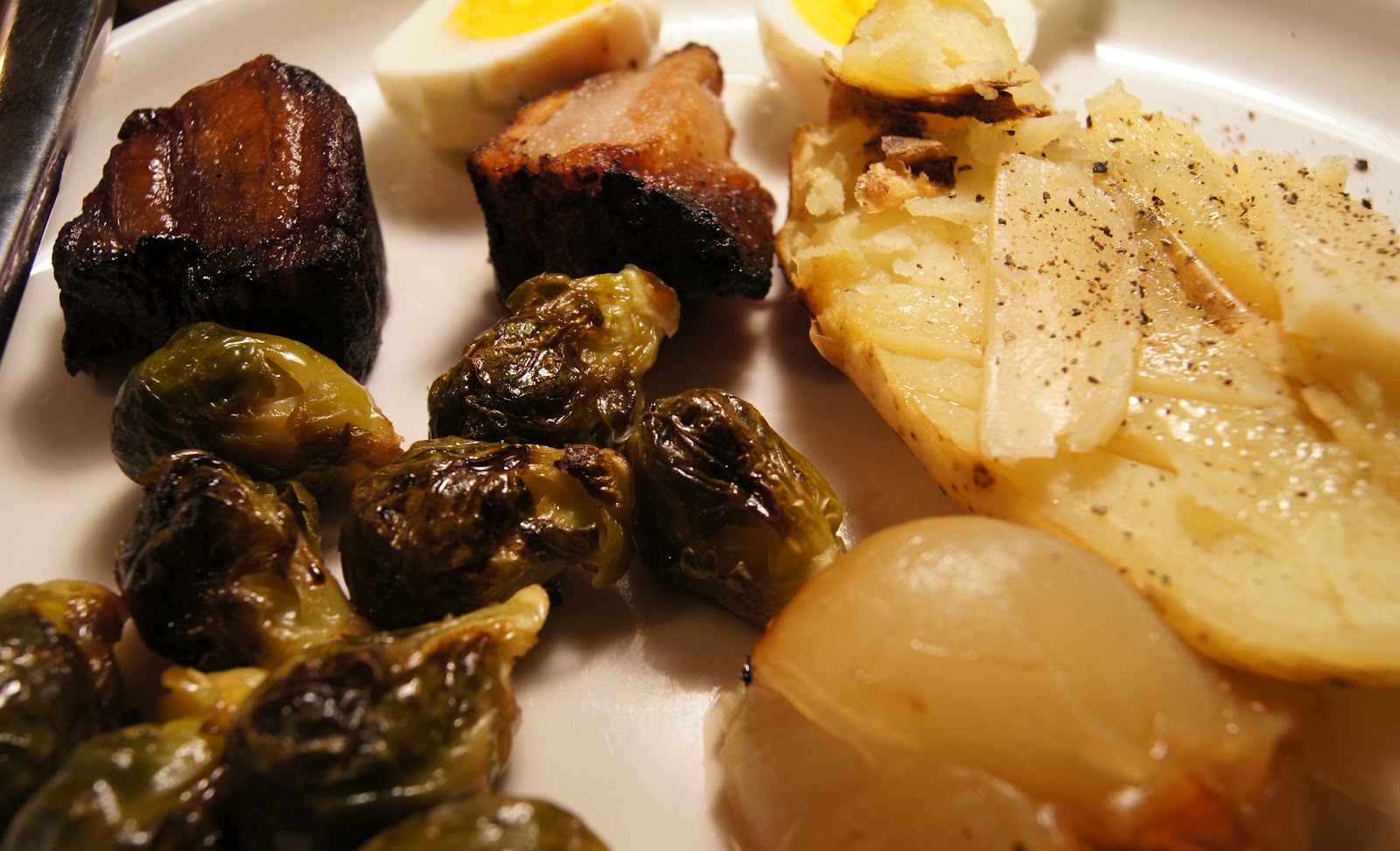
I dug our potato bed this week, and I knew we must dine on them.  I plucked the first brussels sprouts from the garden, too.  Those things, along with some beautiful cippolini-type onions from the market we wrapped up in foil--a little salt and oil in the sprouts and potatoes--and into the coals of a fading fire they went.

Foraging in the fridge I found a piece of pork belly that I had brined as for bacon, but roasted in the oven instead of smoking.  To add variety to the plate, and for the hell of it, I put a couple of eggs in the coals for ten minutes at the very end.  I've never done eggs this way before, and they came out beautifully--yolk sunny yellow and set, white silky, not a hint of sulfurishness about them.


Then cheese, since we are in Dairyland--Marieke gouda both aged and smoked, Roth-Kase gruyère-style.  Hope butter, a sort of creme fraiche ersatz made by combining Cedar Summit cream and goat yogurt, some minced shallot added to that.  Pickles, since this was a sort of faux raclette meal.


This is how we dine on potatoes around here, and we dined very well, indeed.  Happy travels to all.


Text and photos copyright 2012 by Brett Laidlaw

Friday, March 12, 2010

Raw Food, My Way


I have a bit of a problem with the whole raw food diet concept. Now, I'm a firm believer in to each his own and chacun à son gout and all that, and it's not that I don't enjoy a nice cold faux pizza made with faux cheese and dehydrated tomato purée on a pappy crust of compressed sprouts and seeds washed down with a refreshing glass of kale juice....

Okay, it is that. It's that exactly. I do not enjoy that sort of raw food. Not that I can say I've explored every corner of that realm of eating, because, well, I don't like that kind of food, so why punish myself? Beyond the fact that the application of heat does wonderful things for the flavor of food, the whole idea behind the raw food approach goes right over my head. I don't get the idea that people were meant to be pure herbivores, any more than I do to the absurd notion of "caveman cuisine" that has also popped up recently, a regimen centered around large portions of bloody meat and nothing else that has graced the human table since the dawn of civilization. I like civilization. Well, parts of it....

The raw food approach would be more appealing if one were allowed oysters on the half shell, sashimi, or well-seasoned raw chopped steak, but you always run into that whole "vegan" thing, if you know what I mean.

This is all just a snarky, roundabout way of saying: Is there anything better than a plate of good steak tartare, frites, levain toast, and a glass of red wine? The sort of steak tartare I like is a French invention, and I try not to think of its supposed origin in the barbarian practice of tenderizing a piece of meat by keeping it between horse and saddle over the course of a long day's ride. I think I would rather eat hemp and seaweed than that "authentic" sort of tartare.


I had my first steak tartare in Paris, at a chain wine bar called
L'Ecluse, off the Champs Elysées--you can actually see a picture of the dish at that link. What I remember most about it is that the portion was huge. I ate and ate and ate, and Mary had a few bites, too, and still the ginormous mound of meat did not recede. When I could eat no more and abandoned the plate in defeat, the manager came over and regarded my failure with a look of deep disappointment and hurt. He asked me if I hadn't enjoyed my dinner, and I tried to summon enough French to respond, yes, indeed I had, it was very good, but, Monsieur Dude, that was one honking hill of raw beef, n'est-ce pas?

I recall that we ended that meal with an astoundingly good, runny, salty, smelly round of st. marcellin cheese.

I've had steak tartare in France several times since then, and the sum of those experiences leads me to conclude: 1) The French really like steak tartare, as it still shows up on many, many menus, and 2) The French like very large portions of steak tartare. We're often told, and I find it generally true, that the French diet is not focused on large servings of protein, being comprised rather of a balanced approach, several courses, salad, bread, cheese, wine, and vegetables. When the meat is not cooked, though, all bets are off--chop it, mix it, pile it high. Bring on the toast, and let's eat raw beef. And what, I ask, is wrong with that?

Occasionally I've had steak tartare as a first course, but now I prefer to make a meal of it, indeed, an event, Bistro Night! Cue up the Serge Gainsbourg, the Aznavour, the Amélie soundtrack, bring up a bordeaux or a cru beaujolais, and sail across the sea on a dreary Minnesota March night to
Les Bacchantes on the rue Caumartin near the opera--STEAK TARTARE HACHE A LA COMMANDE 14.50.

But I'm getting carried away, and am yearning for Paris and all that it implies, so back to the topic of homemade steak tartare. The question of health issues will invariably arise, and all I can say is that that is something one must decide for oneself, and you should know the source of your beef, and it should be very fresh. I will also say that I have never been made ill by steak tartare, or, for that matter, by the many dozens of raw egg mayonnaises that I've made over the decades. Most bacteria on a piece of meat inhabit the outside surfaces, so if you want to be fastidious you could carefully cut away the outside and use the middle only. And, needless to say, I would never, ever eat raw beef ground by someone else. I want to choose it, see it, smell it, chop it, eat it.

Those are the caveats; on to the recipe.

The meat: sirloin is a good choice, or top round. The most recent version I made with a chuck-eye steak from the Seward Co-op. Pricier cuts like a strip or ribeye would be fine, as well, but you don't need to spend the big bucks to have excellent tartare. I certainly would not use tenderloin, which costs an arm and a leg and has no flavor, but that's what a lot of tartare recipes call for, so, whatever.


My seasoning is a bit idiosyncratic, and I like my tartare very well seasoned. I don't use the traditional raw egg, but I do add some mayonnaise, Hellmann's. This may cause outrage among purists, but I stand by it. It gives lot of savory depth and unctuousness to the tartare.

Finally I feel the steak must be chopped, not ground. I'll usually slice my beef into strips and put it on a plate in the freezer for 15 or 20 minutes to make it easier to chop. Then I go through it with a very sharp knife just as if I'm mincing an onion or such, and when I've got it chopped quite fine I'll spread the meat out on the cutting board, and get another sharp knife, so a knife in each hand and I go chop-chop-chop-chop-chop until I'm tired of chopping, and taste a bit for texture, season, let meld, enjoy.

Steak Tartare Maison
pour deux personnes

10 ounces beef--sirloin or top round
1 small shallot finely chopped, about a tablespoon
1 1/2 Tbsp extra virgin olive oil
2 to 3 shakes Worchestershire sauce, or to taste
1/4 tsp sambal oelek chili paste--or a few shakes Tabasco
1 heaping Tbsp Hellmann's mayonnaise
juice of 1/4 lemon, or to taste
2 good pinches salt
1 tsp capers, chopped fine
2 tsp dijon mustard
a few grinds of black pepper

Mix all together well and let sit at room temp for at least 30 minutes. Serve with good buttered toast,
oven fries, cornichons if you have some, and a green salad. Drizzle a little extra olive oil over the meat on the plate, if you like. You can also bring some of the condiments to the table for individual adjustments.

Our salad this night was our first harvest from the potted greens shown in the previous post. The potatoes came from our root cellar stash, from the market (things are getting pretty sprouty down there; I guess spring is on the way). I baked the bread, of course, made with Minnesota and North Dakota flours. The cornichons, grew 'em, pickled 'em--and this year I'll be able to use my own vinegar. The steak was either Hill & Vale or Grass Run Farm, I forget which--purchased at the Seward Co-op. The nice thing about shopping at co-ops is that you often wind up eating local foods without having to think about it.

But don't assume that because a store has a "green" reputation that they're actually walking the talk. I read something in a blog recently about Whole Foods 365 frozen "organic" vegetables which I found hard to believe, but I checked it last time I was there, and it's true: Many of those vegetables are grown and packaged in China. Talk about your food miles....

These greens traveled about 25 feet from "farm" to table:


Text and photos copyright 2010 by Brett Laidlaw

Friday, January 22, 2010

Bonus Post for Bunny Lovers

La Cuisine de Bretagne et d'Armorique, Clémentine Thibault (Editions Jean-Paul Gisserot)

Page 85:


Page 83:


Note that this book was purchased for 35 francs!

File under: "The French will be French."

Thursday, March 5, 2009

Bienvenue en Alsace

Keeping the northern table interesting through the winter can be a matter of looking at familiar ingredients in different ways, or of looking at different places on the globe. Looking between the 45th and 50th parallels and traveling east across the Atlantic, we find ourselves in...France! Lucky us. Of the regional cuisines we can choose from, we've got Bretonne , Normande, Auvergnate, Tourangelle, Savoyarde, and today's stop, where we'll remain for the next couple of posts, Alsace, in the northeast corner of La Belle France.

The beauty of this approach is not only that we get to try delicious Alsatian "pizza" topped with crème fraîche , onions, and bacon, and succulent simmered sauerkraut served with savory charcuterie; it also gives us a chance to learn about working in imaginative ways with the limited winter larder. The cuisines of these regions are a great deal older and more sophisticated (for all that they might now be labeled "peasant food") than Jell-O salad and hot dish. There's a wealth of knowledge here about making the most of what we've preserved or cellared from last year's harvest.

With its blend of German heartiness and French refinement, Alsatian cooking provides a great template for cooks in the upper midwest, or other northern climes.

We were in Strasbourg a couple of years ago, and picked up a cookbook called La Cuisine Alsacienne Traditionelle. It didn't seem like such a find at the time, a bit "Better-Homes-and-Gardenish," but the more I look into it, the more I like it. This recipe for tarte flambée is a fairly literal translation of the recipe from that book.

Tarte Flambée (Flammekuche)serves 3 to 4

1 cup warm water
1 tsp active dry yeast
1/2 tsp salt
3 cups (approx.) unbleached all-purpose flour
optional-- 1/4 cup whole wheat flour as part of the 3 cups
1 ounce (2Tbsp) softened unsalted butter

Pour the warm water into a large mixing bowl, and sprinkle in the yeast. Let stand five minutes. Add the salt and half the flour, mix. Add the butter in small pieces, mix. Continue adding flour a bit at a time until the dough is too stiff to mix with a spoon. Turn the dough out onto a floured
counter and knead, adding flour as required to keep the dough from sticking, for one minute. Even if the dough isn't perfectly smooth, set it aside, dusted with flour, for 10 or 15 minutes.

Knead the dough again for just a couple of minutes. After the dough has rested it shouldn't take much kneading to achieve a smooth, elastic dough. Return the dough to the bowl, cover with plastic wrap, and let rise at room temperature one to two hours; or, place it in the fridge for a longer, slower rise, taking it out an hour or two before you want to bake the tarte.

For the topping:

3 medium onions, chopped
2 tsp butter
2 tsp grapeseed or canola oil
freshly grated nutmeg
4 ounces best quality slab bacon
1 cup crème fraîche, or 3/4 cream mixed with 1/4 cup sour cream
1 egg
salt and pepper

Sauté the chopped onions in the butter and oil for a few minutes, until they are soft but not browned.

Slice the bacon into 1/4-inch slices, and then cut the slices into 1/4-inch little sticks, or "lardons."

Mix the crème fraîche with the egg and a good pinch of salt, a few grinds of black pepper, and a few scrapings of nutmeg.

Preheat your oven to 500 F. Prepare the dough: This amount of dough will make three or four tartes--I originally made two larger tartes, but smaller ones would be better. Keep in mind the size of your oven and/or baking stone--you may only be able to bake one or two tartes at a time. For four tarts, divide the dough in four, then stretch and/or roll the dough into roughly 8-by-10-inch rectangles. If you're using a baking stone, place the dough on cornmeal-dusted peels. If you don't have a stone, place the dough on cornmeal-dusted baking sheets.

Spread the cream mixture on the rectangles of dough. Spread the sautéed onions on top of that, and sprinkle the bacon lardons evenly over the top.

Bake for 8 to 10 minutes, until the crust is well browned and the cream bubbling. Serve with a salad, like
carrotes rapées , and plenty of cold Alsatian wine, such as riesling or pinot blanc, or the Alsatian blend known as "gentil."


Text and photos copyright 2009 by Brett Laidlaw

Thursday, February 21, 2008

M. Potato-Head


It was our first full day in Paris in December of 2006. We were staying at the Hotel Langlois near the Trinité church in the second arrondisement, Right Bank. We arose late and groggy and walked out into a gorgeous day that could have passed for Indian summer in Minnesota. We had slept through breakfast at the hotel—indeed, it was now lunchtime—and we hadn't gone far before hunger overtook us.
It was our good fortune to be standing at that moment at the intersection of the Rue Richelieu and the Rue Quatre Septembre. Directly across the street was an unassuming little neighborhood brasserie called L’Ami Georges. The sidewalk blackboard listed a lot of the old warhorses—quiche, steak-frites, escargots, smoked salmon—but also less common dishes—house-made rabbit terrine, foie gras with oyster mushrooms, brandade. We had a feeling someone was actually cooking in this kitchen, and once we poked our head in the door we were quickly drawn in by the comfortable dining room and the patron's warm welcome.

Mary ordered quiche with fries and a salad. I was intrigued by the sight and smell of some kind of potato gratin that arrived at several tables while we waited. It turned out that this was the "tartiflette maison," potatoes baked with cream, bacon, and onions, with a copious layer of melted cheese on top. I could think of worse things to eat after a long day of travel and a restless night’s sleep.

We passed the time till our food arrived with a few sips of red wine from a demi-carafe, and a few bites of a really good sliced baguette (you're not guaranteed great bread in French restaurants these days; on one previous trip we'd been in the country for three days before we were served a piece of bread worthy of the name). We didn't have much to say to each other. We were just settling in to the feeling of being in Paris again, getting over the jet lag, the culture and language shift. And we were hungry. When our food arrived with the patron's sincere "Bon appetit," we didn't stand on ceremony, but dug right in.

I didn't know what kind of cheese it was on top of the tartiflette—I guessed brie at the time, and was wrong—only that it was highly aromatic and extremely delicious. I had taken a few healthy forkfuls before I set down my knife and fork, took a bite of bread and a swallow of wine, and began to declaim.

"You know..." I said, which is how many declamations begin, and Mary looked up from her plate with kind attention. (One of my wife's many charms, though surely not her greatest, is her willingness to let me declaim, even over lunch, even in Paris.)

"You know," I said, indicating the dish of creamy, smoky, cheesy potatoes before me, "when you say 'French food,' people tend to think of exotic, expensive ingredients, and fancy sauces and elaborate presentations. But this, this is what French food is really about: potatoes, bacon, cream, cheese. Just simple, great ingredients treated with care and respect. This is what it's all about." Mary reached over with her fork and took a bite. She nodded in agreement. We were both too hungry to brook further declamation. The point had been made. We were glad to be in France, eating real French food, and it's rude to talk with your mouth full, regardless of what continent you're on.

I did make a mental note, though, to track down the origins of tartiflette. Not to imply that I have read the Larousse Gastronomique from cover to cover, but I tend to think that I'm pretty well versed in French cooking, both high and low. To discover a dish that I have absolutely never heard of is rare. It was clearly a country, "peasant" type of dish, the sort of thing you’re served in a half-timbered tavern on a mountain road where you sit beneath ancient beams as the afternoon sun filters in through the thick leaded window panes wavy with age. You’d have a pichet of rough young red wine to go with it, and crusty country bread from a wood-fired oven, and when you broke through the crust of cheese to release the aromas of cream and bacon and onions you took a deep, satisfied sniff, and when you put the first bite in your mouth you thought, “Yes, everything’s going to be all right.”

A
nd so, having concocted in my imagination this venerable romantic history for the estimable tartiflette, imagine my surprise when later that same day, as our train pulled out of the Metro station on our way back to our hotel, there on the tiled station wall we beheld a gigantic poster, in garish red and orange, advertising, "La Maxi Tartiflette" at...Pizza Hut.

It’s the small ironies like this that really make travel interesting. And serve as cautions against letting one’s imagination roam too far unattended.

I'll spare you the suspense and let you in on the secret: Tartiflette is not a dish of ancient peasant lineage, but the relatively recent invention of cheesemakers in the Savoie region trying to move a few more rounds of reblochon. It is, nonetheless, an excellent dish, and worth recreating while the land around us is still white and cold. Like a brand-new piece of furniture expertly distressed to pass for antique, tartiflette wears its novelty well. (As to the Pizza Hut version, I couldn't say.)

I decided to write about tartiflette this week for a couple of reasons. One of those reasons is so I'd have an excuse to show you some pictures of Paris. Now, I know pictures of Paris don't have much to do with local foods (unless, of course, you happen to live in Paris, lucky you), but I see by the calendar that we are smack dab in the middle of February, arguably the most gruesome month of the year here in Minnesota, and seeing a few photos of Paris probably can't hurt. Just to help take your minds off the ice, the snow, and the windchill.

The other reason is local-foods related, though, and it's this: tartiflette and similar dishes, casseroles or gratins, are a great way to make appealing meals out what few local vegetables we still might have access to at this time of year, mainly those that come in root form.

Getting back to the tartiflette before getting on to a recipe: A little research revealed that the term and the dish were invented in the 1980s by the producers of reblochon cheese, a raw cow's-milk cheese from the mountainous Savoie region. It was a good gambit by those French cheeseheads, since the "recipe" (of which I found dozens of variations in an Internet search) generally calls for an entire round of reblochon, about a pound-and-a-quarter, for each four-serving tartiflette. It’s rib-sticking fare, for sure, the après-ski entrée par excellence.

Madeleine Kamman, one of my favorite food writers, has written a book called Savoie: The Land, People, and Food of the French Alps. It was published in 1989, focuses on the unique foods of the region, and contains not a single mention of tartiflette, while reblochon cheese receives a rhapsodic three-page description, and occurs as an ingredient in a number of dishes.

Kamman is an uncommonly intelligent and engaging writer. Her memoir-with-recipes, When French Women Cook, should be on every Francophile’s shelf. And given the climatic similarities between alpine France and our upper Midwest, Savoie... turns out to be an excellent resource for local-foods enthusiasts in our part of the world. The section on gratins, in particular, is full of appetizing ideas for simple main-course dishes based on seasonal ingredients—potatoes, squash, leeks, cabbage, turnips, apples.
Kamman is never shy with her opinions, and I especially enjoyed these introductory remarks to the gratin chapter:

No recipe followed to the ¼ teaspoon will ever give you a civilized gratin….


No two vegetables once sliced give the very same volume when measured in cups; so if a dish is too large, use a smaller one, and if it is too small, obviously, use a larger one. The same applies to the amount of stock or cream needed; if there is not enough cream or stock to cover the vegetables, by all means add more without worrying whether you are doing the right thing or not.


Worrying about amounts of ingredients takes all the fun out of cooking. Make sure that you always have enough cream or broth, or both, when you make a gratin, and proceed from there, cooking the gratin with your eyes and your nose; both will tell you when it is done. One thing is certain, it should look tight and well reduced, not soggy with unreduced liquid. Now good luck, you will make it, I am certain; generations of peasant women have done it very successfully before you.
With those encouraging words as preface, I give you my own take on tartiflette, as well as full permission to tweak it as you like to suit your tastes.

There’s only one small problem with making a true tartiflette here in America: we can’t get reblochon cheese. Until yesterday afternoon I thought we could, because I had purchased something labeled as reblochon at Whole Foods. But while I was out on a cheese research mission yesterday, looking for some sort of local equivalent to reblochon, I found at the Wedge co-op a cheese called “Fleur des Alpes,” which was described as a reblochon-type cheese made with pasteurized milk. That’s the key: Reblochon is made with raw, unpasteurized milk, and since it is aged less than 60 days, it cannot legally be imported to the U.S.

If you were in Paris, however, you'd no doubt have access to enough reblochon to fill the river Seine from right bank to left.

The “reblochon” sold at Whole Foods is labeled as a raw-milk cheese, but I saw the wrapper it came in, and it was called “Fromage de Savoie,” not reblochon, which is one of those watchfully managed appellations d’origine controllée, or AOC for short—if it ain’t certifiable reblochon, you can’t call it reblochon.

So the bad news is you can’t buy real reblochon here. The good news is the alternatives are quite satisfactory, especially when melted over potatoes, bacon and cream. We did a taste test last night of three reblochon imposters, and here’s what we found:

The winner was a Wisconsin cheese called “Les Frères” made by the Crave Brothers dairy in Waterloo, Wisconsin. I found it at Farm in the Market in the Midtown Global Market, as well as at Whole Foods. This is just a lovely, distinctive cheese, rich, sharp, aromatic, and earthy. This was really a find. This cheese would earn its place on any local artisan cheese cart. Definitely not for melting only.

The runner-up was the “Fleur des Alpes,” the pasteurized reblochon stand-in. This was also an estimable cheese to eat on its own. It was perhaps a bit creamier than Les Frères, a bit more refined tasting. We preferred the slightly barnyard-y quality of the Wisconsin farmstead product.

And coming in a distant last was the so-called reblochon from Whole Foods wrapped in the “Fromage de Savoie” label. Proving that raw milk isn’t everything to a cheese, this was the blandest of them all, and though it must have been aged more than 60 days, it also seemed the least well matured. Having said that, this was the cheese we used on our first tartiflette, thinking it reblochon, and it produced a very tasty dish. So, you really can’t lose.

Another local-cheese option would be a nicely fragrant German brick cheese. We’ve used brick on a tartiflette, and found that it has just about the right texture, and melted very well into the potatoes. The only drawback was that the brick is a good deal more…aromatic, let’s say, than reblochon-type cheeses. If you don’t mind the smell, it’s a pretty good substitute.

This recipe calls for four ounces of cheese per person, which is rather a lot, but remember it’s a main course, and most of the rest of it is potatoes. And the portions are hearty—it serves two if those two have good appetites and have been working or playing hard in the cold for a couple of hours. Otherwise it will probably serve three at dinner, or someone gets a nice warming lunch next day.

Tartiflette
Serves two

1 ½ pounds russet or Yukon Gold potatoes, 3 or 4 medium-large spuds
½ pound "reblochon", brick, or other flavorful, melty cheese
2 slices thick-sliced bacon (about 3 ounces), cut into ½-inch lardons
1 small onion, chopped
1 clove garlic, crushed
¼ cup dry white wine
½ cup heavy cream (Cedar Summit our local choice, of course)
Salt and pepper

Peel the potatoes, quarter them, then cook in boiling water till they are nearly done but still a bit al dente, 12 to 15 minutes. Drain and let cool, then slice them ½-inch thick.

Heat your oven to 375.

In a small skillet over medium heat, cook the bacon lardons slowly till they have rendered most of their fat and become golden. Remove the bacon from the skillet and set aside. Leave a couple of tablespoons of fat in the pan and add the onions. Cook till tender and translucent, about five minutes.

Remove the skillet from the heat and add the wine, then put the skillet back on the heat and cook till the wine is reduced by half. Set the skillet aside.

Rub the inside of a 6-cup gratin (oval baking) dish (or 9-inch pie plate) with the crushed garlic clove. Discard the garlic clove. Add the potatoes, bacon, and onion-wine mixture. Season with a couple of good pinches of salt, and a few grinds of the pepper mill. Pour the cream over the top.

If you’re using reblochon-type cheese, slice it in half across the middle, leaving the rind on. Cut these pieces into largish chunks, and arrange them on top of the potatoes in the baking dish, rind side up. If using another type of cheese, cut ½-inch slices and arrange them over top of the potatoes. They probably won’t cover the whole thing.

Bake for 20 minutes, then check to see if the cheese is nicely melted and the top is getting brown. If not, leave it a few more mintues.

Remove and serve immediately.

Here’s a nice winter salad that we enjoyed with our tartiflette a couple of weeks ago:


Cabbage, Carrot, and Apple Slaw
1 small carrot, peeled and julienned or grated
1 wedge cabbage, shredded (about a cup)
1 small apple, peeled, seeded, cut cut into slivers to approximate the carrot and cabbage

Put the shredded cabbage in a bowl and toss with a pinch of salt. Let sit at least 15 minutes.

Add the carrots and apple, and toss with a vinaigrette made of:

1 tsp honey
1 tsp good mustard—we like grain mustard for this, but a good Dijon will work fine
1 tsp white wine vinegar
1 Tablespoon grapeseed or other light vegetable oil
Pepper to taste

Mix it all up and let it sit awhile. You can use green or red cabbage, or Savoy or napa, for that matter. All sorts of winter roots and greens can be used in slaws like this.

Of course you’ll want some good crusty bread with that (a pain de campagne, our Strasbourg Seedy or Wheaty), and a glass of wine—nothing fancy, a crisp dry white from the Savoie would be perfect, or a gruner veltliner or a sauvignon blanc. A lighter red like a beaujolais or a cabernet franc from the Loire (Chinon, Touraine), slightly chilled, would also do very well.

It has been a long, cold winter here already; hey, it’s Minnesota, what did you expect?

Just the same…. A dish like tartiflette can make you not mind the cold so much. Might even make you wish for snow, at least once more before the thaw.

Brett Laidlaw