Showing posts with label Seward Co-op. Show all posts

Friday, May 18, 2012

Pork Shoulder Breakdown


Put your banjos away.  It's not that kind of breakdown.  It is a song, though, a song of praise to a noble piece of meat, versatile, delicious, and cheap.  While the price of local, small-producer beef can be frighteningly high, excellent pastured pork remains a carnivore's bargain.  My quest for meaty nirvana used to center around the search for the perfect steak, and while great steaks are now easier to come by than ever before, I often pick pig over cow when I think of firing up the grill (honestly, I think about firing up the grill just about every day...).  For the ambitious cook, pork is much more versatile than steak.  What do you do with a steak?  Grill it or fry it, maybe make a sauce.  You probably want to just taste the great beefy flavor of a pricey bone-in rib-eye, and there's nothing wrong with that.  But pork is much more an ensemble player than a steal-the-spotlight diva.  You want to add flavors to the meat, because pork accommodates various seasonings so well, and you want to put interesting sides on the plate, because pork plays well with others.

Shoulder bone out.

Pork chops, pork steaks, spareribs, fresh ham, country style ribs, pork belly--I like them all (pork loin or tenderloin, less so).  When you pick up a pork shoulder you've got a cut of meat that has the qualities of nearly all those other cuts, except perhaps the spareribs.  Here's how I deal with a pork shoulder roast of a little more than four pounds, four pounds five ounces, to be exact.  At $4.19 a pound at Seward Co-op , the roast cost $18.01, and will provide the two of us with four meals.  Eight person-meals for $18.01 equals $2.25 per.  A steal, in my book.

This was a so-called "Boston butt," a misleading term, since it comes from the front of the hog, not the rear as "butt" implies.  The butt or Boston butt is the upper part of the shoulder, while the lower part is called a picnic shoulder or sometimes just a pork shoulder roast.  Here's the National Pork Board's explanation for the puzzling terminology, which I found on this appetizing website :

"In pre-revolutionary New England and into the Revolutionary War, some pork cuts (not those highly valued, or "high on the hog," like loin and ham) were packed into casks or barrels (also known as "butts") for storage and shipment. The way the hog shoulder was cut in the Boston area became known in other regions as "Boston Butt." This name stuck and today, Boston butt is called that almost everywhere in the US,. except in Boston."


A good boning knife comes in handy here, and I love my Global flexible boning blade, but a sharp paring knife will work, too.  The butt has just one smallish bone in it, and you extract it by keeping the knife close to the bone, working all around it.  It's kind of oddly shaped, so slightly tricky to remove, but with a little perseverance it comes out in just a minute or two.  It weighed five ounces, leaving me with four pounds of meat.  The bone isn't wasted, by the way--I smoked that to add flavor to a soup or bean pot.


Then, by cutting along the very obvious fat and membrane line between the two major muscles, you get what we see above.  On the left, a 2 1/2 pound piece that could be roasted or smoked whole, although here I'm going to break it down further, as you'll see; and the dimly lit piece on the right, which I ground up for sausage and Chinese preparations (like mapo doufu, fish-fragrance eggplant, ants-climb-a-tree).  You could get a couple more grill-worthy pieces off the righthand piece, too, or chunk it up to make stew.  And, of course, you can roast or smoke the shoulder entire, turn it into pulled pork, carnitas, or various other delicacies.  My purpose here is to demonstrate the versatile nature of this cut.


So I cut that solid block into four cutlets of about six ounces each (I quite amazed myself with my butchering exactitude, as each cutlet was exactly 5.75 ounces), and a one-pound chunk that I intended to smoke-roast.  And here's what that looked like when I did:


The cutlets are great grilled, broiled, or fried.  I recently wrote about a steam-grill technique that produced exquisitely good results.   These aren't dainty pieces of meat, and the cooking of them does not require extreme precision, which is another thing I love about pork shoulder--it's not going to be ruined if it sits on the grill for another minute or two, or five, or that matter, unlike that pricey T-bone that will lose much of its appeal if it goes a tad past medium-rare.

Last night we feasted, absolutely feasted, I tell you, on that smoke-roasted chunk, thinly sliced and bathed in an extremely interesting burnt honey-rhubarb gastrique, with cassoulet cakes and sautéed wood nettles and ramps, details to follow.  Tonight I'll fry off a quick sausage I made from some of the ground pork (added salt, some fennel, some really nice powdered chile from New Mexico, garlic, shallot), add some chopped wild greens and serve that on pasta in a dish inspired by this recent David Tanis "City Kitchen" column.

That's the pork report.  Good eating to all.


Text and photos copyright 2012 by Brett Laidlaw

Thursday, November 10, 2011

"90 Percent of Good Cooking..."


"...is good shopping," is a chestnut (pun fully intended, as you'll see) I keep trotting out when I'm talking to people about the book.  I think sometimes people don't believe me.  I get these skeptical looks, as if people are thinking, "Well, yeah, you can say that 'cause you know how to cook...".  I stand behind the sentiment steadfastly.  But please note that I did not say the 90 percent of good cooking is shopping. I said: good shopping.  That means knowing where to get the best stuff; it means anticipating seasonal goodies like, for example, chestnuts.  And it means knowing when to get out of the way as a cook and just let the ingredients shine.

Case in point:  the dinner pictured above, prepared here in Saint Paul last night.  Bison blood sausage from  Seward Co-op; Iowa chestnuts, also from Seward; savoy cabbage, onions, and fingerling potatoes from the Minneapolis Farmers Market; Bide-A-Wee apples.  A splendid autumnal tableau, prepared in one skillet.  What I contributed in the area of cooking skills:  I used duck confit fat to brown the vegetables; I deglazed the pan at the end with a little chicken stock and a splash of red wine, little water.


That's right: I said bison blood sausage.  I imagine that this is the sort of thing that will have a polarizing effect.  On the one side:  blood sausage? Eeewww!  On the other: blood sausage!  (Accompanied by Homer Simpson-esque drooling sounds.)  But really, this is nothing so radical.  The Seward  butcher counter has become well known for its amazing array of sausages and their inventive combinations of flavors.  I prefer the subtler palate, and believe it or not, the bison blood sausage is definitely on that end of the spectrum.  The ingredients are:  bison, beef, pork, bison blood, buckwheat, onion, salt, sage, white pepper, granulated onion, marjoram, cardamon, nutmeg.  The spice profile is distinct and wonderfully appetizing, but not overpowering.  The texture of the sausage is fairly fine, not too rich.  The salt level is just right, letting the other flavors of meat and spice come through (this is surely a matter of personal taste, but I sometimes find Seward's sausage a bit too salty, which is about the only criticism I've ever had).

I don't have a drop of Scandinavian blood in me, but this sausage struck me as very Swedish, in a good way.  I can easily see it as the centerpiece of a Nordic holiday table, resplendent in candlelight that glints off the ruddy cheeks of a tow-headed crowd of hungry Swedes.  Please pass the aquavit.  Tak.


But I digress.  The sausage was excellent, and the chestnuts were lovely, too, sweet and fragrant with spicy, caramel notes.  Cabbage and fingerling potatoes cooked in duck fat--what could be wrong with that?  But the apple, from one of our Bide-A-Wee trees, browned on the outside, almost custardy within--that was the perfect match to the sausage, and a bite of each taken together was sublime.


Best of all, this was incredibly simple to put together.  I did the potatoes first, and moved them to the oven to keep warm.  Then the sausage, cabbage, and apple all cooked together.  I brought the apple and cabbage out of the skillet when they were cooked, and added the onion to brown a bit, then the chestnuts and a little water, covered and cooked five minutes or so.  When everything was done and out of the pan I added two cubes of frozen chicken stock, and maybe a quarter cup each of red wine and water.  Deglaze, reduce, serve it forth.

Peeling the chestnuts was accomplished by cutting an X into the flat side of the shell with the tip of a paring knife, then roasting them in a dry pan in a 375 oven for 15 to 20 minutes, until you see the flaps of shell start to peel back around the cut.  Then remove the pan from the oven, cover with a dish towel for five minutes, and peel while hot--the skin is likely to adhere to the nuts if you let them cool.  You'll be seeing a lot of chestnuts here in the coming weeks.  They're among the seasonal products I anticipate most eagerly.

Here's another great thing about honing one's shopping skills:  This meal was extremely economical, delivering maximum flavor for the dollar.  The chestnuts are a bit pricey, $9.99 a pound, but I probably used less than four ounces.  The sausage was just $6.99 a pound, so our .69 pound package cost $4.82.  So flavorful was the sausage, and really, the whole plate, that we had leftover sausage--bison blood sausage sandwich for lunch!  Everything else cost around a dollar, total.  The delightful bottle of bourgueil we drank with it was by far the most expensive element (what, 13 or 14 bucks?), and well worth it.  I'm not averse to spending money on food or wine.  I just want to be sure I get the good stuff.


Text and photos copyright 2011 by Brett Laidlaw

Thursday, March 3, 2011

Fat, Sweet, Salt, & Smoke


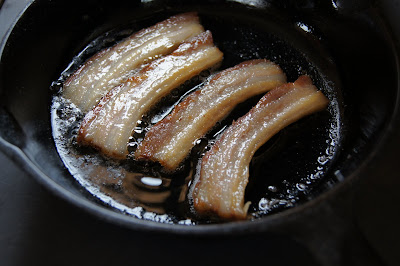
Bacon makes me happy.

I could almost end this dissertation right there, but perhaps you'd like to hear a little more. There's a traditional song, "In My Time of Dying," which in a Be Good Tanyas rendition includes the line: "Ever since I've been acquainted with Jesus, we've never been a minute apart." That's how it is with bacon and me. Ever since I got a handle on the basics of home smoking, and honed (I won't say perfected; there's always room for improvement in some way) my bacon-makin' method, there is always a piece of that salty sweet smoky porcine goodness in our fridge or freezer. It's a staple of the Trout Caviar home economy, like homemade chicken stock and home-baked bread--if any of those things is missing from the larder, something is wrong with the rhythms of my life.


While some bacon lovers will contend that the only bad bacon is no bacon, in reality there's a lot of wretched stuff out there, chemical-soaked, faux-smoked, over-salted pork of dubious provenance whose only virtue is that it's cheap, if that can be considered a virtue at all. There's also very good bacon to be had commercially, but it's so easy to make your own, with all known, local ingredients, that I'll risk repeating myself to encourage any and all to give it a try.


There are exactly four ingredients in my home-smoked bacon, including the smoke:

Pork belly
Salt
Maple syrup
Smoke


I laid out the bacon basics in a very early, incredibly long-winded blog post, and not much has changed in how I go about it, except:

1) I don't write 5,000 word blogs posts anymore,
2) I've learned to ask for nice big slabs of pork belly at the co-op or Asian market, instead of already cut-up pieces, as I apparently used to, and
3) I've changed my standard cure, settling on straight maple syrup, and much less salt than I used to apply.


Now, to two pounds of pork belly, I add 1/4 cup of maple syrup, massaging it well into the meat. I used to reduce the maple syrup, until one time I turned it into maple candy. Then sprinkle three tablespoons of salt over the meat. I use the fine sea salt I get in bulk at the co-op. Any salt will do. In place of maple syrup, you could use 1/4 cup of brown sugar. In that case, mix the salt and brown sugar together, and rub it all over the meat.


Let it cure for 24 hours. Turn it over a few times during that time, and spoon the juices evenly over the meat. Then just before smoking, rinse the belly under cool running water, and set it on a wire rack to dry for an hour or so before smoking.

Now that I have access to loads of apple wood, that's all I use for smoking--oh, well, some oak might get in there, more as a charcoal function than for flavor. I think there's a magic synergy among the pork, maple, and apple smoke flavors. Since this bacon is fully cooked in the hot smoking, you can eat slices of it straight off the slab, and I do. It's the best charcuterie around, in my opinion.

When the bacon has smoked for a couple of hours at 200 to 220 degrees, I take it off and let it cool, then cut it into half-pound portions and freeze all but one.

I just took the bread out of the oven, and the bacon has another hour in the smoke. The freezer has plenty of chicken stock, a few weeks' worth, I reckon. I'm thinking about a bacon, cheese, and apple sandwich for lunch, and I'm feelin' pretty good.


Text and photos copyright 2011 by Brett Laidlaw

Thursday, January 20, 2011

Just a Nice Shreddy Salad, Sparked Up with Green


I'm pretty close to a final list of recipes for the cookbook, which has me looking back to the early days of Trout Caviar (three years old now!). Where once the old standards appealed to me (and often still do), I find that I want to put a bit of a twist on things--and not inadvertently steal somebody else's recipe, just as important.

Céleri remoulade, the classic celery root slaw you find in virtually every French traiteur (like a Super-Deli), became a favorite the first time I ate it. It only suffers from being so...white, white shreds mixed with sour cream and mayonnaise, a polar bear in white tux and tails in a snowstorm. A sprinkling of paprika on top is a bit like lipstick on the pig, not really fooling anybody.

Perusing the produce section of the Seward Co-op for local greenery, I was drawn to a beautiful bunch of watercress from LaBore Farm in Faribault, MN. Chopping a handful into the dressing gave some green relief to that too-pale salad-scape, and a bit of pungency, and made the recipe my own. Also, in place of the usual sour cream, I used goat milk yogurt--a delicious switch. This salad really benefits from sitting for at least a half hour, one hour, better, before serving.

I've made a similar preparation using parsnips instead of celery root, and that was good, too. The parsnip seemed drier than the celery, so up the dressing amounts.

Celery Root Watercress Remoulade
Serves four as a first course

1 medium-size celery root, 9 to 12 ounces untrimmed, 6 to 8 ounces trimmed
2 pinches salt
juice of 1/4 small lemon

Grate the celery root medium to coarse, or shred it on a mandolin. Toss the shreds with the salt and lemon juice, and let sit 20 minutes. To the celery root add:

2 Tbsp mayonnaise
2 Tbsp goat milk yogurt (or sour cream)
A handful of watercress, stems and all, finely chopped, 1/3 to 1/2 cups
freshly ground peppper to taste
salt to taste

Mix it all together and let sit for at least 30 minutes before serving.

Cue up the Amélie soundtrack, and open a nice cotes-du-rhone.