Showing posts with label mayonnaise. Show all posts

Friday, March 20, 2015

Greeting Spring Greenly


It seems every bit appropriate to write about first fresh, green harvest of the year, watercress, on the first day of spring.  I generally gather the year's first cress from a lovely Dunn County spring that seeps from a modest limestone outcropping and slides a dozen long paces before it freshens a sweet little stream; the stream has a name, but I’ve forgotten it.  It’s one of those myriad trout streams, as designated by the State of Wisconsin DNR, which, when you look at the published map showing all such waters, could fool you into thinking that our neighborhood would be a trout fisher’s paradise.  Northern Dunn and southern Barron Counties are as thickly veined with trout streams—color-coded blue, red, yellow, and green—as a diagram of the circulatory system.  But few are worth the trouble to explore; shallow, sandy, alder-choked or simply so tiny that a flycaster would need a marksman’s precision just to land a fly on the water.  But I digress.  It happens.  Have you been here before?


The stream whose name I know not is nonetheless a pretty stream with lots of character, riffle water, bends, promising pools for local kids to either drop a worm into or wade and splash in on a hot summer day.  As winter departs the spring, perhaps 10 feet wide, becomes carpeted with glistening cress, variegated light and darker green, with intimations of reddish veining and browned patches, scars from the last hard freezes.  I mentioned picking cress, but really I snip it—if I’ve had the forethought to bring a pair of scissors.  By snipping the upper leaves I disturb the roots as little as possible, making it a sustainable harvest.  If I don’t have scissors I use my pocket knife to trim the top rosettes.  Half a plastic grocery sack provides plenty of cress to work with for a few meals.


First and best is simply to eat it raw, and lightly dressed (if you’re eating raw cress be sure it comes from a spring or headwaters that hasn’t run through grazing land, particularly where sheep abide).  A straight-up watercress salad is often extremely assertive, but in early spring its peppery pungency is usually tolerable—and a welcome wake-up call to taste buds somewhat dulled by root cellar dining.

Watercress can be used as an herb.  In my cookbook I use it in a pesto with ramps, and to give green relief to celeri remoulade.  The first thing I did with this year’s first snipping was to make a watercress mayonnaise.  Though I almost always make mayo the old-fashioned way, with a bowl and a whisk, I used an immersion blender for this one, for three reasons:

1)      Laziness
2)      So as to really puree the cress into the mayo, and
3)      The immersion blender is a fairly new toy that I haven’t done much with


We smeared the mayo on bread to make bacon sandwiches, and also kept the extra on hand to dunk oven fries from garden potatoes.  In the manner of the old lady who swallowed a fly, the story of this simple, but rather labor-intensive meal, was this: 

I snipped the cress 
to make a mayo
to dress the fresh bread
that made a bed
for the bacon I smoked
from belly that bathed
in maple I tapped
from our own trees
a year ago, or so.

So, how are we doing with the old “eat local challenge” concept that well-meaning folks trot out to promote local produce, usually in September, when eating locally is at its least challenging?  Well, the bread was homemade and leavened with our now 12-year-old sourdough starter and all MN and ND flours; the bacon from MN-based Pastures A’Plenty pork belly cured in our own maple syrup and foreign salt; the mayo contained that Dunn County cress, Ridgeland eggs (Chicken Creek Ranch on county AA), Smude MN cold-pressed sunflower oil, and foreign salt and lemon juice; oven fries from our garden potatoes cooked in duck fat we rendered and more of the Smude oil; carrot slaw with local grower Kate Stout’s wonderful carrots, some of our garden shallots, Smude oil, our cider vinegar.


I would say we’ve met the challenge.  I go through this list not to gloat about how localler-than-thou our diet is, but to illustrate the fact that local eating year-round is eminently doable, even here in the frozen north.  You just keep a very local pantry, is all, and seek out your local producers.  It’s not that hard.  They’re not hiding, and actually want to be found, so they can sell you stuff!  Co-ops of course are a great place to start in shopping local, and there are many farmers markets that keep going through the winter, as well.

None of this is anything new.  I myself have made the point about a thousand times in various ways.  But as I reboot Trout Caviar I’m embracing the perennial, roundabout, here-we-go-again nature of, well, nature, and seasonal eating, which expresses nature in a very intimate and, I hope, delicious way.

The nose knows....

If you want to make watercress mayonnaise you could take as simple an approach as obtaining some watercress, mincing it well, and mixing it into prepared mayonnaise.  I am not opposed to storebought mayo, in fact am on record as a Hellmann’s devotee for many uses (including eating it right off the spoon).  But I think Hellmann’s has too strong a flavor profile, and would drown out the cress which, while very assertive when eaten straight, can get lost in a rich base like mayo.  So a homemade mayo with a milder oil (sunflower, canola; probably not EVOO, or with only a little of it) is the best way to appreciate the tonic bite of springtime cress.  For this particular one, made with the immersion blender, I more or less followed the method I found on this blog.. 

But I found that:

1)      I had to add a fair amount of oil right at the beginning, just to get the blending started;
2)      In the end, with 2 yolks to a cup of oil, it made a much stiffer mayo than I like; I’d try it next time with a whole egg and a yolk, or maybe just the whole egg.  At any rate, it made a mayo that is NOT going to break.  EVER.

Happy spring.


Text and photographs copyright 2015 by Brett Laidlaw

Tuesday, July 2, 2013

Poacher's Delight


It’s interesting that “poaching a fish” has those dual meanings. This is the legal, delicious sort of fish poaching, as easy as it is seemingly old-fashioned. It brings to mind whole poached salmon lacquered in aspic on a fancy buffet, silver serving pieces, white linen, and cucumber sandwiches. When you fry or grill, you're adding other flavors to the fish, but poaching gives you pretty much the pure fish flavor, with only a little influence from the seasoning in the poaching liquid. Therefore, I would only recommend poaching when you have utterly fresh, pristine fish. Which in this case was a whitefish fillet from my beloved Halvorson Fisheries in Cornucopia, Wisconsin.


I should like to point out that absolutely fresh doesn't have to mean fresh off the boat.  This fillet was three days old--we picked it up on a trip to the South Shore on Wednesday, and prepared it on Saturday.  But it had not acquired any off or "fishy" odors or flavors in that time.  Freshly caught fish properly cleaned and treated will stay fresh for at least three or four days.  


Makes you wonder how long some of the fish you buy, even from the top-end fish markets, has been sitting around.  You can pay $20+ a pound for Copper River salmon or Pacific halibut, and sometimes I do, but I never wind up with better fish than when we make the trip to the shore and fill a cooler with whitefish, herring, and lake trout for a pittance (might as well carry on with the old-time lingo, since we're talking about a throw-back way of cooking).  Even if you figure in the cost of gas, I think we come out ahead financially, and we absolutely win in terms of taste and pure enjoyment.


A classic sauce is de rigeur with poached fish.  A beurre blanc would be lovely, or a green sauce fragrant with tarragon, parsley, and chervil.  For this midsummer repast we made mayonnaise, and some of it I flavored with garlic--that's aioli--and to the rest I added herbs, tarragon and chives--that's not aioli, but rather herbed mayonnaise.  I sort of have this peeve, you might recall from past rants, about every kind of flavored mayonnaise being called aioli, because while aioli is usually a type of mayonnaise (there are variations that don't use eggs), it is not a synonym for it.  But, as usual, I digress....


The market this past weekend provided a good deal more than radishes and kohlrabi.  Lovely new potatoes, snap peas, asparagus, baby beets and turnips (and strawberries for dessert).


We boiled all the vegetables separately, till just tender--the beets went last, lest our entire meal come dressed in pink.  And for the fish I prepared a court bouillon, which consisted of:

Water, about a quart
White wine--what was left in a bottle of riesling that was hanging around, half a cup, say
The juice of 1/4 lemon, and then I threw the piece of lemon in, too
A couple of bay leaves, broken up
Some cracked black peppercorns

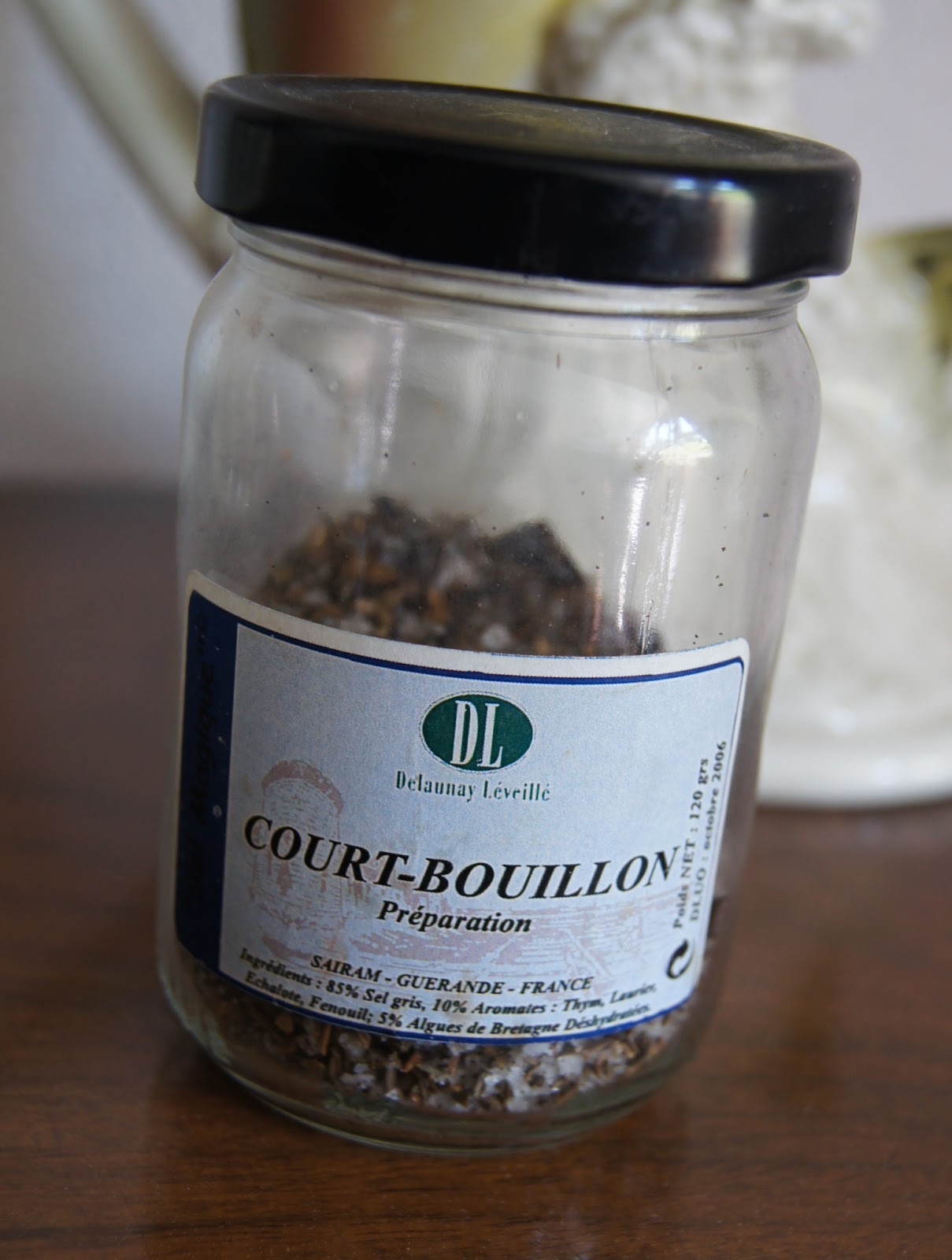
And the secret ingredient, this court-bouillon préparation:


It's mostly gray sea salt, flavored with thyme, bay leaf, dried shallots, fennel seed, and seaweed.  We picked it up in Brittany years ago; it keeps just fine, and it gives the bouillon a decidedly oceanic character.  Whatever sort of thyme is in there is particularly potent, too.  If you don't have something like this, just add the component parts separately.  The seaweed aroma is nice, but not necessary.  Combine everything in a saucepan large enough to hold your fish, bring it to a boil, and simmer for 15 to 20 minutes.  Then turn the heat off, add the fish, cover, and set aside.  The fish was probably cooked through within five minutes, but it didn't hurt it to sit in the bouillon as it cooled, absorbing some of the aromatics.


Service goes family style, the fish with a generous herbal garnish, the aioli and mayonnaise, the lovely vegetables prettily arranged by Mary and Melinda, our guest for the weekend, some crusty bread.  Such a civilized meal, poacher's delight, indeed.

Melinda picked and arranged the flowers, wild meadow bouquets.


Text and photos copyright 2013 by Brett Laidlaw

Wednesday, June 27, 2012

"It's as if there's something in there that you may never get again, so you don't want to eat it too fast, but you can't stop eating it."

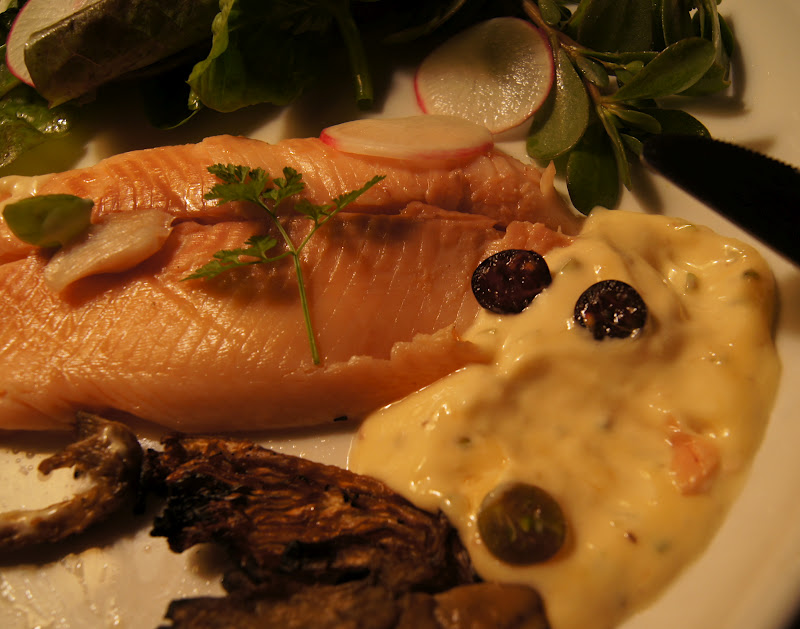
Smoked Trout with Gooseberry Mayonnaise, Grilled Wild Oyster Mushrooms, and Garden Forage Salad


Sometimes the path to a delectable plate of food is short and direct, and sometimes it wanders through an unexpected forage, a sorrel juice swamp, fatigue-induced lowering of expectations, and several happy discoveries before arriving at its destination. This is a case of the latter circumstances.

 The first thing I must confess to: I DID NOT CATCH THE TROUT. No, indeed, I purchased it. Farm-raised rainbow trout from the  Bullfrog "Eat My Fish" trout farm south of Menomonie. See, a writer contacted me asking for a recipe to accompany an article on fly fishing along the Ice Age Trail in Wisconsin. I said, can do, but I didn't want to recycle a recipe. To come up with a new preparation, I needed trout. But with all the recent rain, our streams are flowing bank-full, unfishable. So it was off to the fish farm, which I'd been meaning to visit, anyway. It's a totally charming spot not far from the confluence of the Red Cedar and Chippewa Rivers, and I look forward to a return visit on a weekend when the music is playing and they're cooking up shore lunch trout fries.


I bought four fish. Two of them I grilled and served over market and garden greens with a bacon and spring onion jam. It was great, but that is not the dish I'm writing about today. With the two remaining trout, I had an ambitious plan: one I would grill, and serve with a gooseberry sauce that appears in Judith Jones's memoir, The Tenth Muse ; the other I would poach, and serve with a mayonnaise in which sorrel juice would take the place of lemon. The mayonnaise was an idea I'd been toying with since I started having fun with rhubarb juice. I'd been planning to make that complex meal on Sunday night.


Sunday morning Mary and I loaded the bikes on the car and drove to Downsville (not far from the fish farm, in fact) to take a ride on the Red Cedar State Trail--our first ride together of the year, and a perfect day for it. I had not planned to forage, but sometimes you seek out wild food, and sometimes wild food is thrust upon you. The first thing we encountered was elderberry bushes in bloom. No surprise there, as we had noticed the pretty white umbels along the roadways. We stopped to savor the flowers' delicate aroma, then moved on.


We didn't get far before the gooseberries caught our eye, big patches along a considerable stretch of the trail. We had no bags or other containers (except what our lunch was packed in), so we picked a few handfuls and dropped them into Mary's pannier. Black cap raspberries were also starting to ripen, and we tasted a few of those before moving on (I walked into a patch of wood nettles trying to get at some of the black caps, and was reminded that one ignores the stinging qualities of those innocuous-looking plants at one's own peril--I was scratchin' and pedalin', pedalin' and itchin'...).

We made it without further incident or delay to the end of the Red Cedar trail, where it joins the Chippewa River State Trail, very near where the two rivers meet. The Chippewa drains a considerable watershed, and it was high and roiling after all the June rain. Usually by midsummer the Chippewa meanders sweetly along broad sandy beaches--it always makes me think of the Loire River in France; if only west central Wisconsin were home to the lovely restaurant/inns that are so prevalent in the Loire. It's an up-and-coming wine area, but I honestly don't know where I'd go in this area to enjoy a meal with any kind of French finesse.

Well, we had sandwiches, hard-cooked eggs, and sweet little carrots from the farmers market. But before our déjeuner pique-nique, we were lured to the trailside bushes again by what I first thought were black currants, but which turned out to be ripe gooseberries--the two plants are, of course, very closely related. We picked gooseberries for a while, and also gathered about a cup of black caps--we ate the eggs as an hors-d'oeuvres to free up a container. The day's last foraging surprise came in the form of two clumps of white on a dead standing elm. I made a U-turn and quickly confirmed that they were oyster mushrooms. I used my bike pump to thrash a path through the nettles (succeeded in being stung, nonetheless--you can't say I'm one to learn from painful experience...), reached the tree, and was able to knock both clumps off with a dead branch--one flew off into the nettles, but the other I nimbly snatched before it hit the ground. Both were in reasonable condition (more than I could say for myself) when I put them in my bag--just a few of those beetles that seem to always inhabit oysters.


We ate our sandwiches in a shady spot where a spring trickled out of a limestone wall and made a little cascade as it flowed toward the river. We made it back to the farm in mid-afternoon (after a stop for a root beer float at the Menomonie DQ, utterly satisfying). It was a lot of sun and activity for us oldsters who hadn't been on the bikes much. I took a nap. When I got up I took a shower. I started thinking, grilled trout poached trout sorrel mayonnaise gooseberry sauce.... I started thinking, "Plan B." We had some chicken andouille in the freezer from Seward Co-op. I said to Mary, honey, we're having sausage tonight.

But the thought of those trout in the fridge was nagging me. I'd bought them on Thursday, now it was Sunday, three days later, and they still smelled fine, but another whole day.... I wasn't sure they'd be delicious simply grilled by Monday night. Into the brine they went, to get all tasty for a date with the smoker on Monday.

Late Monday afternoon I built a cottonwood fire while the trout rested after being removed from the brine. I love a homemade mayonnaise with smoked trout, and I still had that sorrel idea in mind. I gathered a few leaves of sorrel from the planter on our deck, chopped them roughly, whizzed them up in the mini-chop with a bit of water. Sieved the resulting slurry, and...oh, baby, that was some nasty stuff. The raw, unsweetened rhubarb juice was pretty harsh, but this stuff was in the chemical weapons department.  Once the initial shock subsided, I took another whiff. It smelled a bit like the rhubarb juice, and very, very strongly like fresh-mown grass--so I wonder if that was precisely the smell of chlorophyll.  I think I'm going to leave the sorrel alone until after a few fall frosts have mellowed it.

At any rate, we were now at Plan C level...or was it D? Enter gooseberries. Judith Jones's gooseberry sauce is an extremely basic concoction of berries, sugar, and water. Intriguing in its simplicity. I was still hankering for mayonnaise. So I took a half cup of gooseberries, half green and half ripe, and put them in the mini-chop with a quarter cup of water, whizzed it up, strained it. Gooseberries have a lot of pectin, so my juice was more of a puree. But it smelled and tasted good, tart but a little sweet. I added half a teaspoon of sugar. That gave me three tablespoons of puree.


I proceeded with my mayonnaise, omitting the mustard I usually start with.  My oil was half plain canola and half Smude cold-pressed sunflower oil.   It took a bit more whisking and slightest dribbling of oil at the start to get the emulsion started, and once started it was looser than usual, but that turned out to be a plus. When the oil was half in I added some of the puree, then near the end the rest, along with a couple pinches of salt. I separated the finished sauce into two ramekins, and to one added a few green gooseberries finely minced, so one ramekin was smooth and one was chunky. Mary and I agreed that we preferred the chunky. The gooseberry flavor was subtle, but there.  I think if I had cooked the berries briefly to extract more of a juice, it might have given a stronger gooseberry flavor, but I don't necessarily think it would have been better.


Here's what Mary said about this mayonnaise at dinner (and she had only had less than one glass of Sancerre--the perfect wine, as it happens, to accompany smoked trout with gooseberry mayonnaise): It's as if there's something in there that you may never get again, so you don't want to eat it too fast, but you can't stop eating it. 


As for the rest: The Bullfrog trout that we had grilled had seemed a little bland compared to stream trout; the smoked fish, however, was some of the best I've ever had. That had to do partly with the moist, fatty flesh of those rainbows, and partly with the cottonwood smoke, another happy accident brought about by the fact that we have all these cottonwood logs lying around the yard. I'd been impressed by the grilling qualities of the wood, so decided to give smoking with it a try. It had a subtler flavor than the apple I usually use, more like Pacific Northwest alder-smoked salmon. (I was about to write that that might make sense, since alder and cottonwood are in the same tree family, but a quick Google reveals that they are not closely related.) It was beautifully smoked fish, moistly sweet and savory, and delicious with a dab of mayonnaise or without.


The grilled oyster mushrooms: Mary said it before I could: Bacon for vegetarians. I had tossed them with a bit of sunflower oil, salt and pepper, and grilled them until well brown. Fungi cum bacon, say no more.

The salad: A proud achievement for us, our first salad entirely from our new gardens. It required a bit of foraging/weeding in the form of the succulent purslane, which will be appearing in many more salads this summer, as it is abundant in our garden, and delightful on the plate, with a refreshing crunch and a lemony twist. Pea tendrils, whoever knew you could eat these, back in the day? I first tasted them when I was teaching in Chengdu, more than twenty years ago, now, and then literally jumped for joy the first time I saw them at the Saint Paul Farmers Market. Now they're everywhere, and more than a bit trendy. I consider it forage, and delicious. Then some red leaf lettuce, bit of sliced radish.  It was dressed with some  Hay River Pumpkin Seed Oil, a bit of our homemade cider vinegar, and a little coarse salt.


 Many detours later, then, a memorable meal.  I hope to get back down to the Red Cedar Trail to gather more berries. Right at the trailhead there's a sign saying that the public is welcome to gather mushrooms, berries, and nuts from this state-owned land. It says to leave the flowers alone, so I'll get my elderflowers elsewhere. They're blooming like crazy now.


Text and photos copyright 2012 by Brett Laidlaw

Wednesday, January 18, 2012

Smelt Po'boys with Wild Remoulade Sauce


We've been in eat-out-of-the-freezer mode for a couple weeks now.  When there's not enough space in the freezer to chill your martini glass, you know something has to be done.  I'm not really a hoarder of stuff, in general, but I am something of a pack rat when it comes to food.  My refrigerator is a pickle museum; I curate a jam and jelly collection there, as well.  Apparently I have a horror of endings, for I keep jars that contain a half-inch of blackberry preserves, one lonely cornichon, some scraps of fermented vegetables.  Sometimes I find jars of pickles entirely absent of pickles, nothing left but the brine.  And then, frighteningly, I'll return that jar to the fridge, thinking, hmm, there was that pickle brine rye bread recipe someone sent me eight years ago, maybe I'll make that....

As for the freezer, that's more of an archaeological situation when it comes to determining what's in there, scraping back through layers of time, discovering freezer burned trout frames, sacks of berries of dubious provenance.  I swear to god, I recently pulled out a zip bag containing a frozen block of something, and in the space where you note the contents, it said "SOUP?"  That got tossed.

But there's good stuff in there, too.  A lot of the very best fish we eat comes frozen, believe it or not.  On our trips to the South Shore of Lake Superior we always stock up on fresh fish at Halvorson Fisheries in Cornucopia. Sometimes the fish is frozen and vacuum-packed there, and sometimes we bring the fresh-off-the-boat lake trout, whitefish, and herring home and freeze what we won't use fresh.


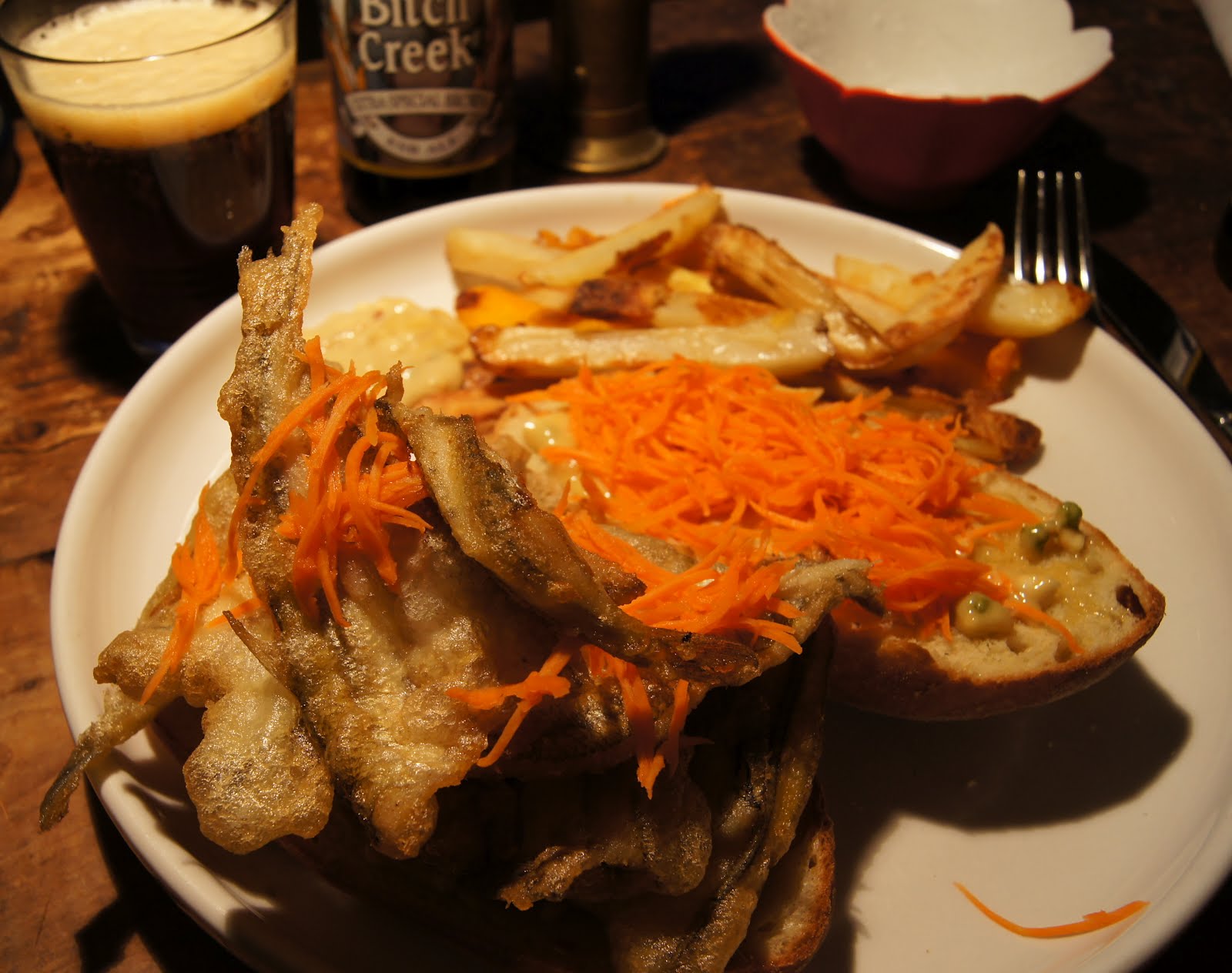
So in our freezer clean-out mode, courtesy of Halvorson's, we've recently had burbot bourguignon (eelpout in red wine, by another name), fish tacos also made with burbot (an intriguing freshwater cod that Amy "Sourtooth" Thielen writes about here ; I'd really like to get up to the Eelpout Fest this year). And our last frozen fish from Corny was a package of smelt that had been in the freezer for at least a year, so I had my doubts as it thawed, but you know what? Here's what: Fish that is packed absolutely fresh, and properly frozen, and kept frozen, is great even a year later. The vacuum-packing provides no opportunity for freezer burn or staling. The smelt had very little "fishiness" to them; rather, they had a cucumber-y, watery scent like some oysters have. Their fate was to be dipped in a light tempura batter, fried, and served on homemade rolls with a remoulade sauce perked up with chopped pickled ramps and salted milkweed bud "capers" on a north-meets-south po'boy. We don't do a lot of deep frying, but a few times each winter we'll fry up fish or shrimp for po'boys or tacos. It makes for a fun and summery meal, most welcome in the depths of January.


It's a joke around our house that writing a cookbook is a rather elaborate way of organizing one's recipes, but damn handy once it's done. There's truth in the gag, too--putting together this meal, I made the buns from the Cornmeal Honey Butter Bun recipe (p. 120), shaping oval buns of about 5 ounces of dough.


The remoulade started with a batch of mayonnaise (p. 219), to which I added some mustard, worchestershire, finely diced celery root, salted milkweed buds, and chopped pickled ramps (p. 224). The tempura batter is in the Walleye Taco recipe (p. 165). And alongside we had Oven-Fried Roots (p. 192)--potato, celery root, and mystery pumpkin (yes, I know, pumpkin is not a root; but it cooks up sort of...rootish).


The beer, Bitch Creek Extra Special Brown, was an impulse buy purchased for all the wrong reasons--because it's from the Grand Teton Brewing Company, and Mary used to live in Jackson Hole, in the shadow of the Tetons; and Bitch Creek is a famous western trout stream, and there's a fly pattern named for it . In spite of that, it was excellent--deep, dark, toasty, and bitter (as I poured out the last few drops to rinse the bottles this morning I got to thinking of beef short ribs braised in Bitch Creek ESP, lots of leeks and onions, maybe a dash of cocoa, some allspice...).


We still haven't made much of a dent in the freezer inventory, and chances are that some day soon I'll get it in my head that I can't go another week without a piece of grilled lake trout, a plate of Herring Milkweed Meunière (p. 171), and I'll hit the road for the South Shore, returning with a cooler full of fish, most of which will go in the freezer.

Hey, I just remembered, there are still some whitefish livers in there. Now, if I can only find them....

Text and photos copyright 2012 by Brett Laidlaw

Wednesday, June 22, 2011

Solstice Aioli


Going back to that idea of honing a finer sense of the seasons , I can report that it's the season of setting fruit out at Bide-A-Wee.  Last year was a dismal one for our apples, as well as for most of  the wild fruits, except for the wild plums, which seem to come through every year.  This year the hawthorns, black cherries, chokecherries, and serviceberries are all setting up nice crops.  In spite of a cool pollinating season, the apples look good--the largest are already an inch-and-a-half across, and reddening.  We have one more gallon of sweet cider in the freezer--maybe barely enough to get us through to a first pressing of this year's fruit if we ration it carefully.  A couple swallows in the morning is enough to start the day off on a happy note.

It's haying time, too--our friend Renee Bartz told us this weekend that they'd cut their second crop of hay, and now hoped for a few dry days to get it baled (not looking like that wish will come true).  You see this age-old practice taking place all across the Dairy State countryside.  Where one day there was a field of tall grass, the next there's a shorn landscape looking something like a very rustic golf course, except dotted across it are the cylindrical bales of hay, a lovely sort of order brought out of the unruly growth, entropy reversed.

With the cows out on new grass, the raw milk we get from the Bartz's Bolen-Vale farm is the richest of the year.  Last weekend we skimmed the cream from the top of the jar and spooned it over the first strawberries of the summer, and we swooned.


And at the market, the season is that of the first summer vegetables.  The leafy things were pleasant enough, asparagus delightful, but it's greatly heartening--and appetizing--to see the next wave coming in, in this case young beets, snap peas, and most gloriously, the first green garlic.  That market haul, and a successful outing on the trout stream (oh, really, they're all successful, whether I catch fish or not), set the scene for an aioli dinner to mark the summer solstice.  (For the mayo/aioli how-to click here.)


Please note that no adjective accompanies aioli here, nor ever will, unless to make the derisive point that none ever should.  Aioli is aioli is aioli.  Chipotle aioli?  Nah.  Lemongrass aioli?  Skip it.  Garlic, oil, egg yolk, a bit of mustard, a squeeze of lemon juice, a pinch of salt, that's what's in aioli.  Oh, now I've read that in Provence some local variations omit the egg yolk, using cooked potato or bread as the binder.  I've never tried it that way.  You could call it garlic mayonnaise and not be far off, except that aioli deserves a more prominent place at the table than is commonly accorded mayonnaise.  It needs to be seen and appreciated, inhaled, dolloped out in copious portions for dipping and dabbing--a clandestine schmear on a sandwich or burger doesn't do it justice.


See the two unctuous globs on the plate above?  The yellow one  on the left is aioli, of course, and the green one is sorrel-tarragon mayo, which only had some garlicky undertones because I chopped the herbs in the same place on the cutting board where I puréed the garlic for the aioli.  I did that on purpose.  To half a cup of mayo I added four smallish sorrel leaves and just a sprig of tarragon, the most assertive of herbs, to my taste.  A dandy combination--but not aioli, mais non.


As for the trout, it was poached in a court bouillon flavored with green onion tops, carrot, thyme, tarragon, cutting celery, black pepper, and some Breton bouillon flavoring containing sea salt, algae, fennel, and some other spices.  We picked it up at a small market in Brittany a good while back.  It seems to keep.


The beets (Menomonie farmers market) and potatoes (not local, I'm afraid), I roasted with olive oil, thyme, rosemary, fleur de sel, black pepper, and chopped green garlic, at 375, for 40 minutes covered, another

15 uncovered.  I peeled the beets first.  And then the asparagus and snap peas (stringed) were blanched in salted boiling water for two minutes.

An aioli plate is the ideal sort of meal for long summer evenings, and this was the longest of all.  We sipped a petit chablis, our glasses
appealingly misted in the humid evening.  The monsoon rains came and went, a downpour, a sunburst. I guess you could say it's summer.

Tuesday, May 4, 2010

The Grand Emulsion


I wish I had saved that "mon amour" bit from the previous post for this one, because while I like morels well enough, I really love mayonnaise. I suppose I could use a variation, like "Mayonnaise, je t'aime," but that would be weird, wouldn't it? Yeah, I guess it would. Not that that has ever stopped me before....

Learning to make a homemade mayonnaise is a milestone moment in anyone's cooking life, I think. When you learn to fix a broken one, then you really feel like a pro. The fact is, both making and fixing are easier than they seem; as with many, many things in life, confidence is key, and confidence comes with success, and success comes with practice. But even if you've never made mayonnaise before, and decide to try it, I urge you to go into it with confidence aplenty, be bloody bold and resolute, as a friend of mine used to say. While creating an emulsion of egg and oil in your very own kitchen might sound awfully daunting and technical, this is in fact one of those formerly everyday tasks that is simplicity itself once you've done it a couple of times. Well, a few times. And it helps if you're old enough that you don't really give a rip about that many things, like one used to, which I am, so my mayonnaise pretty much always turns out. Which I'm not sure is that great a trade-off for being in the over-50 set. But there you go.

I have not written much about mayonnaise here because the focus here is local, of course, and the main component of mayonnaise is oil. While I'm sure that there are canola and sunflower and corn oils made from reasonably local raw materials, these oils tend to come from large, industrial producers. I'll have to look around a little more carefully, see if there are smaller, local oil producers.*

For the moment, though, I'm going to forge ahead, because while my mayonnaise ingredients might not be notably local, it's going to be produced right here, and it's going to be flavored with herbs fresh from my garden, and used to dress a salad of trout I caught and watercress I plucked from a local spring. With a side of fiddleheads. This was much tastier than the photo might indicate.


The ingredients of mayonnaise are few and simple: egg, oil, a little mustard, prepared or dry, salt, lemon juice. Then flavorings as you please. (An important point here is that flavored mayonnaise is not "aioli," as many restaurant chefs seem to mistakenly believe; aioli is a quite specific Provencal preparation which could be called garlic mayonnaise, at least in some of its iterations, but aioli and mayonnaise are not synonymous by any means.)

Probably my favorite mayonnaise flavoring is fresh herbs, and in particular that combination that the French call fines herbes--parsley, tarragon, chives, and chervil. Chervil is a wonderful herb that hasn't yet caught on around these parts. If you want it, you pretty much have to grow it yourself, for I don't believe that I have ever seen it for sale in a grocery store or farmers market, though I have seen chervil plants for sale occasionally in the early spring. It's sort of like very, very delicate parsley with a lovely anise flavor, not too strong. It's not that hard to grow, except it really does not like hot weather, so in a hot dry summer it may wither and bolt if it's not kept a bit damp and cool. Currently I only have chives and tarragon in my garden, and that will do just fine.

The question of food safety often comes up in connection with any preparation using raw eggs. Supposedly raw eggs can contain salmonella. I have never heard of anyone getting sick from a raw or barely cooked egg. And I seriously would like to know, has anyone out there heard of this happening? Sometimes I think people get a little hysterical about things like this, spreading fears that have no actual basis. But if eating something that contains raw egg troubles you, do not make mayonnaise. Hellmann's is great, I love the stuff.

Here's my little mayonnaise pictorial tutorial:


You need a bowl big enough to move your whisk in briskly. The dish towel twisted into a rope, circled beneath the bowl, holds the bowl steady. I made two mayonnaises today, to see the effect of different oils and mustards. For the first I used some prepared dijon mustard, a scant teaspoon; the oil was 1/2 cup grapeseed and 1/4 cup olive oil--3/4 cup oil to one egg yolk is my standard ratio.

You whisk the yolk and mustard together until they're well combined and just a little thickened. (One advantage of using prepared mustard is that it is already an emulsion, which gets you off to a good start.) Now start adding oil, just a drop or two at a time. It's very important to go very slowly at the beginning. You want to whisk briskly and constantly, but you don't have to do it furiously. You'll get tired out and spew oil all over your kitchen if you do that.


By the time you've added a third of the oil, or less, you'll know if the emulsion is going to take. The whisk will leave clean streaks on the bottom of the bowl, you won't see any distinct oil droplets, it will feel thick as you whisk. If you've added a quarter cup of oil and this isn't the case, if instead it still seems very liquid and looks "split," with distinct pools of oil amid curds of egg, it's broken; see the note** below for how to fix it.


If all is coming together nicely, and you've added a third of the oil and things are thickening up, now you can add a couple of pinches of salt, and a squeeze of lemon juice. Then keep adding oil in a slow, steady stream, whisking as before, until all the oil is incorporated. If it becomes too thick to whisk comfortably along the way, add a little more lemon juice, or a tiny bit of water.

Canola-olive-dry mustard on the left, grapeseed-olive-prepared mustard on the right.

When it's done it will be thick and custardy. You can use it as a veggie dip, or to make a truly amazing potato salad, deviled eggs supreme. Homemade garlic mayonnaise stirred into mussels steamed in white wine is probably one of my favorite things to eat. Slather it on grilled bread. Eat it on a spoon. I do.


I wasn't that thrilled with the color of the first mayo, the one with prepared mustard and grapeseed oil. It seemed sort of dark and muddy. I made another using a quarter teaspoon of dry mustard and an oil combination that was 5/8 cup canola to 1/8 cup olive. It had a nicer color, to me. Both were delicious. You can use the mayo right away, but it's better if you let it sit, covered, in the fridge for a couple of hours, to let the flavors come together.


_____________________________________

* (Dang me if I didn't just locate a source for Minnesota extra virgin sunflower oil; I have just ordered a bottle. Will report.)
** To fix a split mayonnaise, get a clean bowl and in it put two teaspoons of water. Start whisking the split mayo into the water, like a quarter teaspoon at a time. Soon you should see an emulsion forming, and you can add the rest of the split mayo, then the rest of the oil, as above.


Text and photos copyright 2010 by Brett Laidlaw