Showing posts with label Bide-A-While. Show all posts

Thursday, April 7, 2016

Happy Birch Days


The Bide-A-While birch syrup family portrait.


It may very well be that we have reached peak birch here at Bide-A-While.  The sap goes on, though sluggishly, with afternoon highs just scraping up into the mid-30s.  Yesterday I gathered “ice birch”—the sap in the bags and containers was half frozen, so I poured the liquid portion into my collection container and left the ice behind, thinking that the liquid sap was probably more concentrated in sugar.  It’s on the woodstove now, and getting right down there.

I’ve also been reading a good bit about birch syrup making, though sources are not abundant.  There are some commercial producers in Alaska, and there have been some official studies of best practices.  It’s all pretty interesting, and useful, since I’ve been proceeding on a trial and error basis, leaning toward the latter.  This is a good compendium of articles on birch.

Pour the sap into a cauldron and light a small fire....

I would have thought that Magnus Nilsson’s massive new tome, The Nordic Cook Book, would show some traditional or novel uses for birch syrup; instead, it has no mention of it, at all.  But in Nilsson’s Fäviken cookbook he does include a “recipe” for birch syrup, along with a couple of interesting observations.  One, he notes that part of the distinctive taste of birch syrup comes from the fact that not only the sugars, but also the trace minerals found in the sap are concentrated in the syrup making process—and since birch sap must be reduced twice, or more, as much as maple sap, that’s bound to have an impact.  I think it’s part of what contributes to the savory edge that birch syrup has, even while it is intensely sweet.  The other, technical note Nilsson makes is that birch syrup contains carboxylic acid, which gives it “outstanding freshness.”  You can’t miss that acidic edge in tasting birch syrup; I just didn’t know what the particular acid was called. 


Oddly, none of the recipes in the rest of the book includes birch syrup.  Nilsson says that he uses it as one would balsamic vinegar, and I’d been thinking along similar lines, wondering what birch syrup would taste like drizzled over vanilla ice cream, as reduced balsamic is sometimes used.


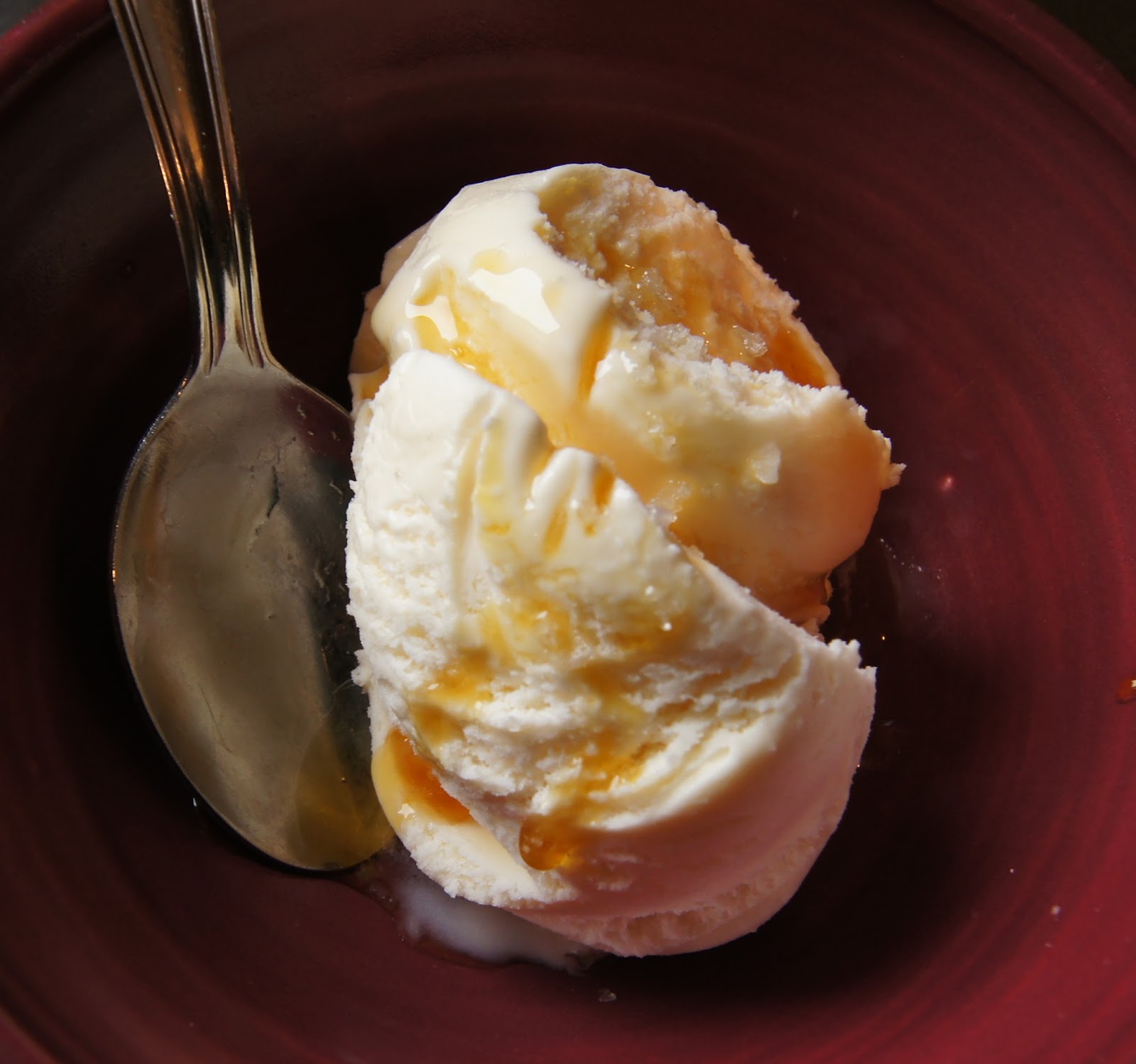
Well, I need wonder no longer.  I fixed up a little late breakfast snack of vanilla ice cream (nothing special, just Wisconsin favorite Cedar Crest) anointed with a couple teaspoons of birch syrup and then a few grains of coarse gray sea salt.  Oh, my.  Why didn’t I think of this sooner?  It was really superb, with elements both of a root beer float and a butterscotch sundae.  If you can get your hands on some birch syrup, this would be the perfect way to end an elegant dinner party.  Your guests will surely have tasted nothing like it.  This was actually my first foray into using birch syrup in a sweet/dessert preparation.  I’m eager for more explorations.

R to L:  2016 no-boil, 2016 stove-boiled, 2013 woodfired.  Amazing range of colors.

If you’re interested in making your own birch syrup, you should pay attention to just how big an impact the way you reduce the sap makes on the final product.  In my first attempts I had rather a lot of sap, and I started the reduction in my homemade evaporator (the legendary half-assed sap contraption).  It really boiled hard, and sap caramelized (not to say burned, though probably some did) on the sides of the pan as the sap reduced, and this caramel got washed back into the sap, adding color and a variety of flavors.  As a result, that syrup was molasses-dark and very strong in flavor.  One of the articles I found online cautioned against making birch syrup this way, saying it would come out with a scorched flavor.  But I don’t think my dark syrup tastes bad or scorched.  It is very, very different from the lighter syrups I’m making this year, but it has its uses, too.


This year, with moderate sap flow and thus manageable amounts of sap to deal with, I’ve done all the reduction inside, first on the woodstove, then on the range, as previously mentioned.  And then with a few gallons I did in entirely on the woodstove, so that it never boiled at all, just slowly, slowly reduced as the water evaporated from the sap.  You can see what a difference that makes in the color of the final syrup.  The taste, as well, is mellower, but it still has that fresh acidity and good complexity.

Three 2016 batches.  I should start a paint line of birch syrup hues....

Fun stuff!  I feel like a bit of a pioneer in upper Midwest small batch birch syrup making.  If anyone else out there has tried his or her hand at this, I’d love to here about your experiences.  I will keep the home fires burning in the ever busy woodstove, and carry on with kitchen explorations, as well.  If you have any thoughts about how to deploy birch syrup in cooking, I love to hear those, as well.


Text and photos copyright 2016 by Brett Laidlaw

Friday, April 1, 2016

The Saps of Spring, 2016 Edition


March is a difficult month.  It promises spring, but often belongs equally, if not more so, to winter.  It makes you think of gardening, of growing things, but at our latitude all you can really do is pile potting mix into little pots, get the seeds of the earliest, cool season plants going—onions, leeks, lettuce, some herbs.   There are days of warm sun that tempt you to get out and till a plot, but when you turn one clump of frigid, sodden soil, you turn quickly to plan B.  Never mind, there’s always that minefield of winter-weathered dog treasures to clear, a perennial March activity that more or less sums up the spirit of the season….


Maybe this is why a lot of my March days since moving to the country have been spent drilling little holes in trees, gathering the cold, slightly sweet water that weeps out, and cooking it down to incomparable sweetness—tree syrups, both maple and birch, and even a bit of black walnut.  It’s nature’s little consolation prize for enduring these purgatorial weeks, equal parts reward and distraction.  Though sap season comes around every year, it’s always a little bit different.  And this year has been more different than most.

People on Twitter tend to get a little excited, you may have noticed if you frequent that world.  I think it’s the ability to communicate instantaneously with friends, acquaintances, and strangers alike, all across the planet, that tends to heighten reactions exponentially.  This year I saw a slew of ecstatic tweets proclaiming that the weather for the week ahead looked perfect for maple sugaring…in the middle of February.  But the trees weren’t looking at the daily highs and lows to decide how to proceed; no, the trees were still frozen solid.

I forget exactly which March Surprise this was; we had a few....

But it did transpire that warmish weather continued—there were days with record highs, with record high lows—and I did wind up tapping a few maples, as well as the big box elder (a type of maple) in our yard, and our one majestic black walnut tree, on February 21, because what the heck.  And within a few days I did have a little sap, emphasis on the little.  The trees ran sluggishly for about a day, then the weather turned seasonably cold again.  Six trees gave me about one gallon of sap, which didn’t take too long to simmer down on the wood stove into a half cup of syrup; and so began the season of passive, micro-batch syruping, which continues to this day, as I reduce another five gallons of birch sap on the woodstove and then on the range top.  I’m not going to wind up with a vast reserve of syrup, but then, I don’t really need one.  The birch, especially, is sparingly deployed, maybe a tablespoon or so at a time, in salad dressings and marinades, mainly for grilled pork.
 
Birch syrup on the final reduction.

With small amounts of sap—5 to 8 gallons at a time—I didn’t bother firing up the labor-and-smoke-intensive half-assed sap contraption I’ve used in years past.  Instead, since we’re still stoking the woodstove every day, at least in the mornings and evenings, I’ve been setting a hotel pan and our Big Blue Le Creuset dutch oven on the stove and letting the sap slowly reduce to a manageable amount, at which point I boil the dickens out of it on our kitchen range top.  You may wonder, Isn’t that a lot of humidity to be adding to your indoor environment?  Aren’t you producing great clouds of water vapor, steaming the wallpaper off the walls, and covering everything with a sticky film? 

Legitimate concerns, to which the answers are: yes, I guess it’s a fair amount of humidity, but things are generally dry this time of year, so we haven’t noticed any issues; and as we have no wallpaper on our walls, none to steam off!  Finally, no, our walls and ceiling bear no resemblance to a movie theater floor after being deluged with Mountain Dew during the kiddie matinee.  The whole idea, see, is that the sugary part remains in the pot as the water evaporates.  Even if some of the sugar escaped a furiously boiling pot, I don’t think it would go very far, the sugar molecules presumably being a good deal heavier than water vapor. 

The long and short of it is this:  I think it’s a myth, one which I myself may have helped to promulgate in the past, that cooking sap down inside has these undesirable side effects.  When I’m doing the fast, final boiling, I’ve got the vent hood running, a couple of windows cracked, and there’s no noticeable change in our indoor weather.  Also, I’ve kept checking the walls near the stove, the inside of the vent hood, for that legendary sticky film—none to be found.  Now, if I had a hundred, or even 40, 20 gallons to deal with at a time, I probably wouldn’t do it inside.  But with these small batches, it works fine.  It’s also really nice to get double duty out of the woodstove, heat for the home on chilly days, tasty syrups for the kitchen.

The Puddock hard at work, multi-tasking.

It has taken me a while, years, in fact, to start to feel comfortable using the birch syrup.  It’s completely unlike anything else I have in my pantry, so it didn’t slide easily into any particular niche.  People ask me what it’s like, and I can only give vague analogies or general descriptions that don’t capture the essence of the thing.  It’s dark, dark as molasses, and it has some molasses qualities, but it’s not thick—in its body, its “mouth feel,” it’s lighter and thinner than maple syrup.  And banish any thought that it’s like maple syrup just because it’s sugar that comes from a tree.  While maple syrup is composed of sucrose, like plain old granulated sugar, birch syrup is glucose and fructose (I think I’ve got that right).  The flavor of birch syrup is much…edgier.  There’s acidity to it, and often a little intriguing bitterness.  It’s very aromatic, with sweet, menthol, spicy, root beer type notes.  Really, if you’re interested in distinctive foods, particularly distinctive northern foods, you’ve got to try it.

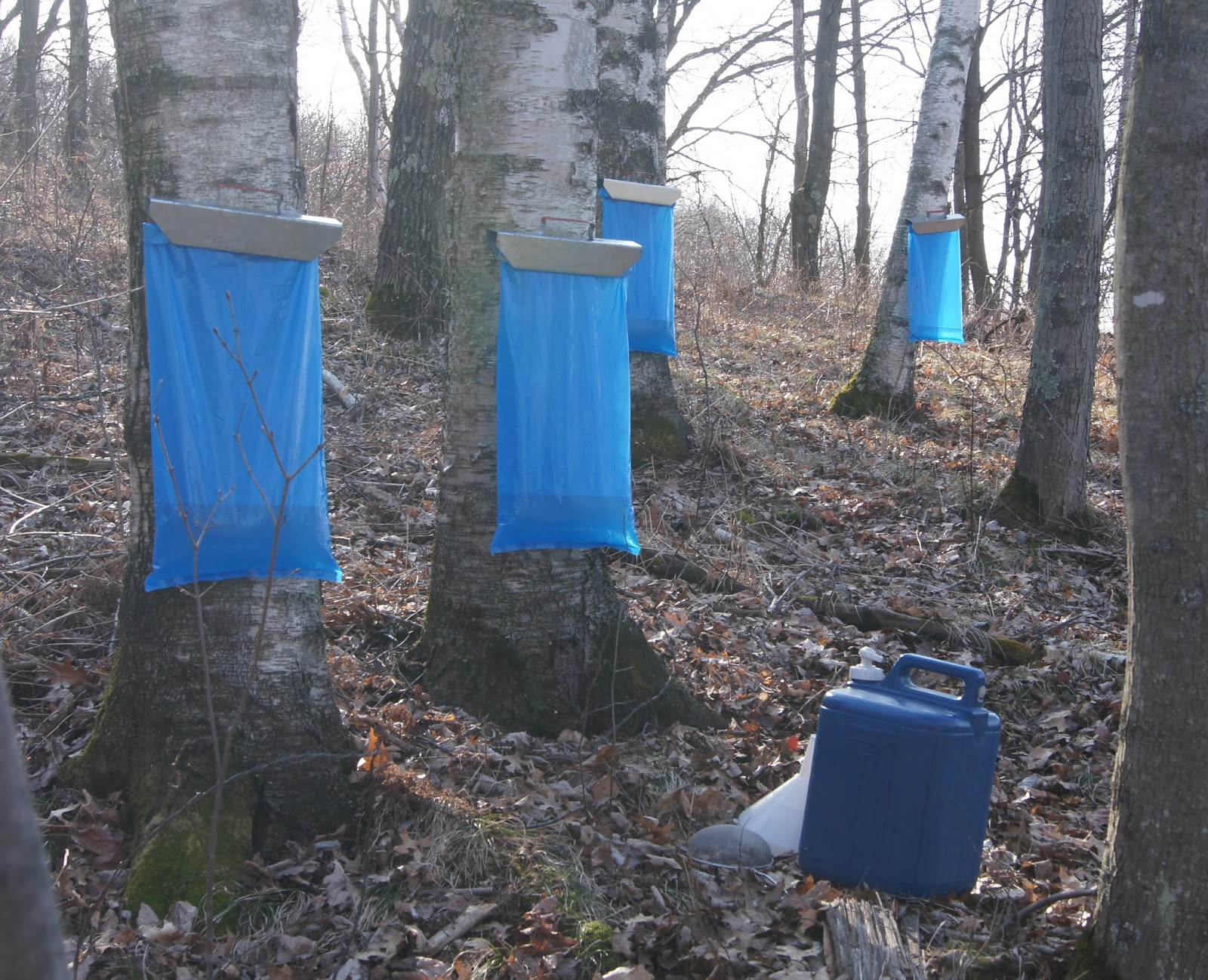
If you have access to a few birch trees, it’s easy enough to get, as long as, you know, nature cooperates.  You tap the trees exactly as you would for maple syrup, drill a little hole about 1 ½” deep, insert a tap, hang a bag, bucket, what have you, or attached food grade tubing to allow the sap to run into a container.  Then when you have a quantity, you cook it down.  And cook it down.  And cook it down….  Because, the thing about birch sap:  it’s generally less than half as concentrated in sugars as maple sap.  So if it typically takes from 30 to 40 gallons of maple sap to produce a gallon of syrup, with birch we’re talking about a roughly 80:1 ration.  Breaking that down into the smaller batches I’ve been doing, 10 gallons of sap gave me one scant pint of syrup.  

Syrup assortment: the small, very light one at center front is black walnut.

I’ve said this before, and I’ll say it again:  you can look at the numbers, even the relatively reasonable maple ratios, and think you get it, but until you actually do it, you can’t possibly understand.  Still, it’s worth it.  I go to a lot of trouble, tapping the trees, hauling the heavy sap down the hill (luckily I do get to haul it down the hill), cooking the sap down and down and down, but at the end I’ve got lovely local products to work with through the rest of the year.

And here’s a handy fact of nature:  the birch trees tend to start running as the maple run is coming to an end.  So if you have access to both kinds of trees, you can move your tapping equipment over to the birches when you’ve had your fill of maple sugaring, and the trees start to break bud, rendering the sap bitter and unusable.  Making syrup, especially birch syrup, is a labor of love, and a rite of the season, a perennial celebration of those immemorial cycles.  A lot of work and time, sure, but hey, it beats picking up dog crap….

Earlier reports from sap season:
 Sapped Out, 2013
The Sweetest Tree, 2013
Sweet Trees X3, 2015
Sweetness, Toil, and Smoke, 2010

How I have used birch syrup:

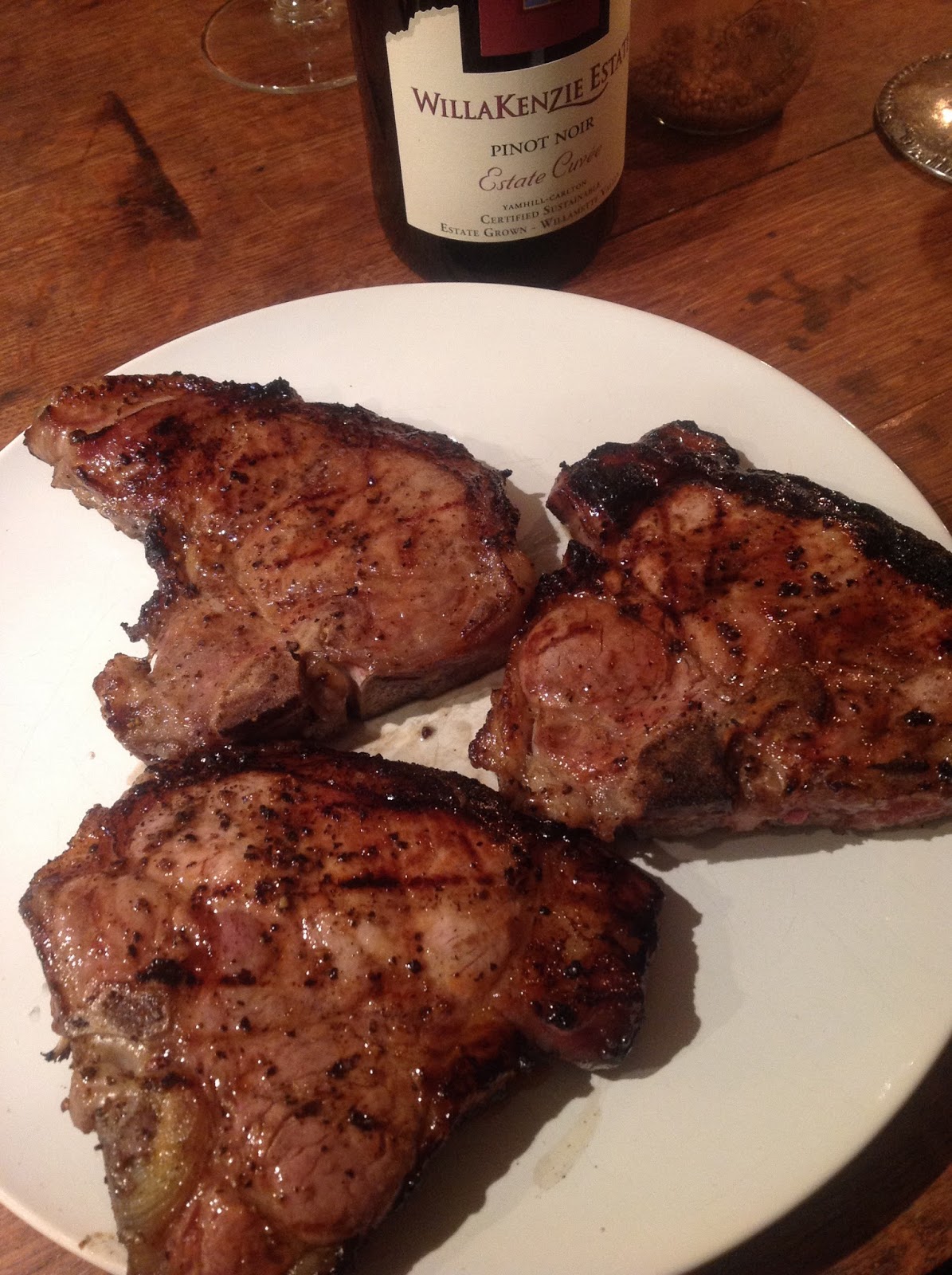
·        *  As a marinade for grilled or smoked meat:  it’s great brushed on a pork chop, which I then season simply with salt and pepper.  For some reason, the birch syrup doesn’t burn on the grill the way maple syrup or honey would.  Perhaps because the sugar composition is different.  I’ve also used it on grilled game birds, particularly woodcock.  And I’ve used it in the cure for smoked duck breast and venison with wonderful results.
Grilled red wattle pork chops in a birch syrup marinade; pork and birch have a delicious affinity.

*  In salad dressings:  just a teaspoon or two in a vinaigrette really makes its presence felt, and brings that distinctive, aromatic birch flavor to any kind of salad.

·         *  In cocktails:  1 teaspoon birch syrup, a few drops of lemon juice, 2 ounces Scotch, bourbon, or rye, stir it up, add ice, garnish with a lemon twist.  Or for the lemon substitute blood oranges in season for a cocktail I’ve dubbed “The Nasty Bruise.”  For a refreshing non-alcoholic drink, stir a couple teaspoons of birch syrup into sparkling water, add ice and perhaps a squeeze of lemon juice.

Those are the main applications I’ve found for birch syrup.  I’m having a decent year with the birch this spring, so I’ll have a good supply to experiment with through the year.  I repeat:  a little goes a long way with birch syrup.


Birch-Mustard Seed Carrot Salad

Two servings.  

1 large or 2 small carrots
2 tablespoons olive oil
2 teaspoons yellow mustard seeds
2 tablespoons lemon juice
1 tablespoon birch syrup
1 small garlic clove sliced very thin
A bit of chiffonade leek or scallion green, optional
Salt and pepper

Peel the carrots and slice them very thin—1/8” or less.   A Benriner mandoline is handy for this—watch your fingers!

Heat the oil over medium low and add the mustard seeds.  Stir them around until they just start to pop, then remove from the heat.  Add the lemon juice, birch syrup, and garlic and stir well.  Pour the dressing over the carrots, add a couple good pinches of salt and a few grinds of pepper, and stir well.  Let the salad sit for at least a half hour or up to several hours before serving.  Sprinkle the optional leek or scallion greens over top just before serving.

Maple syrup variation:  in place of the birch syrup, use 2 teaspoons of maple syrup and ½ teaspoon of Dijon mustard--I haven't actually tried this variation, but I don't see how it could be bad.


Here’s a brief record of weather, phenology, and such since syrup season began at the end of February:

Feb 27 record highs
Feb 29 1st ½ cup maple syrup done
March 1, “brittle and chill” and the trees aren’t producing sap
March 4, 3 inches of snow
March 8 red-winged blackbirds back & a scant half cup of black walnut syrup finished from 56 ounces sap—that’s all for black walnut, it didn’t produce enough sap after that to bother with
3/10 snow’s all gone and Mary notes, looking out the kitchen window, “It’s not winter anymore,” to which I reply, “It’s not spring, either.  It’s mud season.”
3/10 cooked down a tiny bit of box elder syrup, “single source”….
Shrimp on the barbie, definite grilling weather
3/11 picked garlic mustard along the Rush River at Brush Cr Rd; grilled pork chops; summery
3/12 summery; dinner at Tina’s, I wear shorts
3/16? 2” rain, thunder
3/14 woodcock return
3/17 SNOW again, grass covered
3/18 snow gone
3/22 tapped birches and they were running; seemed pretty vigorous, but didn’t get much for a few days
3/23 SNOW again! 3-4”.
3/24 snow gone!
3/27 finished the last maple, moved over to birch
3/28 5 gallons birch mostly cooked down
3/29 another 5 gallons birch gathered, mostly cooked down; sunny and warm, in shorts again
3/30 It didn’t seem that there was much sap flow, but the eight birch gave around four gallons total, which reduced gently on the woodstove overnight
3/31 The house is starting to smell birchy with the sap on the woodstove getting right down there.  It’s raining now, but the forecast is for an inch of snow by the end of the day.  April Fool!

Text and photos copyright 2016 by Brett Laidlaw


Thursday, April 16, 2015

Sweet Trees X3


Boiling birch on the left, maple on the right.

Sugaring season came to an end this week.  The birches were running pretty good for a few days, but with afternoons in the sunny 60s the sap doesn’t keep.  The maples slowed and then dried up a good week ago, and are now breaking bud.  I also tapped our one big black walnut this year, but not soon enough to get much sap—enough to cook down to maybe a third of a cup, which isn’t bad, considering I only had about a half gallon of sap.  My minimal experience with black walnut tells me that the sap is at least as concentrated in sugar as maple, and that it probably starts running at about the same time.  Since our black walnut tree is always extremely late to leaf out, I had assumed the sap would run late, too.  Not so.

I took a very low-key approach to sugaring this year.  I tapped about five maples, exactly two birches, and the one black walnut.  I left my half-assed sap contraption in mothballs, and just reduced the sap on our woodstove, very gradually, and did the final brief boiling on our gas cooktop.  The result was not any great quantity of anything, but the process did produce some observations.

Shades of maple: from left, first to fourth boilings of 2015 syrup, and one from 2014 at right.
The maple syrup was the lightest in color that I’ve ever made.  Even the fourth and final batch, from sap gathered just before the trees dried up, is medium amber at most—the last syrup is usually very dark, verging on what sometimes is sold as “grade B”.  So there’s less of a caramel taste to the maple, but it’s delicious just the same.

Slow birch 2015.
The “slow birch” also made a much lighter, more delicate syrup than hard-boiled versions I’ve done in the past.  It's a gorgeous color, reddish mahogany. There’s still an edge of acidity to it, but it’s rounder, without the aggressive, almost bitter bite of the darker stuff.  I suppose you could liken it to different roasts of the same coffee bean, from light to Vienna, French, espresso.  Actually, I think you could very much liken it to that.  I could see using the lighter stuff to drizzle over grilled or roasted vegetables, where the darker version works better combined with other ingredients, in vinaigrettes, marinades, or glazes.
Hard-boiled 2014 birch.


Finally, the walnut.  As I say, I wound up with about half a cup.  It’s much more like maple syrup than birch, which makes sense—maple and walnut trees are more closely related to each other than they are to birches, aspens, etc.  Also, I believe, though I don’t know for sure, that walnut syrup is composed of sucrose, as is maple syrup, while birch syrup contains mainly fructose and glucose.  I’m just going from taste, and common sense(?) on that.

Black walnut syrup.
The main thing I was aware of with the walnut syrup was trying NOT to describe its aroma or flavor as “nutty.”  I resisted that characterization mightily, and in the end, I failed.  The finished product definitely has a slight, but undeniable, aroma of toasted nuts to it, and a maple-level sweetness.  

There you go.  That’s the sugaring report.  I think all three kinds of syrup are worth making if you have access to a few trees.  And as with my previous explorations of micro-batch pickling and preserve making, I hope I’ve shown that you can have fun with DIY foods without going overboard into tedious mass production.  Sometimes a taste is enough.

Birch in the final reduction.
Next time it’s on to the nettles and other wild greens.  ‘Tis the season.  And it’s been mild enough of late that I think I’ll hit the garden today and plant some radishes, mache, lettuce, and peas.

The Bide-A-While tree syrups family portrait, 2015.

Friday, November 7, 2014

Our New Kitchen


We've just finished our first major kitchen renovation ever, a back-to-studs (and, in fact, logs) affair, with all new cabinets, counters, sink and faucet, and appliances--including a vent hood, which was, in a sense, the impetus for the whole thing.  It started when we ripped the old drop tile ceiling down in a fit of cabin fever last winter, went into high gear late last summer, and culminated in a furious push during the first three weeks of October.  All in all, it went pretty well; we only had to do dishes in the bathroom sink and bathtub for those last three weeks.  We learned a lot of things we may never get to chance to apply again, and one invaluable lesson applicable in many situations, to wit:  if you do your own contracting, you may find that your contractors are idiots.  We did, and we did.

The old oak "chef's table" is a kind of bridge between the old and new kitchens; it was all we cared to save.


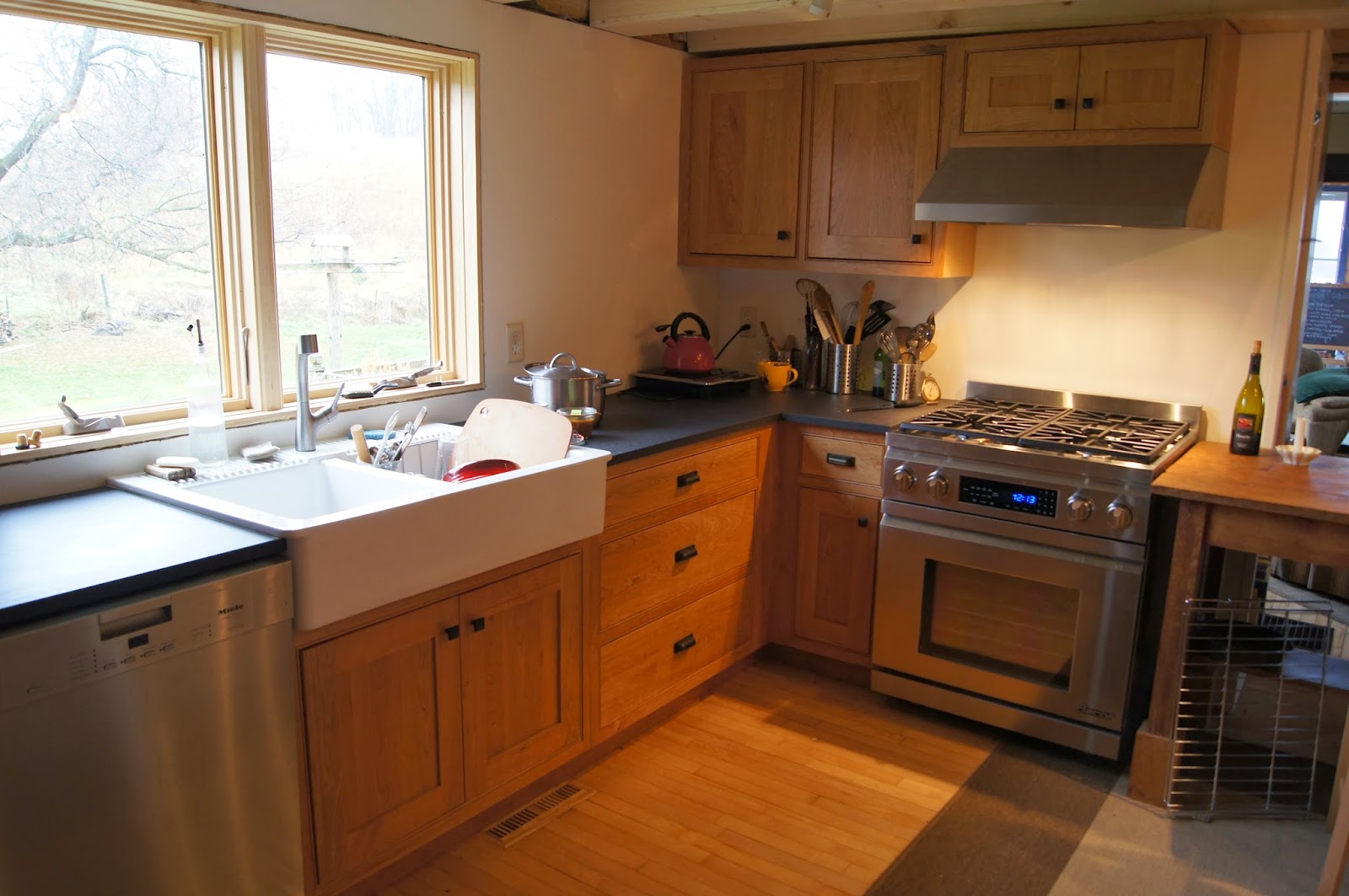
But now that it's (mostly, except for some cosmetic touches) finished and fully functional, and I can stand in front of the big new casement window looking out on the woods and hayfield hill, and lovingly pat the chic, eco-friendly Paperstone countertops (gunmetal), see the autumn light softly burnishing the cherry cabinets, glinting dully off the international array of stainless appliances (from Germany, New Zealand, and the U.S. of A.), I feel completely happy about how it turned out, and I feel, almost, like a grown-up, almost.  The day the cabinets (custom built by the awesome Bruce Schley out of Cedar Falls, but really reasonably priced) arrived, I called Mary, who was at work in the cities, and I said:  Honey, we have a problem; Bruce is here with the cabinets, and they're too nice for us....

The almost original kitchen; we have the wood floor installed, replacing white vinyl, before we moved in.


The new kitchen is especially amazing in contrast with what we inherited when we bought the house.  It's a nice big room, about 15 feet square, so plenty of space to work with.  But in the old kitchen everything--cabinets, sink, range--was lined up down one wall, dead-ending in a weird cul-de-sac created by a chimney, and the huge refrigerator was exiled to a distant corner of the room.  The cabinets were painted a cheery red, which helped to disguise, at least for a while, the fact that the cupboard and drawer fronts were a mish-mash of "styles," to put it nicely.  The best of the drawers were Menard's cheapest, and the worst featured wood-on-wood construction that resulted in a shower of fine sawdust raining down on everything in the cabinet below.  The counters weren't really secured to the cabinets, making vegetable chopping and bread kneading a kind of seasick experience.  The less said about the cheap electric range, where the plastic around the vent opening had melted, that kept whatever oven temp it damn well pleased, depending on its mood of the day, the better.

Indeed, enough about the bad old days.  Here's a run-down of what we did, and why, in hopes that it might be useful if you're planning a kitchen re-do someday.  And yeah, also just to show off, for sure.


We took kind of a total flyer on the countertops, which was crazy because they weren't cheap, and once they're there, they're there.  We love them. They're Paperstone, made from recycled paper bound with some miracle resin, hard as stone!  We came across them while browsing at Natural Built Home in Minneapolis.  The usual stone and composite countertop materials didn't thrill us, so we went to check out the bamboo and other recycled material surfaces at Natural Built Home, and found ourselves instead drawn to the warm matte finish of the Paperstone.  We contacted the company, ordered some samples, and said yeah, let's do it.  Paperstone, what the hell.  Our cabinet guy Bruce (a genius, did I say?) said he could cut it to size for us, so we had a 5' x 12' by 1" thick slab shipped directly to him.  It weighed over 600 pounds; luckily, Bruce has a skid steer.  The 60 square feet was way more than we needed, but getting the 5 x 12 sheet meant he could cut two L shapes to go on either side of the sink, so no seams.  Very cool.  Bruce testified to the hardness of the Paperstone material; it ruined every saw and router blade in his shop....


The sink has a story.  It is from Turkey, via Ikea.  Mary got interested in apron-front "farmhouse" sinks; I said, fine.  I wanted white after many years of stainless sinks.  The Ikea "domsjo" sink was less than half the price of similar sinks from Kohler and the like.  I went to the Twin Cities Ikea to pick one up.  It was out of stock, they didn't know when or if they were getting more.  Could they order one from another store?  No.  Could I buy it online?  No.  Would they sell me one of the display models (there were at least three on the floor)?  Negatory, good buddy.  Thanks for all the help, Ikea.

Back home, I did some research and found that an Ikea store just north of Chicago, in Schaumberg, had several in stock.  I called to see if I could buy it and have it shipped.  Nope.  Would they set one aside for me, so if we made the long drive (about 5 hours each way), we wouldn't arrive to find them sold out?  Well, they could set it aside if I bought it.  So, great, I'll buy it (whip out the Visa, ready to reel off the numbers).  But, they can't take phone orders.  For real?  The mighty Ikea cannot take a credit card phone order?  So they would set it aside if I bought it first, but I had to come to the store, which is, as I mentioned, just north of Chicago, to buy it.  And then why would I need them to set it aside...?  Thanks for all the help, Ikea!


If it seems insane to spend all day in the car just to get a kitchen sink, then you're probably someone who hasn't been through a project like this, and doesn't fully understand what I've come to call Decision Fatigue Syndrome (DFS).  This is a phenomenon reached at that point in a project when so many decisions have already been made, then unmade, remade, almost made, reneged upon, reconsidered, decided again, etc., that rather than having to make a brand new decision about, say, a freaking kitchen sink, you are more than willing to spend a full day in the car, including dealing with crazy traffic on the under-construction-for-40-miles Illinois tollway.  That's what DFS does to you.  Driving to Chicago, at least, was a finite task, over when it was over, and no more decisions to make on that front.  And yes, it was insane.

Here's an interesting thing about apron front sinks:  It's not just a cosmetic difference from the usual inset sinks.  There's actually a big size difference.  I measured.  Our old sink, a typical size from, you know, Menard's (nothing against Menard's, we're there like every other day...), measured 33 inches wide.  The new sink which looks huge, is 36 inches wide.  So, less than 10 per cent wider.  But the area of the sink basins themselves, get this, is more than 35 per cent larger.  Yes, amazing.  You can do the math yourself:  the old sink basins were 14" by 15", or 210 square inches per; new sink 15.5" by 18.5", about 287 square inches.  The difference is very apparent when you're washing stuff up in there, very spacious.  Right, enough sink geekery.
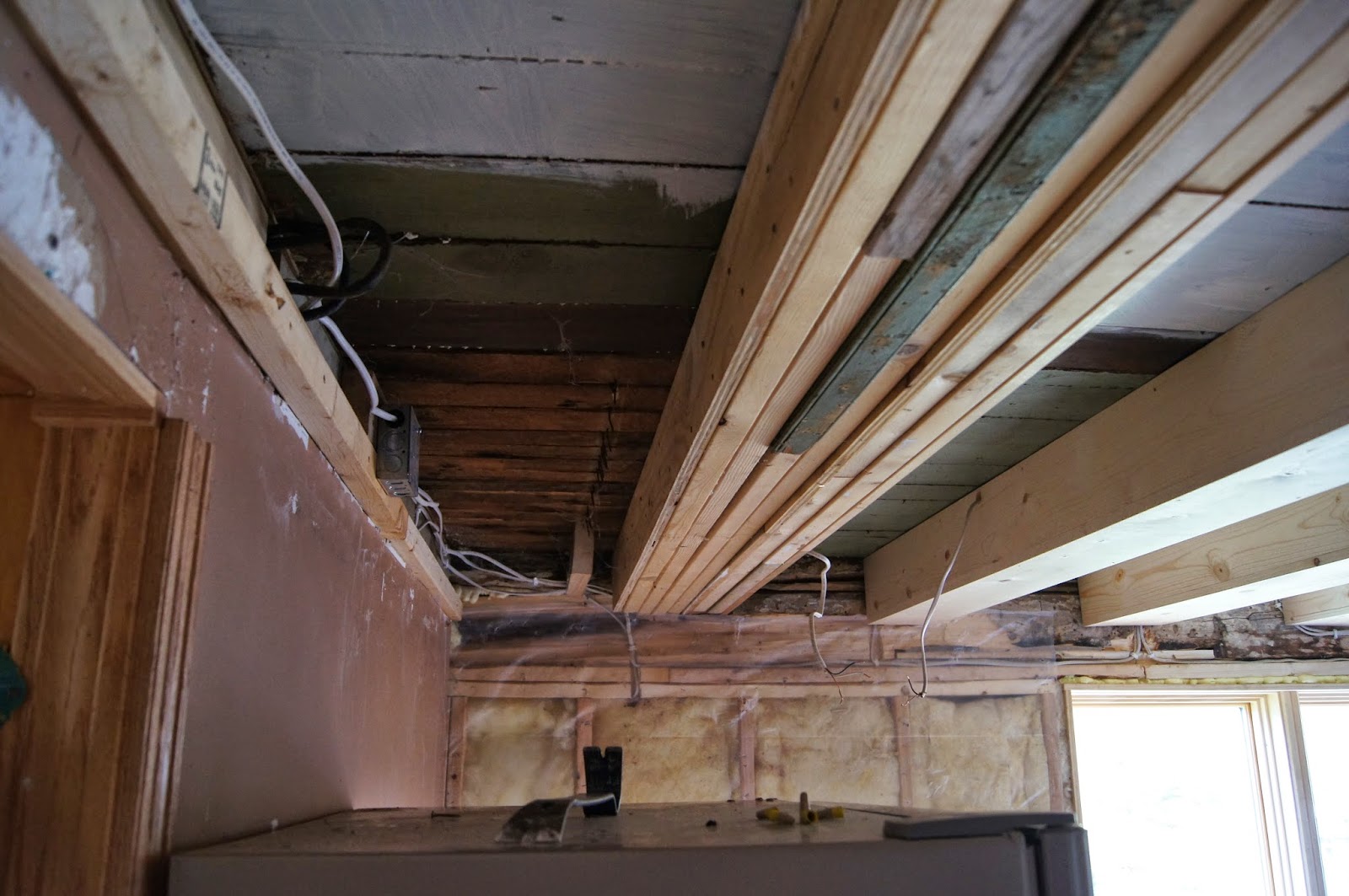
Ceiling before.

One of the biggest conundrums we faced had to do with the ceiling, which, as I said, is where we started down the rabbit hole of deconstruction.  White acoustic tiles with canister lighting, and low enough that even a shortish person could easily reach up and touch it.  Oppressive.  We knew it had to come down, and so, last January I think it was, with our friend Martha visiting and egging us on, we started pulling the tiles down, and then the one-by wood pieces that the tiles were attached to.  We had hoped to find rustic floor joists that we could clean up, paint, and leave exposed, to give an added sense of height to the kitchen ceiling.  We did find rustic floor joists--which had all been fortified with additional 2-by-6s and assorted strips of plywood glued to the old joists and also secured with a million nails.  Not so attractive.


The reason for all the retrofitting is that the original floor joists are 2-by-6s on 24-inch centers; not a lot of support there.  Even with all that additional wood tacked on the stiffen them, the upstairs floor feels a bit spongy in places.  We consulted a couple of reliable sources for an opinion about whether we could remove some of the seemingly haphazard reinforcements, and everyone said:  leave it be.  Thus, covering up the joists became the only option.  We enlisted our friends Mike and Pat Robertson to do that work, and they did a terrific job (they also installed the new window, and put skylights in our upstairs the summer before; they are very accustomed to cutting holes in our house).  These "beams" remain somewhat unfinished.  We were originally thinking to paint them, but now we're leaning toward staining them, or just giving them a clear-coat type finish.


With track lighting tucked up between the "beams," we have plenty of light without the blanket effect of typical overhead lighting.  The lights above the counter are on one switch, the lights on the other side of the room on another, with dimmers on each.  Dealing with the ceiling seemed one of the most daunting aspects of the projects, and it turned out splendidly, a real team effort.


The cabinets, as I said, are natural cherry with a clear satin finish.  They will darken gradually.  Doors and drawers are inset.  They have this "soft-close" system so you close them partway, and then they close themselves the rest of the way.  Nice, I said to Bruce, but can they make sawdust, like our old ones did?  He said he could bring me some sawdust to sprinkle here and there, when I found myself missing the old drawers.  I don't miss them, yet.  Bruce's work is just exquisite; he even used cherry plywood on the cabinet  backs and drawer bottoms.


We love our fridge.  It's weird to write that, but it's true.  It's a Fisher & Paykel, from New Zealand, counter-depth, only about 17 cubic feet but so well designed, it doesn't seem small, at all.  We stumbled upon it at an appliance store in the cities.


The salesman had shown us a number of other much larger fridges, with lots of bells and whistles, and we were still undecided.  He had gone to print up some information for us, and while we waited, we wandered, and found this sleek little fridge.  When the salesman came back we were still admiring the F & P, and we said, Hey, what about this one?  He said, Oh, that one.  Nice fridge, small.  I sell a lot of those to old people from Saint Paul.  And we said, Dude! We are old people from Saint Paul!  This is the fridge for us!


We like that the shelves go all the way across, rather than being split shelves with center brackets to impede moving things around, and that the crisper and freezer drawers come out really easily for cleaning.  We like the shallow storage areas on the door, so things fit snugly and don't rattle around and fall down when you open and close the door, as they did in the old fridge.  That it's not as deep as a regular fridge means you can see right to the back, so stuff is much less likely to disappear back there and turn into runaway science projects.  The freezer has a shallow center drawer just for ice cubes trays, or other shallow items (the other day I froze a bunch of steamed buns in one layer, on parchment paper, before moving them into a plastic storage bag).


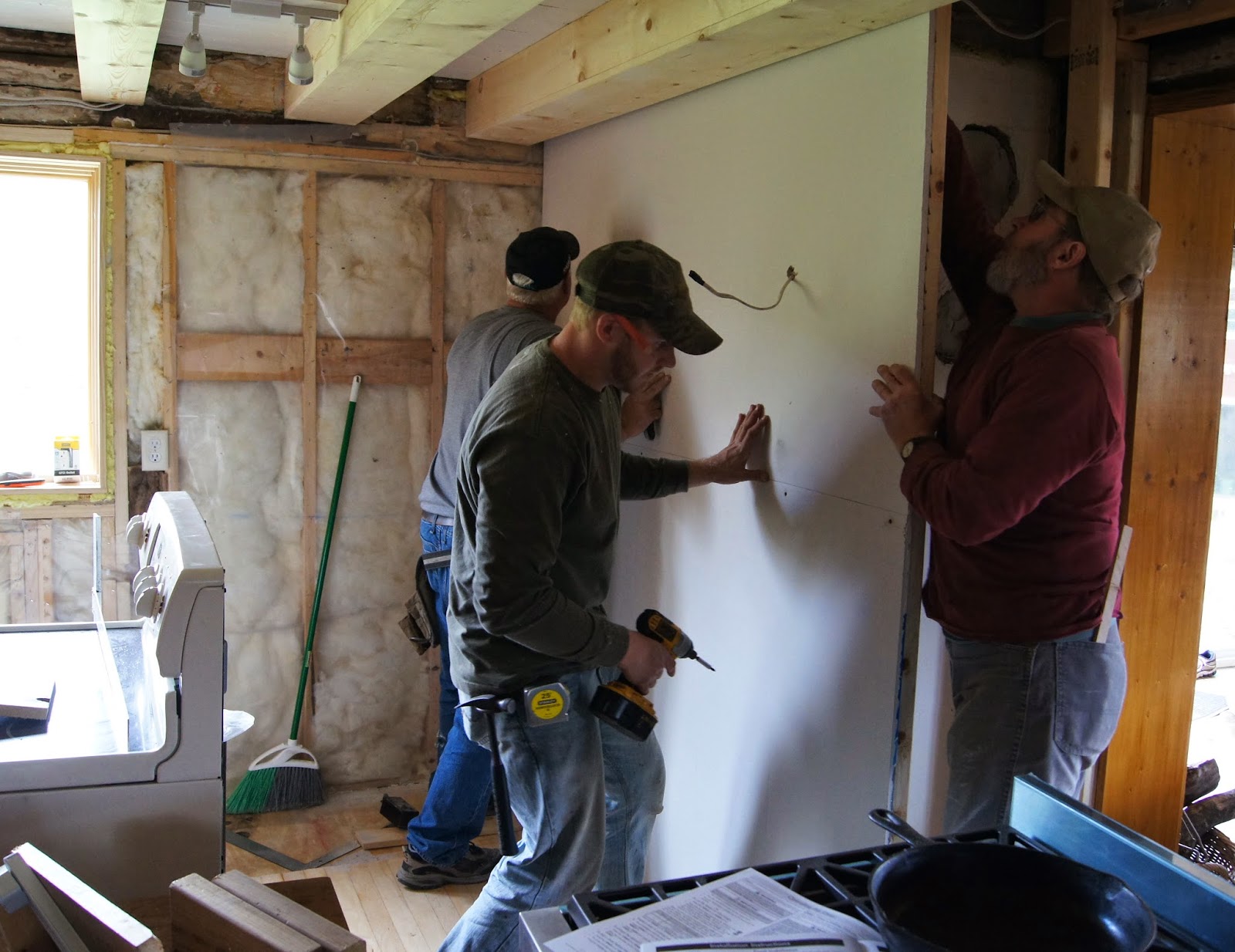
Mike and Pat and the Mike 2 putting up drywall.


Dishwasher is a German Miele brand, same thing we had in Saint Paul, and we liked it, so that was an easy decision.  The most interesting thing about it is that I got it by bidding in a radio auction put on by a Rice Lake station.  I put in the minimum bid at 8:00 in the morning, listened to the radio for five hours, and got the dishwasher for less than half retail price.  The strange thing is that this was exactly the dishwasher we were going to buy for full price, and it just happened to come up in this auction, and I think there was only one other dishwasher in the auction.  So, these things happen, sometimes, I guess.


The range is a Dacor dual-fuel, meaning electric oven and gas cooktop, also replacing what we had in Saint Paul.  We considered all options, knowing that we wanted dual-fuel, as I'm convinced that an electric oven is better for bread baking.  The Wolf and other high-end "pro" models were a little too industrial for me, though Dacor has also gone more in that direction since we purchased our previous range, a dozen or so years ago.  Also no one could really explain to me what we were getting, above and beyond the capacities of the Dacor, for the couple grand extra.  Dacor sometimes gets knocked for not being that reliable, but we used our old Dacor range brutally during our Real Bread stint, and while we did have to make some repairs, it didn't seem out of line given the years of hard use it took.  I am thrilled to be able to bring out the wok again, to have an oven that gets to temperature fast and accurately.  The convection feature is nice, though we never really used it that much on the old range.


The door is very heavy; the whole thing is heavy, well insulated.  At some level an oven is just a hot box, but I've quickly rediscovered that not all hot boxes are created equal.


And finally, one of the coolest things that happened in the course of making our kitchen all shiny and new was discovering, and uncovering, its original bones.  We had gradually become aware that the nucleus of our house was an old log cabin, probably built in the late 1800s.  As we started removing drywall in the kitchen, it became clear that this room was that cabin.  On the east, outside wall, we found that the logs had been mostly removed and replaced with a 2-by-6 stud wall, leaving just the topmost log as a support beam.  On the interior west and south walls, the old logs were still there.  They're partially coated with what looks like flaking whitewash.  There are, for some reason, a million small nails pounded into them.  Most of the chinking is gone.


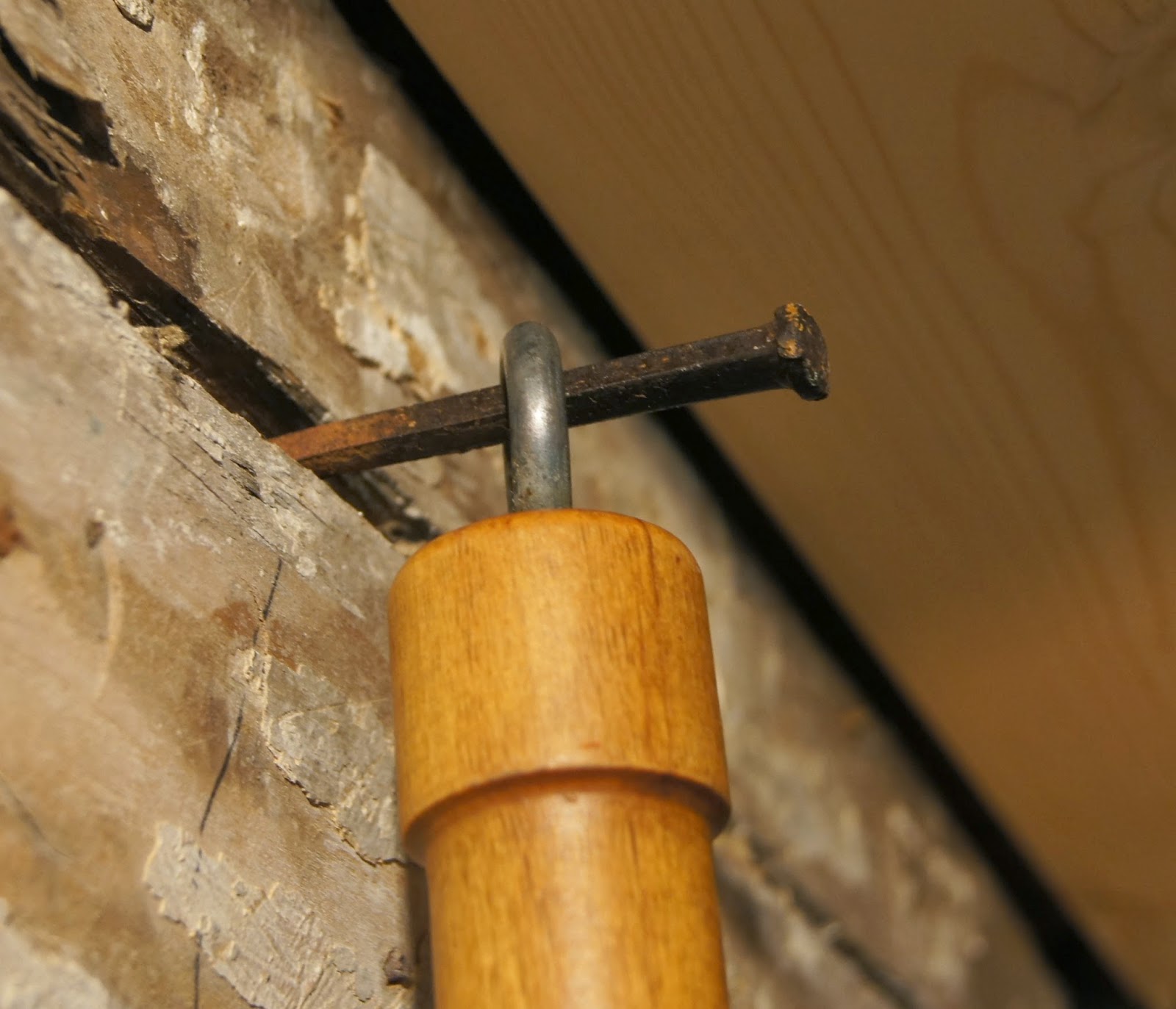
In the southwest corner of the room, you can see where the notched logs meet, forming a kind of pillar, and that, amazingly enough, is what is still holding our house up to this day.  In the course of the deconstruction we removed and saved a few old, square-cut nails from the ceiling.  I smacked a couple of these into cracks in the logs, and used them to hang our cast-iron pans and the wok (which has come out of retirement now that we have gas to cook over again, hooray!).


Overall, though there were stressful moments, and the whole thing unfolded over many months, the period of real inconvenience was fairly brief, and the results are beyond all expectations.  We need to pick up some cherry trim from Bruce for the window and a door frame, and do a few more finishing touches.  We've been slowed down on that because, just as the final practical work was being done, the plumber connecting the sink and dishwasher, and running gas to the kitchen for the range, I got sick, and Mary followed suit, as if, with the final decisions and purchases made, and no more phone calls to coordinate and schedule all the various aspects of the work, we let our defenses down, and germs rushed in....  At least we had a really nice place to cook up a pot of chicken broth to comfort our sniffles and sore throats.

I made this!  This new, yet rustic (thanks to my rustic woodworking skills) shelf unit tucks in along the side of the wood furnace chimney.

Looking from the new to the old; also note volunteer squash/pumpkin harvest on counter in messy laundry room....


Text and photos copyright 2014 by Brett Laidlaw

Wednesday, January 2, 2013

Charge Ahead, Fall Down, Get Up, Repeat (New Year's Wishes, 2013)


From our bedroom window looking north.


2013 came at us from Day One with reminders of what winter used to be like, could still be like, north of 45 degrees latitude in the center of a continental land mass.  The thermometer registered 18-below on New Year’s morning at 7:30, then actually dropped a couple more notches, stopping at minus-20 as the sun crept over the southeast hill.  I looked at the dial with some disbelief, but when I stepped outside and heard the deck boards creak and groan with a frigid lament under my feet, I believed (I have not over-indulged this holiday season, so I’m certain excess weight wasn’t the cause of this phenomenon).  Also my nose hairs went instantly crispy, and my still sleepy eyes were like to be glued shut if I had stayed outside a minute longer.

Odd thing was, the needle stayed put at -20 as the sun grew stronger; Mary eventually went out and gave the dial a tap, and it jumped up suddenly to near zero.  Who knows where we actually bottomed out?  Cold enough.  But it warmed enough by mid-morning that we (Mary and I, guests Martha and Tom ) got into our skiing togs and hit the trails.  A glorious day for it—with bright sun and little wind the exertions quickly warmed us.  Lily charged ahead of us over the crest of the hill and her pounding paws kicked up a flurry of powdery snow while her breath billowed out in a steamy cumulus, caught in the sun’s sharp near-solstice angle on the line where snow meets sky.
 
We skied over the hayfield hill, swooping down the eastern slope to the boundary with LeRoy and Shelly’s land, traversed back up to the top and came down toward the house through the old pasture.  I took the hill first, on a slightly different line than I had taken before, and as I came around the curve and over the knob with speed, I saw that divot, and I thought Oh, crud….  I believe I was airborne for a moment; then I was anything but.  Wipe out. It must have been impressive, but I don’t know if anyone saw.  I got up and shook it off; I was a little embarrassed, but more exhilarated.

Top of the hayfield hill.

One thing I’ve been trying to do a lot while skiing this year is to fall down.  I know that might sound odd, and counter to the general aim of skiing, but I feel that one of the best things a 54-year-old can do is to fall down in the snow—provided that he is able to get up again, of course.  The key is to not be afraid of falling—charge ahead, fall down, get up, repeat.

That’s going to be the theme of 2013 for me.  I’m avoiding the resolutions game.  Except that I have already publicly resolved to eat more Wisconsin cheese.  And I want to learn to play Johnny B. Goode on the Ibanez Artcore electric guitar that Mary surprised me with on my birthday last October, best present ever.

Best present ever, the Ibanez "Blue Beauty"

But back to the ski trail—and just to digress here a bit: I have discovered this winter that one key to perfect bliss for me is to be able to step out my back door and ski in my very own woods; it’s a luxury, for sure, but one that I appreciate fully.
 
I took Martha and Tom through the woods to the northern tip of our land while Mary stayed out in the field (she’s particularly averse to trees on skis as she’s still just picking up the sport).  The woods trails could use some improvements, as there are a lot of downed trees and some brushy patches with no clear way through, but it is so quiet and beautiful there in the snow, skiing is really just a way to get there.  One charming thing I’ve noticed this winter is that there are often deer tracks running right down the ski trails—I don’t know if this is because the deer and I share an intuition about the best way through the woods, or if the deer are cleverly taking advantage of our efforts to lessen their energy output in the cold snowy weather.  Or perhaps they’re curious about these odd emanations in the snow, and follow them wondering what sort or creature they will lead to.  At any rate, it creates a pleasant feeling of simpatico with the animals, like, yeah, we all live here together.  We often see deer at a distance, in the woods at dusk, but I’ve noticed the hoofprints following the ski tracks nearly right up to our back door.


Après-ski, a warming lunch, and Mary and Martha sat on the couch knitting while Tom and I flipped through the Fäviken cookbook they brought us as a gift, wondered about just how tasty would be a tea brewed from forest leaves that have “almost turned into soil,” and vowed that we would mature our own cider vinegar in a charred, hollowed-out stump, so help us Odin.  (Fäviken is a Swedish restaurant on the cutting edge of atavistic Nordic cuisine, employing ultra-local ingredients like, yes, old leaves, moss, lots of other foraged stuff that is very far removed, indeed, from the typical European luxury ingredients like truffles and foie gras.  Some—well, a lot—of the recipes read like parodies of obsessive-compulsive chefdom in pursuit of the hottest trend, and yet I find the idea of digging down (literally and figuratively) into northern culinary roots really fascinating.  It’s the very idea I’m slowly developing for my next concerted project, as I look for emblematic foods, methods, and recipes that speak compellingly of our place.)

Tom and Martha took their leave mid-afternoon, to get back to town before full dark, and I took a nap.  I just zonked out, and woke feeling as if I were getting sick.  But I willed myself out of bed, put on my Swedish Army surplus wool knickers, whistled for Lily (Annabel, 14-and-a-half, pretty much just putters around the yard in the winter), pulled on the ski boots, clicked into the bindings, and headed back up the hill just as it was turning to dusk.  I followed the path along the edge of the field and then, near the top of the hayfield hill, turned left and worked a traversing course up to the highest point on our property, stopping along the way to remove a section of barbed wire.  I got to the top of the hill where a serious deer stand—ours, inherited—is slowly going back to nature, the plywood walls delaminating one by one.  Then I skied out to the tip of the promontory I romantically think of as “The Grande Esplanade”; from here there is a marvelous view of our house and outbuildings far below, and the valley and ridgelines running off to the south and west.
 
It was pretty much dark now.  I took in the view, and the silence, only enhanced by the bit of breeze that rattled some frigid branches.  A very light snow was falling, but I couldn’t really see it, only felt the flakes touch my face.  With my literary education and inclinations, I couldn’t help thinking of Frost, “Stopping By Woods on a Snowy Evening,” and that was okay.  Whose woods these were, I knew.  The woods were lovely, dark, and deep, but I did not have miles to go before I slept.

In our woods going up is often easier than going down—certainly less dangerous.  But coming back down last night I found the line I’d been looking for all winter:  a long traverse of the big swale, between the oaks and maples, avoiding deadfalls and stumps and hidden barbed wire, so that I made it from near the top to the edge of the woods in one exhilarating run, in control but with enough pace to make it interesting.  It felt like an accomplishment, as if I’d worked out a writing problem, and it made me feel like, yeah, I will learn how to play Johnny B. Goode, the coolest song ever.

Then I skied to the top of the hayfield hill and finished with a lovely downhill run with a decent telemark turn, and as I glided into the yard I thought for some reason of Hemingway, something reminded me of a story from In Our Time.  I can’t help it; I’m made that way.

For New Year’s dinner Mary and I raided the fridge for leftovers—a couple of shrimp fritters that were excellent reheated and dabbed with mayonnaise; home-smoked duck breast and its accompanying sauce, so luxurious served on toast with a carrot slaw, “leftovers” seems a wholly inappropriate term.  Then the last remnants of some excellent cheese, Uplands Pleasant Ridge Reserve, and aged Marieke gouda (off to a good start on one resolution…).  We were both weary, we didn’t talk about too much, but it was pleasant.  We sat in our usual living room chairs and noshed.  Mary went to bed around ten; I practiced Johnny B. Goode for a while.  I’ve got about two-thirds of the intro down pretty good.

From my office/spare bedroom window; note Tom (L) and Martha's (R) herringbone ski tracks up the hill, impressive.

Thinking about the events of last year makes my head spin—we bought a house, sold a house, left the city for the country, plunged into home renovations, learned to live in a whole new place, embraced it; my mother went into a nursing home, had to leave her old life behind for one with not promising prospects, but she’s doing okay, has such a positive attitude, she sustains us all; our old dog Annabel had a major health crisis last winter (because of various and numerous fabric items she consumed), and last summer, a seizure, so she’s now on a daily dose of doggy downers; Mary became a country-to-city commuter; book events crescendoed in the fall then completely tailed off (don’t forget, I’m available for birthday parties, bar/bat mitzvahs, bachelorettes, etc.!). 

I hardly fished, barely hunted.  I found morels in our yard, chanterelles where I expect to find them, and missed out on most of the other mushrooms.  Our garden produced a lot of squash, but our apple trees bore little fruit.  We ate exceedingly well, and I grew rather tired of taking pictures of food, or looking at them.  Cutting, hauling, and splitting oak logs to feed our wood furnace has become a consuming concern for me; we could turn on the LP furnace, but to me that feels like a moral failure.  I’m heading up the hill with the chain saw and the ice fishing sled this afternoon.

Not the easiest way to heat a  house, but among the more interesting.

What’s past is past (or not, ask Faulkner), and I’m taking a clean slate approach.  Charge ahead, fall down, get up, repeat.  Focus on the possibilities; it’s never too late.  Resolutely avoid resolutions (except as noted).  Let conclusions present themselves.  Some of this applies to the future of Trout Caviar, as its five-year anniversary nears.   It’s usual to say something like, “Five years ago I never would have believed I’d be writing this damn thing five years later…”, but since, when I started this journal I didn’t put a term limit on it, it sort of makes sense that I’m still doing it, especially in light of the book, and all.

Which is to say:  I’m not sure about the future of Trout Caviar.  I ended the year in a bit of a slump, with only a brief, herring-induced bounce-back; I wonder how long the topic can remain fresh, or why, ultimately, I would keep at it.  I know I am not alone in this, since if you click on many of the sites in my “We Read These” list, you’ll find that there’s not much new to read on a lot of them.  It is probably melodramatic to say that I have seen the best blogs of my generation destroyed by madness, or that the best lack all conviction while the worst are full of a passionate intensity….  Well, melodramatic and derivative, and wrong.  If some of our comrades have fallen by the cyber-wayside, others have picked up the torch and race onward.

Nonetheless, what seems fairly clear to me is that the thrilling promise of a true “Internet community” is paling more than a little.  I’ll bet there are plenty of you reading this who have resolved to spend less time on-line, get off Facebook, give up Twitter.  Who doesn’t want to live her or his life more fully in the actual moment?  There’s good stuff to be gleaned from the Interwebs; it’s setting the limits that is tough.

I revile myself for caring about how many Twitter followers I have (300!), and I believe that the whole of social media creates a lot more heat than light, while at the same time, thanks to the “blogosphere” I’ve met lots of people who have enriched my life.  I’m not planning to crawl into a cave; or, if I do, I’ll be sure to bring my iPhone….

What I meant to say was:  Happy New Year.  The designation is arbitrary, sure, but nonetheless significant.  Marking passages is important, can lend clarity.  I hope your 2013 is filled with satisfaction and growth; that the people and things around you compel your interest, and that you spread it to others.  I wish you moments of calm reflection, bursts of inspiration.  Thanks for hanging around here.  It means a lot to me.

Cheers~ Brett