Showing posts with label trout caviar. Show all posts

Tuesday, October 2, 2012

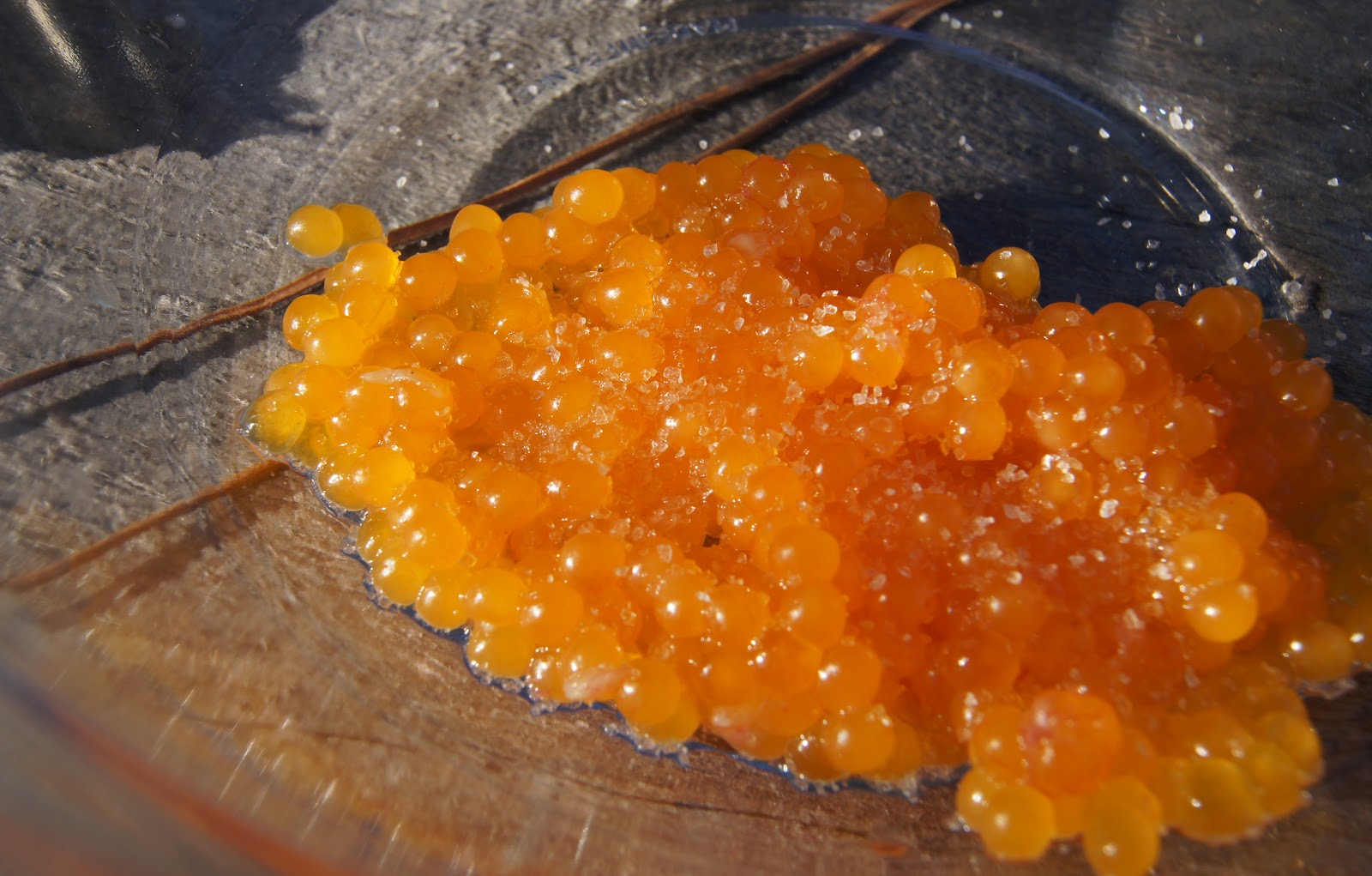
How to Make Trout Caviar


The stream trout season on Wisconsin's inland waters closed at midnight this past Sunday, September 30.  I made up for a disappointing fishing year by logging some serious stream hours during the last week and a half of fishing--my shoulders are still aching from hours of wearing an overloaded fishing vest into which I had stuffed every fly box I could find, containing everything from teeny, tiny size 24 midge patterns to two-inch long streamers and weighted, rubber-legged girdle bugs, because, well, you never know what you might need, and in late September fishing you may be called upon to switch tactics radically in the space of an hour.  There are hatches of miniscule mayflies and midges which bring trout to feed selectively at the surface, in which case one must be able to match the hatch very closely; and then, the fish feel fall coming on, and the spawning season, so they are feisty and hungry, and can be tempted to go after those flies that represent a much bigger meal.


The latter tactic proved most successful for me in the waning days of the season, so I was able to add yet more weight to the vest in the form of trout, mainly browns.  And some of those fish turned out to be hen trout of breeding age, which gave me the opportunity to prepare what around here we refer to as "The Titular Delicacy," i.e., trout caviar.


I often say that the hardest part about making bacon is finding a source for pork belly; similarly, the hardest part of making trout caviar is coming into some trout roe.  If you live near a trout farm, you may be able to get some there--I've obtained rainbow trout roe from the Star Prairie Trout Farm in the past.  If you fish for Great Lakes salmon or steelhead, or know someone who does, the roe of those lake-run fish can be treated the same way that I prepare the roe of brown and brook trout from my local streams.  Here's the somewhat messy process that results in a truly exquisite treat:


When you open up a mature female trout at this time of year you find the body cavity packed with roe contained in egg sacs surrounded by a clear, veined membrane.

My hands are clean, but stained from working with black walnuts!

And now I must digress a bit, because in trying to nail down the terminology of caviar, I've just gone down a bit of a rabbit hole.  I used to think the membranous sac surrounding the roe was called a skein, but I've now come to think that skein refers to the eggs themselves.  Skein in general refers to a loose agglomeration of things--often a loosely gathered bunch of yarn or thread, or in another common usage, it refers to geese:  "One swallow does not make a summer, but one skein of geese, cleaving the murk of March thaw, is the Spring." — Aldo Leopold.  In none of the online dictionaries that I consulted did I find any reference to fish roe, nor was that usage listed in the venerable Oxford English Dictionary, print version.  However, there are plenty of references to skeins on various fishing-related sites, and a quick survey of some of these reveals much confusion as to what skein actually means.  I've found it used to mean the membrane, the roe, and the two combined.  Therefore, I am going to eschew using it at all, and just refer to the sac, and the roe.  Thanks for your patience.
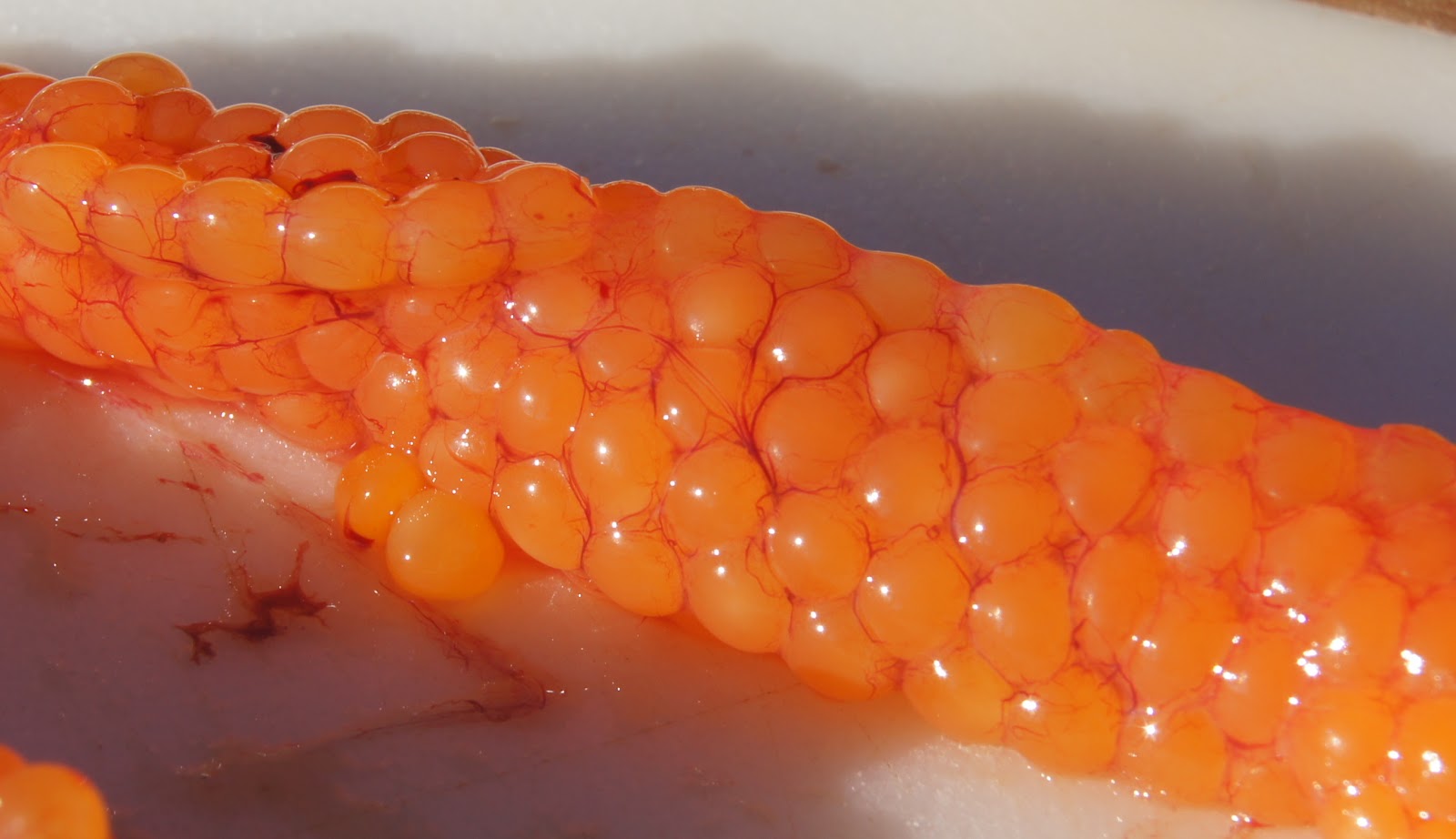

I used to think the sac was gray, but Mary helped document the caviar making process this time, and she cleverly pointed out that it's actually red.  I have this little color blindness thing going on, so I can sometimes miss details like that.  When Mary mentioned the color of the sac, it immediately made sense to me: there are veins in the sac that carry blood, probably to bring oxygen to the eggs, so I guess it's an organ, not just a functional material.


What you want to get rid of. 

Besides obtaining your roe to start with, separating the sac from the eggs is the only difficult part of the process.  The sac is delicate, so it breaks easily as you try to carefully scrape away the eggs.  The more you do it, the easier it becomes.  I use the dull side of a couple of paring knives to separate eggs from sac.


You're going to break a few eggs, but the eggs, in fact, are pretty sturdy.  You just go at it confidently, working quickly but carefully.  It's not necessary that the eggs be totally clean of membrane at this point, as you can pick out any stray pieces after rinsing.


The water turns pink and cloudy as bits of membrane and blood are rinsed away.


Rinse a couple of times, and drain well.


Weigh the roe.  That's just about an ounce, 29 grams.  That might not seem like a lot, but this roe was from a  pretty small fish, just a 12-inch brown.  And the caviar is rich; a little goes a long way.


The salt should be a bit less than 10 percent of the weight of the roe--in the book I say 4 grams salt--that's a scant quarter-teaspoon--to 50 grams of roe.  I didn't quite trust my Ikea scale to accurately weigh two grams of salt, so I went with the volume/eyeball method, and lightly coated the surface of the roe with salt.  That turned out to be the perfect amount.  This batch of caviar was nicely cured and not at all too salty.  We enjoyed it as part of my birthday raw foods dinner, along with a plate of lovely oysters, and steak tartare.  I share my birthday, October 1, with Rod Carew, the People's Republic of China (which made for quite a gala day for me, the two years I passed my birthday in Chengdu), Julie Andrews, Vladimir Horowitz, and Bonnie Parker (of Bonnie & Clyde!).  That it falls the day after closing day takes a lot of the sting out of seeing another fishing season come to an end.


Trout caviar will keep for around a week--in the book I say four to five days, playing it safe.  But it's best eaten fresh, within a day or two.  The salt will permeate the eggs within a few hours, so you can make it in the afternoon and eat it that evening.


I think it should be easy to see why I'm so enthusiastic about this stuff.  On a thin slice of homemade sourdough rye, with some Hope butter and a dab of a goat yogurt-cream mixture flavored with shallots and black pepper, it made a delectable bite.  I have the roe from two trout killed on closing day to salt and consume, and then I'll have to wait until next autumn to enjoy it again.  It's worth the wait.


Text and photos copyright 2012 by Brett Laidlaw


Sunday, October 12, 2008

The Titular Delicacy...

...in evidence, at last. I know of only one way to obtain local trout caviar, and that is to drive to my local trout stream at the proper time of year (late September), string up my fly rod, catch a couple of fat female trout, knock them on the head, harvest their roe, painstakingly separate each individual egg from the tenacious grip of the membrane that holds the egg sack together, rinse the eggs, salt them, and let them sit for a day.


That is why it has taken me a while to get some pictures and a better description of the rare treat that gives this journal its title. (I talked about how this "blog" got its name here, back in my early, even wordier, days of blogging...!)

The end of the open season for trout in Wisconsin's inland waters looks like this at our house (if we're lucky):


That's a spectacularly colored brook trout at top, and two browns. The brookie and the smaller brown were females, and they gave identical amounts of roe. Aside from catching the fish, the only hard part about making trout caviar is separating the eggs from the membrane. Using our trusty Salter scale, the same one that gets a workout during each market bread baking, I found that each fish gave us 25 grams of roe. And I had read that caviar is usually made by adding from four to eight percent salt to the roe. I found that 1/4-teaspoon is about five grams. So I wanted less than half of that for each 25 grams of roe. What that amounted to was a couple of good pinches, just covering the surface of the eggs in their ramekins. That 25 grams, by the way, is just about two tablespoons in volume.

So in the end, here's what we had (brook trout roe on the left, brown on the right):


It was kind of a special evening, being as how I was celebrating an anniversary denoted in Roman numerals by the same letter as my last initial. So after the caviar we moved on to trout in sorrel sauce, with some beautiful little local fingerling potatoes. It made entering my second half-century pretty easy to take, actually.


Sorrel Sauce
Serves two. Sorrel is a relative of rhubarb and buckwheat. Its tart, lemony flavor is wonderful in this rich sauce for fried or grilled trout or salmon.

3/4 cup fish stock
3/4 cup chicken stock
2 Tbsp dry white wine or dry vermouth
1/2 cup cream
1 small onion, sliced
2 Tbsp unsalted butter
1 small bunch sorrel
Salt and pepper

In a small saucepan combine the stocks, wine, onion, and 1/4 cup of cream. Bring to a boil, turn down to a quick simmer, and cook till reduced by half. Strain to remove the onion, then return strained sauce to to saucepan. Set aside.

Remove the thick stems from the sorrel. Take 3/4 of the sorrel leaves and chop them into rough confetti. Slice the rest into very fine ribbons--a chiffonade.

As your fish cooks, add the remaining 1/4 cup of cream and a pinch of salt to the saucepan and bring back to a brisk simmer. Reduce by one third. Turn the heat to low and add the chopped sorrel. Cook for one minute, then whisk the butter in a couple of teaspoons at a time. The sauce should now be thick enough to coat the back of a spoon. If it's not, simmer a couple of minutes more. Taste for salt, add a few grinds of pepper.

To serve, spoon the sauce over and around the fish. Garnish with the sorrel chiffonade. Any extra sauce is fabulous on plain boiled new potatoes.
____________________________________________

p.s: I've added a great new site to our "Friends" list at right--Mr Finspot of Seattle writes a wonderful wild foods blog, Fat of the Land --superb photos, too. I've also added a link for The Creamery Restaurant and Inn, Downsville, WI . Downsville is just a few miles south of Menomonie, a little more than an hour's drive from the Twin Cities. Chef Brian Griep has enthusiastically embraced the local-seasonal food philosophy, sourcing many of his ingredients from local, sustainable and organic producers, including Midtown's own Sylvan Hills Organic Farm (whom you market regulars know as "Jackie"!). Less happy news is that Callisters' Farm in the Market, in the Midtown Global Market, is out of business.


Text and photos copyright 2008 by Brett Laidlaw

Tuesday, February 5, 2008

Something Wild

In searching out great local foods, a farmers’ market is a good place to start. Better still is your own garden—it doesn’t get much more local than your own backyard. But if you want to really get to the heart of the question, and bring to your table the most distinctive of local foods, you need to leave civilization behind altogether: you have to go out into the woods and forage.

Or take to the stream and fish, or go afield to hunt. Over the course of a year I partake of all three methods. I do so avidly, even a little obsessively, I’m afraid. For me there’s nothing like the satisfaction of putting a meal on the table composed entirely of things I've found or caught or shot myself—grilled trout on a bed of watercress with sautéed oyster mushrooms and ramps in spring, or roast grouse accompanied by hen-of-the-woods mushrooms and a wild black currant sauce in autumn.

In years of mild winters with little snow (of which this year is clearly not an example) we often manage to get food from the woods in every month of the year. A couple of years ago I shot a ruffed grouse over Annabel’s point with half an hour left in the last day of Wisconsin’s grouse season, on the last day of January. (It was an atypical point: the bird was hidden in the branches of a big white pine, and though Annabel wasn’t certain where the bird was, she knew one was nearby, and wasn’t budging. As I moved past her the bird took flight, dropping first before rising sharply, then arcing to my right, and I dropped it with my second shot at the limit of the gun’s range. A bird like that presents an extraordinarily difficult chance, and if I had a few more shots like that as precedent I would have said that was some damned good shooting. In all honesty, however, I must admit that it was pretty much a miracle.)

So in a good year, December and January might see game on our table. Come February, when the cabin fever is running high, I often go out to find the only green thing in the woods: watercress. Because cress grows in springs that bubble up from the earth at a fairly constant temperature year ‘round, the cress is protected in a sort of microclimate created by the 40-degree water. The plants dangle their fine white roots over the sandy bottom, but they take most of their nourishment from the water itself—it’s Mother Nature’s hydroponic salad garden.

Now, watercress isn’t exactly a meal, but if you’re able to top it with the last of the beets stored from market or garden, a dollop of local goat cheese, with some walnut bread on the side, it comes pretty close. More than that, the brilliant live green of it, its pungent bracing flavor, remind you that the earth is just napping, and she’ll be waking up soon, yes, very soon.

March: Well, March doesn’t really offer anything more than February, and even a dedicated forager can grow weary of a steady diet of cress. You might get a few early dandelion greens to add to the salad. But let’s move on to April.

April is as abundant as February and March are sparse. There’s wild meat on our table again, when Minnesota’s trout season opens in mid-month, and to go with it all the exuberant bounty of woods and fields springing forth again: ramps, fiddleheads, wild mint and nettles; oyster mushrooms and a few other wild fungi, including some early morels if you’re lucky enough to find them, which I never am. We forage in our garden for volunteer lettuce, mustard and fennel greens, reseeded dill and parsley. Last fall I made a note of several patches of wild asparagus gone to seed along Wisconsin country roads, and I’ll try to beat the local wild-food fanatics to them come spring.

The call of the wild is less pressing in full summer, when the domestic products are so attractive. What shall we have for dinner: Heirloom tomatoes warm from the sunny garden and sweet corn at the market still damp from morning dew? Or some dirty old weeds from the sweltering, itchy, bug-ridden woods? Civilization does have its rewards. But later in the summer I’ll go back to the woods to see how the mushrooms are coming along, and in the process gather raspberries and black currants, then blackberries, wild grapes, and plums. An abandoned orchard I discovered in the Whitewater area a couple of summers ago gave us bushels of “wild” apples.

September often means excellent trout fishing, and the opening of the grouse and woodcock seasons. At the same time, if conditions are right, the woods may erupt with wild mushrooms: hen-of-the-woods, sulfur shelf, giant puffballs, chanterelles, black trumpets, boletes, honey mushrooms, oysters, and more.

Pheasant season opens in October, and for a couple of weeks the seasons for grouse, woodcock and pheasant overlap. Their habitats coincide, too, in some of the covers we hunt, and I look forward to the day when all three birds find their way into my game pocket on the same hunt. Maybe next year.

Woodcock season closes in early November, generally, and pheasant runs through December, while in Wisconsin grouse hunting is open through January. Our hunting ended abruptly last year with the cold and snow of late November.

Our corner of the world is uniquely blessed in our abundance of wild food, and our access to it. Our trout streams are open for all to wade, and Minnesota and Wisconsin offer vast areas of county, state, and national forests in which to forage and hunt.


Sometimes I feel a little guilty shooting a lovely little bird like a woodcock. But any woodcock, grouse, or pheasant I kill has lived natural and free up to the moment it falls to the gun. It has never seen a cage or crowded pen. Also: The biggest threat to many species of game birds and animals is loss of habitat, and the hunting population lobbies tirelessly to preserve those wild lands. The income from hunting licenses provides the resources to manage them.

Ironically, no one cares more about a woodcock than someone who goes out to kill it.

Yet another part of me settles a lot of qualms with anticipation of a uniquely delicious meal. Handling game has made me a much better cook, because I always want to do justice to those rare creatures.

That’s the overview of fish, hunt, and forage 2007, and here are the highlights of last year’s wild feasts and finds:

"Trout Caviar" is the title of this journal, and here's how that came to be: I’m a fly fisherman. I fish for trout in the spring creeks of western Wisconsin and southeastern Minnesota. A lot of fly fisherman are catch-and-release advocates who like to quote the not-unreasonable axiom that “a game fish is too precious to be caught only once.” My feeling is that a trout is too precious not to be appreciated to its fullest—recreationally, gastronomically, aesthetically, communally.


As a result, I have opened up a lot of fish in the past two decades. One of the things you find when you open up a trout is evidence of how trout make more trout. In the males it’s not that conspicuous, just a slick strip of white milt you could easily overlook if you weren’t paying attention. In the females, especially late in summer and early fall, it’s impossible to miss the fat, yellow-orange egg sacks composed of hundreds of glistening jewels, each the size of, say, a peppercorn. Over the years I’m certain that I’ve discarded hundreds of them—not without considering them, but I didn’t know what you could do with them; I’d never heard of anyone eating them.


It was through a Russian, appropriately enough, that I discovered how to make trout caviar, though not directly. I’ve never been to Russia, but I know a few Russians here in Minnesota, and I’ve read enough to conclude that if there’s any group of people more devoted to wild foods than Russians, well, you wouldn’t be able to tell it to a Russian. See Turgenev, "A Sportsman's Notebook," etc. The Russian appetite for wild mushrooms is unmatched even by the French or Italian. And can you think of salted fish eggs—caviar—without imagining blini, iced vodka? I can’t. I believe I even hear a balalaika….


We don’t tend to think of caviar as wild food, but it is. The classic sturgeon caviars—beluga, ossetra, sevruga—came traditionally from wild fish in the Caspian Sea (now drastically overfished, and either banned or soon-to-be banned in this country, I believe). Those luxury versions are what usually come to mind when “caviar” is mentioned, but the eggs of any fish, salted, can bear that name—salmon, lumpfish, flying fish, even herring (a Midwestern locavore delicacy from Lake Superior, available at the Dockside Fish Market in Grand Marais—quite tasty).


Last spring Mary was working with a Russian woman, Irina, at a contract job out in the suburbs. In that fluorescent-lit, piped-in-music, dull beige cubicle world, when Mary and Irina got together they bonded over talk of food and travel. Mary mentioned the joy we take in foraging, and learned that Irina and her husband still keep a house in Russia, which they visit a couple of times a year, and particularly in the late summer or early fall, when they go into the woods with family and friends to gather mushrooms. Somehow the topic of caviar came up, and Irina told Mary that they used to make their own out of all kinds of fish roe, and that her favorite, which she preferred even to the renowned sturgeon caviars, was salted trout roe.


You can well imagine that this fact caught my interest. I got on the Internet to search out recipes for trout caviar, and though I only found one, and a slightly dubious one at that, that was all it took. I knew it could be done, and I was eager to try.


When it came right down to it, I abandoned recipes, fears and preconceptions, and just followed experience and common sense. I liken it to how I finally overcame my fear of smoking food, when the epiphany one day stuck me: “Hey, cavemen did this, maybe I can, too!” Making caviar, it turns out, is even simpler than smoking food.

I came home from the stream one night in September with a couple nice fat female brown trout. It was late, I was tired, but I had told myself I was going to do this. I set aside the egg sacks as I cleaned the fish, and then considered. The eggs were all held together by a membrane that surrounded the sack and others that ran through it. You were supposed to separate the eggs. This was not easy. It was tedious work using fingers and a couple of paring knives to carefully scrape the eggs free of the membrane without breaking too many.

When I finally finished, I had a half-a-ramekin full—a quarter cup or a little more. I considered the wet brine method, the one I’d found on the Internet, and rejected it. The way they make caviar, I told myself, is they put salt on fish eggs. So that’s what I did. I rinsed the eggs and drained them well, then I sprinkled on some fine sea salt, then a bit more, till they were pretty salty. This was, originally, a method of preservation, I imagined, like smoking, curing, or storing in fat a la confit. I covered the ramekin with plastic wrap, put it in the fridge, took a shower and went to bed.


It was a couple of days before I pulled them out again. I was worried they’d have gone all rotten-fishy. I turned back the plastic wrap with some trepidation and took a sniff. Nothing fishy there. I just dipped a pinkie finger in and tasted the ambient juices. Pleasantly salty, that was all. I got a little spoon and dipped out just three or four eggs. The color had intensified, the eggs held a lovely golden light in their centers. I closed my eyes as I raised the spoon, and I told myself that if this wasn’t delicious—not, “not too bad,” or “okay,” or “hmm, that’s interesting…,” or even “pretty good”—if this wasn’t flat out delicious, straight in the trash it went. I wasn’t going to try to convince myself or anyone else that this was really good if I wasn’t instantly convinced of it.


It didn’t go in the trash. Unctuous is certainly one word to describe it. Also both briny and fresh, from the marriage of salt sea and fresh stream. It was a pleasure to burst the eggs between tongue and roof of mouth, and feel and taste the unctuous liquid run out. I only had a couple more opportunities to make more before the trout season ended. We made caviar from both brown and brook trout roe, and both were delicious. We served them on brioche toast points spread with a little crème fraiche. This year I’m looking forward to growing totally bored with trout caviar.


With the usual caveat about eating raw foods, I would recommend homemade caviar to anyone. I imagine other kinds of fish eggs would work, though I only fish for trout, so I don’t know if I’ll find out for sure. I see from a quick search of how commercial caviar is made that it ranges in salt content from four to seven percent, the better caviar containing less salt, malossol in Russian. I wish I’d paid more attention last fall, weighed the eggs and measured the salt. To a quarter-cup of eggs I think I added about a quarter- to a half-teaspoon salt. The last batch kept for over two weeks in the fridge.


I’ve recovered from the remorse I felt over having obliviously discarded such an amazing delicacy for so many years. Sometimes it takes that long to figure out even something so simple, then once you’ve got it, you’ve got it for good. If the coming year brings a discovery half as delightful, I’ll consider myself lucky.


You can purchase trout caviar from Petrossian for around $100 a pound, minimum order half a pound. But I recommend that you string up a fly rod and go get your own. It’s the sort of humble, local luxury that’s worth going to some trouble for.


The drought of early and mid-summer, followed by the deluges of August and September made 2007 a poor year for mushrooming. When the late fruitings finally did come they were reduced by the early dry weather, and didn’t last in the sodden woods once they emerged. But like the bumper sticker that opines that a bad day fishing is better than a great day at the office, a lousy foraging outing beats a stellar trip to Cub, any day.


Foraging is not only about food on the table, any more than a fishing trip is ruined by an empty creel. I go to the woods to be in the woods, and if I bring home wild food, it’s a bonus. I’m going to be 50 this year, a time of one’s life when one starts to assess things, a bit. When I look back over those five decades, I see that one constant has been the joy I take in being out in nature. Now I may go out to the trout stream with a fine bamboo fly rod strung with a French silk line (I really do, no kidding), and walk the grouse woods with a modest 20-gauge side-by-side to hunt over two pedigreed pointing dogs, and know the Latin names of more fungi than I’d care to admit—but really I’m just a kid running around in the woods, just like when I was eight years old in Eden Prairie. The impulse is the same, the joy in the freedom, the beauty, the sense of discovery in every trip afield.


Which means that I am either admirably constant in my passions, or a case of arrested development. It could go either way, honestly….


Whichever way it goes, it suits me. While the foraging didn’t yield bushels of mushrooms last year, there were other remarkable finds in the woods.

On a Monday night in early August a series of storms passed through the Twin Cities and western Wisconsin. One line of thunderstorms produced straight-line winds that dismantled houses and flattened barns and disposed of mature trees as if they were toothpicks. It was a narrow swath of destruction that hit the outskirts of New Richmond, Wisconsin, and just happened to take dead aim on a smallish patch of woods where I hunt and forage.

There’s an open field on the north side of these woods, and I could see a few poplars down along the edge as I drove up. I still had hopes that the heart of the woods had escaped the destruction I’d seen along the highway—corrugated barn roof panels contorted like origami, huge oaks splintered in the yards of farmhouses. It wasn’t until I walked across the fields and into the woods that I saw the extent of the damage. There were ancient oaks, four feet and more across the trunk, snapped off a few feet from the ground, and maples similarly shattered, and tall white pines lying flat, uprooted. Whole stands of poplar lay down in parallel lines as if they’d been arranged that way. A big beehive had been ejected from one demolished oak, and the pieces of honeycomb were scattered on the ground. The air was thick with the scent of honey, and the remaining bees were still going about their now hopeless work.


There were large sections where so many trees were felled, it was impossible to walk. A lot of those tree had held sulfur shelf or hen-of-the-woods mushrooms. The previous year I had found more hen-of-the-woods than I could carry. This time around, I was happy to find a couple of decent clusters. But a toppled poplar covered with vines gave me a nice sack full of wild grapes.


I called the photo series I took there “Exploded Woods.” I don’t know what it will look like next year. In my lifetime it will never again be the woods that it was. Looking at those pictures now, I remember thinking about the astounding contrast between that calm, clear day in the aftermath, and the utter chaos and almost unimaginable violence that had descended on those woods just two nights previous. I'm also struck by all the sunshine in these pictures: Before the storm that forest floor never saw the sky.

Sometimes when you go out looking for mushrooms, you come back with jam. Or the makings of jam, at any rate. I'm not sure why I hadn't found more wild fruit in the past. It could be that, distracted by more abundant crops of fungi, I just hadn't bothered to notice. This year, when the shady woods were more often than not empty of mushrooms, I spent more time in the sunshine, gathering black cap raspberries, blackberries, grapes, and plums. Some of the fruit made it to the market as plum tarts on Mary's puff pastry.


I could go on (obviously, I do). As a "blogger," I clearly have a few things to learn about restraint. On a topic like wild foods, I have a particular enthusiasm, hard to rein in.


But I couldn't end this chapter without mention of scolopax minor, the American woodcock, a small, migratory gamebird much prized in Europe and generally scorned by American hunters, who dismiss it by saying the dark, savory meat "tastes like liver." Well, maybe it does, but it also tastes like woodcock, which is to say that, to me, anyway, it tastes of the wild woods, the scrappy, brambly margins of forest and marsh where it is found; it tastes of autumn, and it tastes of this place. When it is grilled with a bit of home-smoked bacon and a few sprigs of thyme, and served with grilled apples, hen-of-the-woods mushrooms in a cloak of cream, and braised garden leeks, it tastes very good, indeed.

Brett Laidlaw
copyright Brett Laidlaw 2008