Showing posts with label Hay River Pumpkin Seed Oil. Show all posts

Monday, September 10, 2012

这 些不是中国菜 / Ceci n'est pas un repas chinois / This is not a Chinese meal


I honestly feel that the most important tool in my cook’s virtual knife kit is not any twist of technique, nor depth of knowledge gained from reading about cuisines around the world and avidly eating from Strasbourg to Roanoke, Tofino to Chengdu, nor skill attained from picking up the chef’s knife every day to slice, dice, mince, chop, julienne, chiffonade, and brunoise. No, the number one weapon in my kitchen arsenal these days is the ability to go with the flow.  ‘Twas not always so.  Back in the day I’d get a notion in my head—lobster-stuffed potstickered wontons with black bean sauce, say, or a salad of peaches and beets—and doggedly pursue the wildest hare to the bitter end, no matter if that involved blood, sweat, tears, and a disappointing dinner.  Well, often that approach yielded good results—the wontons were excellent (the peach-beet salad, less so).  But it was stressful, and if affairs in the kitchen went amiss, the evening could go completely off the rails.  Nowadays, when I let ingredients lead my cooking more than any overwrought conceit, things tend to turn out better, perhaps because I’m more willing to enjoy how things turn out.  It’s a culinary version of the old, “Wherever you go, there you are.”  Maybe I’ve embraced the zen of cooking, and maybe my standards have just slipped.  Whatever.
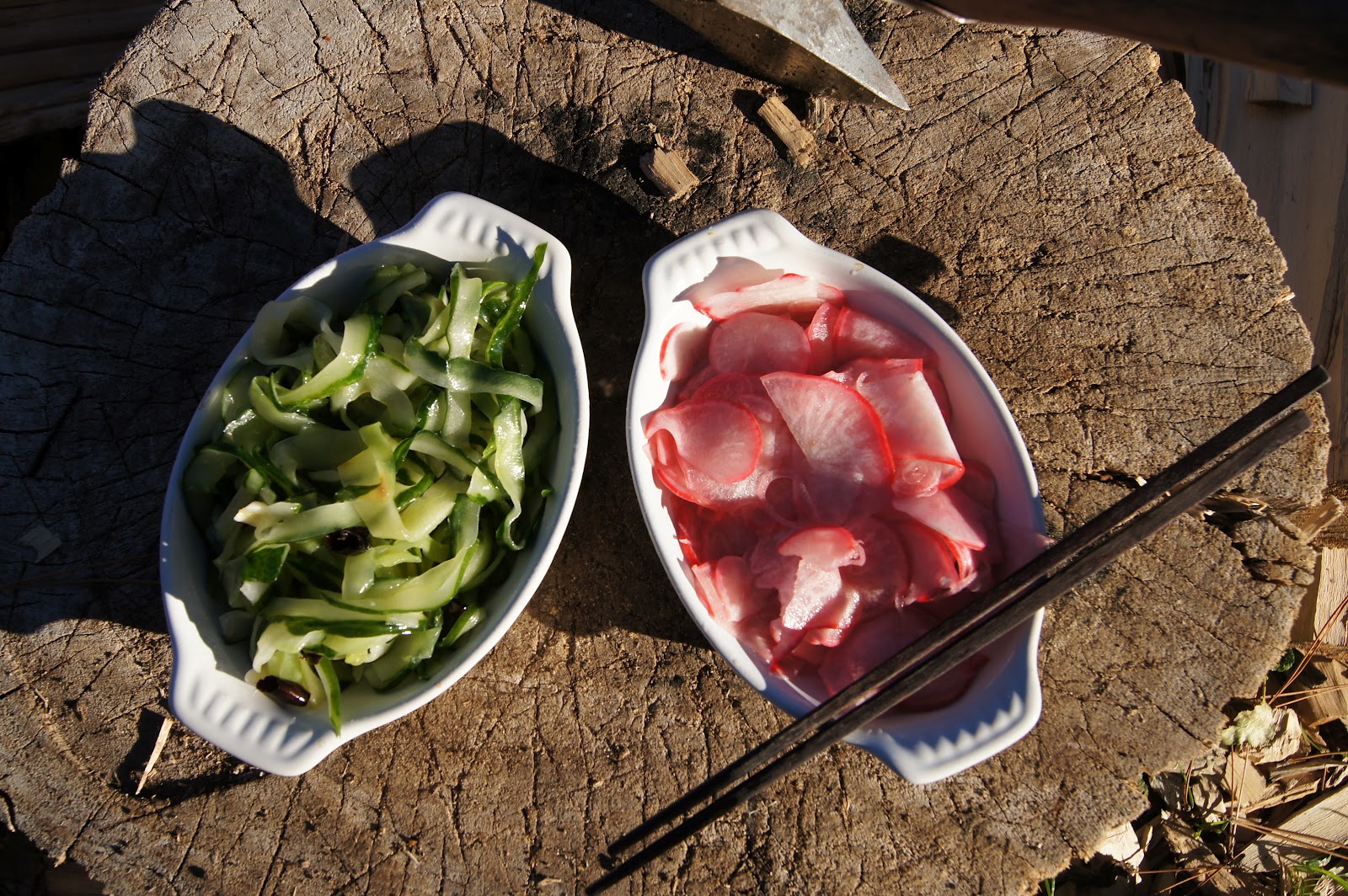

A case in point was last night’s dinner, which was supposed to be brunch, which might have become Chinese supper, which it was not, although it was eaten with chopsticks and rice bowls.  That might require a little bit of explanation. 

We had friends visiting at the farm and Bide-A-Wee this past weekend, and Sunday morning I started preparing some salads to have on a brunch buffet.  I was thinking of something a bit smorgasbord-ish:  there would be corn pancakes as the main event, and homemade herbed yogurt cheese, pickled beets, that sort of thing.  Maybe open a can of kippers. I found a couple of overgrown radishes in the garden which nonetheless were still firm and not too strong, and which sliced up into beautiful pink-and-white coins on the Benriner.  A couple of lovely Suyo Long cucumbers I also shaved into thin planks, and then sliced into veggie noodles, tossed those with a pretty hot chile-garlic oil, with just a splash of cider vinegar.  This could have been a Sichuan dish, except for the context.  Things were coming together nicely in my head for a delightful brunch.


But when Tim and Melinda came down the hill from Bide-A-Wee, it turned out they’d already had some yogurt and granola for breakfast, had enjoyed a walk around the Bide-A-Wee meadows, and were just about ready to head back to town.  No time or belly space for brunch.  No problem.  The salads could chill ‘til dinner.  We saw our friends on their way back home, then hopped in the car to do some shopping errands in Rice Lake.  On the way we stopped at the Crossroads Café in Cameron for Sunday dinner—Mary had the country fried steak, and I had chicken dinner (dark meat).  Both dinners came with a scoop of decent mashed potatoes, kind of soggy but still very tasty stuffing, and niblets corn (or you could have had Jell-O).  Mary’s gravy was white and specked with pepper; mine was chicken-dinner yellow.  Service was friendly and brisk.  My chicken was good, but not as good as the fall-off-the-bone version at the Sand Creek Café.  Mary’s country-fried steak was better, and she let me sample a generous portion.  After lunch we headed to Menard’s well-fed and content.  On the way to the checkout we were drawn to the looming Salted Nut Roll display, thinking that Nut Goodies would be nearby, but there were none to be found.  We settled for a Snickers (Mary) and Hershey’s Milk Chocolate with Almonds (me).   Why am I telling you this?


Okay.  Back home, little nap, some minor chores, a walk.  Radishes and cucumbers do not a supper make, but as lunch had been substantial, we didn’t want anything heavy.  Indeed, with our counters constantly covered in produce, and more, so much more in the gardens coming ripe, we think of vegetable centerpieces to our meals more than meat.  So some of the lovely corn we picked ourselves from a field near Sand Creek (with the farmer’s permission and supervision, of course!), which was originally going to garnish pancakes, that I simmered with onion, jalapeno, garlic, ginger, sage, lemon, and plenty of butter.  I had some eggplants from the market, and a big basket overflowing with patty pan squash from the garden.  My only thought with those was to grill them, toss them with minced shallots.  The thought evolved:  add some Hay River  pumpkin seed oil,* garlic, then a couple pinches of quatre-épices, cumin, and finally some piment d’espelette.  This turned out to be the star of the show.  A recipe worth writing down, passing on, repeating very soon.


And we served it all with rice, and ate with chopsticks, because that seemed elegant and appropriate, although this was not a Chinese meal.  But why not?  The cucumbers, as I say, could easily have passed on a Chinese table, and the radishes too; the eggplant-squash dish, with its mild heat and cumin fragrance, would have drawn compliments but raised no eyebrows as part of a meal in northwest China, along the silk road, where the food can seem Middle Eastern, Indian, or even Mexican.  And the corn was pretty much the same combination of ingredients that I stir-fry together for yumi chao lajiao—corn with chiles—and happily serve in Sichuan meals.  Only the butter—and maybe the sage—took it away from Chinese territory.  And yet, the combination of dishes, and the overall context, made this seem more French than Chinese.  Although it started out Scandinavian.  And it occurred to me in the course of the meal that it was a bit like the banchan dishes—kimchi, salads, and other little bites—that precede and accompany a Korean meal.


Scandinavian-French-Chinese-Korean-American tapas.  That’s what I’d call it.  With chopsticks.**

We drank a French vouvray from Champalou, a longtime favorite wine; always beautifully aromatic, ranging from dry to slightly sweet depending on the vintage.

Good things happen when you go with the flow.


Grilled Eggplant and Summer Squash with Pumpkin Seed Oil and Exotic Spice

Serves two as a side or part of a SFCKAT meal

2 Asian eggplants
2 small zucchini, same size as the eggplant, or a medium patty pan or yellow summer squash
Olive oil
Salt
1 ½ tablespoons pumpkin seed oil
1 tablespoon sunflower oil
1 small garlic clove, minced fine
1 small shallot, minced
2 small pinches quatre-épices 
2 generous pinches ground cumin
1/8 teaspoon piment d’espelette (or another aromatic, mildly hot ground chile that you like)
Good squeeze of lemon juice
Freshly ground black pepper

Remove the peel from the eggplants on two sides, remove stem and trim bottom, then slice the eggplants in half the long way, through the skin, so you have planks with the flesh exposed on the broad sections and strips of skin on the sides.  If that makes sense.  Slice the squash how you like to do for grilling.  Toss both eggplant and squash with a generous amount of olive oil, and salt generously as well.

Grill the vegetables until nicely brown, perhaps a bit charred, and very soft.  Chop them into ¾-inch chunks.  Mix the remaining ingredients, along with another pinch of salt and a few grinds of pepper, and toss with the vegetables.  Garnish with a few very thin shallot slices, if you like.
_____________________________________________________
* This dish turned out to be my favorite-to-date use for our Ken and Jay's wonderful Hay River pumpkin seed oil.  Though the oil's flavor took a backing role to the fragrant spices, the oil's texture gave a real depth and heft to this all-veggie dish.  I don't know why unctuous often has negative connotations; this dish, which actually used three different oils, had a savory unctuousness that was extremely appetizing.


**All of which made me think of  this excellent article by (Dear) Dara Moskowitz Grumdahl on the sense of the authentic in contemporary cuisine, "culinary imperialism", and the Twin Cities Asian restaurant boom--which is much more the real deal than the so-called Scandinavian restaurant boom, which consists of one high-end restaurant and a lunch spot in the American Swedish Institute....


Thursday, July 12, 2012

Oil From Pumpkins


The idyllic western Wisconsin countryside we now call home is a magical place, so perhaps it’s no surprise that amazing things happen here.  There are world-class cheeses produced on modest farms, the hills become flush with morels, then chanterelles in their season, and crystalline spring creeks vivid with trout thread through the lush valleys.  In one such valley two inspired men (with a little help from their friends) are squeezing oil from pumpkins, creating a product not merely distinctive for this region, but rare in the whole U.S.A.  Ken Seguine and Jay Gilbertson are the visionaries behind  Hay River Pumpkin Seed Oil, which has been on the market since December 2006.

Pumpkin seed oil is a product well-known in Europe, particularly Austria, but when the first bottle of Hay River oil hit the shelves in 2006, it was the first
bottle of American pumpkin seed oil to hit the shelves, period.  I’m aware of at least one other company now producing pumpkin and squash seed oils, but it is still a fairly exotic ingredient in the American pantry.  Once more people learn about it, they’re going to like it.  It takes a little getting used to, since it is unlike any other oil we commonly use, but it is both approachable and versatile.  Think of it in the same vein as a high quality extra virgin olive oil in terms of how you might use it; now forget all about olive oil.  This uniquely fragrant oil is nothing like that.

The story behind the oil is as remarkable as the product.  Ken’s from suburban L.A., Jay’s from Eau Claire, and they were living in the Twin Cities when they started looking for a home in western Wisconsin to be near Jay’s parents in 2001.  It took nine months of looking until they found “our picture of heaven,” in Ken’s words.  (Another factor in their move to the area was the siren song of Roberts and Cash—that is, our friends Don and Joni of Otter Creek Growers, previously stewards of Elsie’s Farm, a near legendary endeavor that introduced many Twin Citizens to the wonders of this green, rolling land.  But not us; we didn’t really get to know Don and Joni until we started coming out to Bide-A-Wee. Along with Don and Joni, Ken also acknowledges local farmers Kate Stout and Mike and Patty Wright-Racette for helping them to get started.)

Once they were living in the country, the path to Hay River oil wound its way through their interests and experiences in an unpredictable but, in the end, undeniably organic fashion.  Ken was a life-long gardener with a plant science education, both Ken and Jay were extremely interested in sustainable foods, and they had encountered pumpkin seed oil via Ken’s one-time employer, Horst Rechelbacher—that’s the Horst, of the Aveda company, a native of Austria.  With no American pumpkin seed oil in production at the time, there was clearly a hole in the upscale oil market, and they decided to fill it.


For several years they tested a variety of “naked seeded” oil pumpkins, looking for the best match for the climate.  A trial pressing of their chosen variety took place in 2005.  “At every turn, we've had to invent our own way. Being the first pumpkin seed oil produced in the U.S. meant that there simply was not anyone to tell us what to do or warn us about the pot holes,” Ken wrote in an email.

The growing is the easy part, according to Ken:  “After all, they’re pumpkins, not orchids.”  And the oil, he said, practically sells itself, as well.  Keeping the whole endeavor very local, the seeds are processed by Botanic Oil in Spooner, WI.  Harvesting is probably the hardest part.  For the first few years everything was done by hand: “Very pleasant, very communal, very cool and very expensive.”  Twenty to forty people gathered for these great pumpkin emptying parties.  


When Mary and I encountered Ken and crew last fall they were in the midst of a maiden run with a new, custom-built harvester that wasn’t working very well.  Ken was cordial and smiling when we stopped on a drive to see what strange things were happening in that Barron County field on a choice October day, but he later told me that much cursing had preceded our arrival.  The custom machine was temperamental, and slow; they’re now looking in to buying a European-made harvester.

Ken Seguine and crew harvesting pumpkins


Now about the oil.  Maybe start with the color, which is remarkable.  The Hay River website describes it as dark red, but it can also appear to be a striking dark green, depending on the light and whether you’re looking at a thin or thick layer of it.  This phenomenon is called dichromatism.   Perhaps it has to do with red and green being complementary colors, which is also a factor in red-green color blindness, with which your faithful correspondent is blessed.  But still I have no trouble appreciating the beauty of the oil’s color; to me it appears mostly to be a deep forest green.  The color makes it a splendid choice for garnishing pale, contrasting foods—we’ve used it on polenta, and drizzled on poached eggs.

Polenta with pumpkin seed oil, pan-seared Superior whitefish

The way the seeds are processed contributes to both the color and the aroma of the oil:  the seeds are toasted, then cold-pressed.  The toasting lends a nutty fragrance and flavor, but there’s still a fruity component to the scent.  I’ve often found a simpatico between the smell of chanterelles and that of a fresh sliced pumpkin, and I get some of that in the oil’s aroma, too.  It’s one of the things that led me to concoct the salad below.  As dark as the oil is, you might expect a real noseful when you take a sniff, but it’s subtle, much milder than sesame oil, which can easily take over a dish.  The tempered insinuations of Hay River oil make it much more versatile than I would have thought.  It threads through a salad and nicely blends with the other flavors, while providing a uniquely silky unctuousness.  I wouldn’t splash it into every salad I make, but then, I wouldn’t do that with a really expensive olive oil, either.

Raw squash, celery root, and apple salad with pumpkin oil dressing 


Which brings us to the price.  At nearly $20 for a 250 ml (8.45 ounce) bottle, it’s certainly on the spendy side.  But a little does go a long way, and for adding unique, local flavor to my cooking, I’m happy to keep a bottle on hand (Ken and Jay did give me one bottle to experiment with).  Ken hopes that scaling up production and making the processing less labor intensive will help to bring down the price.  Cooking and salad oil have been one glaring lack in the pantries of those of us trying to keep our food as local as possible; with Hay River pumpkin oil and Minnesota’s Smude cold-pressed sunflower oil, I’m on the verge of phasing out canola, and I’m using way less olive oil than I used to.  I get really excited to see these kinds of products come on the market, and I feel extremely grateful to people like Ken and Jay and the Smude family, true visionaries, for making them available to us.


Ken suggests using the oil drizzled over squash soup, lightly salted as a bread dip, or even on vanilla ice cream—I’ve not tried the latter, but it sounds intriguing.  In a salad dressing made with pumpkin oil, I think the usual proportions of three parts oil to one of acid would be overwhelming.  In the dressing for the chanterelles and green bean salad below, I went one to one, and still the pumpkin oil flavor was pronounced, very pleasantly so.  Maybe the best way to describe the flavor of this oil is to say that it’s assertive, but not aggressive; so it won’t take over a salad made with tender spring greens, but can stand up to stronger flavors, like wild mushrooms, or beets.

Hay River Pumpkin Seed Oil is pretty easy to find in the Twin Cities and western Wisconsin  See here for exact locations.


Shaved Chanterelle and Haricots Verts Salad with Raspberries and Pumpkin Seed Oil Vinaigrette

Except for the salt, this salad is one hundred percent local, and with chanterelles and pumpkin seed oil, it combines two of the most distinctive flavors I know.  A total whim based entirely on seasonal convergence and my own personal association of chanterelles and pumpkins, it is a splendid blend of contrasting and complementary flavors, aromas, and textures.  If you don’t have a really good cider vinegar, rice wine vinegar might work, or try a bit less sherry vinegar.  The raspberries provide bright flavor and lovely color.  I used small wild red and black raspberries.  Chanterelles are unique among mushrooms in nearly every respect, but I suspect that a firm cultivated mushroom, like shitake, might work; or perhaps oysters?  Worth a try. This is a keeper.

Serves two

4 medium chanterelles, about 2 ounces total
2 teaspoons unsalted butter
20 small haricots verts
1 tablespoon minced shallot or sweet onion
Salt
2 tablespoons raspberries
Chervil for garnish, optional

Dressing:
1 tablespoon pumpkin seed oil
1 tablespoon cider vinegar
¼ teaspoon maple syrup
Pinch salt
Coarse sea salt

In a small saucepan blanch the beans in boiling water for 1 ½ to 2 minutes.  Drain and refresh under cold running water. Drain and set aside.

Place each chanterelle cap side down on a cutting board and slice very thinly through the stem end to the cap.  Melt the butter in a medium skillet over medium heat and add the chanterelles and a pinch of salt.  Toss the chanterelles in the butter for about a minute, then add 3 tablespoons of water, cover the skillet, and cook for 2 minutes.  Remove the lid and add the shallot or onion, and continue cooking over medium heat until the water has evaporated.  Cook for another minute, then remove the chanterelles from the pan into a mixing bowl.  Add the beans to the mixing bowl, as well.

Mix the dressing and spoon it over the chanterelles and beans.  Mound the salad on small plates and garnish with raspberries—a perhaps 8 per person.  Sprinkle a bit of good coarse sea salt--like sel de Guerande, fleur de sel, or Maldon--over top.  Add a sprig of chervil if you have it.  It is the prettiest of the herbs, I think.


(Disclosure:  Jay Gilbertson, a novelist, reviewed my cookbook on Amazon.com; the review was also printed in the Hay River Review and the Dunn County News.  It was pretty much a dream review, for which I am extremely grateful, and might seem to be beholden, except that I was a fan of Hay River oil well before the book or review appeared.)


Text and photos copyright 2012 by Brett Laidlaw


Wednesday, June 27, 2012

"It's as if there's something in there that you may never get again, so you don't want to eat it too fast, but you can't stop eating it."

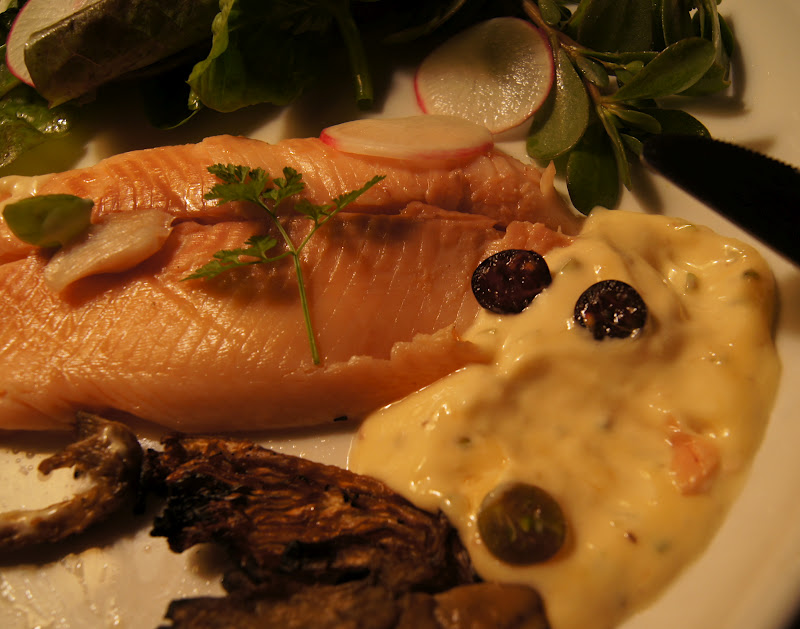
Smoked Trout with Gooseberry Mayonnaise, Grilled Wild Oyster Mushrooms, and Garden Forage Salad


Sometimes the path to a delectable plate of food is short and direct, and sometimes it wanders through an unexpected forage, a sorrel juice swamp, fatigue-induced lowering of expectations, and several happy discoveries before arriving at its destination. This is a case of the latter circumstances.

 The first thing I must confess to: I DID NOT CATCH THE TROUT. No, indeed, I purchased it. Farm-raised rainbow trout from the  Bullfrog "Eat My Fish" trout farm south of Menomonie. See, a writer contacted me asking for a recipe to accompany an article on fly fishing along the Ice Age Trail in Wisconsin. I said, can do, but I didn't want to recycle a recipe. To come up with a new preparation, I needed trout. But with all the recent rain, our streams are flowing bank-full, unfishable. So it was off to the fish farm, which I'd been meaning to visit, anyway. It's a totally charming spot not far from the confluence of the Red Cedar and Chippewa Rivers, and I look forward to a return visit on a weekend when the music is playing and they're cooking up shore lunch trout fries.


I bought four fish. Two of them I grilled and served over market and garden greens with a bacon and spring onion jam. It was great, but that is not the dish I'm writing about today. With the two remaining trout, I had an ambitious plan: one I would grill, and serve with a gooseberry sauce that appears in Judith Jones's memoir, The Tenth Muse ; the other I would poach, and serve with a mayonnaise in which sorrel juice would take the place of lemon. The mayonnaise was an idea I'd been toying with since I started having fun with rhubarb juice. I'd been planning to make that complex meal on Sunday night.


Sunday morning Mary and I loaded the bikes on the car and drove to Downsville (not far from the fish farm, in fact) to take a ride on the Red Cedar State Trail--our first ride together of the year, and a perfect day for it. I had not planned to forage, but sometimes you seek out wild food, and sometimes wild food is thrust upon you. The first thing we encountered was elderberry bushes in bloom. No surprise there, as we had noticed the pretty white umbels along the roadways. We stopped to savor the flowers' delicate aroma, then moved on.


We didn't get far before the gooseberries caught our eye, big patches along a considerable stretch of the trail. We had no bags or other containers (except what our lunch was packed in), so we picked a few handfuls and dropped them into Mary's pannier. Black cap raspberries were also starting to ripen, and we tasted a few of those before moving on (I walked into a patch of wood nettles trying to get at some of the black caps, and was reminded that one ignores the stinging qualities of those innocuous-looking plants at one's own peril--I was scratchin' and pedalin', pedalin' and itchin'...).

We made it without further incident or delay to the end of the Red Cedar trail, where it joins the Chippewa River State Trail, very near where the two rivers meet. The Chippewa drains a considerable watershed, and it was high and roiling after all the June rain. Usually by midsummer the Chippewa meanders sweetly along broad sandy beaches--it always makes me think of the Loire River in France; if only west central Wisconsin were home to the lovely restaurant/inns that are so prevalent in the Loire. It's an up-and-coming wine area, but I honestly don't know where I'd go in this area to enjoy a meal with any kind of French finesse.

Well, we had sandwiches, hard-cooked eggs, and sweet little carrots from the farmers market. But before our déjeuner pique-nique, we were lured to the trailside bushes again by what I first thought were black currants, but which turned out to be ripe gooseberries--the two plants are, of course, very closely related. We picked gooseberries for a while, and also gathered about a cup of black caps--we ate the eggs as an hors-d'oeuvres to free up a container. The day's last foraging surprise came in the form of two clumps of white on a dead standing elm. I made a U-turn and quickly confirmed that they were oyster mushrooms. I used my bike pump to thrash a path through the nettles (succeeded in being stung, nonetheless--you can't say I'm one to learn from painful experience...), reached the tree, and was able to knock both clumps off with a dead branch--one flew off into the nettles, but the other I nimbly snatched before it hit the ground. Both were in reasonable condition (more than I could say for myself) when I put them in my bag--just a few of those beetles that seem to always inhabit oysters.


We ate our sandwiches in a shady spot where a spring trickled out of a limestone wall and made a little cascade as it flowed toward the river. We made it back to the farm in mid-afternoon (after a stop for a root beer float at the Menomonie DQ, utterly satisfying). It was a lot of sun and activity for us oldsters who hadn't been on the bikes much. I took a nap. When I got up I took a shower. I started thinking, grilled trout poached trout sorrel mayonnaise gooseberry sauce.... I started thinking, "Plan B." We had some chicken andouille in the freezer from Seward Co-op. I said to Mary, honey, we're having sausage tonight.

But the thought of those trout in the fridge was nagging me. I'd bought them on Thursday, now it was Sunday, three days later, and they still smelled fine, but another whole day.... I wasn't sure they'd be delicious simply grilled by Monday night. Into the brine they went, to get all tasty for a date with the smoker on Monday.

Late Monday afternoon I built a cottonwood fire while the trout rested after being removed from the brine. I love a homemade mayonnaise with smoked trout, and I still had that sorrel idea in mind. I gathered a few leaves of sorrel from the planter on our deck, chopped them roughly, whizzed them up in the mini-chop with a bit of water. Sieved the resulting slurry, and...oh, baby, that was some nasty stuff. The raw, unsweetened rhubarb juice was pretty harsh, but this stuff was in the chemical weapons department.  Once the initial shock subsided, I took another whiff. It smelled a bit like the rhubarb juice, and very, very strongly like fresh-mown grass--so I wonder if that was precisely the smell of chlorophyll.  I think I'm going to leave the sorrel alone until after a few fall frosts have mellowed it.

At any rate, we were now at Plan C level...or was it D? Enter gooseberries. Judith Jones's gooseberry sauce is an extremely basic concoction of berries, sugar, and water. Intriguing in its simplicity. I was still hankering for mayonnaise. So I took a half cup of gooseberries, half green and half ripe, and put them in the mini-chop with a quarter cup of water, whizzed it up, strained it. Gooseberries have a lot of pectin, so my juice was more of a puree. But it smelled and tasted good, tart but a little sweet. I added half a teaspoon of sugar. That gave me three tablespoons of puree.


I proceeded with my mayonnaise, omitting the mustard I usually start with.  My oil was half plain canola and half Smude cold-pressed sunflower oil.   It took a bit more whisking and slightest dribbling of oil at the start to get the emulsion started, and once started it was looser than usual, but that turned out to be a plus. When the oil was half in I added some of the puree, then near the end the rest, along with a couple pinches of salt. I separated the finished sauce into two ramekins, and to one added a few green gooseberries finely minced, so one ramekin was smooth and one was chunky. Mary and I agreed that we preferred the chunky. The gooseberry flavor was subtle, but there.  I think if I had cooked the berries briefly to extract more of a juice, it might have given a stronger gooseberry flavor, but I don't necessarily think it would have been better.


Here's what Mary said about this mayonnaise at dinner (and she had only had less than one glass of Sancerre--the perfect wine, as it happens, to accompany smoked trout with gooseberry mayonnaise): It's as if there's something in there that you may never get again, so you don't want to eat it too fast, but you can't stop eating it. 


As for the rest: The Bullfrog trout that we had grilled had seemed a little bland compared to stream trout; the smoked fish, however, was some of the best I've ever had. That had to do partly with the moist, fatty flesh of those rainbows, and partly with the cottonwood smoke, another happy accident brought about by the fact that we have all these cottonwood logs lying around the yard. I'd been impressed by the grilling qualities of the wood, so decided to give smoking with it a try. It had a subtler flavor than the apple I usually use, more like Pacific Northwest alder-smoked salmon. (I was about to write that that might make sense, since alder and cottonwood are in the same tree family, but a quick Google reveals that they are not closely related.) It was beautifully smoked fish, moistly sweet and savory, and delicious with a dab of mayonnaise or without.


The grilled oyster mushrooms: Mary said it before I could: Bacon for vegetarians. I had tossed them with a bit of sunflower oil, salt and pepper, and grilled them until well brown. Fungi cum bacon, say no more.

The salad: A proud achievement for us, our first salad entirely from our new gardens. It required a bit of foraging/weeding in the form of the succulent purslane, which will be appearing in many more salads this summer, as it is abundant in our garden, and delightful on the plate, with a refreshing crunch and a lemony twist. Pea tendrils, whoever knew you could eat these, back in the day? I first tasted them when I was teaching in Chengdu, more than twenty years ago, now, and then literally jumped for joy the first time I saw them at the Saint Paul Farmers Market. Now they're everywhere, and more than a bit trendy. I consider it forage, and delicious. Then some red leaf lettuce, bit of sliced radish.  It was dressed with some  Hay River Pumpkin Seed Oil, a bit of our homemade cider vinegar, and a little coarse salt.


 Many detours later, then, a memorable meal.  I hope to get back down to the Red Cedar Trail to gather more berries. Right at the trailhead there's a sign saying that the public is welcome to gather mushrooms, berries, and nuts from this state-owned land. It says to leave the flowers alone, so I'll get my elderflowers elsewhere. They're blooming like crazy now.


Text and photos copyright 2012 by Brett Laidlaw

Saturday, February 4, 2012

A Winter Salad by Any Other Name


What shall we call the shreddy salads of winter, the festive haystacks that make the most of root cellar holdings, long-keeping fruits, and the squashes of our season?  Slaw fails the task, too burdened by associations with perfunctory and over-dressed deli/burger/picnic sides.  A celeri remoulade is a lovely dish of shredded root, denizen of every traiteur's cold case, but the remoulade refers more to the dressing than to the shards of celeri-rave.

One thing I've found:  the more I eat with the season, the more I want to eat with the season.  We used to pick up a head of red leaf lettuce on nearly every weekly grocery trip, but eventually our enthusiasm for those often leathery leaves shipped in from warmer climes waned.  Local hydroponic greens are a reasonable choice, but one that doesn't excite my palate much, these days.  I've become more inclined toward broadened ideas of salad, and the shredded type tops my list.  This particular one here, of Benriner-ed squash, celery root, and apple, has become a regular in our shreddy salad rotation.


The squash really is the key, and if you're thinking, "Raw squash...?", well, so was I.  Would it taste too squashy, or gluey.  Let your dubious heart be comforted--neither is the case.  I've made this with kabocha and...something else.  A small hubbard type, I think.  I think any hard winter squash would work.  Butternut, for sure.  The drier types, like buttercup, maybe not so much, but I could be wrong.  The raw squash really has quite a mild flavor, especially in this combination of more assertive tastes.  What it does provide is texture, an al dente quality that is almost more pop than crunch--very intriguing, extremely refreshing.


If you are very, very good with a knife you can do this by hand.  I used the medium blade on my  Benriner mandoline--every kitchen should have one.  But watch your fingers!  I shredded up roughly equal amounts of squash, celery root, and apple.  I mixed up a dressing of cider vinegar, a little honey, oil, salt and a wee bit of pepper.  I've been keeping it really local with my oil choices this winter, too.  This is becoming easier since local sunflower oils from small producers have started showing up, like those from Smude and Driftless Organics  .  I love the Smude oil--it's light in texture, but it has a definite presence, and is excellent in salad dressings.  I haven't tried the Driftless Organics product.

There's another local oil, a more specialized product, which I have

mentioned recently, and which is produced over in beautiful west central Wisconsin by a very cool couple of guys, Ken Seguine and Jay Gilbertson--that's Hay River Pumpkin Seed Oil. The salad pictured here was made using that oil. It has a teasingly nutty aroma, a bit like sesame oil, but less in-your-face. Much more on Ken and Jay and their pumpkin seed saga to come.

I don't really miss the leafy salads that were so delightful in the warmer months. Soon now I'll be starting lettuce seeds in flats, and moving them to a sunny window. In this mild winter March will likely provide the first wild green spriglings of dandelion, sheep sorrel, and cress to fill out a salad of lettuce thinnings, and it will only get better from there. Until then I'm going to enjoy my shreddy salads, my root cellar raw spaghetti, whatever you want to call it. But if you've got a better name for it, please do let me know.


Text and photos copyright 2012 by Brett Laidlaw

Friday, December 23, 2011

2011 Highlights: Pumpkin Seed Harvest

Get your entries in for the Trout Caviar book giveaway--leave a comment about one of your 2011 LOCAL! food highlights by January 1; be specific, be evocative, regale and entice us!


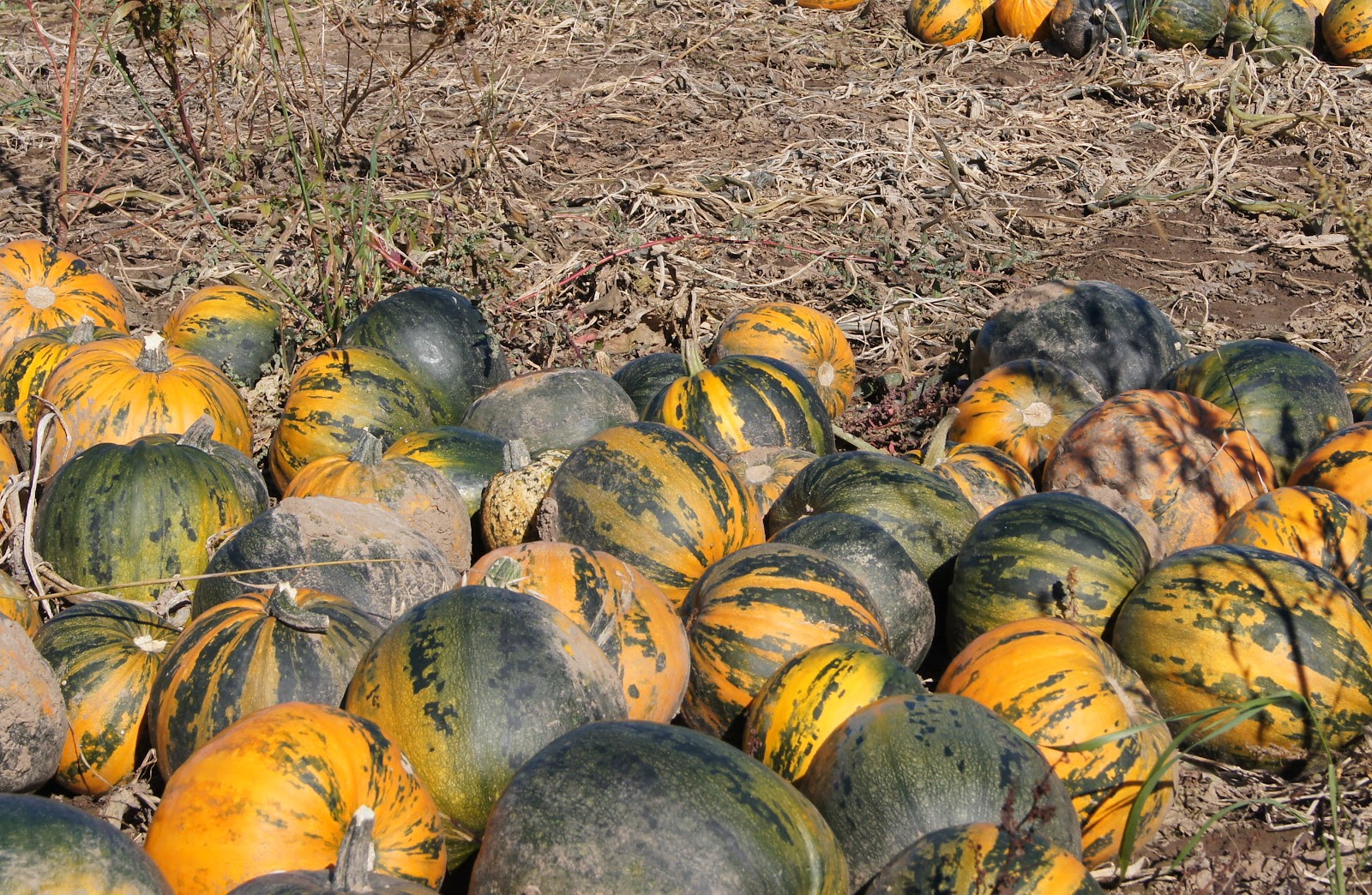
One of my local food highlights of 2011 didn’t actually involve any food—well, not directly, at least. Last October Mary and I were driving through the western Wisconsin countryside, and came across an intriguing scene. Off to our right was an unremarkable field in which were growing, it appeared, squashes or pumpkins of some sort. The intriguing part was the odd contraption parked near the side road, around which an group of people were gathered, intent on a mysterious task.


In addition, between the county road we were driving on and the contraption and crew, there were piles of what appeared to be smashed-up pumpkins. We peered intently as we drove past, up a hill and around the bend. A couple hundred yards along, I swung to the shoulder and hung a U-ie. We had to go back and see what was going on.


Once we started down the side road and approached the group of people, I knew what we had come upon: it was harvest time in the fields where the pumpkins that produce Hay River Pumpkin Seed Oil are grown. Ken Seguine was the man in charge, and he was working out the kinks in a newly automated form of pumpkin seed extraction—prior to this year, a dedicated group of volunteers performed the task of smashing open pumpkins and sorting out the seeds by hand.

The new pumpkin seed machine consisted of a sort of conveyor belt/elevator that lifted the pumpkins up, to be dropped into a grinder that busted them into pieces. These pieces fell into a rotating, perforated drum. As the drum went round it further agitated the pieces so that the seeds fell out and dropped through the perforations into a bin below.


The rest of the process from there is a bit of a trade secret, but it involves toasting and then pressing, and the result is a fragrant, dark oil that’s popular in Europe (particularly Austria), but nearly unknown in this country—indeed, Hay River is the first pumpkin seed oil produced in America.


I’ve just gotten a fresh bottle of the oil to experiment with, and will write more about the culinary applications of the oil in the next few weeks—a slaw of raw kabocha squash, celery root, and apple tossed with a pumpkin seed oil, cider vinegar, and honey dressing was a winner. I just love that this kind of thing is going on out in the western Wisconsin countryside.


Text and photos copyright 2011 by Brett Laidlaw