Showing posts with label Halvorson Fisheries. Show all posts

Wednesday, July 10, 2013

A Midsummer Night's Smørrebrød


You don’t have to be Danish to appreciate smørrebrød, those open-face sandwiches—knife and fork sandwiches—composed upon dense, buttered rye bread, usually containing appropriately Nordic ingredients like pickled herring, beets, and pork paté. If you like bread, and noshy food in that tapas mode, you’ll like smørrebrød. As a summer evening meal it has the additional virtue that most of the toppings can be prepared ahead—or are themselves commercially prepared foods of the very best sort, like cheese, smoked fish, cured meats, etc. Finally, because finishing preparation is so simple, these mini-canvases beg to be decorated to the full extent of your garnishing imagination.


Bready. Noshy. Easy. Pretty. What, I ask, is not to like in that combination?


It’s usually this time of year, when we’ve just slipped past the solstice, and the gardens are really starting to produce, the market stalls are burgeoning as the plants make the most of that vital sunshine, that my appetite turns to smørrebrød. It’s an elegantly rustic (or is it rustically elegant?) kind of meal to enjoy in those long twilights as the strong sun softens on descent, spreading welcome shadows, and the heat of the day begins to mellow.


That pretty well describes the evening last weekend when we prepared a smørrebrød repast at the house and packed it in a cooler for a picnic on the hill. It was a bit warm and muggy in the valley, but we caught a nice breeze as we headed up the hill. I’d been cleaning up a little impromptu sort of dump at the edge of the woods this spring, hauling down old car batteries, car seats, beer cans and bottles, what have you. Then I ran the lawn tractor up there to mow a small picnic area. Among the detritus I’d found a piece of sheet metal and some cinder blocks, and these we turned to better purpose as a makeshift picnic table (pleasantly, though very rustically, reminiscent of a Parisian zinc bar). It was, I dare say, one of the best picnics ever.


We settled in very comfortably (so did the dogs, eventually) to enjoy the view of the green, green hills, mist-shrouded in the distance. The aspen leaves overhead kept up a  calming kerfuffle. There was even a floor show, of sorts, as the neighbor who rents our hayfield came to bale up the last few rows of the oats and grass they cut last week. Urban al fresco dining has its pleasures, but when was the last time you saw a John Deere tractor and baler on the Nicollet Mall?


As we ate our smørrebrød and sipped our pinot gris and watched the sun pass out of sight behind the western hills—though it would still be light for a couple of hours—I had a thought about terroir—you know, that idea that foods and wines can taste distinctly of the place they came from, express some quality of the soils in which they grow, the waters that sustain them, and the human cultures that have nurtured them through time. My idea had something to do with how a cuisine is shaped by the sense of the seasons experienced by the people who create it. And how, for us specifically and for northern peoples in general, our long annual journey from the abyss of winter’s frigid darkness to midsummer’s almost too abundant light and warmth, and back again, how this must have as great an impact on the savor of our food as the molds in the caves of Roquefort, or the chalky soils of Sancerre.


It profoundly affects what we eat, how we eat it, what we want to eat, and how we experience it in the context of the year. A midsummer picnic at 45 degrees north latitude must taste different from the same meal consumed in Florida or southern California; in those places, their own seasonal context would shape their experience of what they eat.  For me, high summer dining has meant that I’ve hardly wanted to look at a piece of red meat—give me vegetables, salads, simply prepared fish, cheese and bread. Oh, and maybe a glass of wine.


I made a small rye loaf that included a little birch syrup. You want a pretty dense bread, with a close crumb--not something like a baguette that's full of holes.  Then top to your heart's desire.  I don't let myself be constrained by any rules, but rather see the smørrebrød concept as the base for using the best of the local and seasonal.  One of my favorite, oft-repeated mantras--Ninety percent of good cooking is good shopping--is on full display here.  That is not to say, of course, that you should hie thee to a high-end supermarket, but rather that best ingredients make for best results.


The Superior shore was well represented in fresh herring from Cornucopia, smoked whitefish from Port Wing, cheese from Bayfield.  The Menomonie farmers market gave us snap peas, onions, beets, turnips, potatoes, and asparagus, and our garden contributed, too, with radishes, chives, and mustard greens.  There was a bit of home-smoked bacon in the potato and asparagus salad, and the yogurt cheese was home-cultured using wonderful fresh milk from just down the road.  Oh, and the mayo, also homemade, using eggs from our neighbor Tina's chickens, and Minnesota sunflower oil Smude.

On Wisconin! was surely the theme of this meal, especially as the sandwiches were literally presented on Wisconsin.  A more thorough description of the various toppin's below.


Smoked whitefish salad combined about four ounces of flaked smoked whitefish with roughly three tablespoons of peas—we shelled some sugar snaps—two ounces of Wisconsin hickory nuts, chopped and lightly toasted in a dry skillet. (The nuts were a generous gift from my buddy Lucas “The Beard” Madsen; hickory trees grow in his part of southeastern Wisconsin, though they’re scarce here. Other local, wild alternatives would be black walnuts or hazelnuts; a good storebought option would be pecans.) To the fish, peas, and nuts I added some sliced red onion and about three tablespoons of mayonnaise—homemade in this case, and for a dinner like this I think it’s really worth the effort. Garnish with a little more red onion and thin slices of sugar snaps.


I was inordinately pleased with my checkboard composition of roasted baby beets and turnips. The base was fresh yogurt cheese (with just a dollop of chevre added in for body, and flavor) mixed with chopped chives and lots of coarsely ground pepper. Lay down a good bed of the cheese mixture, and decorate to your heart’s content. You can leave the vegetables round and create a fish-scale effect. I really liked the geometrical drama of the squares—just cut straight down around the sides of each little beet or turnip, and then slicing across produces squares.


Asparagus and potato salad was originally going to be oyster mushroom and potato sauté, but the little critters had honeycombed my ‘shrooms, so it was Plan B, which was just delightful. The potatoes were preroasted (along with the beets and turnips). Wash and slice the asparagus bite-size.  Dice up some good bacon fairly coarse, begin to render, then add the asparagus. Then add a couple of generous pinches of caraway seeds, about half as much cumin seed, and…mustard seed! About a teaspoon. Add the cut-up potatoes to warm and brown just a bit, and absorb the other flavors. This I served atop a generous spread of that homemade mayo.


Brie and radishes. A study in simplicity and the wonder of felicitous combinations. This one was just delicious. The cheese was one you probably haven’t heard of, but of which I predict you’ll be hearing quite a bit in the near future. It was Happy Hollow Creamery's “Snowy Spring Brie,” which we picked up at Ehler’s store in Cornucopia on the shore recently. Happy Hollow lists a Bayfield, WI address. This cheese, beautifully ripened, was exquisitely flavorful. Not even terribly expensive. If you happen to come across it, just buy it. Their Lazy Daisy raw milk cheddar is also excellent. As I say, I predict you’ll be hearing more about these cheeses and this creamery. For the sandwich: butter, cheese, radish, pepper, boom.


Last but surely not least, grilled Superior herring atop mustardy mustard greens. I’ve said plenty about this superb fish, which never disappoints—we usually get it hours after it’s been caught, so that’s a good start. I’ll have more to say in a future post about the greens preparation, which combines oil, mustard or other strongly flavored greens, more mustard—a good, strong Dijon style—a bit of honey, some vinegar, salt and pepper. This is going to be a standard greens preparation at our house right through the summer and fall. Butter, mustardy mustard greens, a piece of grilled fish, and a radish flower—yep, radish flower, you knew? They’re a bit sweet and a bit peppery at the same time.


Partly what inspired us to climb the hill for supper was a story we heard on  WPR's new show 45 North .  Last week Anne Strainchamps interviewed the British adventurer and writer Alastair Humphreys , who has bicycled around the world, run a marathon in the Sahara, and rowed the Atlantic, and now (maybe because he's tired...) is promoting the idea of "micro-adventures," mini-excursions in one's own backyard.  He's encouraging people just to get outside, and outside one's usual comfort zone--just grab a sleeping bag, a sandwich, and a bottle of wine, and go sleep on a hill, look at the stars, watch the sun come up.  I think it's just a brilliant idea whose simplicity is at the heart of its brilliance, and while we retired down the hill with the last fading light to all the comforts of home, we did feel as if we'd been away for a while, even if our adventure was, literally, in our own back yard.

And the food, if I need to say it, was good to the last pea.


Text and photos copyright 2013 by Brett Laidlaw

Thursday, May 16, 2013

Brandade Rampante


This is most definitely one to file under "Happy Accidents."  A piece of whitefish rubbed with salt and birch syrup, intended to cure for a day and be served like gravlax, is instead forgotten in the back of the fridge for a week.  Upon being unearthed it is found not to be spoiled or to have turned fishy, but instead is beautifully preserved, though much too salty to be eaten as is.  But a clever salvage operation then turns it into something extraordinary:  brandade rampante.  Which is to say: a mousse of salt fish, potato, butter, milk, and instead of the garlic traditional in this Provencal dish, lovely fresh ramps, among the first of the season. (Rampante, by the way, is indeed a French word, but it has nothing to do with ramps, the wild leeks; actually it means creeping, groveling, or obsequious, so my made-up usage is purely fanciful.)


This was just damned exquisite, a more-than-the-sum-of-its-parts dish which I may never to able to replicate exactly, but I will try, and try to give you the best how-to I can.  This was a polish-the-plate meal--we practically scrubbed the finish off the gratin dishes with our toast trying to get the last rich, rampy molecule of flavor.  And then the next day, when we were out running some errands, driving in the car and not talking, out out of the blue Mary comes out with, "Man, that brandade last night was good."  And I looked over to see her gazing at some point in space, rapt in happy taste memory.


I've made brandade a couple of times before using store-bought salt cod, a product which is a staple in Provencal cooking--odd, considering that they've got this rather famous source of fresh seafood, i.e., the Mediterranean, right on their doorstep.  It's well loved in Spain, too, particularly among the Basque.  Salt cod is generally very salty and very dry, and requires at least a day's soaking, and several changes of water, to make it palatable.  While I have enjoyed my previous iterations of brandade, I have found that the salt cod itself, even after soaking, poaching, and puréeing, still has a somewhat fibrous texture and a slight bitterness.  Probably because my salted whitefish had the sugar and acidity of the birch syrup, and was not buried in salt, it retained a lot more moisture.  There was no fishiness, no bitterness, and the texture was excellent.  It could still be easily cut into thin slices, as seen here:


 I'm kind of winging it here, because I don't remember exactly how much salt and syrup I used, but I did glance at my recipe for maple-cured lake trout gravlax in the book, and that calls for an 8 to 12 ounce fillet, 2 tablespoons of maple syrup, and 3 tablespoons of salt.  I think I only had about 6 ounces of fish, the end of a big fillet, and I hit it with a generous tablespoon of birch syrup and a scant 2 tablespoons of salt. (I'll try to do a side-by-side taste test with my next piece of whitefish, one with maple, one with birch, and see if there's a difference; I realize birch syrup is not easy to come by.)

I did this on a piece of plastic wrap, snugged the fish up, set it flesh side down on a plate--and promptly forgot about it, for at least a week.  When I rediscovered it, all the syrup had dried up and the fish was encased in a salty crust.  I rinsed it off and dried it, tasted it and determined that it was still edible, then wrapped it loosely in parchment paper and put it back in the fridge--this is how I store my home-smoked bacon, too, and I believe the fish would have kept indefinitely in this state.

To make the brandade, I loosely followed Mireille Johnston's recipe from Cuisine of the Sun, my go-to book for southern French cooking.  But my recipe was heavier on the potato, lighter on the fish.  I subbed local sunflower oil (Smude) for olive oil, and of course, the ramps instead of garlic.  Here's my recipe:


Love my kitchen chalkboard.  That's just blackboard paint on a piece of plywood.  Now I'll translate:  I cut my fish into four pieces, and soaked it in water for a few hours, changing the water maybe three times.  It was still fairly salty at the end of this brief soaking, but I didn't add any additional salt to the dish, and when it all came together it was nicely seasoned.  After the fish soaked, I put it in a small saucepan of water and brought the water to a boil, turned it off, set it aside, and let it cool a bit.  Then I skinned the fish--you could remove the skin before boiling and/or soaking if you like.  It came off easily once the fish was cooked.

Previously I had quartered and boiled a small potato, a russet of about 5 ounces, I'd say.  I chopped my four small ramps, sautéed the bulb part in about a tablespoon of butter until just nicely wilted but not browned, then added the greens and removed it from the heat.

Then the puréeing:  this batch was small enough to do in my mini-chop, but you could use a regular food processor or a blender.  In goes the fish, peeled potato, the juice of 1/4 of a small lemon, milk, and sunflower oil.  In total I used 1/3 cup of whole milk and 2 tablespoons of oil--I added these a little at a time, so the whizzing didn't get too messy.  Once everything was in, I blended it very well, into a smooth, mousse-like texture.  Then I dumped it into a mixing bowl and added the sautéed ramps, 2 tablespoons more of soft butter, and a good grind of pepper.  Yes, it's rich, but the portion is not huge, and it was the main course for us.


I divided the mixture into two small gratin dishes, and topped them generously with homemade fresh breadcrumbs that I had moistened with a bit more butter.  Into a 425 oven for around 15 minutes, until the crumbs were toasty brown and the brandade was bubbling up around the edges.  And, serve it forth.


Nice toasts of a homemade sesame batard, a delightful white wine from the Loire, a chenin blanc (this wine was new to us; got it at Zipp's on Franklin in Minneapolis, and I would definitely get it again).  And a salad of Minnesota hydroponic frisée and Minnesota tomatoes--huh?  Minnesota tomatoes in May? Yes, Living Waters hydroponic tomatoes that we got at Seward Co-op, really remarkably good--and they come on the vine, with that gorgeous aroma of midsummer garden to them.  A surprise.


Brandade is not always served in a gratin like this.  Once you've whizzed it up, it's fully edible, and in Provence it might be served in a bowl along with a plate of crudités for dipping, or stuffed in a tomato, as we might do tuna salad (if we were ladies who lunched, that is...).  I hope I can recreate that wonderful salt whitefish on the next try, and if I do, this will go on the regular rotation.  One more use for our splendid local "seafood," Lake Superior whitefish, from Halvorson Fisheries in Corny on the South Shore, of course.


Text and photos copyright 2013 by Brett Laidlaw

Thursday, December 13, 2012

A Superior Supper


This was a sort of herring-inspired tapas supper, if you will, or perhaps smorgasbord would be more appropriate to northern provenance of the fish, and the Nordic twist I administered to a classic French preparation, fish quenelles.  Whatever you want to call it, a superior supper, indeed.

Quenelles de brochet, pike dumplings, is a standard in the cuisine of Burgundy and the northern Rhone.  Like most dumplings, it probably had humble origins--a way to use up bits of fish for the dumplings and the bones for the sauce.  But most of the quenelles recipes I'd encountered were from the haute cuisine end of things, exceedingly rich and fussy to make.  In these high-end versions, the fish was there to hold as much butter, cream, and eggs as possible.  The traditional lobster, shrimp, or crayfish sauce that anointed these ethereal pillows of poisson does not scrimp on the fat, either.  Which is okay with me, from time to time, but since we planned to sample a variety of dishes, I didn't want that much richness in the quenelles.


This was a preparation that had intimidated me for a long time--well, until last week, to be honest.  It seemed to have the potential to be phenomenally delicious, but the one time I tasted it in France, the dumplings were kind of rubbery, and fishy tasting, and the one time I tried to make it at home, following a New York Times recipe, was an expensive, extremely messy disaster--turned out the recipe in the paper was wrong, and my email prompted a correction, which was very small consolation, indeed.  I never made the corrected recipe.

I'm not sure what prompted me to try fish quenelles again--perhaps just to test the versatility of my splendidly fresh herring.  In one of Rick Stein's books I found the streamlined quenelle recipe I'd long been looking for.  This one used bread soaked in milk--a "panade"--to hold things together without too much butterfat.  Also, unlike every other quenelle recipe I had encountered, it did not ask you to push the fish paste through a sieve (how appetizing does that sound?!).  Before the days of the food processor, sieving the puree was probably necessary to achieve a smooth texture in the dumplings; modern technology has eliminated the need for that step, but a lot of French recipes have not caught up.  (Madeleine Kammen notes that she could never forget learning to make quenelles, pounding the fish in a mortar and pestle; she was always reminded by the painful bursitis in her shoulder....)

Although rich, most classic quenelle preparations make a dumpling that must be pretty bland.  There is rarely any seasoning besides salt and perhaps a bit of white pepper.  I wanted my dumplings to be flavorful independent of rich sauce, so I gave them strong, northern notes with apple cider vinegar, grain mustard, and shallot (and a nod to Mme Kammen with the pinch of quatre-épices, "confit spice," that I learned from one of her books; I have a tin of that in my spice drawer at all times).

Carrying on the Nordic theme, my chowder sauce is heavy on the hardy roots--rutabaga, parsnip, and celery root.  I toned down the smokiness of the bacon by first water-blanching the meat.  The sour cream and lemon added at the end of cooking gives this sauce a nice acid lift; it would be a bit flat without it.

Do not worry if you don't have herring caviar.  A garnish of chopped herbs would be nice, too--some snipped chives, perhaps, or a little dill.  I think thyme leaves would suit it, too.


While I was roasting my potato slices in duck fat for the caviar canapé, I added the "tails" of the parsnip and rutabaga, sliced in half the long way.  They made for a charismatic, savory garnish, and a very rustic-looking counterpoint to the elegant dumplings and roe.

For the other dishes in our Nordic tapas spread, Mary mixed leftover broiled herring with its homemade chile mayo accompaniment for a lovely canapé served on toast:


I combined smoked whitefish, apple, and roasted beets in a dressing of Smude sunflower oil, cider vinegar, some honey, about a quarter teaspoon of mustard seeds and a generous pinch each of caraway and cumin seeds, some shallot, I think.  A bit of a mess in the plate, but fresh and flavorful:


And then those luxurious rounds of duck-fat-roasted potatoes with sour cream and a liberal topping of the herring roe, home-cured:


I think we're going to start seeing more and more chefs exploring the possibilities of Lake Superior herring.  Anybody out there need a menu consultant?  I'm available....


Herring Quenelles with Nordic Chowder and Caviar

6 ounces skinless, boneless Lake Superior herring
1 tablespoon minced shallots
2 tablespoons unsalted butter
½ cup fresh bread crumbs
1/3 cup whole milk
1 teaspoon grain mustard
1 teaspoon apple cider vinegar
1 egg
3/8 teaspoon salt
A few grinds of black pepper
2 tablespoons sour cream mixed with ¼ cup cream

Melt the butter in a small saucepan and add the shallots.  Just as the butter starts to sizzle, remove the pan from the heat and stir in the bread crumbs, then the milk.  Refrigerate until well chilled.

Cut or scrape away the line of brown-gray fat running down the herring fillets and discard.  Cut the fish into ½-inch cubes and place in the bowl of a food processer with the bread-shallot-milk mixture, the mustard, vinegar, confit spice, egg, salt, and pepper.  Process to a  very smooth puree, about 2 minutes.   Then, with the processor running, add the cream mixture and process just long enough to incorporate.  Refrigerate this mixture until you’re ready to make your quenelles.

Bring a saucepan of water to a simmer.

Using two kitchen tablespoons, shape quenelles, little football shapes, from the fish mixture.  They should be about 2 ½ inches long and just over an inch wide.  Poach the quenelles in the water, adjusting the heat to keep a gentle simmer, for 3 to 4 minutes, until they are firm.  Keep warm in a warm oven until ready to serve.

Root Vegetable Chowder

2 tablespoons each celery root, rutabaga, parsnip, and onion, in very small—less than ¼-inch—dice
1 ounce slab bacon, blanched in boiling water for 2 minutes, drained and minced
1 teaspoon butter or oil
2 teaspoons flour
½ cup fish, chicken, or vegetable stock
½ cup whole milk
Salt and pepper
2 tablespoons sour cream
Lemon juice
Herring caviar

Heat the bacon and butter in a small saucepan over medium heat, and as the bacon begins to render fat, add the vegetables.  Cook for about 3 minutes, until the onion becomes translucent.  Sprinkle the flour over the vegetables, stirring with a wooden spatula.  Combine the stock and milk and slowly add to the pan, scraping with the spatula to deglaze.  Add a couple of good pinches of salt and a few grinds of pepper.  Simmer for 5 minutes, stirring occasionally. 

The chowder can be made two or three days ahead to this stage, and finished just before serving.  When you’re ready to serve, heat the chowder and stir in the sour cream and a squeeze or two of lemon juice, if you like.  Taste for salt and pepper and add more if needed.  Ladle some chowder into shallow soup bowls, place the warm quenelles atop the chowder.  Sprinkle herring caviar here and there on top of the chowder and the quenelles.  Serve.

Text and photos copyright 2012 by Brett Laidlaw

Monday, December 10, 2012

Fresh


Having stooped to the depths of writing about avocadoes in this journal supposedly devoted to northern foods, it was probably in everyone’s best interests that I took a little break. The hiatus was not planned, just happened, as each time I considered a possible topic for a post, my inner editor said, “Meh.” I needed some fresh inspiration, and I got it from a road trip that Mary and I took up to the South Shore of Lake Superior (aka “The Cheesehead Riviera”; I just made that up...), destination Halvorson’s Fisheries in Cornucopia, Wisconsin.


There we watched the herring boats come in on a chill but beautiful afternoon. They had to break through a couple of inches of ice in the harbor—the trip was a preview of things to come, too, as our northward drive took us from the dusting of Dunn County snow to nearly a foot along the shore. We loaded a cooler with fresh off the boat herring—including several whole fish that yielded a pile of roe—along with smoked lake trout and whitefish. 


Lake Superior herring is an under-appreciated, misunderstood fish.  Its reputation suffers, I think, from its being confused with other fish known as herring to which it is not, in fact, closely related. The Lake Superior herring, Coregonus artedii, is more closely related to trout and salmon than it is to the saltwater herrings so well known in northern Europe. It’s a reasonable surmise that Scandinavian and German immigrants in the northland mistook this freshwater fish that schools in vast numbers for the ocean fish they knew from home—there are, indeed, superficial resemblances in size and color. And when you consider that for many people, their main association with herring is with the pickled variety, perhaps of indifferent quality, there’s a general reluctance to embrace the lake herring as the superb and versatile food fish that it is.


 As for the name confusion, lake herring is variously known as cisco, bluefin, and, where it occurs in smaller lakes, tullibee. There have been efforts in some circles to “rebrand” lake herring as cisco, but I doubt that is likely to gain much momentum—especially since I’ve seen smoked herring and smoked cisco resting side by side in the cooler case in lakeside fish shops over the years. There’s little consensus on what to call what, it seems, at least at the local level.  So I don't think the term herring is going away.  We just need to work on spreading the word about what a delightful fish it is to cook with.


Over the past couple of weeks I’ve prepared herring in a half dozen ways, and I’m still not tired of eating it. Last night a herring fillet went into a Sichuan-inspired dish with fermented vegetables and tofu in a hot bean sauce. On the our first night back from Corny, I simply fried fillets in a cornmeal dusting and served them with a crunchy, savory garnish of fried bacon, leek, and jalapeno, with a splash of apple cider beurre blanc. Other nights I fried chunks in a tempura-like batter for the best fish tacos I’ve ever eaten; broiled it and served it with a chile-laced mayonnaise; whizzed it up in the FP to make herring quenelles, fish dumplings that I served in a chowder-inspired sauce; and we snacked on the salted herring roe atop rounds of garden potatoes roasted in duck fat, with a dollop of sour cream.


That roe, by the way, is where the real money is for the Lake Superior commercial fisheries, Maureen Halvorson told me. Completing the ironic herring circle, it is shipped to Scandinavia, where it is considered a delicacy—even though it comes from a fish that does not exist anywhere near those northern European shores.

Here are a few more shots from our quick, fishy trip to Corny:

The beach at Corny, "The Cheesehead Riviera"


Cornmeal-dusted pan-fried lake herring with crunchy garnish, cider beurre blanc

It just occurred to me on this trip that they wear orange jumpsuits so they'll be easy to see if they fall overboard....


This was not the first time the three-hour drive to the South Shore was a time trip--that short distance often takes you to another season on the shore.


Waiting for the herring boats

Ice on the deck


The South Shore herring fishery is thriving; Halvorson's added another boat this year, bringing the fleet to four.

"...in the rooms of her icewater mansions...".


Text and photos copyright 2012 by Brett Laidlaw

Wednesday, January 18, 2012

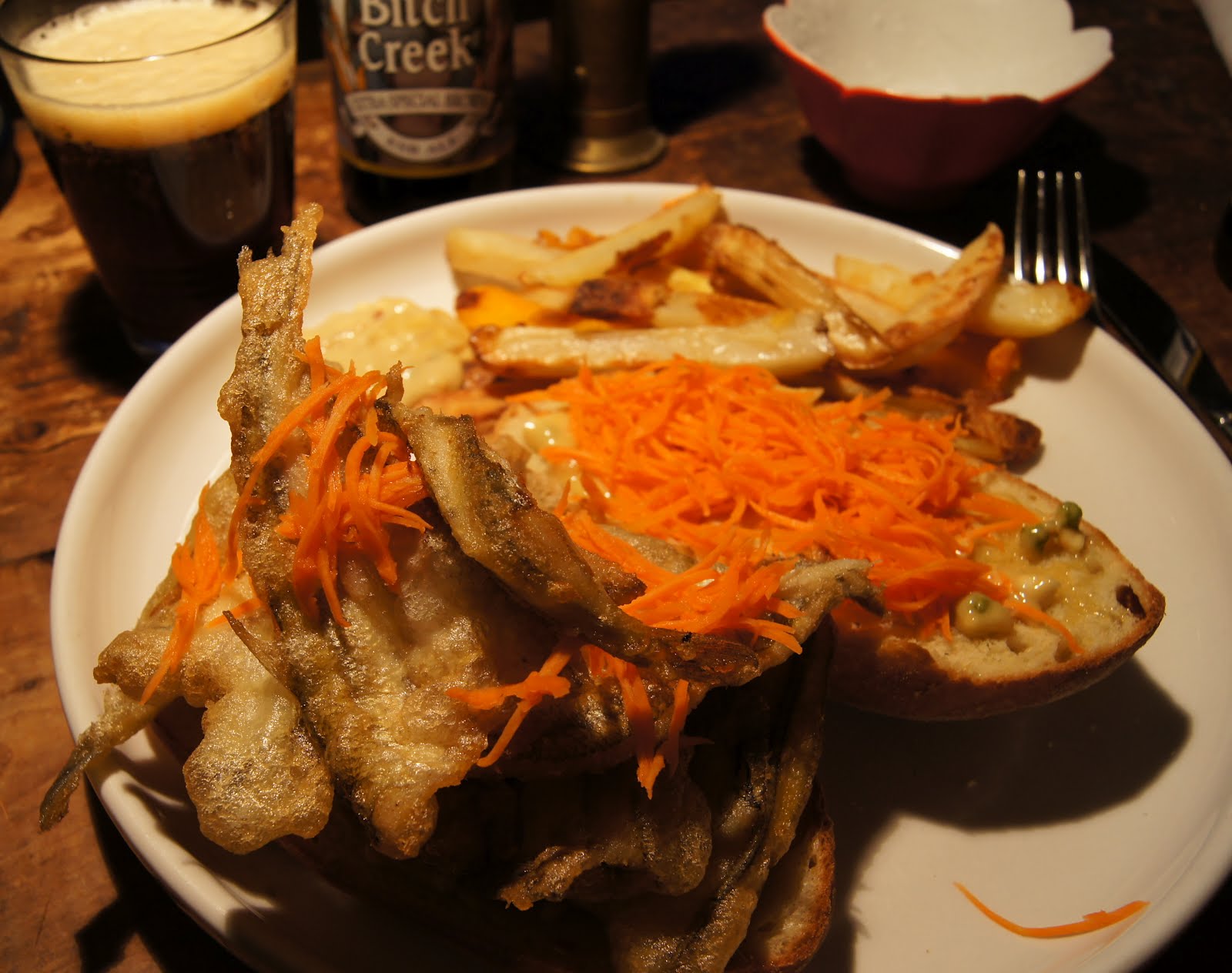
Smelt Po'boys with Wild Remoulade Sauce


We've been in eat-out-of-the-freezer mode for a couple weeks now.  When there's not enough space in the freezer to chill your martini glass, you know something has to be done.  I'm not really a hoarder of stuff, in general, but I am something of a pack rat when it comes to food.  My refrigerator is a pickle museum; I curate a jam and jelly collection there, as well.  Apparently I have a horror of endings, for I keep jars that contain a half-inch of blackberry preserves, one lonely cornichon, some scraps of fermented vegetables.  Sometimes I find jars of pickles entirely absent of pickles, nothing left but the brine.  And then, frighteningly, I'll return that jar to the fridge, thinking, hmm, there was that pickle brine rye bread recipe someone sent me eight years ago, maybe I'll make that....

As for the freezer, that's more of an archaeological situation when it comes to determining what's in there, scraping back through layers of time, discovering freezer burned trout frames, sacks of berries of dubious provenance.  I swear to god, I recently pulled out a zip bag containing a frozen block of something, and in the space where you note the contents, it said "SOUP?"  That got tossed.

But there's good stuff in there, too.  A lot of the very best fish we eat comes frozen, believe it or not.  On our trips to the South Shore of Lake Superior we always stock up on fresh fish at Halvorson Fisheries in Cornucopia. Sometimes the fish is frozen and vacuum-packed there, and sometimes we bring the fresh-off-the-boat lake trout, whitefish, and herring home and freeze what we won't use fresh.


So in our freezer clean-out mode, courtesy of Halvorson's, we've recently had burbot bourguignon (eelpout in red wine, by another name), fish tacos also made with burbot (an intriguing freshwater cod that Amy "Sourtooth" Thielen writes about here ; I'd really like to get up to the Eelpout Fest this year). And our last frozen fish from Corny was a package of smelt that had been in the freezer for at least a year, so I had my doubts as it thawed, but you know what? Here's what: Fish that is packed absolutely fresh, and properly frozen, and kept frozen, is great even a year later. The vacuum-packing provides no opportunity for freezer burn or staling. The smelt had very little "fishiness" to them; rather, they had a cucumber-y, watery scent like some oysters have. Their fate was to be dipped in a light tempura batter, fried, and served on homemade rolls with a remoulade sauce perked up with chopped pickled ramps and salted milkweed bud "capers" on a north-meets-south po'boy. We don't do a lot of deep frying, but a few times each winter we'll fry up fish or shrimp for po'boys or tacos. It makes for a fun and summery meal, most welcome in the depths of January.


It's a joke around our house that writing a cookbook is a rather elaborate way of organizing one's recipes, but damn handy once it's done. There's truth in the gag, too--putting together this meal, I made the buns from the Cornmeal Honey Butter Bun recipe (p. 120), shaping oval buns of about 5 ounces of dough.


The remoulade started with a batch of mayonnaise (p. 219), to which I added some mustard, worchestershire, finely diced celery root, salted milkweed buds, and chopped pickled ramps (p. 224). The tempura batter is in the Walleye Taco recipe (p. 165). And alongside we had Oven-Fried Roots (p. 192)--potato, celery root, and mystery pumpkin (yes, I know, pumpkin is not a root; but it cooks up sort of...rootish).


The beer, Bitch Creek Extra Special Brown, was an impulse buy purchased for all the wrong reasons--because it's from the Grand Teton Brewing Company, and Mary used to live in Jackson Hole, in the shadow of the Tetons; and Bitch Creek is a famous western trout stream, and there's a fly pattern named for it . In spite of that, it was excellent--deep, dark, toasty, and bitter (as I poured out the last few drops to rinse the bottles this morning I got to thinking of beef short ribs braised in Bitch Creek ESP, lots of leeks and onions, maybe a dash of cocoa, some allspice...).


We still haven't made much of a dent in the freezer inventory, and chances are that some day soon I'll get it in my head that I can't go another week without a piece of grilled lake trout, a plate of Herring Milkweed Meunière (p. 171), and I'll hit the road for the South Shore, returning with a cooler full of fish, most of which will go in the freezer.

Hey, I just remembered, there are still some whitefish livers in there. Now, if I can only find them....

Text and photos copyright 2012 by Brett Laidlaw