

It’s the last week of December 2015 as I (begin to) write this, 2016 looming just days away, and for cooking options we are decidedly into the winter larder. On December 6 we were amazed to eat, and very much enjoy, the last garden tomato. The last leaves of fresh kale were part of a festive Christmas dinner: seared venison loin (harvested from the Bide-A-Wee property last year) with a rich, savory red wine and port reduction; lima beans simmered with stock and aromatics, then pureed, a surprisingly luxurious result from a humble dried bean; then the kale, braised with chestnuts and garden leek, a splash of our homemade cider vinegar. Though we haven’t really celebrated Christmas in any traditional way for some years, I’m not going to let an opportunity for a festive dinner go by. And anyway, we think of it as a continuation of our solstice festivities—especially appropriate here, as Mary’s birthday occurs during the same time.
Once those last leaves of kale vacated the crisper, dinner
planning turned a page. It’s true that
there’s still quite a bit of “fresh” produce, from both garden and farmer’s
market stock-ups, in our cellar, in the fridge. But the term fresh doesn’t
really mean the same when applied to storage carrots, cabbage, squash, and onions, as it does when describing a handful of beans or a bowl of tender
lettuce harvested from the garden to be prepared and served minutes later. Those winter stand-bys are fresh in the sense
of not being frozen, dried, pickled, fermented, etc., but…you know what I
mean. It’s not the same as throwing
dew-dappled snap peas in the wok or snipping fragrant dill into a
dressing. Our vocabulary fails us in
efficiently denoting that crucial difference:
there’s fresh produce, and then there’s fresh produce.

This is not to disparage the stalwart vegetables of winter,
not at all. Like reliable character
actors, they show up and fill their roles with unfailing professionalism,
year after year, decade after decade, while the fad for arugula fades, or a trendy heirloom cucumber
turns out to be just another pickle, after all.
Cabbage, potatoes, carrots, squash, onion, leek, turnip, beets--the roster might at first glance suggest
daily supper at the gulag: bung it all in a kettle, boil until done. But there’s a saying I like (and as far as I
know, I came up with it), goes like this:
There’s meat, and then there’s cooking.
Which is to say: It’s not always
only about the ingredients, but often as much or more about imagination and
skill in preparation. Today’s soup, which we had as a first course on Christmas night, is a
perfect example.
If it hadn’t come with a sexy French name, I might never
have tried it. Puréed cabbage and potato
soup sounds, you must admit, a good deal less appealing than
Crème de Choux aux Beurre de Roquefort.
The source is Madeleine Kamman’s In Madeleine’s Kitchen. There are three remarkable and surprising
things about this recipe:
1) In spite of the cream—crème—in the title, there’s no cream
in the soup.
2) In spite of the fancy-sounding title, the list of
ingredients is short and plain.
3) In spite of the short, plain ingredient list, the resulting
soup is delicious, even luxurious, the result of “Fucking French cooking
magic,” as I described it, enthusiasm overwhelming decorum, in a tweet.

There are a couple of secret ingredients: walnut oil, and confit fat. But I think you could do without those if you
don’t have them, substituting good butter for the confit fat, olive oil for the
walnut oil. However: if you haven’t tried French walnut oil,
it is well worth seeking out. A commonly
available brand, and the one we always buy, have even brought back from Paris in the past, is J.
Leblanc. It’s pricy, but a little goes a
long way. For me, a salad of fresh
tender lettuces straight from the garden, dressed with nothing more than walnut
oil and a bit of fleur de sel is one of life’s simple luxuries. But I’m getting ahead of the season. Just one more note on the walnut oil: the French stuff is made from lightly toasted
walnuts, so it’s amber in color and has that nutty fragrance and flavor. The golden walnut oil often sold at “health
food stores” and co-ops is not the same.
The French walnut oil should not be used for cooking, only dressings and
seasoning. (NB: the English name is in small print on the bottle, so you’re looking for a bottle labeled “Huile de
Noix,” as above. For Mpls/St Paul readers, Cooks
of Crocus Hill carries it, but are currently out of stock in all stores.)

The basis of the soup is potatoes, cabbage, and water. It gets a smoky depth of flavor from
bacon. Not a lot of bacon, either, less
than an ounce per person in Kamman’s recipe (she actually calls for pancetta). No
cream or milk, as noted above. No stock,
just water (you can call it Chateau Sink, as Jacques Pepin sometimes jokes, or perhaps Domaine du Tappe, to French it
up). There’s a bit of garlic, whose
presence is felt. The beurre de
Roquefort is simply blue cheese and soft butter mashed together, a few grinds
of coarse black pepper—a simple compound butter; it’s worth making extra, for
it’s nice to have around, to smear on a burger, say.

And that, my friends, is it, the ingredient list in its
entirety. You gently render off small
cubes of the bacon or pancetta, add potatoes and garlic, then the cabbage. This sweats for a few minutes (“mellows,” in
M Kamman’s version), then you add water and simmer until the cabbage is very
tender. The well mellowed vegetables and
bacon are then whizzed up in a blender (I used a food processor, carefully
spooning out the solids, adding liquid gradually; an FP is really not the best
appliance for pureeing soups, I’ve learned from bitter experience).

And get this: it
suffers not at all from being made a day ahead and reheated just before
serving. On Christmas Eve I added a
little crunchy garnish, chopped goose skin cracklings—yeah, I happened to have
some lying around; don’t hate me because I’m beautiful—from the goose we cooked
for our first solstice celebration. When I made it again for lunch I toasted some small croutons in olive oil—it’s really about the textural contrast, that crunch to
perk up the creamy soup. (See: "It's all about the garnish".)

Coming back around to my earlier point and seasonal eating
and the winter larder: this is a
fabulous dish that you would never make in the summer, but which is perfect for
the cold months when, you know, you have a lot of potatoes and cabbage
around. It also reminded me how
absolutely lovely and civilized it is to start a meal with a soup, so elegant and yet so comforting. A fading tradition I hope to start reviving
in our house.
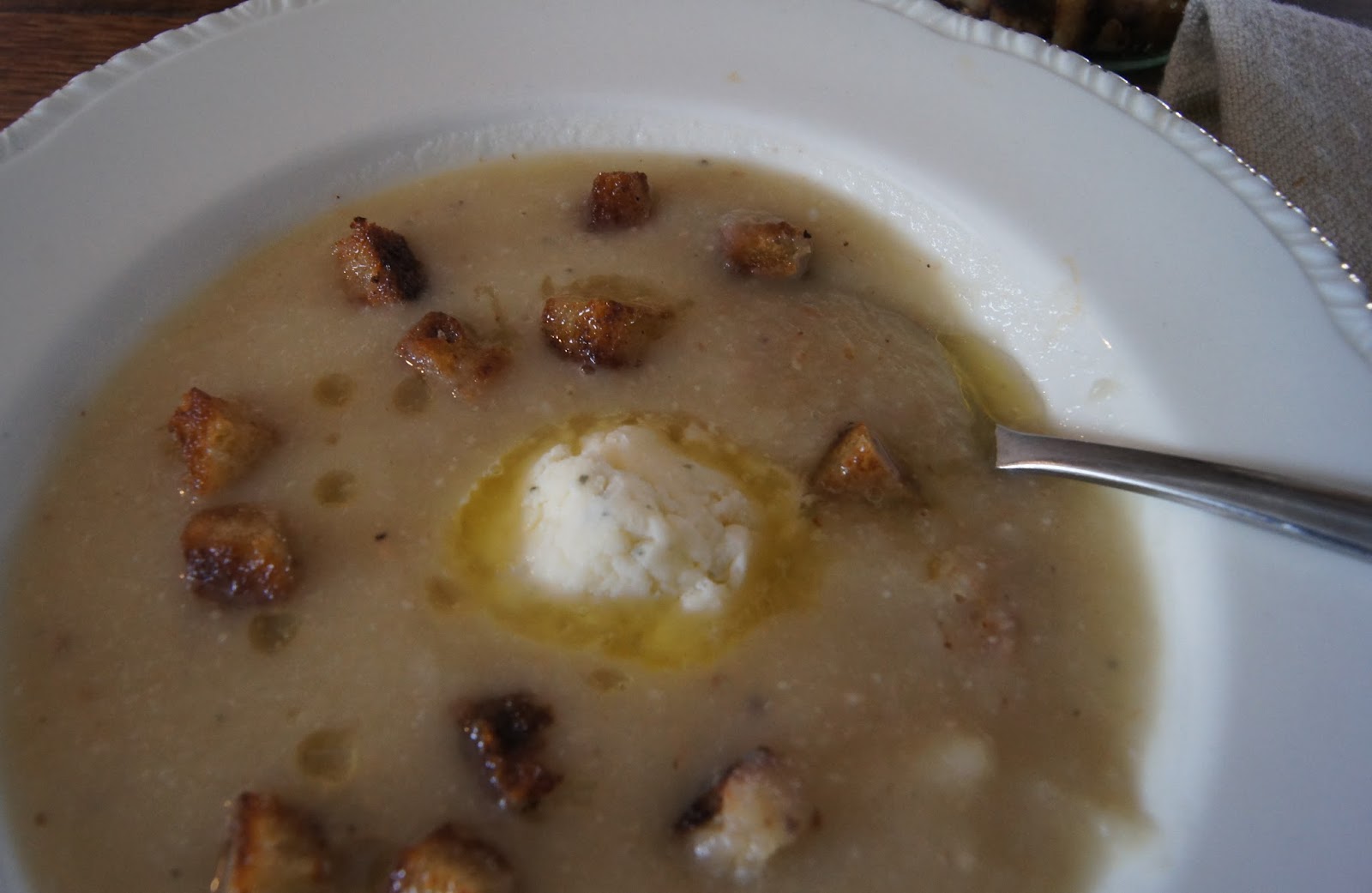
My adaptation of Madeleine Kamman’s recipe:
Creamy Bacon, Potato, and Cabbage Soup with Blue Cheese Butter
Serves four as a first course, two to three as a main
course—add salad and crusty bread to make it a meal
2 ounces bacon or pancetta, preferably in one chunk
1 tablespoon duck confit fat or butter
1 medium or 2 small potatoes, 6-7 ounces total
1 large or 2 small cloves garlic
¼ of a green cabbage, about 12 ounces
1 tablespoon walnut oil, plus additional for garnish*
Salt and freshly ground black pepper
For the blue cheese butter:
2 ounces unsalted butter at room temperature
2 ounces blue cheese
Croutons or cracklings, optional but highly recommended
In a small bowl, mash the butter and blue cheese together with a fork
until well blended.
Cut the bacon or pancetta in small dice, about ¼-inch. Peel the potatoes and cut them into smallish
cubes, about ¾-inch. Shred the cabbage
into ½-inch strips.
Heat a medium saucepan and add the confit fat or butter,
then the bacon. Cook over medium-low
heat. As the bacon renders its fat and
begins to brown, add the potatoes, tossing them in the fat, then cook, stirring
occasionally, until they become a little bit brown, 4 to 5 minutes (you’re just
looking for a golden color, not deeply browned as for hash browns). Stir in the garlic and cook for another minute
or two, then add the cabbage, a couple generous pinches of salt, and several
grinds of black pepper.
Turn the heat to low, cover, and let the cabbage sweat
(“mellow” is the term M Kamman uses) until well wilted, about 5 minutes. Add 3 cups water, bring to a boil, turn down
to a simmer, and cook partly covered until the cabbage and potatoes are very
soft, 15 to 20 minutes.
Let the soup cool for a few minutes before pureeing. If using a food processor, separate the solid
from the liquid parts of the soup and purée the solids first, then gradually
add in the liquid. When everything is in
the FP, purée for about a minute. At the
end of the minute, drizzle in the walnut oil.
Return the soup to the saucepan.
Reheat just before serving. (Note: Kamman directs you to strain the soup back into the pot after puréeing; I did not bother with this step, finding the soup smooth enough to my taste without straining. Straining would no doubt produce an even more velvety and elegant purée, if that's what you're after.)
To serve: heat the
soup and taste for salt; you will probably want to add another pinch or
two. Ladle the soup into bowls, and to
each add about a tablespoon of the blue cheese butter. Add croutons or cracklings, as you please,
drizzle a small amount of walnut oil over the surface of the soup, and serve.
*If you don’t have/can’t find walnut oil, use a flavorful
olive oil—or, perhaps pumpkin seed oil, such as Wisconsin’s own Hay River Pumpkin Seed
Oil. And, how about this—if using
pumpkin seed oil, think about substituting butternut squash for all or part of
the potatoes, then garnish with toasted pepitas instead of the
croutons/cracklings.


