Showing posts with label sichuan cooking. Show all posts

Thursday, January 28, 2016

Zesty, Rootsy Winter Pickles


With fresh local vegetables becoming more and more widely available to us year-round, even here in the Frozen North, there’s no reason that pickling season has to end with the first frost.  Co-ops and winter farmers markets are burgeoning these days with locally grown vegetables in great variety.  Yes, they’re mostly roots, but what an abundance and variety of roots, from black, watermelon, beauty heart, and daikon radishes, to turnips in several colors, rutabagas, beets red and golden, celery root, sweet potatoes, carrots, parsnips.   

What’s great about this is:  Fresh, locally grown produce, in the middle of frikkin’ winter!  What’s less awesome is:  They’re all pretty much radishes and turnips!


Personally, I like radishes and turnips, but a steady diet of them through the long cold months becomes pretty monotonous.  A little pickling is a good way to change up the flavors and textures of these hearty, assertive roots.  And for winter pickling, I tend to lean to the East.  So here are two easy Asian pickles to make in small batches and enjoy alongside a bowl of ramen, a rice bowl meal, or as part of a regular Chinese meal, or just to nosh on at will. 


The first, Sichuan Pao Cai (Pickled Vegetables) is something I’ve made off and on for a long time, and something I would often order at the little restaurants in the alleys outside the university gates when I taught English at Sichuan University in Chengdu, waaayyy back in 1989-90.  A little dish of pao cai would be served bathed in chile oil (hong you) and a dash of soy sauce.  The pickles in Chengdu were always pink, I’m not sure why.  Recently I came across a fabulous recipe for a chile oil scented with wonderful aromatics.  I’m now addicted to it, and here’s the recipe, from Elaine Luo's excellent China Sichuan Food website--you'll find the red oil (hong you) recipe in the larger wonton recipe.

The other is a super quick pickle of thinly sliced radish (but you could sub/add turnip or carrot or what have you) in a simple mixture of soy sauce, vinegar, and sugar, with a little ginger and garlic for added depth.  To me, the sweet/sour/salty flavor combination of sugar/vinegar/soy is crazy delicious.  I could drink it like broth, but it would do weird things to the inside of my mouth, I fear, so I enjoy it in moderation and in pickles. 

This can be whipped up at the last minute, or made a day or two ahead.  It loses some freshness if left to sit too long, but it’s not going to go bad.  I often make up a small quantity to liven up rice bowl dinners.  With small radishes I tend to slice them very thin on the Benriner, while with larger radishes like a big daikon, I might shred instead.


Sichuan Pao Cai (Pickled Vegetables)

Makes one quart

You can use pretty much any firm vegetables in this pickle.  In winter it’s going to be mainly roots—red beets are the only one I would probably avoid; they would take over the pickle, both in color and taste, and also, they’re just not very Chinese.  In summer you could use green beans, cucumbers, peeled, diced broccoli stems, the thick white center rib of napa cabbage or bok choi.  My veg mixture for this batch was black radish, daikon, rutabaga, kohlrabi, cabbage core, and another radish, the one that’s pink inside, I don’t know the name, a friend had picked it up for me.  

This recipe is adapted from Mrs Chiang's Szechwan Cookbook, a key book in my cooking history.

4 cups firm vegetables in ½-inch dice, about a pound
6 – ¼-inch slices ginger root
2 or more dried red chiles—I used 2, as these particular chiles are VERY HOT!!!
½ teaspoon whole hua jiao (Sichuan peppercorns)
1 ½ cups water
1 tablespoon salt
2 teaspoons sugar
1 tablespoon rice wine or dry sherry
1 tablespoon cider or rice wine vinegar

Combine everything except the diced vegetables in a small saucepan, and heat just to dissolve the salt and sugar.  In a quart jar, layer ginger slices, chiles, and vegetables.  Pour in the brine, put a lid on it, and allow to ferment at cool room temperature for 3 or 4 days. You’ll see the brine start to become cloudy, and bubbles will rise from the depths when you open the jar.  When they are fermented to your taste, refrigerate.  The pickles will keep indefinitely.


Soy-Pickled Radish Slices

A mild radish, such as daikon or watermelon, is best in this pickle, which can be used almost right away, or refrigerated to mellow for a few days.  I used my Benriner Japanese mandoline to slice the radishes, but you can also slice them very thin with a sharp knife.

About 2/3 cup thinly sliced small radishes, or shredded larger ones
1 teaspoon finely shredded ginger root
1 small clove garlic, crushed, optional
2 tablespoons soy sauce
1 tablespoon water
4 teaspoons cider or rice wine vinegar
2 teaspoons sugar

Combine the radish slices, ginger, and garlic, and place them in a small jar—half-pint will do.  Combine the rest of the ingredients, stirring well to dissolve the sugar.  Pour this mixture into the jar with the radishes, put the lid on, give it a little shake.  Let stand at least 30 minutes before serving, or refrigerate for later use.  Will keep at least a week.

Wednesday, October 31, 2012

Honey Hua Jiao Braised Lamb Shoulder with Turnips (Welcome to Braising Season)


Braising season is full upon us, that time of year when meats and roots and wines and seasonings convene in the stew pot, the dutch oven, the cocotte, even the crockpot, and slowly simmer to succulence, producing homey, savory dishes that warm the hearts of those chilled of cheek who come in from the frosty outdoors to the warm kitchen with grateful appetite and glasses all a’fog.  Or perhaps it’s incorrect to speak of braising season, since that occupies better than half the year in these parts; more like braising semester, plus.  Or a twist on the old joke about the two seasons of the Northland—road repair, and braising season.

I do love a braised meal, both for the simplicity and for the phenomenally satisfying results.  But given that our climate is more than generous in providing us opportunities to enjoy braised dishes, it’s wise to look for ways to keep our simmered suppers interesting.  Case in point, today’s plate of Honey Hua Jiao Braised Lamb Shoulder with Turnips. That’s a mouthful—and a delectable one, though I say so myself.  Let’s break it down.


The danger with braised dishes is that they can all start to taste the same—the pot roast factor, if you will.  Exactly what is comforting about this type of cooking is what can also make it dull.  The deep, meaty flavors imbue everything in the pot, and without some thoughtful flavor additions, the end result can be kind of one-dimensional.  So we look for flavors to counter-balance the meaty, salty, and fatty; we want acid, maybe even a little bitterness, and perhaps sweetness, and interesting spice.

This dish has them all:  acid from wine, cider vinegar, and honey; bitterness, just a smidge, from the turnips; sweetness from the honey, of course, and also the turnips, shallots, and garlic; interesting spice, from the hua jiao, aka Sichuan peppercorns, and my beloved thyme, which goes so well with lamb and with honey.


I think it’s about time for hua jiao to burst upon the American culinary scene.  It’s such an intriguing, appetizing spice, I think it’s a simple matter of unfamiliarity that keeps it on the back shelf—or, more literally, on some dusty shelf in a corner of the Asian market, where it may be labeled Sichuan pepper, but just as likely flower pepper (the literal translation from Mandarin), dried pepper, or even xanthophyllum (the plant genus from which it comes, a type of “prickly ash” related to citrus).  For a long time it was hard to find good hua jiao; I don’t know if mainstream sources like Penzey’s even carry it.  What I’ve been finding in my local Asian markets lately is pretty good.  But if you happen to travel to China, or know someone who’s going, of course getting it from the source is the best way to go.

Hua jiao is the spice responsible for the ma, numbing quality, in Sichuan ma la dishes, the la being chile heat.  But it also has a wonderful aroma, slightly sweet, a bit tart and citrussy, appetizing in the way that a well balanced curry powder piques the appetite.  It goes well with hot, sweet, and sour flavors, and in a long-simmered meat dish it creates a flavor layer that tempers the richness of the meat—in this case, it mellows the potentially gamy flavor of the lamb.


You could put the hua jiao in cheesecloth and remove it at the end of cooking, but I like to bite into the individual peppercorns, which will have lost most of their numbing quality in the long cooking, but which still provide intriguing bursts of flavor.

I only made this dish for the first time last night, and as soon as the various components began coming to mind, I started to write it down, thinking this might be something I might want to replicate, and pass along.  We were not disappointed.  Served over soft polenta, with the brothy sauce combining all the aforementioned flavors beautifully, still allowing the individual elements to come through, it was beyond satisfying. 

The lamb was from the Lamb Shoppe  via Seward Co-op, a lovely piece of shoulder that actually contained the end of the rib rack—just spectacular meat.  Anyone who thinks they don’t like lamb should give Lamb Shoppe meat a try.  Often when people say they don’t like lamb, it’s because the lamb they’ve had was closer to mutton.  Knowing your source in matters of meat can make all the difference.


Honey Hua Jiao Braised Lamb Shoulder with Turnips

Serves four

3 pound lamb shoulder, bone in
1 ½ cups stock, water, or a combination
½ cup dry white wine
2 tablespoons honey
1 tablespoon apple cider vinegar
¾ teaspoon whole hua jiao, Sichuan peppercorns
6 to 8 small shallots, peeled
6 cloves garlic, peeled and halved the long way
A few sprigs thyme
Salt and freshly ground glack pepper
4 small turnips, quartered
Butter

Season the lamb with salt and pepper.  In a dutch oven or similar, heavy-bottomed pot, brown the lamb in a little bit of oil (I used Smude sunflower).  Working over medium-high heat, brown it well on all sides.

Combine the stock, wine, honey, and vinegar, stirring to mix well.  When the lamb is browned, remove it from the pan and deglaze the pan with the combined liquids, scraping up the brown bits with a wooden spatula.  Return the lamb to the pan along with the shallots, garlic, thyme, and hua jiao.  Add a couple good pinches of salt and a few coarse grinds of black pepper.

Bring to a simmer and place, partly covered, in a 350 oven.  Roast for 30 minutes, then turn the lamb over and cook another 30 minutes.  Remove the lid, add the turnips, and raise the heat to 425.  Continue to roast, turning and basting occasionally, for about another 45 minutes, until the turnips and lamb are both tender.

Remove the lamb from the pot and let it rest for 10 minutes before serving.  While the lamb rests, reduce the cooking liquid on the stovetop to your desired consistency—I like it fairly brothy, but with a bit of viscosity.  Swirl in a knob of butter at the end, if you like, taste for salt.  Serve over polenta, noodles, or rice.


Text and photos copyright 2012 by Brett Laidlaw

Monday, September 10, 2012

这 些不是中国菜 / Ceci n'est pas un repas chinois / This is not a Chinese meal


I honestly feel that the most important tool in my cook’s virtual knife kit is not any twist of technique, nor depth of knowledge gained from reading about cuisines around the world and avidly eating from Strasbourg to Roanoke, Tofino to Chengdu, nor skill attained from picking up the chef’s knife every day to slice, dice, mince, chop, julienne, chiffonade, and brunoise. No, the number one weapon in my kitchen arsenal these days is the ability to go with the flow.  ‘Twas not always so.  Back in the day I’d get a notion in my head—lobster-stuffed potstickered wontons with black bean sauce, say, or a salad of peaches and beets—and doggedly pursue the wildest hare to the bitter end, no matter if that involved blood, sweat, tears, and a disappointing dinner.  Well, often that approach yielded good results—the wontons were excellent (the peach-beet salad, less so).  But it was stressful, and if affairs in the kitchen went amiss, the evening could go completely off the rails.  Nowadays, when I let ingredients lead my cooking more than any overwrought conceit, things tend to turn out better, perhaps because I’m more willing to enjoy how things turn out.  It’s a culinary version of the old, “Wherever you go, there you are.”  Maybe I’ve embraced the zen of cooking, and maybe my standards have just slipped.  Whatever.


A case in point was last night’s dinner, which was supposed to be brunch, which might have become Chinese supper, which it was not, although it was eaten with chopsticks and rice bowls.  That might require a little bit of explanation. 

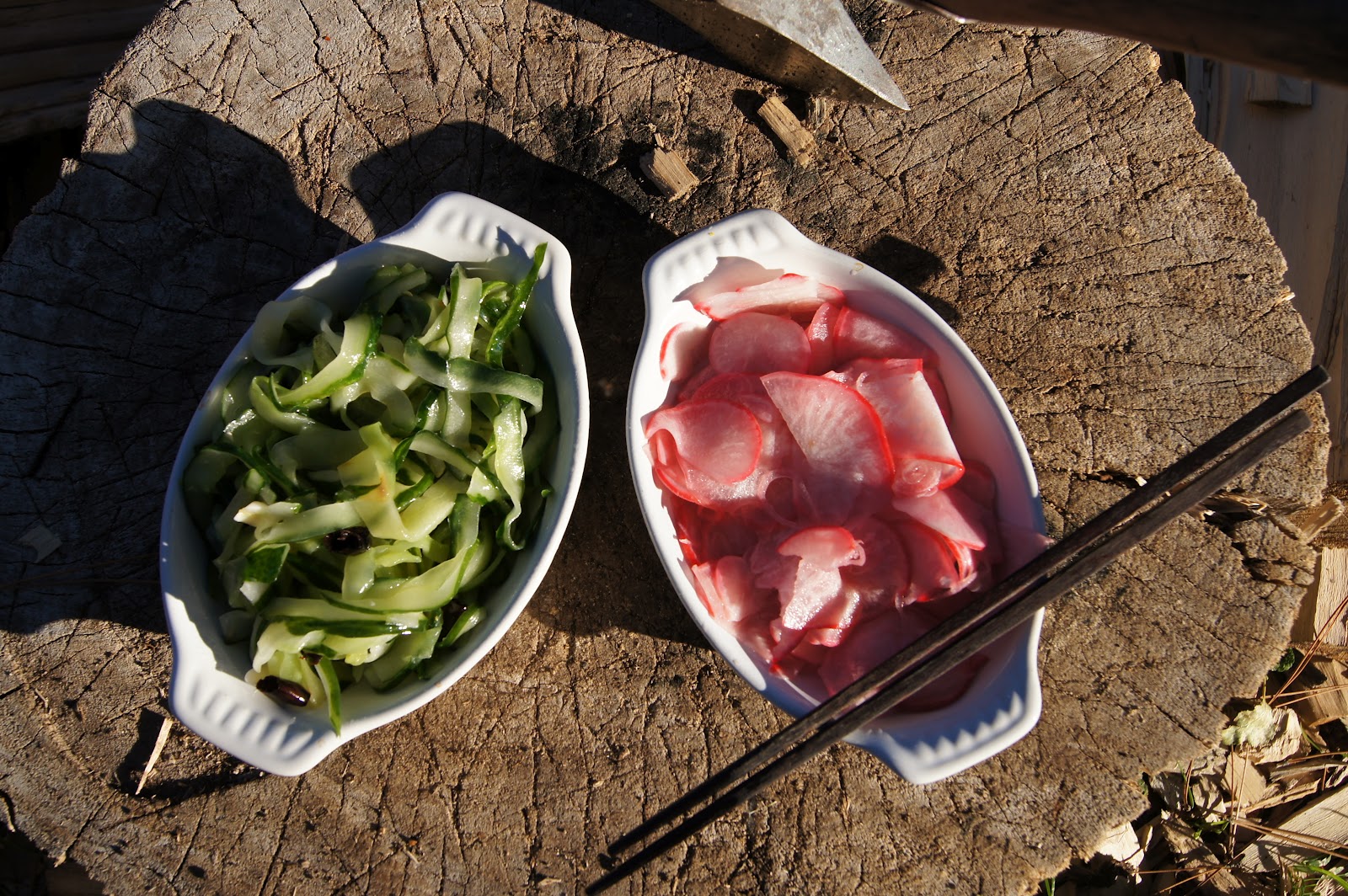
We had friends visiting at the farm and Bide-A-Wee this past weekend, and Sunday morning I started preparing some salads to have on a brunch buffet.  I was thinking of something a bit smorgasbord-ish:  there would be corn pancakes as the main event, and homemade herbed yogurt cheese, pickled beets, that sort of thing.  Maybe open a can of kippers. I found a couple of overgrown radishes in the garden which nonetheless were still firm and not too strong, and which sliced up into beautiful pink-and-white coins on the Benriner.  A couple of lovely Suyo Long cucumbers I also shaved into thin planks, and then sliced into veggie noodles, tossed those with a pretty hot chile-garlic oil, with just a splash of cider vinegar.  This could have been a Sichuan dish, except for the context.  Things were coming together nicely in my head for a delightful brunch.


But when Tim and Melinda came down the hill from Bide-A-Wee, it turned out they’d already had some yogurt and granola for breakfast, had enjoyed a walk around the Bide-A-Wee meadows, and were just about ready to head back to town.  No time or belly space for brunch.  No problem.  The salads could chill ‘til dinner.  We saw our friends on their way back home, then hopped in the car to do some shopping errands in Rice Lake.  On the way we stopped at the Crossroads Café in Cameron for Sunday dinner—Mary had the country fried steak, and I had chicken dinner (dark meat).  Both dinners came with a scoop of decent mashed potatoes, kind of soggy but still very tasty stuffing, and niblets corn (or you could have had Jell-O).  Mary’s gravy was white and specked with pepper; mine was chicken-dinner yellow.  Service was friendly and brisk.  My chicken was good, but not as good as the fall-off-the-bone version at the Sand Creek Café.  Mary’s country-fried steak was better, and she let me sample a generous portion.  After lunch we headed to Menard’s well-fed and content.  On the way to the checkout we were drawn to the looming Salted Nut Roll display, thinking that Nut Goodies would be nearby, but there were none to be found.  We settled for a Snickers (Mary) and Hershey’s Milk Chocolate with Almonds (me).   Why am I telling you this?


Okay.  Back home, little nap, some minor chores, a walk.  Radishes and cucumbers do not a supper make, but as lunch had been substantial, we didn’t want anything heavy.  Indeed, with our counters constantly covered in produce, and more, so much more in the gardens coming ripe, we think of vegetable centerpieces to our meals more than meat.  So some of the lovely corn we picked ourselves from a field near Sand Creek (with the farmer’s permission and supervision, of course!), which was originally going to garnish pancakes, that I simmered with onion, jalapeno, garlic, ginger, sage, lemon, and plenty of butter.  I had some eggplants from the market, and a big basket overflowing with patty pan squash from the garden.  My only thought with those was to grill them, toss them with minced shallots.  The thought evolved:  add some Hay River  pumpkin seed oil,* garlic, then a couple pinches of quatre-épices, cumin, and finally some piment d’espelette.  This turned out to be the star of the show.  A recipe worth writing down, passing on, repeating very soon.


And we served it all with rice, and ate with chopsticks, because that seemed elegant and appropriate, although this was not a Chinese meal.  But why not?  The cucumbers, as I say, could easily have passed on a Chinese table, and the radishes too; the eggplant-squash dish, with its mild heat and cumin fragrance, would have drawn compliments but raised no eyebrows as part of a meal in northwest China, along the silk road, where the food can seem Middle Eastern, Indian, or even Mexican.  And the corn was pretty much the same combination of ingredients that I stir-fry together for yumi chao lajiao—corn with chiles—and happily serve in Sichuan meals.  Only the butter—and maybe the sage—took it away from Chinese territory.  And yet, the combination of dishes, and the overall context, made this seem more French than Chinese.  Although it started out Scandinavian.  And it occurred to me in the course of the meal that it was a bit like the banchan dishes—kimchi, salads, and other little bites—that precede and accompany a Korean meal.


Scandinavian-French-Chinese-Korean-American tapas.  That’s what I’d call it.  With chopsticks.**

We drank a French vouvray from Champalou, a longtime favorite wine; always beautifully aromatic, ranging from dry to slightly sweet depending on the vintage.

Good things happen when you go with the flow.


Grilled Eggplant and Summer Squash with Pumpkin Seed Oil and Exotic Spice

Serves two as a side or part of a SFCKAT meal

2 Asian eggplants
2 small zucchini, same size as the eggplant, or a medium patty pan or yellow summer squash
Olive oil
Salt
1 ½ tablespoons pumpkin seed oil
1 tablespoon sunflower oil
1 small garlic clove, minced fine
1 small shallot, minced
2 small pinches quatre-épices 
2 generous pinches ground cumin
1/8 teaspoon piment d’espelette (or another aromatic, mildly hot ground chile that you like)
Good squeeze of lemon juice
Freshly ground black pepper

Remove the peel from the eggplants on two sides, remove stem and trim bottom, then slice the eggplants in half the long way, through the skin, so you have planks with the flesh exposed on the broad sections and strips of skin on the sides.  If that makes sense.  Slice the squash how you like to do for grilling.  Toss both eggplant and squash with a generous amount of olive oil, and salt generously as well.

Grill the vegetables until nicely brown, perhaps a bit charred, and very soft.  Chop them into ¾-inch chunks.  Mix the remaining ingredients, along with another pinch of salt and a few grinds of pepper, and toss with the vegetables.  Garnish with a few very thin shallot slices, if you like.
_____________________________________________________
* This dish turned out to be my favorite-to-date use for our Ken and Jay's wonderful Hay River pumpkin seed oil.  Though the oil's flavor took a backing role to the fragrant spices, the oil's texture gave a real depth and heft to this all-veggie dish.  I don't know why unctuous often has negative connotations; this dish, which actually used three different oils, had a savory unctuousness that was extremely appetizing.


**All of which made me think of  this excellent article by (Dear) Dara Moskowitz Grumdahl on the sense of the authentic in contemporary cuisine, "culinary imperialism", and the Twin Cities Asian restaurant boom--which is much more the real deal than the so-called Scandinavian restaurant boom, which consists of one high-end restaurant and a lunch spot in the American Swedish Institute....


Tuesday, August 21, 2012

Consider the Eggplant


Here’s another vegetable that we sophisticated eaters now take for granted, but which was rarely seen on the tables of our youth.  In fact, I cannot remember my mother cooking eggplant, ever.  Not once.  Really.  Eggplant parm on the menus of the local Italian-American restaurants, that was pretty much the extent of my acquaintance with eggplant until sometime in the early ‘80s.  Not that I ever ordered it.  And you know, you can’t really blame American cooks for approaching eggplant a bit leerily.  After all, here was a vegetable for which all the recipes instructed you to first slice it and salt it, maybe press it, to draw out the bitter juices.  Can you blame a guy if he wondered:  Can’t we just start with something that doesn’t have bitter juices?  And while many vegetables are perfectly lovely in their raw state—tomatoes, sweet peas, green beans, sweet corn, even kale—no one’s going to be snacking on raw eggplant while prepping dinner at the cutting board.


What's great about eggplant, of course, is the way it combines with other flavors, and the creamy texture it attains when properly cooked.  I think it was ratatouille that first interested me in eggplant, then baba ganouj, but where the purple fruit really shines is in Chinese cooking, and when I say Chinese cooking I mean Sichuan food, and when I say Sichuan food I mean yu xiang qiezi, and when I say…that, I mean:  Fish Fragrance Eggplant, one of my favorite Sichuan dishes, which puts it well up there among my favorite things to eat, period.  Where the fish in the title comes from, we will probably never know.  There are theories:  that the seasonings in the dish are the same commonly used to cook fish (but I had fish prepared many different ways in Sichuan); that in land-locked areas this preparation was somehow meant to mimic seafood (but even where there are not oceans, there are lakes and rivers).  


What’s certain is that there is nothing remotely fishy about the dish.  The eggplant is first fried to soften and brown it, then a sauce is prepared, of garlic and ginger, hot bean paste, soy, vinegar, and sugar, then the eggplant is anointed with this fragrant mélange, and the result is a really quite humble dish which nonetheless bursts with a complex interplay of flavors, aromas, and textures.  Zhen hao chi!

You can make this with the larger, Italian type of eggplant, but the skinny Asian kind is best.  I really like the pale lavender-and-lilac varieties, but I've only seen the dark versions this year.  I don't have them in my garden this year; the couple of plants I purchased failed to thrive.  It has been my experience that really fresh eggplant, whether of the Italian or Asian type, isn't bitter.  I think it's the long-haul, far-from-fresh eggplant we find in grocery stores in winter, dull-skinned and soft, that tend toward bitterness, and should be avoided.    Look for eggplant that is firm and shiny-skinned.  Don't let it sit around too long; it does not keep well.


The height of vegetable season--i.e., now--is a great time to dive into Chinese cooking.  Meat is often used more or less as a seasoning in many Chinese dishes, and the multi-plate format of a Chinese meal is a wonderful way to enjoy the amazing variety of produce available right now.  Sweet corn and chiles, cucumbers, and eggplants were the stars of a recent dinner chez Ecklaw.  Since our new house has an electric range, doing a proper stir-fry is difficult.  The wok doesn't get hot enough; a big sauté pan works okay, but it's really not the same.  So on this recent evening I decided to try the live-fire method.


A hunk of old metal we found in the woods at Bide-A-Wee made an adequate wok burner cooktop.  Things were off to a good start with the corn and chile stir-fry:


But we were racing against time:


And we lost.  We got one dish done on the fire, then made a mad dash back into the house to finish cooking in the kitchen.  It turned out okay.


Sichuan "Fish-Fragrance" Eggplant (Yu Xiang Qie Zi)


If you can’t find the long, thin Chinese or Japanese eggplant, this dish can be made with regular eggplant.  If you use regular eggplant:  Trim the ends and cut the eggplant in half the long way; use a spoon to scoop out the seediest part of the center, then cut the rest into bite-size wedges.  Chopped pickled chiles are usually used in China; sambal is a more than adequate substitute.

A little bit of ground pork is often added to vegetable dishes in Sichuan.  You can omit it for a vegetarian version, but the well-fried, slightly crunchy pork makes a wonderful textural contrast to the creamy eggplant.

1 pound Chinese eggplant    
1 cup cooking oil

Trim the stem from the eggplants, cut them in half the long way, then cut on the diagonal into 2- to 3-inch pieces.  Heat a wok or heavy saucepan, then add the oil.  When the oil is hot deep-fry the eggplant slices, in two or three batches, until they are soft and just a little bit brown on the cut ends.  Drain them on a paper towel.  Pour out the deep-frying oil (you can save it to use again) and wipe out the wok.


1 tablespoon sugar       
1 tablespoon dark Chinese vinegar* (see note)
2 tablespoons soy sauce          

Mix the sugar, vinegar, and soy sauce together, and stir well to dissolve the sugar.


¼ pound ground pork  
1 ½ tablespoons minced garlic
1 ½ tablespoons minced ginger
1 tablespoon chile paste (such as sambal oelek)
1 tablespoon broad bean paste with chile
2 tablespoons cooking oil         
½ teaspoon ground roasted Sichuan pepper
2 scallions, minced

Heat your wok or fry pan and add 2 tablespoons oil.  When the oil is very hot add the ground pork and stir-fry until the pork is cooked and slightly browned,  2 to 3 minutes.   Add the garlic, ginger, and and both chile and chile bean paste, and stir fry for 1  minute.

Now add the eggplant and stir-fry for about a minute to coat the eggplant with oil.  Then stir up the soy-vinegar-sugar mixture and add it to the pan.  Stir-fry for 1 minute and then remove everything to a serving plate.  Sprinkle the scallions and Sichuan pepper over it, and serve.


* Chinese dark vinegar is not at all the same as "black vinegar," as I was reminded yesterday when I mistakenly purchased the black kind, which tastes almost like Worchestershire sauce.  The dark vinegar I usually buy has a yellow label and is called "Chinkiang Vinegar": picture of the bottle in this post from last summer. 

Text and photos copyright 2012 by Brett Laidlaw

Monday, August 13, 2012

Cool As


There’s that old saying that in summer’s dog days you can sit by a country road and hear the corn grow.  Along those same lines, I do believe that I could sit myself down in a corner of my garden right about now and watch the cucumbers swell.  Not that I have the patience for that, nor do I mean to imply that our rural life is quite that somnolent.  We do have Dish TV, you know, and the New York Times, and fairly active minds.

However, it is certainly true that a pinkie-sized cuke the evening before can easily grow to kosher dill-size by the next morning.  Also, as all you gardeners will have observed, some cucumbers possess a sort of stealth technology that allows them to escape detection until they have reached near football size.  As diligently as one might rummage in the prickly leaves, a few fruits always get away, until one day when you reach in and your hand latches on to a cucumber as big around as your forearm.  Honestly, how does this happen?  It’s a phenomenon that has perplexed me over decades.


Cucumbers are easier to find, easier to pick, and more pleasant to behold when they are growing up a trellis.  We have this sort of rotty white wooden fence that I screwed a metal grid onto, and both cucumbers and beans have happily ascended it.  I have two kinds of cucumbers in my garden—Burpee Pickler and my favorite cucumber, the Suyo Long.  I used to seek out French cornichon cucumber seeds, until I realized that a cornichon is just a little cuke.  If you pick the Burpees at 2-inch size, they work just fine for those vinegary pickles, tel mignon, which must accompany a slice of terrine.  I’m not picking the babies this year, though, as I still have a good stock of cornichons in the fridge from last year.
 

I’m letting the picklers grow a bit more, and they’ll get fermented in a simple brine with dill, garlic, and chilies to make Russian-style (or is it Jewish?) sour dills.  Oh, how I love those pungent, fragrant cukes, slightly piquant, sour and salty.  I could eat a bowl at a time, but I help myself judiciously, to make sure they last me through the winter.  The trick of adding currant, oak, grape, or cherry leaves to the brine to ensure crispness really does work.

Now about the Suyo Long, a type of cucumber I first encountered in China, where this is the standard cuke.  How long is a Suyo Long?  Pretty darn long.  The one spanning the frame below would be a good 16 inches if straightened out, and they’ll go a few inches longer than that.  Growing them on a trellis causes them to grow straighter.  If they’re lying on the ground they tend to curl up.


The virtues of this type of Asian cucumber are many.  Let me count them:  First, although they come from the vine very prickly indeed, once the spines are washed off the skin is quite tender, and not bitter.  Then, while by no means seedless, they have fewer seeds, and less tough, than the typical cuke.  And the flesh seems less watery, with a slight fragrance of watermelon rind.  They really are a total taste of summer for me.  They’re my favorite for bread & butter pickles, sliced into a classic salad with sour cream or yogurt dressing, chopped for a cool and hot salsa.

And of course they make me nostalgic for the time I spent in China, where I would sit with my fellow teachers or my Chinese students in one of the little open-air restaurants along the narrow grubby streets just outside the university gates on warm, hazy evenings and order up mapo doufu (tofu in spicy pork sauce), hui guo rou (twice-cooked pork), and often a dish of liang ban huang gua, cucumbers in a dark, spicy dressing with plenty of garlic.  Indeed, cucumbers and garlic are one of those classic combinations found in cuisines all over the world.  There’s another Sichuan cucumber salad, suan ni huang gua, in which the dressing consists of little but very finely minced garlic.  Not for the faint of heart, or first-daters.

Printed on cheap, cheap paper, poorly bound, Selected Sichuan Recipes 1 & 2 from the Sichuan Culinary College are among the most cherished volumes in my cookbook collection.
Like the French, the Chinese often cook cucumber, pairing it in stir-fries with cubed chicken or pork.  If you haven’t tried it, cooked cucumber is a delightful surprise.  It retains some of its iconic coolness even while hot, and pairs wonderfully with the numbing and hot (ma la) flavors of Sichuan cooking.  The recipes below are copied directly from handouts for Sichuan cooking classes I taught a long time ago, almost no changes.  They worked then, they should work now.  Have a try.
  

Cucumber Salad (Liang Ban Huang Gua)

The Chinese don’t eat many raw vegetables, for a variety of reasons.  But this cucumber “salad” is a common summer dish in Sichuan.  Serve it right along with the other dishes in a multi-dish Chinese meal.  With the potent flavors of chili oil and pulverized garlic, it will hold its own.

2 medium cucumbers, about a pound

With tender summer cucumbers, leave the skin on.  With winter grocery store cukes, peel them entirely or just mostly, leaving some thin strips of the skin for color.  Cut them in half lengthwise, scrape out the seeds, and cut each half lengthwise again.  Smack these quarter strips with the side of a cleaver or heavy knife a couple of times—this opens the flesh up a bit to take in more of the sauce.  Cut the strips into 1-inch pieces. 

3 cloves garlic  

Peel the garlic, then smash each clove flat with the side of a cleaver or heavy knife.  Mince and scrape the garlic on your cutting board till it is nearly a paste.  Adding a little bit of  salt will help this process but is not necessary.

2 scallions, minced        
2 Tbl soy sauce
1 Tbl Chinese dark vinegar       
2 tsp sugar
1 Tbl chili flakes in oil    
1/2 tsp sesame oil
1/2 tsp ground Sichuan pepper

Mix the garlic and the rest of the sauce ingredients.  Pour the sauce over the cucumbers and mix well.  Serve.


Chicken with Cucumbers (Huang Gua Ji Ding)

Cucumbers are often cooked in Chinese cuisine.  They must be treated rather delicately, cooked just enough to take away the raw flavor, but not so much that they lose their crispness.  This simple recipe combines diced cucumber with chicken, chilies, and a copious dose of garlic. [This is also very good with pork subbed for the chicken, and a bit of sugar (1/2 tsp?) and soy sauce (2 Tbl?) added to the marinade.]

1 medium cucumber                  
1/2 tsp salt

Peel the cucumber, cut it in half lengthwise, and scoop out the seeds.  Cut the cucumber into 1/2-inch dice, put them in a bowl, and mix in the 1/2 tsp salt.  Let it sit for 20 minutes or so, while the salt draws off some of the moisture from the cucumber.  Then drain the cucumber, squeezing to remove as much liquid as you can.

6 oz boneless, skinless chicken breast or thigh meat, cut in 1/2-inch dice
1 Tbl rice wine or dry sherry
1/2 tsp salt
2 tsp cornstarch 
1 tsp sesame oil

Mix the chicken with the rice wine, salt, cornstarch, and sesame oil.  Let marinate at least 20 minutes.

1 1/2 Tbl minced garlic
4 whole dried red chilies (or more, to taste), broken in half
2 Tbl vegetable oil
1/4 tsp ground roasted Sichuan pepper

Heat a wok or fry pan over high, then add the 2 Tbl oil.  When the oil is very hot add the chilies and stir-fry until they begin to darken, about 30 seconds.  Then add the garlic and stir-fry for just 10 seconds.  Add the chicken and stir-fry until the chicken is white and firm, about 1 minute.  Add the cucumbers and stir-fry for 1 minute. 

 Remove to a serving plate, sprinkle with the Sichuan pepper, and serve.


Text and photos copyright 2012 by Brett Laidlaw

Saturday, July 30, 2011

Our Own Private Chengdu


The hot and soupy weather we've been swimming through the last few weeks has at least one fringe benefit for me--it reminds me strongly of the year (1989-90) I spent teaching English at Sichuan University (sichuan daxue, Chuanda for short) in Chengdu, the capital city of Sichuan province in southwestern China.  It also makes my kitchen intensely fragrant with the scent of hua jiao, Sichuan pepper, that I keep in a bamboo container in a cupboard.  When it's this humid and warm, every time I open my cupboard I'm just about knocked over by that tart, citrusy smell.

The guide books characterize Chengdu's climate as "subtropical monsoonal"--so now you know how to describe this summer in a nutshell.  Whether the cuisine of Sichuan evolved as a response to the climate, or through other factors, it's certainly true that the vibrantly flavored food of Sichuan is just the thing to boost the appetite on sticky hot evenings.  Sichuan cooking--and Chinese cooking in general--also allows you to perform a leisurely prep of your ingredients (perhaps while sipping a cold beer), then finish the cooking--generally stir-frying--in just a few minutes (then pop another brew to drink with dinner).

The distinctive flavor combo of Sichuan food is the yin-yang duo of ma la: ma for numbing, from fragrant Sichuan pepper, la for spicy hot, from chile peppers.  In addition, Sichuan dishes are often quite salty, from soy sauce and fermented bean paste, and brightly piquant with vinegar, usually a pungent dark vinegar that gives Sichuanese liang ban dishes--salads, basically--a unique and exotic kick.


Of the dishes shown here, two are standard dishes that I and my friends and colleagues at Chuanda would order at the little open-fronted restaurants that lined the alleys just outside the university gates.  I'm swooning in memory to recall the full-sensory assault that a slow walk through those narrow lanes entailed on a warm damp evening:  the strangely pungent smell of raw rapeseed oil--the standard cooking oil--turning from repellent to appetizing as it heated in a wok; the funkily delicious aromas rising from bins of bean paste, dried shrimp, and other aromatic goods at a vendor's stall; the savory scents wafting from a hot pot restaurant where bubbling cauldrons, topped with a slick of fiercely red oil, held highly aromatic broth, the secret ingredient of which, so it was said, was an opium poppy seed pod.  There were less appealing olfactory elements, as well--a breeze from the east would bring the air off the river, far from pristine; a passing bicycle cart carrying a container of nightsoil left a fetid wake--it was my year-long nightmare that I would some day collide on my bicycle with one of these ripe vehicles that carried dilute human waste to fertilize the vegetable fields just outside the city (and there's your explanation for why the Chinese do not eat leafy green salads...).


Seated at a small table in one of the very basic restaurants, we would order tea and pijiu, beer, and never bother to look at a menu, which, at any rate, we couldn't read, since it was entirely in Chinese characters.  The thing is, the Chinese customers didn't bother with a menu, either, and it was about two-thirds of the way through my year in Chengdu that I discovered that my favorite small restaurant, "The Sisters," even had a written menu.  Instead, we just ordered according to the ingredients we saw displayed at the cook's station--if there was eggplant we'd get yu xiang qiezi, fish-fragrance eggplant; if there were fava beans, liang ban can dou, a salad dressed like the cucumbers shown here.  Always you could get mapo doufu, the wickedly ma la Sichuan tofu in meat sauce (which is never nearly ma enough at any American Sichuan restaurant--it should set your mouth tingling to where you think your tongue has swelled to twice its normal size), or shui zhu rou pian, perhaps the hottest Sichuan dish of all--pork slices stir-fried with hot bean paste, simmered in water, poured over vegetables in a small casserole, then topped with absurb amounts of ground dried chile and Sichuan pepper which is set sizzling when anointed with smoking hot oil; its name translates, innocuously, as "water-cooked meat slices."


Well, I could go on.  But on to the dishes here displayed, a simple, nearly vegetarian meal we put together on a recent, extremely Chengduvian evening.  First the cucumber salad, liang ban huang gua.  When I was in Chengdu I ate this at least once a week while cucumbers were available, but I've never seen it on a menu here, even though there are now several authentic Sichuan restaurants in the area (as for what passed for Sichuan cooking up until recently, the less said, the better).  There's often a cucumber dish on the appetizer menu, but it's often cooked--which is fine--and bland--not so fine.  This salad is one of my favorites, and especially good if you have the long, ridged Asian cukes, but fine with any kind.

Sichuan Cucumber Salad (Liang Ban Huang Gua)
Liang Ban means "cool, mixed", and generally denotes a salad

1 medium cucumber

If the skin is tender, leave it on; if it seems tough, remove all or part.  Trim off the ends, then halve it the long way, and if it is very seedy, remove some or all of the seeds--the Asian cukes tend to have fewer and smaller seeds than the typical American slicer.  Cut each half in half again, the long way, and with the side of a cleaver or chef's knife, whap these long pieces a few times--assertively, but not vindictively.  This opens up the flesh a bit to take in more dressing.  Now cut the cucumber strips crosswise into roughly 3/4-inch pieces.

The dressing:

2 large cloves garlic (or more, to taste--there's a sort of variation on this salad called suan ni huang gua, which is cucumbers in a sea of puréed garlic)
1 tablespoon soy sauce
2 teaspoons Chinese dark vinegar (see picture)
This is the brand of Chinese dark--not black--vinegar I buy
1 1/2 teaspoons sugar
2 teaspoons chile flakes in oil (or to taste; use some sambal if you don't have the chile oil)
1 teaspoon ground roasted Sichuan pepper
1 scallion, chopped fine
sesame oil, optional

Peel the garlic, crush it with the side of a cleaver or big knife, then mince it very fine.  Combine the garlic with all the other ingredients except the scallion and sesame oil.  Toss the cucumber pieces with the dressing and transfer to a serving dish.  Sprinkle with the scallions and a few drops of sesame oil, if you like.

This will serve two to four, depending on how many other dishes you make.  The two of us polished this off easily on the night in question.


Corn in China is called yu mi, or "jade grain"--and in these pictures I think you can really see why. This dish is yumi chao lajiao, corn stir-fried with chile (or sometimes qing jiao yumi, green chile corn).  Corn, needless to say, is not native to China--but then, neither are chiles, which virtually define Sichuan cooking in most people's minds.  But corn is fairly common in Sichuan and Yunnan, and this simple stir-fry with chiles fresh and dried, garlic, and whole Sichuan peppercorns, is its most common manifestation. 

Sichuan Stir-Fried Corn with Chiles (yumi chao lajiao or qing jiao yumi)

2 ears corn, kernels stripped from the cobs
2 fresh chiles, halved, seeded, cut into 1/2-inch pieces--anaheim, hungarian wax, banana, a not-too-hot jalapeno
3 cloves garlic, peeled, roughly chopped
3 scallions, white and green, cut into 1/2-inch pieces
3 dried red chiles, broken in half
1 teaspoon whole, untoasted Sichuan peppercorns
1/8 teaspoon salt
2 tablespoons oil (peanut, canola)
sesame oil, optional

Get a wok very hot.  Add the cooking oil, and as it just starts to smoke, add the dried chiles and the Sichuan pepper.  Swirl these in the oil, then add the corn, fresh chiles, garlic, and salt.  Stir-fry over highest heat for 2 to 3 minutes--watch that the garlic doesn't burn.  Add the scallions and stir-fry for another minute or two--some of the corn should be getting a bit brown on the edges.  Transfer the corn to a serving dish, and sprinkle on a few drops of sesame oil, if you like.

This dish can be made with frozen corn, thawed, patted dry with paper towels.  A little bit of sugar can be added if the corn isn't very sweet.


The third dish, chanterelles with bacon and garlic chives, was my own concoction, and while decent (it has home-smoked bacon, and chanterelles...), it's not one I'd make again.  The bacon overpowered the chanterelles--it might actually be better with something like oyster mushrooms, and more chile.

We always serve steamed jasmine rice in a small bowl for each person, and pretty much always drink beer with Sichuan food.  We take the Chinese approach of dipping into the communal bowls with chopsticks (though a spoon helps with the corn).

I'll pull out a Sichuan recipe--and reminiscence--from time through the rest of the summer, while the market stalls are full of produce begging to be stir-fried, and the hua jiao is at its most fragrant.

Text and photos copyright 2011 by Brett Laidlaw

Wednesday, June 23, 2010

Gong Bao Tu Dou Ding


Mary got home from work yesterday, came into the kitchen, stopped and said: "It smells like summer in here. Why does it smell like summer?"

I swept a hand toward my mise en place of chopped and sliced and slivered garlic, ginger, green onions, chilies, and a bowl of "fish fragrance" dressing, soy, sesame, dark vinegar, sugar, sambal, hua jiao. "Because we're having Chinese food!" I said.

Mary smiled.

Specifically, we were having Sichuan food, the best thing in the world to eat on a hot and humid summer evening; last night definitely qualified.

One of the dishes was gong bao tu dou ding, which might bring to mind the desperate, slurred imprecations of a drunk outside a bar after closing time.

Drunk outside bar, disheveled, holding out hand, staggering: "Hey, buddy, couldja gong bao tu dou ding me?"

You, alarmed, recoiling: "I beg your pardon? You want to go where? You want me to bring you what? Look, uh, I, I gotta go...".

And...scene! Here concludes another episode of Trout Caviar Internet Theater.

Gong bao tu dou ding=Kung Pao Potato Cubes. You might not have heard of it. I might just have made it up, as gong bao tu dou ding draws exactly zero results in a Google search. Kung pao potatoes gets a few. But this isn't any particularly original preparation, just a nice vegetarian variation on the Sichuan classic Kung Pao Chicken, gong bao ji ding. Gong bao is usually translated as "grand duke," as a certain gentleman of that rank was said to have particularly enjoyed the dish. Ding is a small cube, a dice. Many Chinese dishes specify the shape of the food in the title. Pian=slice; si=shred.

I'm not going to tell you what ji means. Here I substitute pieces of nice, firm, sweet market new potatoes for the meat component of the dish. Chicken is used most commonly in Sichuan, followed closely by pork, and gong bao tu ding, kung pao rabbit, is on many menus, as well. Vegetarian versions may use mock duck (wheat gluten) or cubes of fried tofu.

Oh, and I have to tell you the literal translation of the characters that mean potato, tu dou: it's "earth bean." Love that.

I was very pleased with this earth-beany iteration of kung pao. I would make it again, if I didn't have any meat on hand, or just for variety, and another way to use those excellent new potatoes.

Gong Bao Tu Dou Ding

1 generous cup (6 ounces by weight) small new potatoes, red or white or a combo
1 Tbsp slivered ginger
1 Tbsp finely sliced garlic
2 scallions, in 1/3-inch pieces (use the white and the light green)
3 dried red chilies (or more, to taste), cut in half
1/2 cup raw skin-on peanuts--available in Chinese markets and at co-ops
1 tsp whole Sichuan peppercorns (hua jiao)

Sauce:
1 Tbsp rice wine or dry sherry
1 1/2 tsp Chinese dark vinegar
1 1/2 Tbsp soy sauce
1 tsp sugar
1/2 tsp sesame oil
1 tsp cornstarch

1 cup canola or peanut oil

Wash but do not peel the potatoes. Cut them into pieces, roughly 1/2- to 3/4-inch cubes--my potatoes were so small, barely bigger than grapes, I just cut them in half, and some I even left whole.

Heat a wok or deep fry pan, and add the oil. When it is hot (dip a piece of trimmed scallion green in; it should sizzle right away), add the potatoes and fry for 3 minutes, moving the pieces about gently with a wok shovel or spatula. The potatoes should just start to brown. Drain on paper towels.

Pour the oil off into a clean heat-proof container, like a Pyrex measuring cup, and reserve. Heat the wok again, add about 1 tablespoon of the oil, and the peanuts. Cook over medium heat, stirring constantly, until the peanuts are lightly, uniformly brown, about 2 minutes. Drain on a paper towel.

Mix all the sauce ingredients in a small bowl. All these steps can be done well in advance.

Just before you're ready to serve, then, heat your clean wok again, and add 2 tablespoons of the reserved oil. Add the chili pieces and the hua jiao, and stir-fry--high heat--for 30 seconds, until the spices become dark and fragrant (you will sneeze). Add the garlic and ginger, and stir-fry for 15 seconds--don't let the garlic burn. Add the potato pieces and the scallions. Stir-fry for 1 minute.

Stir the sauce well to dissolve the settled cornstarch, and add it to the pan all at once, stirring briskly. Add the peanuts. Stir-fry another 30 seconds.

Serve with steamed rice and cold beer.


Quick pickle of snap peas and carrots.

The flashing chopstix of delight.


Text and photos copyright 2010 by Brett Laidlaw


Wednesday, December 2, 2009

Sichuan Chicken with Chestnuts (with a "Mild Diatribe in Support of More Interesting Local Foods Restaurants" on the side)

People eat local and seasonal foods all around the world, you know.

Well, duh-uh.

Maybe so, but you wouldn't necessarily know it from the menus of most American restaurants devoted to that culinary philosophy. For the most part, local foods restaurants in these parts offer a kind of cooking generally described as "contemporary American," which you could translate this way: French. Now, the contemporary American chefs purveying this kind of cuisine might protest, but when I see coulis, sabayon, consommé, fricassé, gateau, fromage de tete (these are all from one local menu I just peeked at online); when I see soufflé, brioche crouton, jus, terrine, crepe (from another)--if it looks like a duck, walks like a duck, quacks like a duck--c'est peut-etre un canard, n'est-ce pas?

Not that I have anything against French cooking. You kiddin' me? Love it to bits. But when I think of all the things we could eat, all the ways we could eat, I sometimes find this rigid adherence to what is, in many ways, an outdated way of putting together a meal--I find it kind of stultifying, uninspiring. I think it's often more about fulfilling diners' expectations of a "nice dinner" than it is about making the most of great local products. And now, not that there's anything wrong with fulfilling diners' expectations, but....

This creeping dissatisfaction with the typical "nice" restaurant format came into sharp relief for me during our lunch last month at
Momofuku Ssam Bar in New York (though even there, I now note, there's a prix fixe option; mon dieu). The flavors there came from China, from Korea, from Vietnam, from Japan; but also from Pennsylvania, Missouri, and New York. This, to me, was truly contemporary American cooking. It's not that I don't love my rillettes, but could I please have them with a side of kimchi?

Another meal we enjoyed on that trip was a dinner at
The General Greene restaurant in the Fort Greene neighborhood of Brooklyn (don't know why their menus don't come up on the website, but you can look at the pictures, at least...). Here they don't quite reinvent the wheel in the manner of the Momofuku restaurants, but the eclectic menu and informal manner of service create a very contemporary dining experience overall. They skip the usual categories of appetizer, entrée, etc., and just list all the dishes together. The priciest thing on the menu was a whole fish, a dorade, for $24 (it was also, I thought, one of the less interesting things we ate, though I love fish). Everything else was well under $20.

We had five good eaters at the table, and so we ordered pretty much the whole menu: chicken liver toasts, sliced radishes with anchovies, roasted three-squash salad (some cheese in there), grilled hanger steak, cockles with potatoes (also a bit boring, though I love cockles!), candied bacon (as good as you'd imagine, $5 for two big hunks), dirty rice, green bean salad, kale sautéed with garlic.

When the waiter informed, rather than asked, us how the meal would be served, I admit I was a little taken aback (hey, I want my expectations fulfilled here!). Dishes would come out according to the kitchen's pace, and were intended for sharing, we were told. When the food started to hit the table, I quickly forgot my little silent snit. The flavors were bright and satisfying, and everything spoke of the season without being pedantic about it. It was truly fine dining, and truly good fun. (I thank my Brooklynite friend David for taking us to The General Greene; he claims to not know much about food, but he's modest. At least he knows a great restaurant when he sees one.)

I'm not knocking our restaurants that hew to the French program in presenting local foods. They do great work in promoting local products and opening people's eyes to the delicious foods our region has to offer. I just wish the local-seasonal ethic would trickle down a little, down to noodle shop level, say. There is one local restaurant that applies the local foods approach to less traditional fare, and it's a very good example, indeed:
Ngon Vietnamese Bistro on University Avenue in Saint Paul (Ngon is pronounced "nong," I've heard, and I believe it means "tasty" in Vietnamese). Ngon's traditional Vietnamese dishes are very, very good, and some of their more contemporary creations, like crispy rabbit dumpling with curry sauce, are superb. It's one of our top three lunch spots these days (I just wish they'd turn the music down a notch or two...).

Is Ngon the exception that proves the rule here, or am I just not getting out enough? If you know of Twin Cities restaurants that break the fine dining mold and feature local ingredients, I'd love to hear about them--examples from other cities would be great, too. I saw something recently about a new Doug Flicker restaurant that will swim against the Euro-centric tide. Welcome news.

I know it's hard to break out of old habits. Even cooking at home, I often fall into starting with a meat and adding on sides when I begin to plan a meal. I'm going to work on that, a great project for the winter. And so I begin here with a dish which, though I've titled it Chicken with Chestnuts, was in fact inspired by the chestnuts, beautiful, fresh, sweet chestnuts from Iowa. They're in the co-ops now, but they won't last long.

We served this with steamed rice and cabbage stir-fried with bean paste. This is an unusually mild dish for Sichuan fare. The original didn't even include the bit of chili and Sichuan pepper I added. I nearly burned the chestnuts, so be careful when you fry them. Good fresh chestnuts have lots of sugar, and will go from nicely brown to black in a flash. But in the end the combination of the deeply browned chestnuts, excellent local chicken, and good homemade stock created a sauce which would have been at home in--dare I say it?--a fine French restaurant.

Sichuan Braised Chicken with Chestnuts
serves two--you could easily double or triple this recipe

14 chestnuts
2 chicken thighs
6 thin slices fresh ginger root
2 scallions, in 1-inch pieces
1/2 tsp whole Sichuan peppercorns (optional)
1 small fresh or dried red chili, chopped (optional)
1 cup unsalted chicken stock
1/2 cup water
2 Tbsp Chinese (Shaoxing) rice wine or dry sherry
2 tsp soy sauce, preferably dark soy
2 tsp brown sugar or equivalent of rock sugar
salt
vegetable oil such as canola or peanut oil

First you need to peel the chestnuts. The Chinese cookbooks I've consulted suggest slicing off one end and boiling them, but I prefer to roast them: With the tip of a paring knife, cut an "X" in the flat side of the chestnuts, just barely going through the shell. Roast the chestnuts in a 400-degree oven for 15 to 20 minutes, until the little flaps of shell created by the "X"s you cut start to curl back. Remove from the oven, and as soon as the chestnuts are cool enough to handle, peel them, making sure you also remove the papery skin that may adhere to the flesh.

Heat a wok or sauté pan and add a teaspoon of oil. Over medium heat, sauté the chestnut meats until they are deep golden brown--careful don't burn them! Remove to a paper towel-lined plate.

Whack the chicken thighs in half through the bone with a cleaver. Salt both sides lightly. Wipe out your wok or sauté pan, heat over high heat, and add 1 tablespoon oil. Add the chicken and brown over medium-high heat, about five minutes per side. Remove the chicken from the pan.

Add everything but the chicken and chestnuts to the pan. Stir to dissolve the sugar (especially if using rock sugar). Bring the liquid to a boil, add the browned chicken, partially cover and simmer for 30 minutes.

Add the chestnuts and simmer, uncovered, for five minutes. At this point the sauce should be quite reduced. If it still seems too watery, remove the chicken and chestnuts to your serving dish and reduce the sauce over high heat to desired thickness. Pour over the chicken and serve.

Text and photo copyright 2009 by Brett Laidlaw