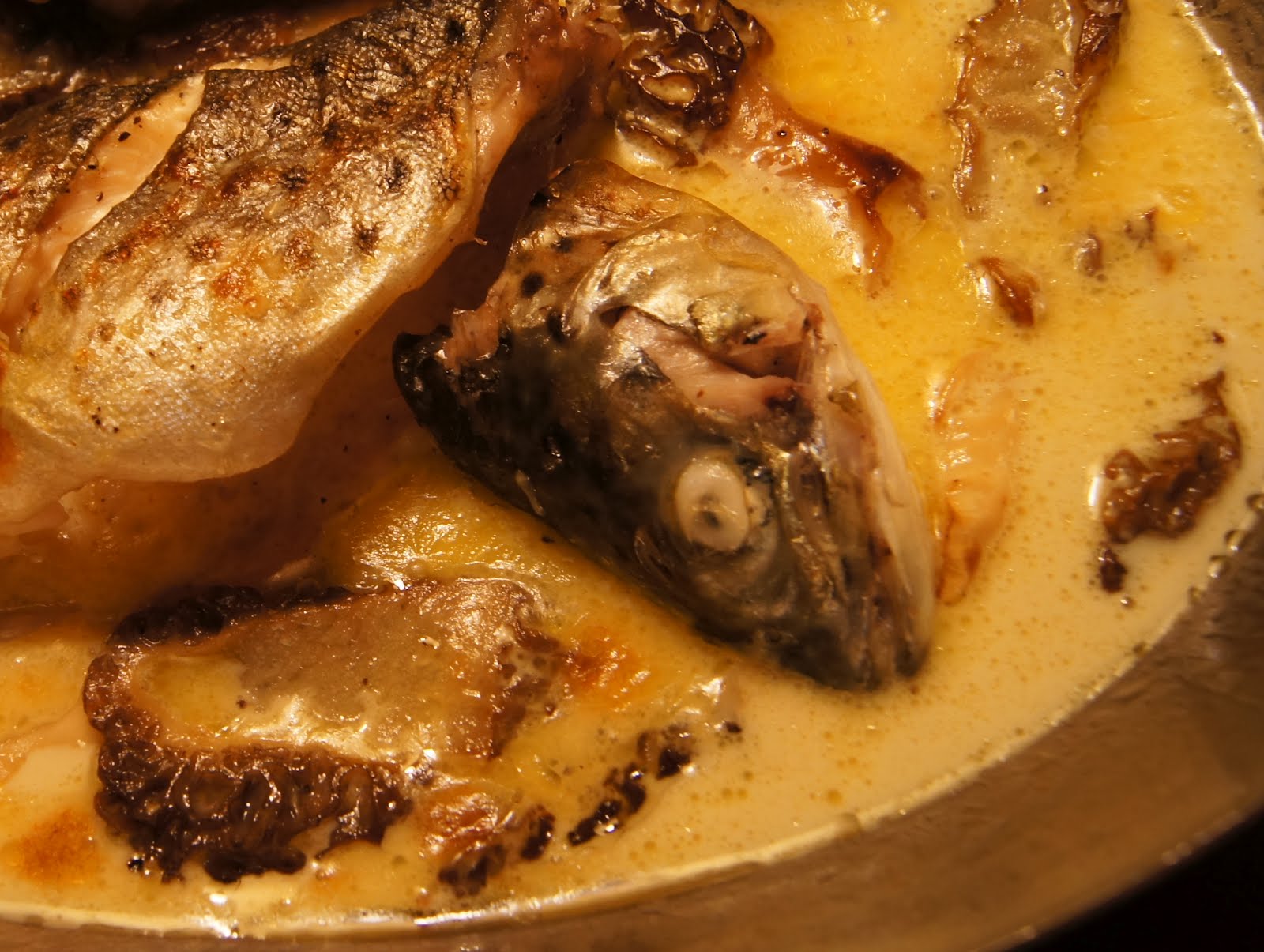
Not to say that stream-caught brown trout, foraged morels, and farmers market asparagus couldn't have held their own quite ably on the dinner plate, but what took our Sunday night supper over the top was the cream. Some of you are smacking your lips and murmuring,
Amen, brother, amen, solemnly, and to you I need say no more than, "Bon appétit." Others of you are cringing a little, but still eager to hear more, repelled by
all that fat, cholesterol, artery-clogging stuff, and yet
mmmm that does really look pretty good, but no, I couldn't.... To you people, let me me say a few words.
Cream is beautiful. Do not fear it. The reflexive revulsion that many people experience when they hear the words "cream sauce" is, for the most part, quite justifiable. Whether it has its source in the gut-busting, gaggingly rich sauces that used to characterize classic French cooking, or their abominable ersatzes made with canned "cream of..." soups, the aversion to cream sauce often has a real and understandable basis. But please note that I am not talking about cream sauce, a heavily reduced, butter-laden concoction that leaves you feeling bloated after just a couple of teaspoons. No, I am talking cream, sweet gold from green meadows, the pure essence of pristine pastures, a gift from our gracious grazers.... Eh. Right. Sorry. Let's try that again.

Cream is beautiful. It is a wonderful ingredient, and when used properly--which usually means sparingly--it brings a quality to cooking that can be achieved in no other way. Sure, you can blend some potato into your lo-cal soup, or achieve a creamish texture to a sauce via a flour roux or cornstarch, but in no case will the result be creamy. For that, you need cream. (
Cedar Summit cream is the best around, though available only in the Twin Cities area. But the small-scale dairy movement is growing (is that an oxymoron?), so perhaps there's an excellent small dairy in your area.)

Because my cookbook doesn't shirk from employing cream, cheese, and excellent bacon in its recipes, I think some people have assumed that I'm a proponent of what we might call "The New Gluttony." That's the approach to food that champions low-brow, high-fat eating as exemplified by "Diners, Drive-Ins, and Dives," "Man V. Food", and the like. I'm brand new to pay TV, since we had to get a dish to get any television at all out here in the country, and I'm finding what passes for food programming, well, pretty appalling. Why people keep tuning in to watch Guy Fieri shove yet another burger or piece of fried chicken into his plump, shiny face is beyond me, but there you go. Obviously it sells, and I'm just an unknown food blogger with an oddball cookbook, so I should just shut up about it. I won't even mention Paula Deen or Sandra Lee (whoops...), but the non-stop glorification of two-pound bacon cheeseburgers, doormat-sized pizzas, grease-soaked breakfast platters that would feed a Chinese family of eight for a week, at a time when roughly a third of the American public is clinically obese, that percentage expected to rise to over 40 percent in the next few years, well, where is your shame, you peddlers of slow, oily death, where, I ask
is...
your...
shame?
Uh, so, where was I? Oh yeah, I was telling you to eat more cream. Well, the point I was weaving towards was that while a lot of my recipes do call for cream, they rarely use more than a half a cup, nor do I reach for that bottle of liquid deliciousness more than once or twice a week. Same thing with the bacon. I smoke bacon three or four times a year, and do four pounds or so each time, but let's estimate on the high side and say that this household of two consumes 20 pounds of bacon a year. That's ten pounds per person per year, or 13.33 ounces per month, or 3.33 ounces per week, less than a quarter pound--
on the very high end. I had bacon for breakfast this morning, by the way, from a batch I smoked up yesterday. My day is off to a good start.
But I wonder if home-smoked bacon on sourdough wheatberry bread for breakfast can be linked to high levels of digressiveness. What is wonderful about cream is that is makes dishes taste, yes, creamy. But also, it brings flavors together in marvelous ways. Using a couple examples from my book: in Summer Lake Trout Chowder the cream--all of three tablespoons for two generous servings--marries the flavors of fresh and smoked trout and aromatic herbs and vegetables, and gives the broth a hint of richness that makes the dish; in Farmers Market Confetti Vegetable Sauce for pasta, a quarter-cup of cream in a dish that serves four enriches the broth that coats a market vegetable medley that would just be too...vegetal without it, and then brings together sauce and pasta, as well (yes, there's a little cheese on top, but cheese is another super flavor carrier that I use often and sparingly).

The trout dish served up here as an example of how large a flavor impact a little cream can have was inspired by one of Jacques Pépin's lesser known books, but one I reach for all the time:
A French Chef Cooks at Home. A French chef cooks at home rather differently from how you and I do, unless your daily menus run to dishes like
Canard Montmorency or
Cervelles de Veau Provencale, but it also has simpler dishes, such as
Truites Grillées à la Crème--broiled trout with cream.
I usually do this on the grill, as Jacques suggests, but Sunday evening was rainy and blustery, and the broiler had to stand in for the grill. Thanks to a little cream and a few morels, it did so admirably (and it kind of took me back a few years--why stop the digressions now?--because when I was a kid, broiling was one of my family's main ways of cooking. We broiled everything, chicken, steaks, pork chops, bacon--those two aluminum broiler pans, one big, one small, scorched and dented from years of service, would go in a shrine if I had them here today. My mom would broil chicken wings so hard, you could eat the whole thing, bones and all...).
Looking more closely at Jacques's recipe, I see that what I did was quite different from the original, where the trout is grilled over charcoal (back in 1975 Jacques was advocating for real wood charcoal over briquets), then placed "in a nice row in a gratin dish," the cream poured over, brought to a simmer, then served. I did mine entirely under the broiler. In the hopes of heading off further deviations, I revert to recipe style:
Broiled Trout and Morels in Cream
serves two
2 10-11" trout, brown, brook, or rainbow, bone in
2 tablespoons butter, divided
3 ounces fresh morels, quartered the long way (oysters, chanterelles, or hedgehogs would also be good)
1/4 cup dry white wine or dry vermouth
1/3 to 1/2 cup cream
salt and pepper
Make a couple of diagonal slashes in each side of the trout to help them cook more evenly and take up more of the sauce. Season the trout with salt and pepper inside and out. Heat your broiler with the rack six inches or so below the heat source--not too close. Place 1 tablespoon of butter in a gratin or baking dish, and place this in the oven just long enough to melt the butter. Remove the pan from the oven and add the trout to it, turning them to coat with butter. Place the pan under the broiler and cook for 2 minutes on each side, until the skin starts to blister.
While the trout is cooking, prepare the morels: heat the remaining 1 tablespoon of butter in a small sauté pan and when it is hot add the morels and a pinch of salt. Cook over medium high for a couple of minutes, until the morels give off some liquid, shrink, and just start to brown. Remove them from the pan and set aside. Deglaze the pan with the white wine or vermouth.
Remove the trout pan from the oven once the trout are brown on both sides. Add the morels and deglazing liquid. Pour about half the cream over the trout, and toss the morels in it. Place the pan back under the broiler and cook for a minute, bring it out, turn the fish and stir the morels. Add a bit more cream to the trout and broil for one more minute. Remove the trout from the oven. Serve the trout and morels over noodles or rice. Add a little more cream to the pan sauce, if you like, and nap it over the fish and morels.
We broiled some pencil-thin asparagus and boiled up some excellent thick Mennonite noodles, both from the
Menomonie-Farmer's Market. We felt blessed by the abundance of this place.
______________________________________
I was thinking about veganism recently (in a purely academic way, don't worry), and while I don't dispute the validity of anyone's personal dietary choices, and while I could consider a return to the vegetarian life I practiced as a young man, I realized that the vegan life would never work for me, not least because of its banishing of dairy. Beyond that, looking at veganism as a movement, eliminating dairy from one's diet for arbitrary reasons seems to me not a terribly defensible position, in terms of sustainability of our food supply. Living out here in America's Dairyland, it is clear that the earth is very, very good at making grass, and while we can't eat grass (leaving aside the current high-end trend for cooking with hay, which I'm eager to learn more about), cows can, and they can turn grass into rich, wonderful milk that gives us cream, cheese, yogurt, sour cream--splendid products on their own, and part of a culture that has linked humans to the earth for as long as, well, as long as there have been people and cows, I guess. I could imagine the world without slaughterhouses. Without dairies? No.
Cream is beautiful. Therefore: you should eat more cream. Just, not too much.
Text and photos copyright 2012 by Brett Laidlaw