Showing posts with label farmers markets. Show all posts

Friday, June 21, 2013

When the Market Gives You Radishes and Kohlrabi

 
You know it's been a sluggish growing season when, at the farmers market two days before the summer solstice, you greet the appearance of kohlrabi with...excitement isn't the right word.  Joy is too strong.  Glee? Nah.  It's, you know, kohlrabi.  How about interest?  That'll do.  It's something different, at least, adding a mild variety to the growers' tables which, since late May, have held monotonous tableaux of rhubarb, asparagus, spinach, lettuce, and spring onions.  Oh, and radishes, absolute rock stars compared to the other blah offerings.

Now, I'm not actually knocking any of those lovely spring delicacies.  The first salad of real fresh lettuce after the long white winter is an absolute delight, something to be celebrated.  It's just that, you know, it's supposed to be summer now, it's the freakin' solstice, is it too much to ask for some peas, a strawberry, even new potatoes?  The market in Menomonie has been a pretty sleepy spot so far this year, I'm afraid.

But, you make the best of what you have, don't you, and with the proper attitude and some good supporting players, that can be damn good.  What I love about this salad is that the title, "Radish and Kohlrabi Salad with Yogurt Chive Dressing," contains the entire list of ingredients, other than salt and pepper (and after I made this I wished I'd omitted the pepper; I only mention it because you can see it in the picture, so you might wonder, Hey why didn't he mention the pepper? if I hadn't).

The chives are a bit droopy this morning after last night's pummeling rain.


Chives!  I love chives.  They are usually the first thing to appear in the garden in spring, and they are an absolutely reliable perennial.  To my utter astonishment, our garlic chives failed to make it through last winter.  Our sorrel also perished, equally astounding.  But the chives soldiered through, as did what must be the world's hardiest tarragon plant--the true fragrant French tarragon, transplanted last year from our former house in Saint Paul.  It was in a container on the deck, too, making its survival all the more remarkable.

Anyway:  chives.  I love the flavor of chives, I love the blue of chive flowers.  The chives are usually up with the ramps, and when the ramps are all done, the chives are still going strong.  Chives are excellent in a tart dairy dressing based on buttermilk or sour cream.  In this case I used some wonderful yogurt that Mary cultured using fresh whole milk from our friend Renee's farm.

The sweet kohlrabi goes well with the bitey radishes.  The dressing, simple as it is, is both mellow and perky, and, of course, wicked chivey.  This salad would go well on a picnic or barbecue buffet.  You don't want a lot of it, but it's a lovely accent dish.  We had it as part of a noshy dinner that included superb charcuterie from the Underground Butcher in Madison (they do mail order, too, and their stuff is great), Marieke gouda (one of those cheeses which, as many times as I've eaten it, blows me away every time I try it), a green salad with market lettuce (our will be ready in a few days), and some simply boiled new potatoes (from Madison, again; they had strawberries down there last week, too, so it's on the way).  And of course some of our homemade sourdough bread.

Looking over the table I was so impressed with how various and delicious our local foods are, even if the market isn't booming yet.  And I was reminded of how simple is the answer to the question of how to keep a local diet: Well, just buy local stuff, that's all, or grow/make your own.  And as summer progresses, it will become easier and easier.


Radish and Kohlrabi Salad with Yogurt Chive Dressing

Serves two

6 radishes
1/2 a small kohlrabi
A fistful of chives (or a few chives more, for Sergio Leone), chopped
About 3 tablespoons excellent yogurt
Salt
Chive flowers for garnish

Slice the radishes into coins, not too thin, maybe six coins per radish.  Quarter the half a kohlrabi and then cut the pieces crosswise into wedges--you want the kohlrabi pieces roughly the same size as the radishes.  Combine the veggies in a bowl and toss with a couple good pinches of salt.  Add the yogurt and mix.  Stir in the chives.  Put it in a pretty bowl (mine from Theresa of Utile Mud, who appears to have moved from the Twin Cities to Everett, WA, I didn't know that).  Garnish with chive flowers.  We're done.

Happy Solstice to all.


Text and photos copyright 2013 by Brett Laidlaw
 

Tuesday, May 1, 2012

There's Rhubarb and Ramps in the Ranch, and Nuts in the Couscous! (part one)


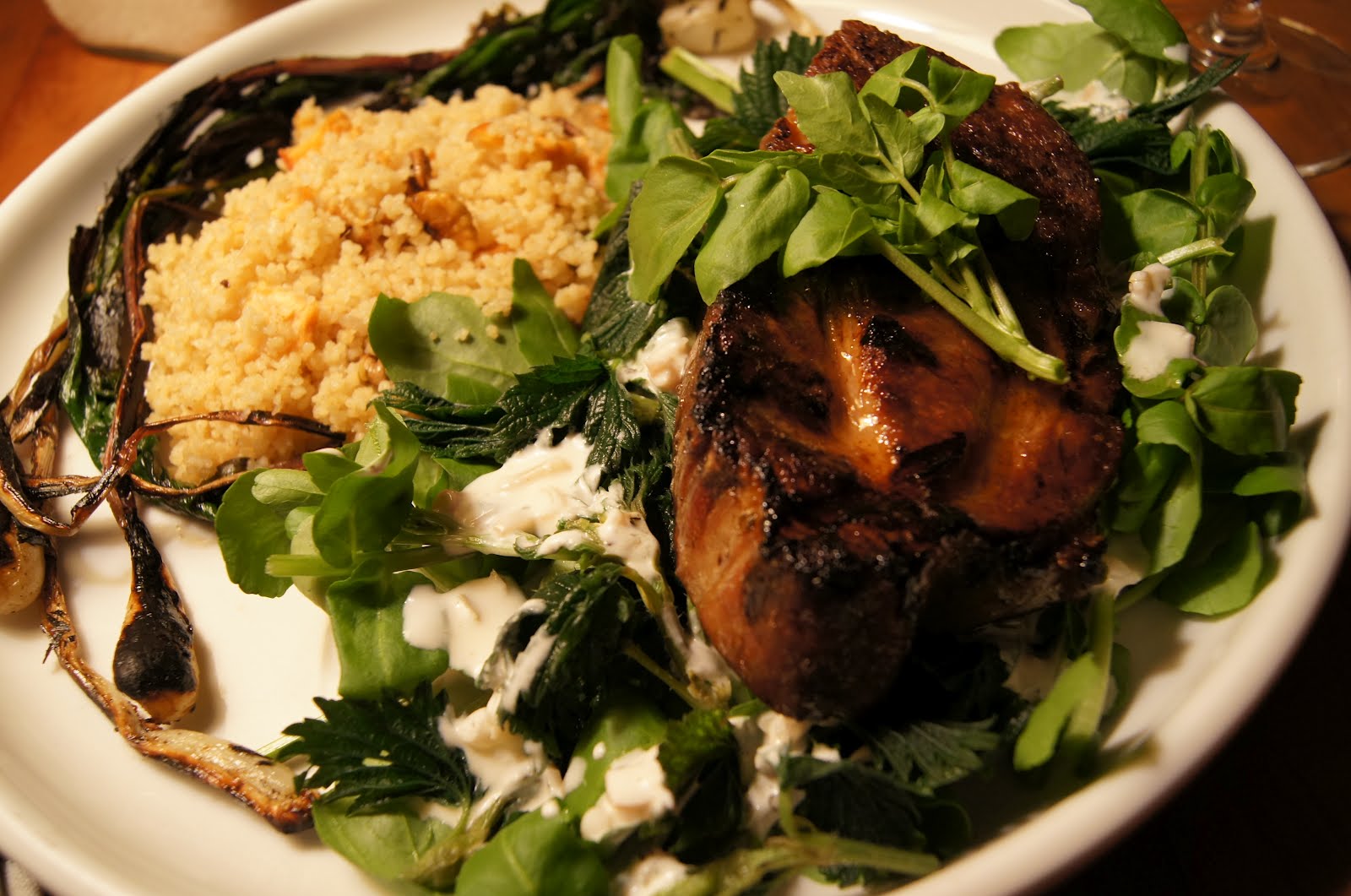
The goofy title of today's dispatch comes courtesy of the fact that, well, I'm not at all sure how to start describing the adventures that led up to a particularly splendid local and seasonal supper of a pork shoulder cutlet prepared à la "sauna sous vide," then grilled with a rhubarb-maple glaze, perched atop a salad of stinging nettles and watercress in a rhubarb-ramp ranch dressing, with whole wheat couscous tossed with local hickory nuts and Bide-A-Wee dried apples.  Oh, and blackened ramps on the side.

The trail leads through a rhubarb renaissance, a marvelous market, a grand gourmet graze, some fun fruitful foraging, and...probably some other alliterative antics that slip my mind at the moment.  I think this particular meal has inspired me to point of giddiness because it perfectly represents what I might somewhat pompously describe as the Trout Caviar Ethos:  taking the best of local, seasonal ingredients from a variety of sources and preparing them in fresh and creative ways that combine far-flung influences and homegrown ingenuity, the culmination of which is a truly expressive plate of food, artful even if it is not art, and satisfying in every way food can be.  And you lick your plate.  We might as well start with the rhubarb.


Rhubarb Renaissance

This is, it appears, the rhubarb moment.  The homely red avatar of tartness that adorns the corners of many country gardens is having its diva turn.  Kim Ode's fascinating and appetizing new book, Rhubarb Renaissance (from MHS Press, a force to be reckoned with in culinary literature!) is the prime example, but not the only one.  I don't know whether Kim is setting the tone or riding the wave, but rhubarb seems to be everywhere these days, and she is surely one of its most enthusiastic advocates.  The current fascination with this old-fashioned staple seems to me in keeping with the way that other throw-back ingredients and methods have been rediscovered in recent years--the sudden sexiness of brussels sprouts, kale, and beets, the enthusiasm for fermenting, smoking, canning, and other DIY food preservation techniques.  We're re-examining a lot of things we've come to take for granted, and finding beauty in humble northern products.  It's all good, very good indeed.


Me, I am good and ready to jump on the rhubarb bandwagon, as we have inherited a robust mound of the stuff at our new Wisconsin home.  Also, I have deep, fond memories of rhubarb from childhood:

We had a big rhubarb plant in the back corner of the garden, and on hot summer days we would sit in the shade on the stoop by the back door, bare feet on the cool concrete, and eat those crimson stalks raw, dipping them into a bowl of sugar. I can taste that sweet-tart-astringent explosion of flavors even now. Perhaps a sense of gourmandise was born there.

On a recent dinner in Madison, Wisconsin, I had a pork chop served over a bed of vegetables liberally anointed with a rhubarb-ramp ranch dressing.  It was phenomenal.  I knew I had to try to recreate it.


Grand Graze

The restaurant was Graze, sibling restaurant of the legendary L'Etoile.  Mary and the dogs and I were in Madison for a book signing at The Kitchen Gallery cooking store (well, I was there to sign books; Mary was dog sitting, and the dogs, they were being dogs; and they were very, very good dogs the whole trip).  We arrived Friday afternoon, checked in to our canine-friendly room at the Econo-Lodge out on the dismal strip, and went in to explore the town.  I had been to Madison exactly once previously, on a college-scouting visit 35 years ago.  Ahem.  That is just a little painful to write, but there you go.  I won't wait 35 years to go back.

The city is beautiful, largely constructed on the isthmus (love that word: just try not to sound like Daffy Duck when you say it) between Lake Mendota and Lake Monona, and a canal connects them.  On a cool but sunny April evening, the whole place seemed idyllic, urban and sophisticated, but mellow.  We were instantly charmed--until we had to go back to the Econo-Lodge, but let's just say that the contrast made the good parts that much sweeter....

The food scene in Madison is dynamic.  We got our first literal taste of that at Graze, which looks upon the capitol from a grand and soaring space.  Picture = 1,000 words:


The Graze  menu celebrates local products and producers without whacking you over the head with their righteousness, or boring you to tears with an endless recitation of sources.  I started with beef marrow bones cut the long way, served with a fabulous sort of beef jam made from oxtails and short ribs, just barely lightened by a few slices of pickled shallots, and Mary ordered crawfish beignets with a lovely remoulade sauce, tart and creamy.  She then went for bibimbap with pork, and for me, that pork chop.  The bed of vegetables beneath the beautifully grilled chop was described as asparagus panzanella; there were a few token croutons here and there, so the analogy to the classic tomato and bread salad is a stretch--but the croutons were nothing special, so I didn't lament their scarcity.  What impressed me, and mightily, was the way all the flavors on the plate came together into something comforting but surprising, robust but nuanced.  And I love to eat grilled meat on top of salad.  The pork chop had a sweet and sour glaze, and at the corners where the char was deepest and the glaze the thickest, it reminded me in the most remarkable and unexpected way of the sweet and sour spareribs my mother used to make, probably my favorite of her signature dishes.  I suspected that rhubarb figured in the glaze, though the menu didn't say so.  That piquant flavor of spring was also detectable in the "ranch" dressing, balanced by the ramp flavor that played through the creamy base.  One of the best restaurant meals I've had in a long time.


Marvelous Market

The Dane County Farmers' Market is one of the biggest and best in the country. The vendors set up on the broad sidewalks of the capitol square, and the market stretches all the way around that grand structure, spills down side streets, as well. We were there for opening day of the outdoor market, and thanks to the extraordinarily warm March weather, there was abundant produce: asparagus, rhubarb, lettuce, chard, mustard, radishes, sorrel; overwintered spinach, leeks, and parsnips; cellared celery root, beets, potatoes, squash; foraged morels, ramps, and nettles. I checked my wallet before we started our circuit, and found $80--more than enough, I thought. And when I reached in there to pay for our last purchase...purt near empty. We went away with a rabbit, morels (I'm not ashamed to say that I'll sometimes pay for it...), lovely fingerling potatoes, a couple celery roots, asparagus, dried shell beans, and hickory nuts.


Hickory nuts! I thought I had tasted hickory nuts in the past. Having tasted the ones we purchased at the Madison market, I conclude that I had not. These were a revelation, amazingly good, as buttery as pecans, but lighter, more subtle, with a finely textured crunch. I'm a convert to the church of the hickory nut. The vendors with hickory nuts also had butternuts (I tasted those for the first time this winter; they are also great), and black walnuts (we have a tree in the yard of the new house; black walnuts have always intimidated me, but I'll have to get over that).  The hickory nuts were pricey, around $20 a pound, but the flavor is so rich, a few bites really makes an impact.

And oh, oh, oh!  Pre-market we passed by Graze again.  They were selling coffee and pastries in the restaurant's courtyard.  When you had made your purchase you could go inside to eat, or stroll the market with breakfast in hand.  On this chilly morning we went inside with coffee and a chocolate croissant and a "ham & swiss market bun."  The croissant was dandy, and the ham and swiss bun was out of this world, like a croque monsieur wrapped in croissant dough.  Maybe the best savory pastry I've ever eaten.  That place has it going on.  I don't think I've ever done anything remotely approaching a restaurant review here, and I don't plan to make a habit of it, but I found Graze, the market, the whole Madison vibe to be inspiring.  Worth going on about, for a bit.

It was a slam-bang trip, into town Friday evening, on the way back home mid-afternoon Saturday (after lunch at Merchant, another very good farm-to-table restaurant just off the market/capitol square).  Less than 24 hours in Mad City, lots of great eating, market browsing, dog walks, a book signing--and to top it off, I got to meet   Sara of  "Put Your Shovel Where Your Mouth Is"  (I think of her as Ol' Shovelmouth, but don't tell her I said that; it has absolutely nothing to do with her appearance, I assure you) and her husband, Donn, a delightful couple; and the vibrant Erika Janik, who produces the  WPR essay series Wisconsin Life, to which I have contributed a couple of pieces, and who writes  a highly literate, always interesting blog.

We were pretty beat by the time we arrived back at the farm, so dinner was a simple repast, omelets with the wonderfully fresh eggs we get from our neighbor Tina, steamed asparagus, and sautéed morels.  Nothing stupendously gourmet about it, but this is one of my favorite ways to enjoy those distinctive spring flavors.


Phew.  Next time, details of the meal that our Madison adventure inspired.

Wednesday, December 22, 2010

Consider the Shallot

Beautiful shallots, beautifully braided, from Morgan and Ben Tartakoff, whom we met at the Dallas (WI) Farmers Market last summer.


To get right to the point, I think if one wants to understand the delicious mysteries of French--or of Italian, Spanish, or even Chinese--cooking, a really good place to start is to learn more about onions. Or rather, perhaps I should say, we ought to explore the many expressions of the allium family, lilies all, many beautiful, some poisonous if ingested, but many others exquisitely edible.

I've been flipping through some vintage cookbooks recently, and one thing that has struck me (along with that whole canned soup thing), is how timidly flavored many of the recipes are. Now, I'm all for simplicity, but when your palate of flavors goes no further than salt, pepper, and a bit of onion, that seems like a recipe for monotony. Rarely in these sorts of mid-century middle-American dishes will you even see a clove of garlic. A scallion is something rather exotic. Leeks, shallots? Unheard of.


Along with making your own stocks, I think adding more alliums to your cooking is one of the main keys to big, savory flavors in home cooking. And come to mention it, adding more alliums to your stocks--the tough outer layers of leeks, trimming of shallots, bits of scallion greens--makes them that much better, too. It's a synergistic thing....


Now, by no means to I mean to dismiss the contributions of the everyday onion, yellow, red, white, what have you. Those are still the most-used alliums in my kitchen. But when you move into the realm of leeks and shallots, you get layers of flavor, both savory and sweet, and, I'd have to think, wickedly umami, just utterly delicious. A lot of times when we're heading out to our cabin in Wisconsin, I'll nip into our garden in Saint Paul and pull a leek out of the ground, peel off the dirty parts and toss it on top of the groceries tote. In the hour and a half it takes to drive to Bide-A-Wee, the car fills up with such an appetizing aura, it's like being inside a bag of Cool Ranch Doritos--I mean, if those things were actually good, instead of being fake-good.


And shallots are another beautiful onion-family member you ought to get to know. They're becoming more common, though you still won't find them everywhere. They can be pricey in grocery stores, cheaper at Asian markets, usually very reasonable at farmers markets. Used raw in small doses, like in a sauce mignonette to drizzle on a raw oyster, or minced in a vinaigrette, they bring a pungent kick. Sliced and sautéed to serve over a steak or chop, they make for magical bistro deliciousness. Employed more liberally, whole or halved, added towards the end of a long braise, so you can still pick them out in the final dish, they're mellow and toothsome, sweet and savory at once, with still a little vegetable crunch.

And then, cooked a long time, they become a sort of jam, so utterly edible that, once you take a bite, it's hard to stop eating. You could do this same thing with onions. I took half the basic jam this recipe below produces, warmed it up with a quarter-cup of heavy cream, and served it beside warmed smoked herring. I served what seemed an ample portion on the plate with the fish, brought the leftovers to the table in a little bowl. It's all a little fuzzy now, but by the end of the meal I think Mary and I were fighting to lick the last drop from the bowl. I'm pretty sure Mary won....

Then the other half, we served that plain as a condiment on a lovely charcuterie plate, all store-bought, mostly from the excellent Seward Co-op. Oh, brave new world, that has such speck and coppa picante in it!

At lower right. The stuff is not too photogenic, but it's damn good:


Cidered Shallots

8 ounces gray shallots, sliced ¼-inch thick
2 Tbsp butter
½ cup sweet apple cider
¼ cup apple cider vinegar
1 large clove garlic, sliced
¼ cup water
3 sprigs thyme
¼ tsp salt
Freshly ground black pepper

In a heavy-bottomed saucepan melt the butter over medium heat. Add the shallots and the ¼ tsp salt. Cook gently, stirring frequently, for 6 minutes, until the shallots are much reduced in volume and starting to look and smell a bit caramelized. Stir in the garlic and a few grinds of black pepper. Cook for 2 minutes. Add the cider, vinegar, water and thyme, bring to a simmer; cook at a quick simmer until almost all the liquid is gone. Taste for seasoning.

You can take the recipe to this point several days ahead of time. You can serve this jammy mixture--as is or with the addition of a spoon of grain mustard--alongside charcuterie or a cheese plate, or on a turkey sandwich.

To make the warm sauce to serve with warm smoked fish and steamed fingerling potatoes: Combine half the shallot-cider reduction with ¼ cup heavy cream. Warm gently, stirring. Serve with smoked herring, whitefish, or lake trout, wrapped in foil and warmed in a 400 degree oven.


Text and photos copyright 2010 by Brett Laidlaw

Thursday, September 2, 2010

Warm Salad of Wax Beans with Caramelized Shallots, Blackberry Vinaigrette


This one was inspired by our visits to the Dallas, WI Farmers Market over the last couple of weeks. While you won't find the variety at this small-town market that you will at larger markets, everything we've had from the Dallas market has been excellent. The market is held on Friday evening from 4:00 to 8:00 on main street Dallas in Barron County, in front of the Viking Brewing Company (soon to be former Viking Brewing Company; they've got a big name change coming up...).

A couple of weeks back we bought a beautiful braid of shallots from Morgan and Ben Tartakoff. We hung it on the French porte-clef at Bide-A-Wee, and admired it every time we sat down at the table. Next time wewere at the market, we mentioned how much we'd been enjoying the shallot braid as home decor, and Ben said, "The hell you say, decoration? You should eat the damn things." Actually, he didn't say anything like that. He merely implied, with all due politeness, that they were at least as good to eat as they were to look at.

And I agreed, chastened. Along with leeks, I think shallots are one of the secret ingredients in French cooking. They're both related to onions, of course; the flavor of leek is on the mild end of the onion spectrum, while shallots lie toward the more assertive end. Shallots are frequently chopped fine and added raw to salad dressings, or sliced and sautéed to make the base of pan sauces for steaks and chops. These shallots from Morgan and Ben are some of the best I've seen in a long time--plump, firm, very flavorful. Shallots keep well in a root cellar or cool, dry basement. We plan to stock up before season's end.

For this dish I cooked the shallots slowly in a nice amount of oil and butter to concentrate the sugar. That, along with some blackberry jam, gives a sweet and sour character to the dressing.

I didn't have to look far to find what I'd pair with the shallots, just the next table over, where Rhonda Johnson had a pile of lovely yellow wax beans. Maybe I'm just not looking hard enough, but you don't seem to see wax beans that much anymore. They have really homey connotations for me, the kind of thing my mom used to serve with baked pork chops and acorn squash when I was growing up. I decided to give them the central role in this warm salad. You blanch them in boiling water for a couple of minutes, till they're tender-crisp, and toss them in the pan with the well-cooked shallots (and some garlic), then slick everything down with the blackberry vinaigrette. It's best if it sits for 20 minutes or so, to let all the flavors come together.

The vinaigrette dressing was the Bide-A-Wee element in this salad, flavored with our own blackberry jam and blackberry vinegar. (That and the fact that we first made it out at Bide-A-Wee, on our wood-fired "stove.") You could substitute raspberry jam for the blackberry, and red or white wine vinegar if you don't have berry vinegar. You'll taste the difference using homemade jam instead of store-bought, so do try to find some good local product if you want to try this dish.


We've made this salad twice now, and both times we wound up having it alongside pasta, but I think it would be great with pork chops, grilled chicken, even flavorful fish like salmon or lake trout.

You could also use green beans or flat romano beans in place of the wax beans. I particularly like the colors of the yellow beans, shallots, and blackberry dressing.

Warm Salad of Wax Beans with Caramelized Shallots, Blackberry Vinaigrette
serves two

2 good handfuls of yellow wax beans, 24 to 30, rinsed, stem ends trimmed
2 shallots about the size of small eggs, peeled, sliced 1/4-inch thick (about 2/3 cup)
2 large cloves garlic, slice thin
1 Tbsp olive oil
1 Tbsp butter
salt

1 Tbsp blackberry jam
1 Tbsp vinegar, preferably blackberry, or, in order of preference: raspberry, red wine, or white wine vinegar
1 Tbsp olive oil
salt & freshly ground black pepper

fresh thyme leaves, optional


In a medium sauté pan over medium heat, melt 1 tablespoon of butter and add 1 tablspoon of olive oil. Add the sliced shallots and a good pinch of salt. Cook over medium heat until the shallots start to wilt, then turn the heat down to medium-low and cook gently, stirring often, for 10 to 12 minutes, until the shallots are very soft and are just starting to brown. Add the garlic and continue to cook for 2 minutes more.

Wipe the shallots are cooking, blanch the beans for three minutes in boiling water. Drain and set aside. Mix the jam, vinegar, olive oil, a good pinch of salt and a few grinds of black pepper. (Note that this vinaigrette is light on the oil compared to a usual dressing; that's because it's going to combine with the butter and oil already in the pan.)

After adding the garlic to the shallots, add the beans and sauté for about a minute. Turn off the heat, pour the vinaigrette over beans and shallots, stir it all together, and transfer to a serving dish. Let sit at least 20 minutes before serving, and stir it up again just before serving, and taste for salt. If you like, strip some fresh thyme leaves from the stem and sprinkle over the salad to taste (if all you have is dried thyme, leave it out).

The whole salad can be prepared a day or two ahead, refrigerated, then brought to room temp before serving.


Text and photos copyright 2010 by Brett Laidlaw

Tuesday, August 31, 2010

Terrific Toms


As dynamic as the world of food is these days, there are many people who still live in the hotdish, meatloaf, burger and chops world, where lettuce means iceberg and salad dressing comes from a grocery store bottle--no shame in that, though I do think those people are missing out on some profound pleasures. For these kinds of eaters, a tomato is simply something round and red that isn't an apple. It may have a name, and if it does it's likely Beefsteak or Big Boy, but more likely it's an anonymous salad garnish purchased from a chain grocery store, and it tastes the same summer, fall, spring and winter, which is to say, it doesn't taste like much.

Then there are those of us who when we meet exchange a knowing glance, and whisper to each other, "Green Zebra, Black Cherokee, Prudens Purple, Jaune Flamme...", like members of a secret society reciting the arcane password that opens the door to the Inner Sanctum. We are the Brotherhood and Sisterhood of the Heirloom Tomato. We are smitten and obsessed, and our palates are spoiled and perfectly jaded, incapable of enjoying any tomato that doesn't come with pedigree and provenance, that doesn't still bear traces of the heat of the sun when it comes to hand and then to table.

Red Brandywine, Hillbilly Potato Leaf, Wapsipinicon Peach, Green Zebra, Matt's Wild Cherry, Big Rainbow, Japanese Trifele Black, Tigerella, Pineapple, Ethiopian Black. That's my roster of tomatoes for this year. At least I think it is. In the typical springtime planting frenzy I neglected to take good notes on what I planted where, and the Sharpie-marked plastic stakes I used to identify the plants in the garden have either been wiped clean by wind and sun, or have disappeared entirely--I wouldn't doubt that the slugs have eaten them....


Most of them I started myself from seed, the rest I picked up when the market plant vendors were trying to clear out their stock in June. With my own home starts I experimented this year, extending the lazy man's gardening approach by not bothering to put the seedlings under lights. We have a sunny south-facing room, and I figured that by late March, early April, that room would be getting plenty of good sun, and the seedlings would do just fine, and I was wrong wrong wrong about that, of course. Then a very warm April turned to a very chilly May, and the plants sat in their pots too long, and when finally I got around to planting my sadly lilliputian sproutlings, I patted the dirt around the plants thinking, "Well, as least we have good farmers markets here...".

But one of the things that keeps gardening interesting is how we never know what Great Nature has in store for us next. June turned warm again, and my seedlings took root and grew, and the summer stayed warm, grew hot, and pretty soon I was staking those plants, that I doubted would be anything more than ankle-biters. It has turned out, overall, to be a perfect summer for tomatoes--oh, except for the heavy rains that caused the fruits to crack, the humidity that encourages blossom-end rot, the too-warm nights that prevent the flowers from setting fruit, and the late blight that's now taking out one plant after another. Aside from that, pretty much flawless tomato growing conditions.

It is ever thus, that the good comes with bad and the light with shadow, and another perennial facet of the gardener's understanding is a familiarity with redemption. Of course you have to be a bit of a sinner to know how that feels; for me, nearly every year, Great Nature manages to forgive my laziness, presumptuousness, arrogance and general ignorance. She takes pity because, though I am hopelessly flawed in all these ways, I am also steadfast, and trusting. Hey, it's really all I've got going for me.


Forgive my digression. I meant to speak of the wonder of heirloom tomatoes, and the first thought that spurred me to take up the topic--well, after the sheer inspiration of a counter overflowing with those beautiful fruits--the first thought was that it has been within my gardening life that heirloom tomatoes, as well as the whole notion of heirloom or heritage crops and breeds, have become widely familiar. I grew up in that Beefsteak, Big Boy, Better Boy, Early Girl world. Who didn't? Those and other hybrid varieties were all anyone grew, because they were all anyone could get. And they were--and are--productive, disease-resistant, reliable; and let's not be snobs about it: a vine-ripe just picked Big Boy from your own garden can hold its own with just about anything.

But some of us are easily bored, require lots of stimulation. For us, it's a wonderful thing that the world of tomatoes has expanded so, not by going forward via the hybrid route, but by going back to those open-pollinated varieties so expressive of the times and places where they arose. I don't want to go all academic on you (in part because that would require way too much work on my part) but I'll just lay this little factoid on you: The Brandywine, perhaps the best known of all heirloom tomato varieties, first appeared in the Seed Savers Exchange Catalog in 1982. I was going to guess that most folks didn't know much about heirlooms before 30 years ago; I'm amazed to learn that virtually no one had even heard of a Brandywine prior to 1982.

No doubt the world is changing fast, accelerating even faster. I remember (kind of) ordering Brandywine, Double Rich and other heirloom tomato seeds from Seeds of Change back in the early '90s. I recall the delight of opening the seed catalogs each winter and seeing more and more heirloom varieties of tomatoes and other plants appearing in those enticing pages. Now, those of us who watched the emergence and boom of heirloom vegetables can only shake our heads and sigh to see the "heirloom backlash" that has sprouted up in the last couple of years, in the form of newspaper and magazine articles opining that heirloom tomatoes aren't worth eight bucks a pound, that a Mortgage Lifter can be as insipid and mealy as a winter hothouse tomato, or bemoaning that an heirloom plant isn't as productive, is more fickle about growing conditions, or more susceptible to disease.

And you know, I have to agree, no tomato, not even an organic heirloom, is worth $8 a pound. At that price, one of the Brandywines sitting on my counter right now would ring up at $12! And hell, it's mostly water! The $12 tomato is the Whole Foods price in June for import California tomatoes--the sucker's price, in other words. If you look at your produce purchases as status symbols, then you probably deserve to pay $12 per. It's more important to know where your tomatoes come from, and who grew them, than to buy by trendy names and price tags, duh.

But I digress again. In 1982, those of us cautiously poking our callow noses up into the rarified air of gourmandise were just catching wind of extra virgin olive oil, balsamic vinegar, kalamata olives (forget about nicoise or picholine), and pesto. It may shock some of you to know that plain old basil is a relative newcomer to farmers market stalls around here. We were just learning that not all "parmesan" cheese came from a green can, pre-grated. I'll digress within a digression to say that upon discovering the culinary alchemy that transpires upon combining several of those products, I consumed so much basil pesto over the span of a couple of years that I wound up going completely off the stuff for more than a decade--I'm just now getting back the taste for it.

Of the heirlooms I've grown more than a couple of times, some of my top picks are Brandywine, Green Zebra, Big Rainbow, and Matt's Wild Cherry. I've also really enjoyed Cherokee Purple, Black Krim, and Jaune Flamme. The last two years I've grown--or tried to grow--the Wapsipinicon Peach, named for a river in Iowa. I'm not sure how big these might grow under ideal conditions. Mine are about golfball size, and they're covered with peachy fuzz. Maybe it's the power of suggestion, but I find their flavor fruity, too, tart and sweet with a savory richness behind it all. I'll keep trying to grow them, though they appear the most blight-prone of any tomato I've ever grown. I suspect it might wither under the force of a sidewise glance.


But I don't care. I might not grow those every year. I'll remember them with pleasure, regardless. There are literally hundreds of heirloom tomato varieties available now, and while I've no desire to try them all, I'm delighted by the selection, and by what it says about our sensibility regarding the food we eat. To me, the most meaningful backlash is the one that turned away from selecting tomato varieties for uniformity and "ship-ability," and back toward those old varieties, each with a taste and a story all its own.

Each year I wonder, briefly, if it's worth it to start my own seeds, and I succumb, more briefly still, to doubts about whether those heirlooms really are over-hyped, do I really like tomatoes all that much, don't we get sick of plate after plate of sliced tomatoes with basil when the glut of late summer is on? Maybe so, but I persevere (remember what I said about steadfast?), and each year when the first tomatoes come ripe in the garden, I'm given ample reward to carry through till next spring. Maybe that space could be better used growing rutabagas for the root cellar, but...wait, what the hell am I saying?

I close with one of my favorite heirloom tomato memories, inspired by a dinner at the Native Bay restaurant in Chippewa Falls, WI--our one and only dinner there, sadly, as that admirable outpost of local, seasonal eating in west central Wisconsin lasted only a couple of years, and we learned about it late. Everything about our dinner there was excellent (Mary will be happy to expound at great length upon her appetizer of soft-cooked egg with lamb gravy, just ask her...), but the best thing I took away--literally, in part--was a simple plate of perfectly ripe, perfectly chosen heirloom tomatoes from a local organic grower. There were four different varieties on the plate, which arrived with this slip of paper, what I think of as the "tomato clock":


I note with interest that I'm growing three of those four varieties in my garden this year (and the fourth, Cream Sausage, was fantastic, I need to find that one...), a sheer coincidence, but I also see it as an homage to Native Bay (its chef and owner, Nathan Berg, is still around), and to the tomatoes themselves. They're a vegetable...fruit...fruit eaten as a vegetable...that deserves the hype, if anything does.


Text and photos copyright 2010 by Brett Laidlaw

Thursday, August 5, 2010

Not So Hot


Aaahhh. The cool front came through in the night. Lovely. Temps in the 60s this morning. I hit the garden for an hour of watering, weeding, and slug control, and--I...am...not...sweating! Give me the cool & dry anytime. The dogs were absolutely exultant. Happy dog dances, Lily running laps around our tiny Saint Paul yard, Annabel bumping up against my leg, saying, "So are we going hunting, huh? Are we, huh? Are we, can we, huh?" Well, not quite yet, that's a ways off still, and we're not out of the woods yet, swelter-wise.

Last night we were sweltering, indeed, a desperate time calling for desperate measures, to wit: cold soup for supper. But what a soup. I have to tell you, I am inordinately pleased with how this one came out. Context has something to do with it, and this is definitely a dish for a time and place, a hot summer night, dinner on the screen porch or a shady patio. Do not eat this in an air-conditioned room. You need the contrast between soup and surroudings the get the most from it.


I initially saw this as a starter soup to be followed by a more substantial main course, but it wound up being the main event for us. The beauty of the DIY garnishes is that you can make your own portion as chunky--or not--as you please. As we reached the end of our meal, I noticed that my plate looked like the dregs of an overdressed salad, while Mary's was distinctly soupy. Chacun(e) à son gout!

We sated ourselves après-soup with a slice of levain cracked wheat toast, an apple, and some
Marieke gouda. Uncorked a bottle of cold white côtes de gascogne, Domaine d'Arton (less than ten bucks), and I have to tell you, my friends, all things considered, this was about as close to a perfect meal as I can imagine. We eat pretty well around here, you've probably noticed, and sometimes I wonder if I'm becoming a little jaded--but this dinner was so freakin' happy-making, it made me realize anew just how happy-making food can be, and it doesn't have to be anything fancy, just good local stuff of the season prepared with care, presented in its proper context. Voilà: Happy meal, our way.

Right, then, a recipe. No cooking involved. The set-up:


Buttermilk Apple & Cucumber Gazpacho
serves two as a main course, four to six as a starter

1 large Asian or English cucumber, or 2 small, thin-skinned slicing cukes
1 apple (I had some of the first gnarly little ones from our land, that's why there are four in the picture; I figure that's about one regular apple)
1 shallot
1 large clove garlic
2 yellow romas tomatoes, or 1 larger yellow or a ripe green tomato like a Green Zebra
1 flavorful red tomato, peeled, seeded, chopped--for garnish
croutons of good, grainy levain bread (mine were from a cracked wheat loaf, just toasted in a skillet with a little butter and olive oil until nicely browned)
1 cup buttermilk
1/4 cup heavy cream
a few sprigs each of chervil and mint
1/2 cup watermelon small dice, optional
lemon juice
salt

In a food processor combine: 1/2 cup water, half the cucumber, half the apple, the shallot, the peeled garlic clove, the yellow or green tomatoes, 1/4 tsp salt (roughly chop all for easier blending; no need to seed apple or cuke). Process for about a minute, till everything is pretty well liquified. Run this mixture through a food mill or pass it through a sieve. Add the buttermilk. Refrigerate for at least one hour. You can do this part up to a day ahead.

Prepare the garnish: Seed the remaining half cucumber, and the apple, and chop into very small dice, 1/4-inch or smaller. Place in separate bowls. Squeeze a little lemon juice over the apple bit to prevent browning. Sprinkle a pinch of salt over both the apples and the cukes. (To peel the apple and cuke, or not to peel? The choice is yours. My cuke had a nice thin skin, so I didn't peel it. I partly peeled the apples, which had rather tough skin, but I left some for color.)

Refrigerate all the garnishes until just before serving.

Just before serving: Mix the cream into the buttermilk-veg mixture. Chop most of the mint and chervil (use a little tarragon or fennel greens if you don't have chervil), reserving some for garnish, and stir the chopped portion into the soup. Taste for salt and add if needed--but don't overdo it; I found I liked this a little undersalted to my usual taste, to let the fruit and veg flavors really shine.

Serve out the soup into individual bowls, and take to the table along with the garnish items--the reserved cucumber and apple, the chopped red tomato, croutons and optional watermelon dice--in their separate bowls. Then each person can garnish to his/her own preference.

Other optional garnishes that occured to me: chopped roasted red pepper; finely chopped fresh hot chili (you could also blend a little hot chili into the base); toasted hazelnuts.

As I said, we wound up making this our main course, but it would be a fantastic palate-perker as a starter for an elegant summer dinner.

It's turning hot and humid again this weekend, I hear. You've been warned. Make like a good scout, and Be Prepared!


Text and photos copyright 2010 by Brett Laidlaw