Showing posts with label maple syrup. Show all posts

Friday, April 1, 2016

The Saps of Spring, 2016 Edition


March is a difficult month.  It promises spring, but often belongs equally, if not more so, to winter.  It makes you think of gardening, of growing things, but at our latitude all you can really do is pile potting mix into little pots, get the seeds of the earliest, cool season plants going—onions, leeks, lettuce, some herbs.   There are days of warm sun that tempt you to get out and till a plot, but when you turn one clump of frigid, sodden soil, you turn quickly to plan B.  Never mind, there’s always that minefield of winter-weathered dog treasures to clear, a perennial March activity that more or less sums up the spirit of the season….


Maybe this is why a lot of my March days since moving to the country have been spent drilling little holes in trees, gathering the cold, slightly sweet water that weeps out, and cooking it down to incomparable sweetness—tree syrups, both maple and birch, and even a bit of black walnut.  It’s nature’s little consolation prize for enduring these purgatorial weeks, equal parts reward and distraction.  Though sap season comes around every year, it’s always a little bit different.  And this year has been more different than most.

People on Twitter tend to get a little excited, you may have noticed if you frequent that world.  I think it’s the ability to communicate instantaneously with friends, acquaintances, and strangers alike, all across the planet, that tends to heighten reactions exponentially.  This year I saw a slew of ecstatic tweets proclaiming that the weather for the week ahead looked perfect for maple sugaring…in the middle of February.  But the trees weren’t looking at the daily highs and lows to decide how to proceed; no, the trees were still frozen solid.

I forget exactly which March Surprise this was; we had a few....

But it did transpire that warmish weather continued—there were days with record highs, with record high lows—and I did wind up tapping a few maples, as well as the big box elder (a type of maple) in our yard, and our one majestic black walnut tree, on February 21, because what the heck.  And within a few days I did have a little sap, emphasis on the little.  The trees ran sluggishly for about a day, then the weather turned seasonably cold again.  Six trees gave me about one gallon of sap, which didn’t take too long to simmer down on the wood stove into a half cup of syrup; and so began the season of passive, micro-batch syruping, which continues to this day, as I reduce another five gallons of birch sap on the woodstove and then on the range top.  I’m not going to wind up with a vast reserve of syrup, but then, I don’t really need one.  The birch, especially, is sparingly deployed, maybe a tablespoon or so at a time, in salad dressings and marinades, mainly for grilled pork.
 
Birch syrup on the final reduction.

With small amounts of sap—5 to 8 gallons at a time—I didn’t bother firing up the labor-and-smoke-intensive half-assed sap contraption I’ve used in years past.  Instead, since we’re still stoking the woodstove every day, at least in the mornings and evenings, I’ve been setting a hotel pan and our Big Blue Le Creuset dutch oven on the stove and letting the sap slowly reduce to a manageable amount, at which point I boil the dickens out of it on our kitchen range top.  You may wonder, Isn’t that a lot of humidity to be adding to your indoor environment?  Aren’t you producing great clouds of water vapor, steaming the wallpaper off the walls, and covering everything with a sticky film? 

Legitimate concerns, to which the answers are: yes, I guess it’s a fair amount of humidity, but things are generally dry this time of year, so we haven’t noticed any issues; and as we have no wallpaper on our walls, none to steam off!  Finally, no, our walls and ceiling bear no resemblance to a movie theater floor after being deluged with Mountain Dew during the kiddie matinee.  The whole idea, see, is that the sugary part remains in the pot as the water evaporates.  Even if some of the sugar escaped a furiously boiling pot, I don’t think it would go very far, the sugar molecules presumably being a good deal heavier than water vapor. 

The long and short of it is this:  I think it’s a myth, one which I myself may have helped to promulgate in the past, that cooking sap down inside has these undesirable side effects.  When I’m doing the fast, final boiling, I’ve got the vent hood running, a couple of windows cracked, and there’s no noticeable change in our indoor weather.  Also, I’ve kept checking the walls near the stove, the inside of the vent hood, for that legendary sticky film—none to be found.  Now, if I had a hundred, or even 40, 20 gallons to deal with at a time, I probably wouldn’t do it inside.  But with these small batches, it works fine.  It’s also really nice to get double duty out of the woodstove, heat for the home on chilly days, tasty syrups for the kitchen.

The Puddock hard at work, multi-tasking.

It has taken me a while, years, in fact, to start to feel comfortable using the birch syrup.  It’s completely unlike anything else I have in my pantry, so it didn’t slide easily into any particular niche.  People ask me what it’s like, and I can only give vague analogies or general descriptions that don’t capture the essence of the thing.  It’s dark, dark as molasses, and it has some molasses qualities, but it’s not thick—in its body, its “mouth feel,” it’s lighter and thinner than maple syrup.  And banish any thought that it’s like maple syrup just because it’s sugar that comes from a tree.  While maple syrup is composed of sucrose, like plain old granulated sugar, birch syrup is glucose and fructose (I think I’ve got that right).  The flavor of birch syrup is much…edgier.  There’s acidity to it, and often a little intriguing bitterness.  It’s very aromatic, with sweet, menthol, spicy, root beer type notes.  Really, if you’re interested in distinctive foods, particularly distinctive northern foods, you’ve got to try it.

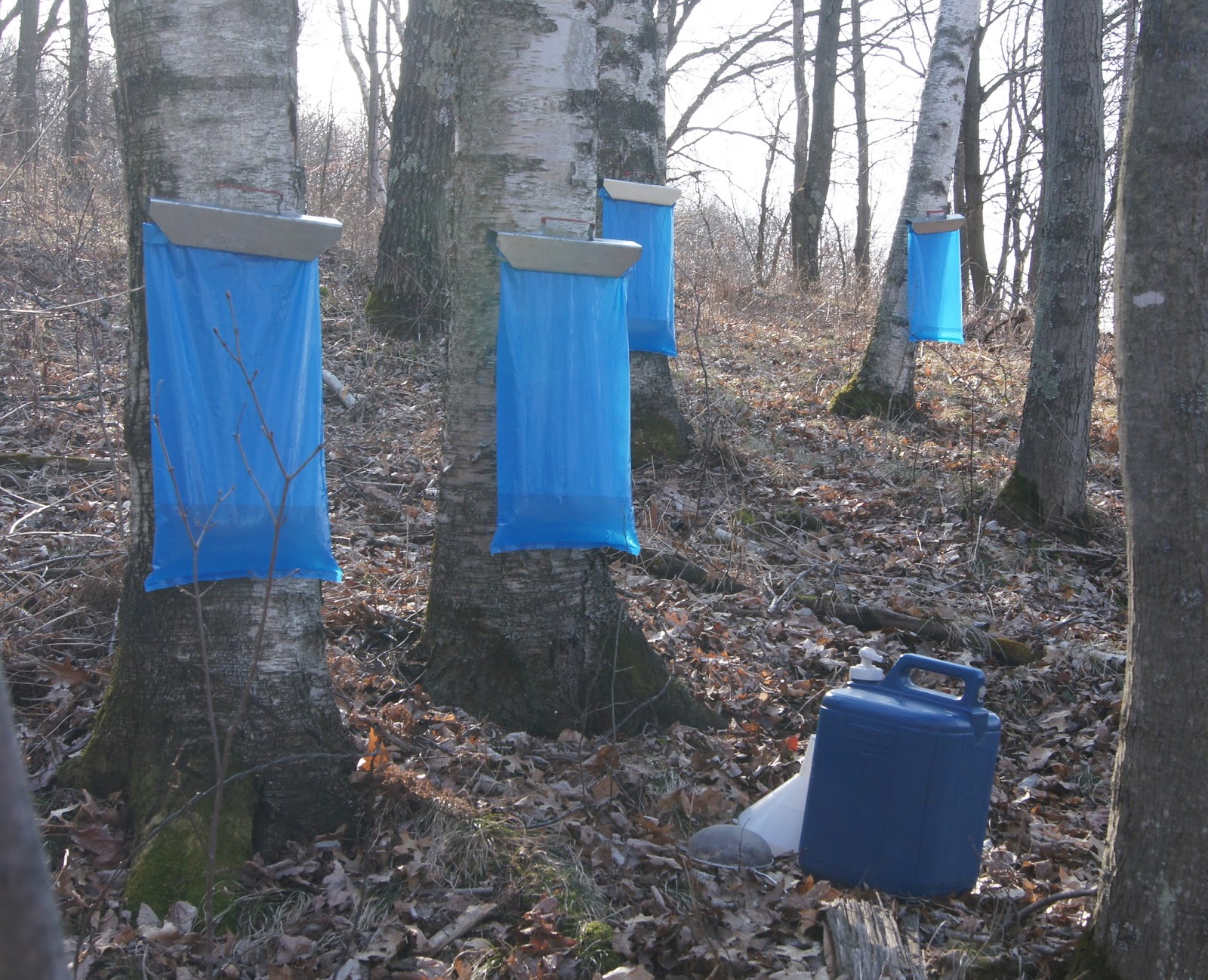
If you have access to a few birch trees, it’s easy enough to get, as long as, you know, nature cooperates.  You tap the trees exactly as you would for maple syrup, drill a little hole about 1 ½” deep, insert a tap, hang a bag, bucket, what have you, or attached food grade tubing to allow the sap to run into a container.  Then when you have a quantity, you cook it down.  And cook it down.  And cook it down….  Because, the thing about birch sap:  it’s generally less than half as concentrated in sugars as maple sap.  So if it typically takes from 30 to 40 gallons of maple sap to produce a gallon of syrup, with birch we’re talking about a roughly 80:1 ration.  Breaking that down into the smaller batches I’ve been doing, 10 gallons of sap gave me one scant pint of syrup.  

Syrup assortment: the small, very light one at center front is black walnut.

I’ve said this before, and I’ll say it again:  you can look at the numbers, even the relatively reasonable maple ratios, and think you get it, but until you actually do it, you can’t possibly understand.  Still, it’s worth it.  I go to a lot of trouble, tapping the trees, hauling the heavy sap down the hill (luckily I do get to haul it down the hill), cooking the sap down and down and down, but at the end I’ve got lovely local products to work with through the rest of the year.

And here’s a handy fact of nature:  the birch trees tend to start running as the maple run is coming to an end.  So if you have access to both kinds of trees, you can move your tapping equipment over to the birches when you’ve had your fill of maple sugaring, and the trees start to break bud, rendering the sap bitter and unusable.  Making syrup, especially birch syrup, is a labor of love, and a rite of the season, a perennial celebration of those immemorial cycles.  A lot of work and time, sure, but hey, it beats picking up dog crap….

Earlier reports from sap season:
 Sapped Out, 2013
The Sweetest Tree, 2013
Sweet Trees X3, 2015
Sweetness, Toil, and Smoke, 2010

How I have used birch syrup:

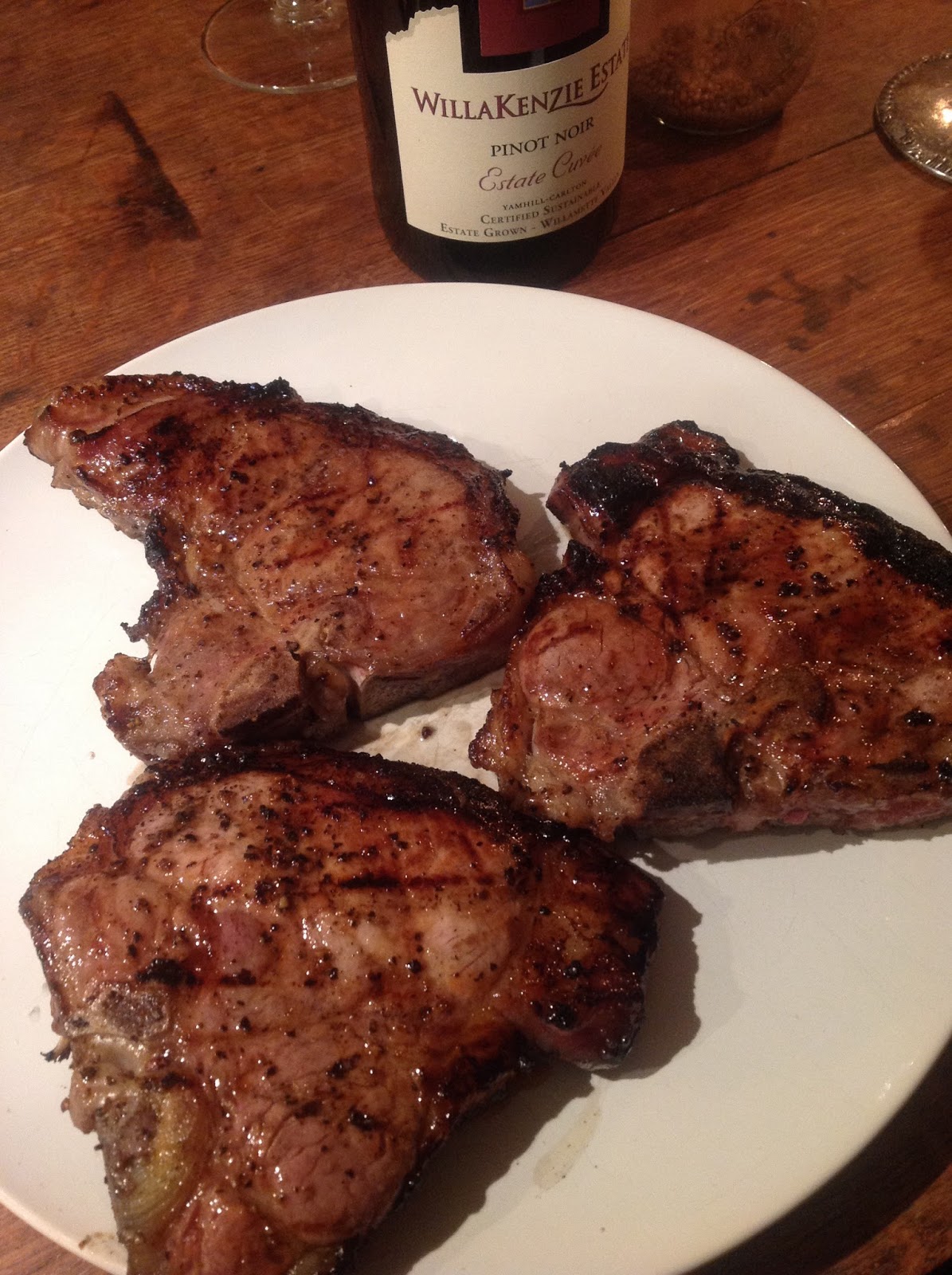
·        *  As a marinade for grilled or smoked meat:  it’s great brushed on a pork chop, which I then season simply with salt and pepper.  For some reason, the birch syrup doesn’t burn on the grill the way maple syrup or honey would.  Perhaps because the sugar composition is different.  I’ve also used it on grilled game birds, particularly woodcock.  And I’ve used it in the cure for smoked duck breast and venison with wonderful results.
Grilled red wattle pork chops in a birch syrup marinade; pork and birch have a delicious affinity.

*  In salad dressings:  just a teaspoon or two in a vinaigrette really makes its presence felt, and brings that distinctive, aromatic birch flavor to any kind of salad.
·         *  In cocktails:  1 teaspoon birch syrup, a few drops of lemon juice, 2 ounces Scotch, bourbon, or rye, stir it up, add ice, garnish with a lemon twist.  Or for the lemon substitute blood oranges in season for a cocktail I’ve dubbed “The Nasty Bruise.”  For a refreshing non-alcoholic drink, stir a couple teaspoons of birch syrup into sparkling water, add ice and perhaps a squeeze of lemon juice.

Those are the main applications I’ve found for birch syrup.  I’m having a decent year with the birch this spring, so I’ll have a good supply to experiment with through the year.  I repeat:  a little goes a long way with birch syrup.


Birch-Mustard Seed Carrot Salad

Two servings.  

1 large or 2 small carrots
2 tablespoons olive oil
2 teaspoons yellow mustard seeds
2 tablespoons lemon juice
1 tablespoon birch syrup
1 small garlic clove sliced very thin
A bit of chiffonade leek or scallion green, optional
Salt and pepper

Peel the carrots and slice them very thin—1/8” or less.   A Benriner mandoline is handy for this—watch your fingers!

Heat the oil over medium low and add the mustard seeds.  Stir them around until they just start to pop, then remove from the heat.  Add the lemon juice, birch syrup, and garlic and stir well.  Pour the dressing over the carrots, add a couple good pinches of salt and a few grinds of pepper, and stir well.  Let the salad sit for at least a half hour or up to several hours before serving.  Sprinkle the optional leek or scallion greens over top just before serving.

Maple syrup variation:  in place of the birch syrup, use 2 teaspoons of maple syrup and ½ teaspoon of Dijon mustard--I haven't actually tried this variation, but I don't see how it could be bad.


Here’s a brief record of weather, phenology, and such since syrup season began at the end of February:

Feb 27 record highs
Feb 29 1st ½ cup maple syrup done
March 1, “brittle and chill” and the trees aren’t producing sap
March 4, 3 inches of snow
March 8 red-winged blackbirds back & a scant half cup of black walnut syrup finished from 56 ounces sap—that’s all for black walnut, it didn’t produce enough sap after that to bother with
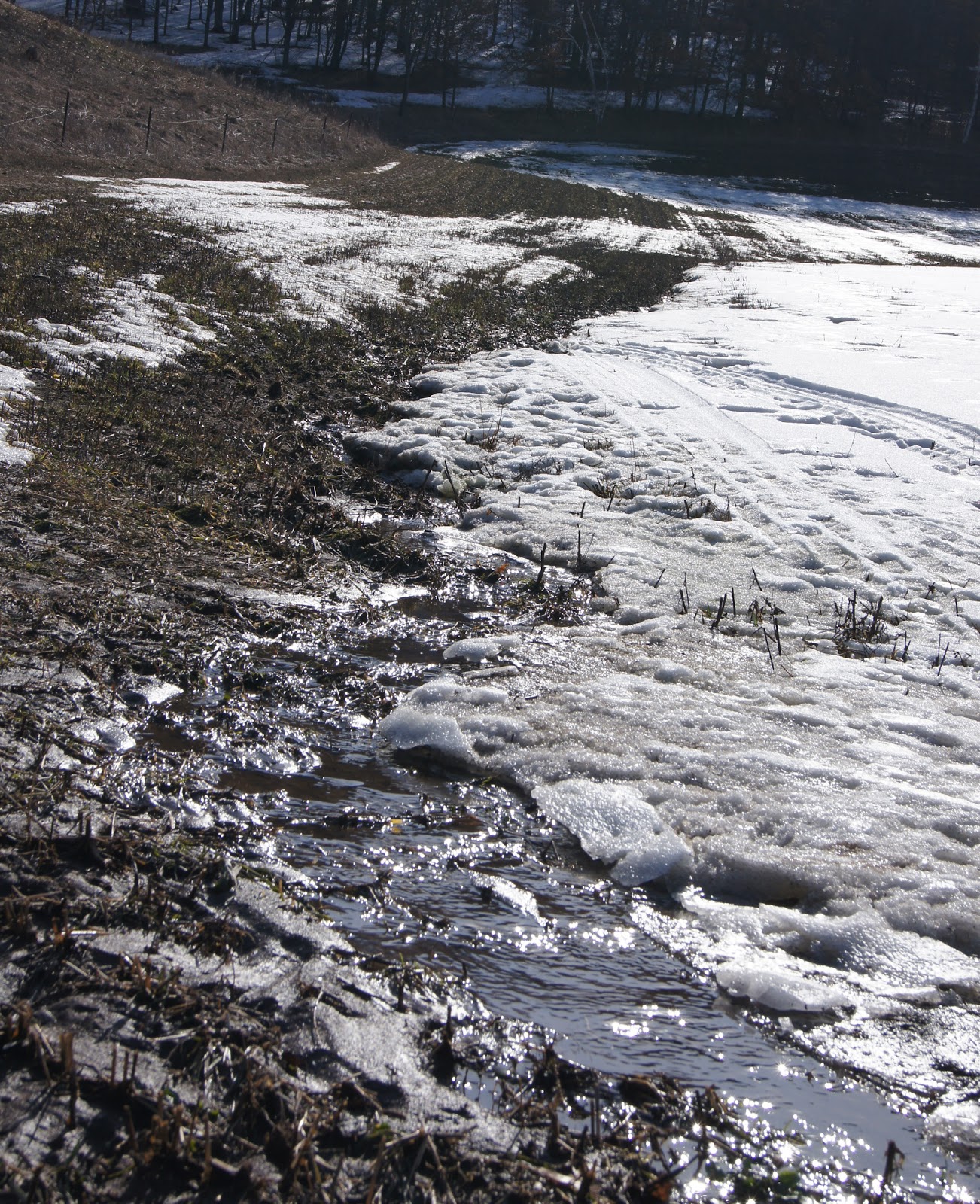
3/10 snow’s all gone and Mary notes, looking out the kitchen window, “It’s not winter anymore,” to which I reply, “It’s not spring, either.  It’s mud season.”
3/10 cooked down a tiny bit of box elder syrup, “single source”….
Shrimp on the barbie, definite grilling weather
3/11 picked garlic mustard along the Rush River at Brush Cr Rd; grilled pork chops; summery
3/12 summery; dinner at Tina’s, I wear shorts
3/16? 2” rain, thunder
3/14 woodcock return
3/17 SNOW again, grass covered
3/18 snow gone
3/22 tapped birches and they were running; seemed pretty vigorous, but didn’t get much for a few days
3/23 SNOW again! 3-4”.
3/24 snow gone!
3/27 finished the last maple, moved over to birch
3/28 5 gallons birch mostly cooked down
3/29 another 5 gallons birch gathered, mostly cooked down; sunny and warm, in shorts again
3/30 It didn’t seem that there was much sap flow, but the eight birch gave around four gallons total, which reduced gently on the woodstove overnight
3/31 The house is starting to smell birchy with the sap on the woodstove getting right down there.  It’s raining now, but the forecast is for an inch of snow by the end of the day.  April Fool!

Text and photos copyright 2016 by Brett Laidlaw


Thursday, April 16, 2015

Sweet Trees X3


Boiling birch on the left, maple on the right.

Sugaring season came to an end this week.  The birches were running pretty good for a few days, but with afternoons in the sunny 60s the sap doesn’t keep.  The maples slowed and then dried up a good week ago, and are now breaking bud.  I also tapped our one big black walnut this year, but not soon enough to get much sap—enough to cook down to maybe a third of a cup, which isn’t bad, considering I only had about a half gallon of sap.  My minimal experience with black walnut tells me that the sap is at least as concentrated in sugar as maple, and that it probably starts running at about the same time.  Since our black walnut tree is always extremely late to leaf out, I had assumed the sap would run late, too.  Not so.

I took a very low-key approach to sugaring this year.  I tapped about five maples, exactly two birches, and the one black walnut.  I left my half-assed sap contraption in mothballs, and just reduced the sap on our woodstove, very gradually, and did the final brief boiling on our gas cooktop.  The result was not any great quantity of anything, but the process did produce some observations.

Shades of maple: from left, first to fourth boilings of 2015 syrup, and one from 2014 at right.
The maple syrup was the lightest in color that I’ve ever made.  Even the fourth and final batch, from sap gathered just before the trees dried up, is medium amber at most—the last syrup is usually very dark, verging on what sometimes is sold as “grade B”.  So there’s less of a caramel taste to the maple, but it’s delicious just the same.

Slow birch 2015.
The “slow birch” also made a much lighter, more delicate syrup than hard-boiled versions I’ve done in the past.  It's a gorgeous color, reddish mahogany. There’s still an edge of acidity to it, but it’s rounder, without the aggressive, almost bitter bite of the darker stuff.  I suppose you could liken it to different roasts of the same coffee bean, from light to Vienna, French, espresso.  Actually, I think you could very much liken it to that.  I could see using the lighter stuff to drizzle over grilled or roasted vegetables, where the darker version works better combined with other ingredients, in vinaigrettes, marinades, or glazes.
Hard-boiled 2014 birch.


Finally, the walnut.  As I say, I wound up with about half a cup.  It’s much more like maple syrup than birch, which makes sense—maple and walnut trees are more closely related to each other than they are to birches, aspens, etc.  Also, I believe, though I don’t know for sure, that walnut syrup is composed of sucrose, as is maple syrup, while birch syrup contains mainly fructose and glucose.  I’m just going from taste, and common sense(?) on that.

Black walnut syrup.
The main thing I was aware of with the walnut syrup was trying NOT to describe its aroma or flavor as “nutty.”  I resisted that characterization mightily, and in the end, I failed.  The finished product definitely has a slight, but undeniable, aroma of toasted nuts to it, and a maple-level sweetness.  

There you go.  That’s the sugaring report.  I think all three kinds of syrup are worth making if you have access to a few trees.  And as with my previous explorations of micro-batch pickling and preserve making, I hope I’ve shown that you can have fun with DIY foods without going overboard into tedious mass production.  Sometimes a taste is enough.

Birch in the final reduction.
Next time it’s on to the nettles and other wild greens.  ‘Tis the season.  And it’s been mild enough of late that I think I’ll hit the garden today and plant some radishes, mache, lettuce, and peas.

The Bide-A-While tree syrups family portrait, 2015.

Friday, April 3, 2015

A Few Tastes of Maple

I got a chance today to talk maple syrup cookery with Rob Ferrett on the Food Friday segement of Wisconsin Public Radio's Central Time and have compiled here a few of the recipes I mentioned on the show.  I've made this dish a lot lately, while testing the recipe out for the cook-off, at the cook-off, and then as the featured dish I prepared at Kate's Occasional Cafe at the Dairyland Cafe in Ridgeland this past week.  I'm still not tired of it.


Sichuan-Spiced Maple Chicken Wings (This recipe was inspired by Teresa Marrone’s Two-Pepper Maple Chicken Wings from Modern Maple.)

Serves 2 as a main course, 4 to 6 as an appetizer

Serve these spicy-sweet wings over a bowl of rice, accompanied by a stir-fried vegetable, for a main course; or as a zingy appetizer—keep a cold beer close at hand.

2 pounds chicken wings (about 10 wings), tips removed, separated in 2 pieces
¼ teaspoon salt
2 tablespoons soy sauce
1 tablespoon oil (sunflower, canola, or the like)
2 teaspoons sambal chile paste (or to taste)
¼ cup maple syrup
3 cloves garlic, coarsely chopped
2 tablespoons coarsely chopped ginger
1/2 teaspoon ground roasted Sichuan pepper
1 teaspoon coarsely ground black pepper
4 scallions, trimmed and cut into 1-inch pieces

Preheat your oven to 425.  Combine all the ingredients except the scallions in a large bowl and toss to coat the wings with the seasonings.  Place the wings and seasonings in a heavy roasting pan, and bake, stirring every 15 minutes or so, for 45 minutes.  Add the scallions and continue baking, stirring occasionally, until the wings are well browned and the seasonings have become a glaze that coats the wings.  This will probably take another 15 to 25 minutes.

Options:  For really dark and glazy wings, turn on the broiler for the last few minutes of cooking, and turn the wings a couple of times so they brown evenly, being careful that they don’t burn.
            If you have a convection feature on your oven, you can produce excellent results without resorting to the broiler.  Bake at 400 convection and check every 10 minutes, adding the scallions after 30 minutes.  Total cooking time with convection should be 40-45 minutes.

These wings can be made ahead and reheated before serving.  


Maple Spice Grilled Sirloin (original post here)
serves 4--next time I make this I'm going to try it with venison

1 1/2-2 pounds sirloin steak 

Marinade:
½ teaspoon ground cumin
2 teaspoons sunflower or canola oil
1 teaspoon sambal oelek chile paste
1 tablespoon maple syrup
2 teaspoons soy sauce
Pinch salt
Lots of freshly ground black pepper
1 large clove garlic minced
Combine all marinade ingredients and pour over the steak, coating well.  Marinate the steak for a couple of hours at room temp.  Prior to grilling remove the steak to a separate plate, saving the marinade.  Add hte marinade to 1/3 cup chicken stock in a small saucepan and bring to a simmer. 
Grill the steak over hot natural wood coals to desired doneness--about 3 minutes per side for rare, 4 for medium rare.  Let the steak rest on a platter for at least 5 minutes; add the juices that the resting steak produces to the stock and marinade mixture.  Serve with grilled vegetables and salad. 


The Thighs Have It


In terms of underappreciated, tasty bargain meats, chicken thighs are right there with pork shoulder steaks, in my opinion.  The thigh is my preferred part of the bird, though I fully appreciate the wing thing, too.  Chicken wings prepared in a Sichuan dry-fried manner are an exquisite treat.  The thighs, though, are more accommodating in a knife-and-fork meal context, and when they are boneless, why, they make positively civilized eating--cooking them over nice smoky hardwood coals keeps them on the rustic side.

Ramps season is starting as the maple season ends, and I often wind up putting the two together, frequently on chicken.  This is a flavorful, simple dish to celebrate the return of grilling weather (well, comfortable grilling weather; we cook over the coals year-round).

A paillard is a flattened out piece of meat.  I wail away at my thighs with the side of a heavy cleaver--a meat mallet, or even a small sauté pan will get the job done.
Maple-Ramp Marinated Chicken Paillards
Serves two to three

4 boneless chicken thighs, skin on
½ cup chopped ramps, whites and greens
Juice of ¼ lemon, and some zest, if you like
2 tablespoons maple syrup
½ teaspoon sambal oelek chili paste (or more, to taste)
¼ teaspoon salt
Freshly ground black pepper

Purchase boneless skin-on chicken thighs, or bone them yourself. Place one thigh at a time on a cutting board, and with a meat mallet, the side of a heavy cleaver, or a small, clean saucepan, pound each thigh vigorously until the meat is about ½ inch thick—the surface area of the thighs should nearly double.

Combine the rest of the ingredients in a mixing bowl and add the chicken, coating it well on all sides. Let the chicken marinate for at least 60 minutes at room temp, or longer in the fridge. When you’re ready to cook, prepare a fire of natural wood coals, and grill the chicken over medium-hot coals, turning often, for 12 to 15 minutes total. The chicken should be very well browned on both sides.

If you have extra ramps, toss a few in what remains of the marinade, and grill them along with the chicken.


Sweet & Sour (Tree Crop) Chard (original post)
serves two generously
5-6 good-sized chard leaves (2 cups chopped)
1/2 medium onion, sliced
2 Tbsp olive oil
1 cup chicken stock (or 1/2 cup stock, 1/2 cup water)
2 good pinches salt
a few grinds black pepper
2 to 3 tsp maple syrup
1 to 2 Tbsp apple cider vinegar
options: a bit of thyme, a small knob of butter stirred in at the end

Cut the thick ribs out of the chard leaves, and slice these diagonally into 1/2-inch pieces. Tear or cut each leaf into four or five pieces. Heat a 10-inch skillet or the like, and add the olive oil, then the onion and the chard rib pieces. Add a couple of pinches of salt, the stock (or stock and water, or water). Cover and cook over medium heat for 6 to 8 minutes, until the chard is starting to soften. Then add the chard leaves, and as soon as they wilt into the liquid add the vinegar and maple syrup. Cook uncovered for another three to four minutes, until the chard is tender to taste and the liquid is somewhat reduced. Taste for salt, sweet, and sour. Serve in a dish
 

Roast Baby Carrots with Maple-Mustard Glaze (original post)
2 cups baby carrots, scrubbed (mine weighed 9 ounces)
1 1/2 Tbsp maple syrup
1 tsp canola or grapeseed oil
pinch of salt, grind of pepper

Combine all the above in a gratin dish or small baking dish. Roast, uncovered, at 375 for 45 minutes, until they become a little brown and glazy. Stir them every 15 minutes during this time.

Remove from the oven and add:

1 rounded tsp grain mustard
1/8 tsp piment d'espelette, or a good pinch of cayenne (optional)
1 tsp red wine vinegar

Add another grind of pepper, taste for salt. Serve warm or at room temp.
 

Sunday, March 8, 2015

Starting Now


Our local food year starts, appropriately enough, with the first upwellings of sap from the maples.  Cold and clear, only barely sweet, maple sap straight from the tree carries the flavor of a small miracle.  Through it we tap in—literally and figuratively—to a perennial process that encapsulates what it means to live and eat seasonally like nothing else.  In the fall the trees sent all their resources down into their roots, to safeguard them through the long dormant season.  As days grow longer to the equinox’s tipping point, and the thaw-freeze cycle starts and continues, the trees call up that liquid food—it’s used to make leaves that enable to trees to utilize the sun’s energy, to make more leaves, to make seeds that make more trees, all of it cyclical, like the seasons, endless rise and fall and rise again.

We intercept the sap as it travels—simple enough, drill a little hole, stick in a tap, or spile, hang a bucket or a bag, collect sap, and when you have a quantity cook it down until most of the water is gone, all the sweetness remains.  Homemade maple syrup has qualities of terroir (the French term most often applied to wine), I believe; especially when the syrup is infused with traces of smoke from a fire stoked with wood from the same hillside where the maple trees grow.  All maple syrup is good; maple syrup from your own trees is both good and meaningful, and deeply satisfying.

I’ve been pretty slackardly in keeping up Trout Caviar for the last couple of years.  This year I’m going to make an effort to get back on top of it and document a year in local food from where we sit, at Bide-A-While just down the road from Bide-A-Wee in northern Dunn County, township of Wilson just southeast of Ridgeland, Wisconsin.  Starting now.  I tapped three maple trees today; the sap had not yet started to run.  But conditions over the next week and more look perfect--highs near 50, lows in the 20s.  It will be flowing very soon.

Lily found a really nice stick.  So awesome.

___________________________________________________________________________________

Mary made tartlets today, very local in nature, and appropriate to the early spring theme.  She wanted to test the recipe for the Maple Madness Cook-Off that's part of the Hungry Turtle Weekend program  of classes and cooking demos happening in Amery next weekend, March 13-14.  The tarts use maple syrup, dried apples from our trees, Wisconsin hickory nuts, dried cranberries.


The original recipe was for something called Ecclefechan tarts—it came along with a knitting pattern Mary bought a while back, Ecclefechan being a town in Scotland.  We’ve changed it up enough to make it our own.  We made these for a dinner/class at the Palate kitchen store in Stockholm, WI last spring, and came up with a fancy little accompaniment, the chevre maple cream, as below.  The tartness of the chevre works nicely against the sweetness of the tarts, but regular whipped cream would be great, too.  Or just eat them plain, with a cup o' tea.


Hickory Nut & Maple Tart(let)s with Dried Fruit
Makes 8 four-inch tarts or 24 tartlets

Pastry:
200 grams (1 ½ cups) all-purpose flour
120 grams (1 stick; or 4 ounces) unsalted butter
1 tablespoon granulated sugar
1 tablespoon brown sugar
1/8 teaspoon salt
1 egg yolk
Water if needed (Mary has found that water is usually needed, up to 1/4 cup; start adding 1 tablespoon at a time)

Cut the butter into ½-inch pieces and rub it into the flour until the mixture looks like breadcrumbs. Stir in the sugars and the salt, mixing well. Stir in the egg yolk and mix well. If the mixture is crumbly, add cold water a tablespoon at a time until you can form a dough that holds together. Knead very briefly, just so all the ingredients are well combined. Wrap in plastic and refrigerate for at least 30 minutes.

Filling:
50 grams (1/4 cup) granulated sugar
50 grams (3 tablespoons) maple syrup
100 grams (7 tablespoons; or a stick minus 1 tablespoon) butter
1 egg
50 grams (1/2 cup) ground almonds
50 grams (1/2 cup) coarsely chopped hickory nuts (or substitute walnuts, pecans, or almonds)
30 grams (1/2 cup, packed) dried apples, chopped
60 grams (generous ½ cup) dried cranberries
1/8 teaspoon salt

Combine the sugar, salt, syrup, and butter in a small saucepan, and place on low heat until the butter melts. Add the fruits and nuts and let this mixture cool for several minutes, then mix in the egg.

Roll the pastry out into a layer about 1/6-inch thick. Cut rounds appropriate to the pans you're using--mini tart pans, muffin tins, etc. Fit the pastry rounds into the pans, fill 1/2 full.

Bake at 375 until the pastry is golden brown and the filling brown and nicely puffed up. Depending on the the size of the tarts, this will take 25 to 30 minutes. Check after 15 minutes, then every 5 minutes until they're done.  Serve with chevre maple cream, plain whipped cream, a slice of sharp aged gouda or cheddar, or just a cup of tea.

Chevre Maple Cream

2 oz fresh chèvre, at room temperature
2 tablespoons maple syrup
1/2 cup unsweetened whipped cream

Combine the chèvre and syrup, and mixing with a fork until well blended. Fold in the whipped cream. Refrigerate until ready to use.
 

Tuesday, January 28, 2014

Winter Fuel: Porridge of Wheat Berries, Rye Berries, and Steel-Cut Oats with Dried Apple and Toasted Hickory Nuts


It was -26 here this morning, probably the coldest night of this very cold winter.  To get going on mornings like this, you need hearty sustenance, you need fuel.  Our favorite simple winter breakfast this year is this three-grain mush flavored with dried apples and toasted hickory nuts (and of course some excellent local milk, and a splash of our maple syrup).  We prepare it on the woodstove the night before, making a batch to last a couple of days.  In the morning I put a portion for two in a small saucepan, add some water and a pinch of salt, snip in some dried apples, and let it warm while we fix tea.


What I love about this porridge is that it's not just mush--it has bite, a satisfying chew, because the rye and wheat berries never totally succumb, no matter how long you cook them.  They have a natural sweetness, as well, and the apples add more subtle sweetness, along with tartness and yet another texture.  And then the hickory nuts, toasty, rich, lightly crunchy.

I think I'm ready for another bowl....

Steel-cut oats lower left, wheat berries right, rye berries top, hickory nuts, dried apple.

For four ample servings I used:

1/2 cup wheat berries
1/4 cup rye berries
3 cups water

Bring that to a boil and let it simmer a good long while, at least an hour, I'd say.  Check every 15 minutes or so to make sure all the water hasn't cooked away.  When the berries are yielding but still quite al dente, you can add the oats.

1/3 cup steel-cut oats
2/3 cup water

Add the oats and water right into the wheat and rye berries.  Cover and simmer 20 to 30 minutes, then remove from the heat and set aside.

In the morning reheat the porridge with a little added water and a couple pinches of salt, and snip in dried apple or other dried fruit--or, as mentioned above, spoon your desired portions into a small saucepan, and do likewise.  When it's hot, dish it up, add milk, maple, top with toasted nuts.  We are in love with the local hickory nuts we found at the little market in Ridgeland, but walnuts or pecans, toasted pumpkin seeds, what have you, all would add that nice contrasting crunch.

This is the kind of cold weather breakfast that could almost make you wish winter would never end.

Almost.


Text and photos copyright 2014 by Brett Laidlaw

Tuesday, May 7, 2013

Sapped Out


I'm doing the last boil of the sugaring season today, cooking about 10 gallons of birch sap down to what will probably be around a pint of syrup.  It has been a long, satisfying, at times grueling, few weeks--tapping the trees, awaiting the sap run, at first reluctant, then rising to a spate; checking the taps, hauling the sap, cutting firewood, and boiling, boiling, boiling.  All this in the midst of one of the most remarkable stretches of springtime weather...I was going to say "in memory," but I don't think anyone remembers such a season, as such a one has not occurred before, not in my time.

That's because water has been falling from the skies--mainly as snow--just as steadily as it has been pulsing up through the capillary systems of the maples and birches.  We thought that the April of storm after storm was remarkable, until we experienced a historic May weather event, a two day-plus storm that dropped around 16 inches at our house.  The Twin Cities record for a May snowfall was around three inches--and that record held, because the cities were on the rain side of the line.  Three inches is not a lot of snow, but then, May is supposed to be a spring month.  Well, so is April, for that matter. 

May 4, 2013, Ridgeland, Dunn County, Wisconsin

As the snow melts water flows down our hayfield hill, around the corner of the yard (and right across where I dug our garden last year, bad planning), and pools up in a low spot north of the garage.  From this holding area it then trickles out to form a perfect little brook past the lone pine tree behind the garage, and out into the pasture.  It's a good distance from there to the corner of our property at the crossroads of the county road and our town road, where tiny Hay Creek makes a hard southward turn, but some of those snowflakes from our hilltop surely make it to the creek, which meanders through some very pretty countryside about 15 miles, crow-wise, and who knows how many crooked stream miles, to the Red Cedar River.

The Red Cedar takes a more direct route south and empties into the Chippewa River south of Downsville (in summer we ride our bikes on the state trail that follows the Red Cedar down to this confluence).  The Chippewa in springtime is a mighty river, at some spots it can seem as broad as the Mississippi; until, of course, you see the Mississippi where the Chippewa enters, a shining, stirring inland sea--Lake Pepin--from which greening bluffs, grander than castles, rise on the western shore in Minnesota.


And the Mississippi, of course, it goes to the Gulf, where a warm wind picks up water molecules from the salty surface, and perhaps on some strange May day (or it could be March, December) a driven jolt of northbound air carries that laden breeze back up the course of the great river in an anomalous weather system that sets up a stationary line of torrential snow from Iowa into southeastern Minnesota, across west central Wisconsin, dropping nearly a foot-and-a-half of snow on a hilltop in northern Dunn County.  Did some of those snowflakes start here, years ago?  Seems crazy, but it's possible.  Clearly, I'd like to think that they did.

All this water coming down, water gushing down, the gathering of the streams, the boiling of the sap, it's had me thinking about accretion, and reduction.  All that water from the skies, gathering on our hilltops, in the woods, in our yards--in everybody's yards, forest, fields.  It comes down drop by drop, or flake by flake.  When you get down to where the Chippewa joins the Mississippi, you wouldn't have thought just a few snowflakes, a few raindrops, could amount to all that.  If all you see is the mighty flow, I think you're missing the bigger picture, which, oddly, only comes into focus when you start with a snowflake.

Accretion, it's kind of an odd word, but the one which, to me, sums it up (no pun intended).  Things gathering together, things piling up. "Any gradual increase in size, as through growth or external addition."  It's how every little bit helps, and every litter bit hurts, how the extra Christmas cookie, one more beer, or french fry, amounts in time to...self-loathing.  A garden is an accretion, created one seed at a time, then one leaf at a time until, there it is, a verdant expanse.  Since I've started cutting wood for next winter (and that wet, heavy snow has given me lots of broken limbs to cut up for the pile), I see the woodpile as an accretion, one split, one stick at a time until, by the time the frost returns (think not of that...), we'll have a winter's worth of heat, and cooking fuel, and dark nights' cheer stacked up to see us through.

A good novel is an accretion of detail and incident and image, all adding up to something marvelous, and all compiled one word at a time.  And running accretion backwards, in an abstract but very, very meaningful way, that's the phenomenon of moments slipping by, it seems to me, of time past and not to be regained--Proust can search all he wants.  More positively, what is life but an accretion of moments, experience, memory?  Whatever it is that's piling up, it's all happening in time, so a snowflake falling is a tick of the clock, and as the meltwater drips out of our ephemeral pond, it's a sort of liquid hourglass--though we won't be turning it over.


With the wet snow coming down, the saps coming up, we started to feel inundated from all sides.  When the snow stopped and the sun came out (it did, a couple of times in the last six weeks), things seemed better, but in another way it only sped the spate--the water flowed down the hill, the creek filled to the banks; the sap gushed from both maples and birches.  I couldn't keep up with it.  I dumped gallons and gallons of sap on the ground--I don't know why it felt wasteful, it was going to wind up there eventually, and the trees had all the sap they wanted.

Meantime, with all that accretion going on downstream, I was going against the tide, a few gallons at a time, engaged in the frantic race toward reduction--take 10 gallons of maple sap, 20 of birch, 80 or 160 pounds of liquid, turn it into something you can hold in your hand.  Pour on your pancakes, use to flavor a salad dressing.  Drop by drop, in wisps of steam, or through gentler evaporation in the final reduction on the woodstove overnight, as the fire gradually died down, I was sending all that water back into the air.  To harvest an essence, a distillation.  Some sweet stuff.  Here taking away everything extraneous, which is in fact all you could really see was there, the watery part, to leave something of which we only had the vaguest insinuation, that fleeting sweetness on the tongue.  An act of faith, in its modest way.

The pros at this business probably philosophize less and boil a lot more than I do, so in this bountiful year for sap I've seen syrup offered at $25 a half gallon, cheaper if you buy more and bring your own containers. 

________________________________

I recorded the first drops from our maple taps on March 25.  With the back-and-forth spring going mostly back, it was a couple of weeks before I had enough sap to boil.  Thanks to Twitter, I'm able to report with utter accuracy that our first boil was on April 5: "My half-assed homemade sap contraption did a fantastic job on its maiden boil."  Thus I tweeted.  It went pretty steadily from there, reaching full spate by mid-April, wearing out my willingness to spend the day bathed in wood smoke by about the third week of April.

At which time I drilled an inch into a big birch, and sap came pouring forth.  Here we go again.

It's pretty easy to see how people started making maple syrup.  Although maple sap is clear as water, still it tastes faintly sweet to the tongue.  To the squirrels the sap that dries on maple trees, naturally flowing out from cracks in the bark or broken branches, definitely has a sugary appeal, and perhaps that's how aboriginal people figured out that there was something good here, from observing how the squirrels lapped it up.  Then there were probably a few steps involved, and a lengthy evolution, before getting to maple syrup and maple sugar, but the end result was reliable and delicious.

It's much harder to understand how birch syrup came to be.  A birch tree in a good year can provide an astonishing amount of sap, but when you taste it, it doesn't seem sweet, containing only about half the sugar of maple sap.  Perhaps I should modify that:  It doesn't taste sweet to me.  It doesn't taste sweet to the contemporary American palate, bombarded with sweetness from every side, sugar hidden in just about every processed food from salad dressing to crackers.  But maybe to a purer palate, way back when, the sweetness of birch sap was detectable, and desirable.  It you had a lot of birch sap, and firewood, and time, it was probably worth it.


As my last batch of birch sap boils away, with a pint of finished syrup in the fridge, I'm asking myself if it was worth it, and mainly coming down on yes, now that it's nearly over.  It's a fascinating product, unlike anything I've tasted before.  It's dark, dark, dark--more like molasses or sorghum syrup than even grade B maple.  And I'm not sure what accounts for this, but it is quite acidic, too, with a spiciness dominated by a menthol or wintergreen note, and a smokiness that may literally be from wood smoke wafting across the surface of the pan as it cooks.  But also, perhaps because of that acidity, it has a fruitiness, almost a wininess, that maple syrup lacks.  At first taste, I must say, it's not immediately likeable--it takes you aback and sits you up straight.  But part of what I like about it is that sense of extremity--that it is difficult to make, not easy to like, and that it requires some thought to determine how best to use it.

Here's what I've done with it so far, and how these preparations turned out:


Birch-cured whitefish gravlax.  I followed the method I used for maple-cured lake trout gravlax (in the book), but:  then I forgot about it in the back of the fridge for over a week.  Oops.  I was afraid it would be spoiled; instead, it is just very, very salty.  But the flavor, other than the oversalting, is good, and the texture is excellent, which I attribute to the birch syrup.  So I'll use it as I would salt cod, probably make something like a brandade, the Provencal dish of salt cod pureed together with potatoes, lots of garlic, olive oil or butter.  Maybe I'll work in some other seasonal things like ramps and watercress.


Pork chops marinated in birch syrup, ramps, and Sichuan pepper.  A couple hours ahead of cooking I brushed the chops with a couple of tablespoons of birch syrup, added chopped ramps, salted and peppered liberally, also a good sprinkling of roasted, ground Sichuan pepper (hua jiao).  On the grill, medium coals, 10 to 12 minutes total--excellent, and the interesting thing was, the birch syrup didn't burn as another sweetener would.  I'll look into this phenomenon further.


As a salad dressing component, birch syrup (you don't know how many times I've typed bitch while writing this post, and had to correct...) is superb, especially with assertive greens like watercress.  Since it brings both sweetness and acidity, you don't need vinegar or lemon juice in the dressing.  I've simply been mixing the birch, some sunflower oil, a wee bit of mustard, salt and pepper--terrific.  Shown here as the base for pan-fried trout with sauteed ramps and lardons, duck fat potatoes.

You experience the land and the season in a different way when you take up sugaring, and I'm as glad to have done it as I am that it's over.  I probably won't make birch syrup every year, and with three gallons of maple syrup in the pantry, I likely won't have to do as much next year.

On the other hand, I recently saw a link on Twitter to an article about making syrup from black walnut sap.  Oh, why did I have to look...?


Text and photos copyright 2013 by Brett Laidlaw

Wednesday, April 17, 2013

The Sweetest Tree


It has snowed here nearly every day for the last week, interspersed with rain, freezing rain, and sleet, and the frigid precipitation has been accompanied at times by gale-force winds. We had a break from all that yesterday, a pleasant, sunny day when the temperature tiptoed into the 40s. The sun was strong—I got a bit of color on my winter-pale face, I noticed as I brushed my teeth last night—and our yard turned to slush by mid-afternoon.

But all good things must come to an end, they say, and that warm, bright idyll will seem as a dream today when snow and rain and snow again return, and the streams may flood and windchill makes it feel like February. Well, what the freakin’ ever…. Last spring, March in particular, was freakishly warm, so I guess this is just how we come by our historical average temperatures, or it’s evidence of global weather weirding, or something. There is not much we can do but piss and moan, and pretty much everyone I know has been doing plenty of that.


It’s true, this endless winter of a springtime is not good for much, but in attempting to look on the bright side, here are a few pluses amid all the grimness: We haven’t seen any ticks yet, where in a mild winter we sometimes encounter them in the midst of a February thaw. Likewise, no sign of mosquitoes. Small blessings, perhaps, but we must take what we can get.

Also, once the fruit trees bloom, they probably won’t be hit as bad by late frost as they were last year, when all our fruit—from apples to wild black cherry, nannyberries and hawthorn—took a hit. Only the blackberries produced a decent crop.

And then, with springtime so drastically deferred, once it does warm up we’ll likely see an amazing confluence of blooms as everything bursts into flower at once, to catch up with the season. That’s something to look forward to.


Finally, this reluctant spring has been ideal for a seasonal rite cherished across our part of the northland: maple sugaring. With freezing nights and daytime temperatures creeping at least a little bit above 32, the sap has been flowing for the last couple of weeks, and has really picked up in the last few days. Last year, the sudden March heat put an end to the sugaring season pretty much before it started. This year is looking like a banner year; I have ten trees tapped, and nearly two gallons of finished syrup made, the most I’ve ever done in three years of sugaring. I’ll probably stop collecting sap in a couple of days, cook down what I have stored, and look forward to many happy pancake breakfasts ahead. Then maybe I’ll tap a couple birch trees, to diversify our stock of sweeteners.


Collecting the sap and boiling it down has been easier (and thus, much more enjoyable) this year for a number of reasons: one, living here full-time makes it much easier to keep on top of the process, since I can manage things a little bit at a time. Also, whereas collecting sap at Bide-A-Wee meant hauling heavy containers quite a distance over bumpy terrain, and mostly uphill, the trees I’ve tapped here are just a couple hundred yards up the hill from the house. I pour the sap into five- to seven-gallon containers, put those in our beat-up but still serviceable black plastic sled, and it’s an easy cruise downhill to the house.


 Boiling down the sap was problematic in the past, as well. My method this year is not terribly sophisticated, but it’s a step up from previous years and shows a good deal of Yankee ingenuity, if I say so myself. What I did was, I took an old oil-burning heater that had been dumped in our woods, and I disemboweled it so I was left with a big metal box, about the size of a dehumidifier, open on one long and one short side, the other short side covered with venting slits. I bought a hotel pan, like the ones you see on buffet lines, to be my evaporating pan. To make it fit, I attached some strips of metal roofing material (left over from the garage we had built last year) to the sides of the larger opening. I placed a grate from our portable fire pit in the bottom, to elevate the wood a bit and provide good air circulation—it fit perfectly. Set this half-assed sap contraption up on cinder blocks, and I was ready to go.

The important feature of this contrivance, something I noticed looking at boilers built specifically for syrup making, is that the evaporating pan fits right down in the fire box. This way you’re getting heat not just on the bottom, but on the four sides, as well. It’s sort of the surround-sound concept applied to syrup making.


My boiler is not that efficient, and could be improved, I’m sure (for instance, I could line it with fire brick to retain more heat), but I’m a small-timer at this, and plan to remain so. I’ll make what small adjustments occur to me over time, but mostly I just hope my salvage operation of a boiler lasts me a couple of years. I know now that you can cobble something together from mostly found materials that really works quite well. I don’t cook the syrup all the way down in the boiler. I take the sap down to maybe one-tenth its original volume, bring it inside and strain it through a scrap of old dish towel into my 5-quart Le Creuset pot (aka “Big Blue”). That sits on the woodstove, and the sap reduces gently until it’s almost syrup. A final, closely supervised boiling, either on the woodstove or the electric range, finishes the syrup off. To determine when it’s done, I just go by feel and taste—I’ll dip in a spoon, pull it out and let it cool for a few moments, and taste. When it was the flavor and viscosity of syrup, well, I figure that’s syrup. I usually let it bubble for around five more minutes, then take it off the heat and bottle it.


If you’re interested in making maple syrup yourself, there’s still time, if you’re above 45-degrees north latitude, and you have access to some trees. Virtually any kind of maple, even box elders, can be tapped for sap. There are various on-line tutorials to show you how to get started, but a wonderful resource for maple fanciers has just been published by the Minnesota Historical Society Press, the second title in the Northern Plate series (the first was Kim Ode’s Rhubarb Renaissance, which made a tart-sweet splash last spring).


The new title is by my friend Teresa Marrone, and it’s called Modern Maple. In it Teresa has compiled around 75 maple-inspired recipes, along with a brief history of maple syrup, and step-by-step instructions for DIY-ers. I know her method is sound because she’s the one who got me started, in 2009. I made a visit to her house in south Minneapolis where she had a couple of big silver maples tapped in her yard. Since then I’ve purchased a few commercially-made metal spiles, and those clever blue bag hanger devices for collecting the sap, but I started out with PVC tubing and repurposed plastic pickle buckets from the burger joint in our former Saint Paul neighborhood. (Here are my maple posts from 2009 and 2010; seems maybe we didn’t do any tapping in 2011, as I was feverishly working on finishing the book that spring, and then 2012, as mentioned, was a bust because of the weather.)


The recipes in Modern Maple beautifully illustrate the versatility of maple syrup in the kitchen. While the flavor of maple is beloved by many, I still think it’s underrated as an ingredient. Teresa’s book should help to correct that situation. Many of the recipes highlight maple’s unique sweetness, but there are also many great examples of how well it works in counterpoint with other flavors like vinegar and citrus, chile heat, and various spices, including a favorite of mine, Sichuan pepper (although I am mildly dismayed to see the outdated Szechuan used in Teresa’s book; unfortunately, many style books haven’t caught up with the times).


I like the sound of her Sweet and Spicy Chile-Maple Dipping Sauce, and I may have to make a batch of her Near-Beer Peanuts tonight for a happy hour snack. Other tasty sounding dishes that caught my eye: Red Cabbage and Berry Salad and Escarole and Radish Salad with Smoky Maple Dressing; Corn on the Cob with Spiced Maple Glaze; Pork Tenderloin with Rhubarb-Maple Sauce and Cheese Grits (though I’d probably use a humbler, tastier cut of pork, like cutlets from the shoulder, or country-style ribs); and Shortbread with Maple Caramel and Sea Salt.

Teresa recently started a blog, which will certainly be worth reading. All the recent interest in wild foods has been great in highlighting the qualities of these most local of foods, and Teresa’s involvement in the topic goes back way before foraging became trendy; she’s the real deal, indeed.


With all this sap boiling down around here, I’ve been using a lot of it in my cooking. When I’m making bread I’ll add a ladle of not-quite-syrup to the dough, to the obvious delight of the yeast in my starter. The other night I came up with a dandy topping for broiled fish, combining fresh bread crumbs from a flavorful sourdough loaf with butter (warm these together so the butter is integrated), toasted sesame seeds, ground roasted Sichuan pepper, and a moistening of maple syrup (I think there was something spicy in there, too, perhaps a couple of pinches of espelette or similar fragrant, not too hot chile).  Pat this mixture liberally on a skinless fish fillet--I used Lake Superior herring--get an oven-proof fry pan hot, and fire up the broiler, too.  Add a little oil to the pan and gently slide or lift the fish into the pan.  Then move it directly to the broiler, five or six inches away, and broil until the topping is nicely browned.  The syrup in the mixture sort of welds everything together into a crunchy caramelized crust, and the direct heat of the broiler really brings out the fragrance of the Sichuan pepper.

I get sort of fanatical about not wasting even a drop of syrup—I’m all too aware of the time and effort required to make it—and this has led me to some delightful treats. A couple of days ago I found a bit of tea left in the pot, and a recently emptied, not yet washed pan from reducing syrup. I deglazed that maple pot with the tea, added a generous portion of whole milk from a local farm, and warmed the mixture on the woodstove: Maple milk tea, the woodcutter’s delight.


I wouldn’t turn my nose up at any kind of maple syrup, and in the past couple of years most of what we’ve used has been purchased. The homemade stuff, though, that’s a different thing entirely. When the sap is reduced over a wood fire, it does pick up a hint of smokiness, which you don’t tend to find in the commercial syrup. And then, your own syrup expresses the terroir from which it sprung—no other syrup will taste quite the same. Also, you get to see how the syrup changes through the season, generally going from a lighter, more refined tasting syrup early in the run, when the sugar concentrations are highest, to darker syrup with more robust flavors as sugaring nears its end, and the sap requires longer boiling times.

It is, indeed, a hell of a lot of work, for what can sometimes seem meager results. And you simply must do it yourself to have any comprehension of what’s required to turn something between 30 to 40 gallons of sap into a gallon of syrup. But however much syrup you wind up with, it’s gold, it’s magic, it’s something more than food and more than sweetness. It’s the taste of the northern forest, distilled into amber genius.


Text and photos copyright 2013 by Brett Laidlaw