Thursday, May 10, 2012

Savage Soupage


I also like the sound of potage sauvage, but I'm trying to wean myself from always running to the French.  That one will go in the title pantry, though, and I'm sure it will find its way out.  This is one of the most foraged dishes I've ever made, although, wild as it is, it did not require a lot of foraging far afield.  Indeed, much of it--morels, nettles, dandelion greens--came from our yard or near outskirts.


We had a nice, surprising fruiting of morels twenty feet from the house, near some cottonwoods.  Stinging nettles encroach at every edge of the yard, and our dandelion crop is amazing--not just the sheer number of plants, but the size of the leaves, and their mildness.  I haven't done enough with them this year.


As I was putting this soup together I worried that it might turn out to be a bit challenging, might lean toward the medicinal or excessively "healthy" side.  Ramps, nettles, dandelion greens, and fiddleheads all have distinctive flavors, which I had never tried to incorporate in one recipe before.  The morels were there to lend their musky mellowness, modulate the highs (bitter dandelions) and lows (earthy fiddleheads); and then, there's just the magic of soup--and of cream (which I may have mentioned recently...).  I needn't have worried, not a bit.  This weedy wild soupage was far more comforting than challenging, though the textures of all the wild greens still intrigued.  A garnish of dandelion petals brightened things up and removed at least one of those darned weeds from my yard.   One down, 600 trillion to go....

Stinging nettle tips left, wood nettles right.

A big part of the greenery in the soup was wood nettles, the lesser known cousin (sort of) of stinging nettles. These are at a lovely size in our woods now, and not terribly threatening, yet.  I'll have more to say about these in my next dispatch.

I had some cress I could have thrown in, but with four kinds of greens already, I refrained.  I cooked up some wild rice, thinking I might need something to give the soup more body, but there was no room for it, and it would have diluted this full-on forager's feast.


Savage Soupage
serves four

6 ostrich fern fiddleheads, each with about 6 inches of stalk, cut into 1/2-inch pieces
1 good handful of nice big dandelion greens, coarsely chopped
3/4 cup chopped ramp bulbs and stems
Greens from the ramps, sliced
3 ounces fresh morels
1 1/2 tablespoons cooking fat--butter, bacon or duck fat, or olive oil
4 cups (loosely packed) young wood nettles
1 1/2 cups (loosely packed) stinging nettle tips
3 1/2 cups chicken or vegetable stock
1/2 cup heavy cream
salt

Blanch the fiddleheads in salted boiling water for 5 minutes.  Drain and refresh in ice water.  If your dandelion greens seem quite bitter, blanch them for 1 minute, drain and refresh, and drain well.

Chop most of the morels, reserving a couple of caps to cut in rings and fry for garnish.  In a large saucepan or dutch oven, heat the cooking fat and add the ramp bulbs and stems.  Sauté for a minute or two, until they start to shrink a bit, then add the morels and a good pinch of salt.  Cook until the morels shrink and start to brown a bit, 3 to 4 minutes.  Add the dandelion greens and stir them in for a minute.  Add the wood nettles and ramp tops (save a bit of the greens for garnish) and stir to wilt them.  Add the stock and a couple of pinches of salt.   Add the stinging nettle tips and fiddleheads.  Bring to a boil and turn down to a simmer.  Simmer, partly covered, for 20 minutes.  Add the cream and taste for salt.  Simmer for 10 minutes.

Just before serving, fry the reserved rings of morel caps in a bit of butter until browned.  Garnish the soup with these, a few bits of ramp greens, and some dandelion petals, if you like.

Text and photos copyright 2012 by Brett Laidlaw

Tuesday, May 8, 2012

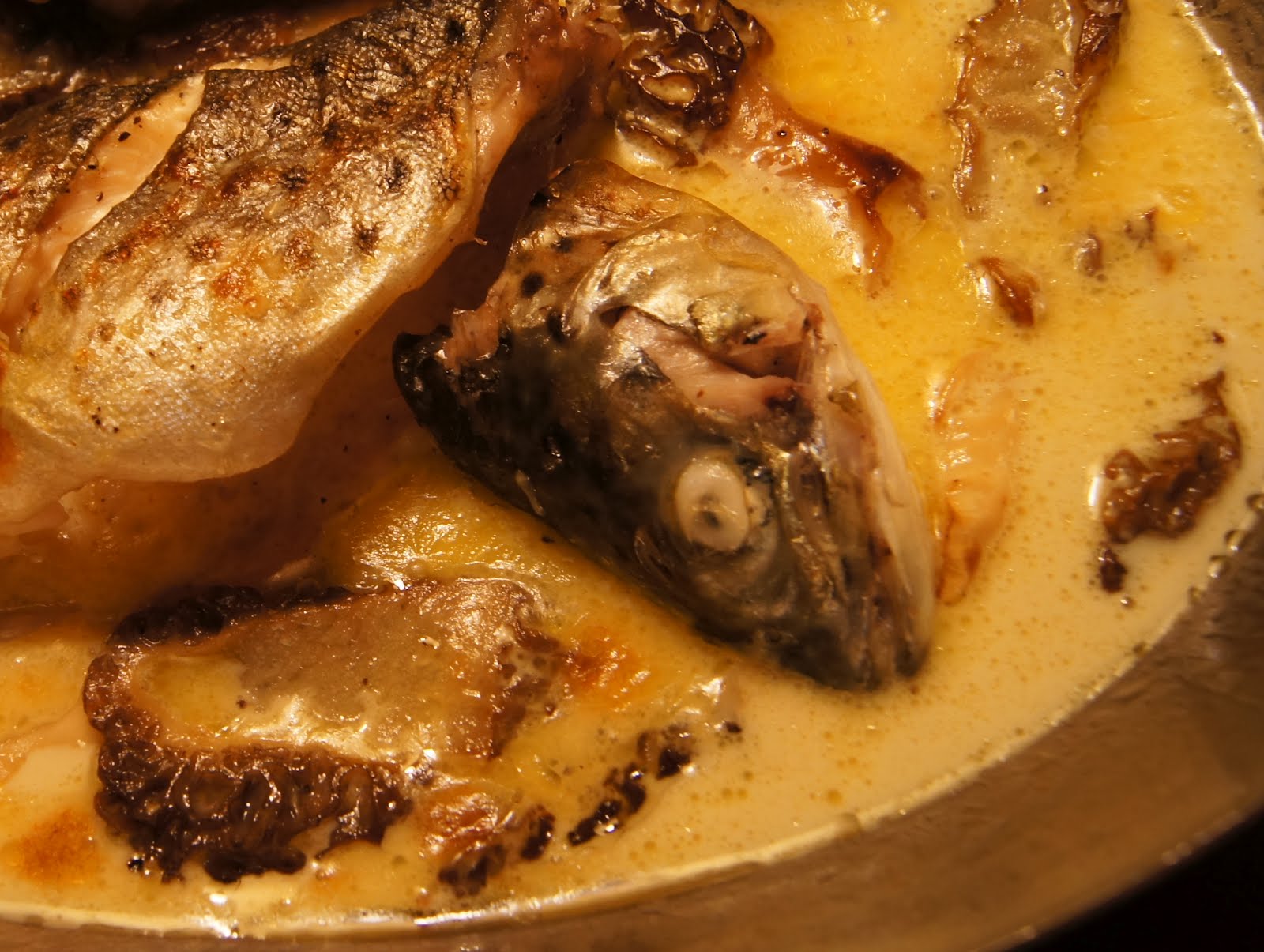
Cream of the Cream of the Trout of the 'Shrooms


Not to say that stream-caught brown trout, foraged morels, and farmers market asparagus couldn't have held their own quite ably on the dinner plate, but what took our Sunday night supper over the top was the cream.  Some of you are smacking your lips and murmuring, Amen, brother, amen, solemnly, and to you I need say no more than, "Bon appétit."  Others of you are cringing a little, but still eager to hear more, repelled by all that fat, cholesterol, artery-clogging stuff, and yet mmmm that does really look pretty good, but no, I couldn't....  To you people, let me me say a few words.

Cream is beautiful.  Do not fear it.  The reflexive revulsion that many people experience when they hear the words "cream sauce" is, for the most part, quite justifiable.  Whether it has its source in the gut-busting, gaggingly rich sauces that used to characterize classic French cooking, or their abominable ersatzes made with canned "cream of..." soups, the aversion to cream sauce often has a real and understandable basis.  But please note that I am not talking about cream sauce, a heavily reduced, butter-laden concoction that leaves you feeling bloated after just a couple of teaspoons.  No, I am talking cream, sweet gold from green meadows, the pure essence of pristine pastures, a gift from our gracious grazers.... Eh.  Right.  Sorry.  Let's try that again.


Cream is beautiful.  It is a wonderful ingredient, and when used properly--which usually means sparingly--it brings a quality to cooking that can be achieved in no other way.  Sure, you can blend some potato into your lo-cal soup, or achieve a creamish texture to a sauce via a flour roux or cornstarch, but in no case will the result be creamy.  For that, you need cream. (Cedar Summit cream is the best around, though available only in the Twin Cities area.  But the small-scale dairy movement is growing (is that an oxymoron?), so perhaps there's an excellent small dairy in your area.)


Because my cookbook doesn't shirk from employing cream, cheese, and excellent bacon in its recipes, I think some people have assumed that I'm a proponent of what we might call "The New Gluttony."  That's the approach to food that champions low-brow, high-fat eating as exemplified by "Diners, Drive-Ins, and Dives," "Man V. Food", and the like.  I'm brand new to pay TV, since we had to get a dish to get any television at all out here in the country, and I'm finding what passes for food programming, well, pretty appalling.  Why people keep tuning in to watch Guy Fieri shove yet another burger or piece of fried chicken into his plump, shiny face is beyond me, but there you go.  Obviously it sells, and I'm just an unknown food blogger with an oddball cookbook, so I should just shut up about it.  I won't even mention Paula Deen or Sandra Lee (whoops...), but the non-stop glorification of two-pound bacon cheeseburgers, doormat-sized pizzas, grease-soaked breakfast platters that would feed a Chinese family of eight for a week, at a time when roughly a third of the American public is clinically obese, that percentage expected to rise to over 40 percent in the next few years, well, where is your shame, you peddlers of slow, oily death, where, I ask is...your...shame?


Uh, so, where was I?  Oh yeah, I was telling  you to eat more cream.  Well, the point I was weaving towards was that while a lot of my recipes do call for cream, they rarely use more than a half a cup, nor do I reach for that bottle of liquid deliciousness more than once or twice a week.  Same thing with the bacon.  I smoke bacon three or four times a year, and do four pounds or so each time, but let's estimate on the high side and say that this household of two consumes 20 pounds of bacon a year.  That's ten pounds per person per year, or 13.33 ounces per month, or 3.33 ounces per week, less than a quarter pound--on the very high end.  I had bacon for breakfast this morning, by the way, from a batch I smoked up yesterday.  My day is off to a good start.

But I wonder if home-smoked bacon on sourdough wheatberry bread for breakfast can be linked to high levels of digressiveness.  What is wonderful about cream is that is makes dishes taste, yes, creamy.  But also, it brings flavors together in marvelous ways.  Using a couple examples from my book:  in Summer Lake Trout Chowder the cream--all of three tablespoons for two generous servings--marries the flavors of fresh and smoked trout and aromatic herbs and vegetables, and gives the broth a hint of richness that makes the dish; in Farmers Market Confetti Vegetable Sauce for pasta, a quarter-cup of cream in a dish that serves four enriches the broth that coats a market vegetable medley that would just be too...vegetal without it, and then brings together sauce and pasta, as well (yes, there's a little cheese on top, but cheese is another super flavor carrier that I use often and sparingly).


The trout dish served up here as an example of how large a flavor impact a little cream can have was inspired by one of Jacques Pépin's lesser known books, but one I reach for all the time: A French Chef Cooks at Home.  A French chef cooks at home rather differently from how you and I do, unless your daily menus run to dishes like Canard Montmorency or Cervelles de Veau Provencale, but it also has simpler dishes, such as Truites Grillées à la Crème--broiled trout with cream.

I usually do this on the grill, as Jacques suggests, but Sunday evening was rainy and blustery, and the broiler had to stand in for the grill.  Thanks to a little cream and a few morels, it did so admirably (and it kind of took me back a few years--why stop the digressions now?--because when I was a kid, broiling was one of my family's main ways of cooking.  We broiled everything, chicken, steaks, pork chops, bacon--those two aluminum broiler pans, one big, one small, scorched and dented from years of service, would go in a shrine if I had them here today.  My mom would broil chicken wings so hard, you could eat the whole thing, bones and all...).

Looking more closely at Jacques's recipe, I see that what I did was quite different from the original, where the trout is grilled over charcoal (back in 1975 Jacques was advocating for real wood charcoal over briquets), then placed "in a nice row in a gratin dish," the cream poured over, brought to a simmer, then served.  I did mine entirely under the broiler.  In the hopes of heading off further deviations, I revert to recipe style:


Broiled Trout and Morels in Cream
serves two

2  10-11" trout, brown, brook, or rainbow, bone in
2 tablespoons butter, divided
3 ounces fresh morels, quartered the long way (oysters, chanterelles, or hedgehogs would also be good)
1/4 cup dry white wine or dry vermouth
1/3 to 1/2 cup cream
salt and pepper

Make a couple of diagonal slashes in each side of the trout to help them cook more evenly and take up more of the sauce.  Season the trout with salt and pepper inside and out.  Heat your broiler with the rack six inches or so below the heat source--not too close.  Place 1 tablespoon of butter in a gratin or baking dish, and place this in the oven just long enough to melt the butter.  Remove the pan from the oven and add the trout to it, turning them to coat with butter.  Place the pan under the broiler and cook for 2 minutes on each side, until the skin starts to blister.

While the trout is cooking, prepare the morels:  heat the remaining 1 tablespoon of butter in a small sauté pan and when it is hot add the morels and a pinch of salt.  Cook over medium high for a couple of minutes, until the morels give off some liquid, shrink, and just start to brown.  Remove them from the pan and set aside.  Deglaze the pan with the white wine or vermouth.

Remove the trout pan from the oven once the trout are brown on both sides.  Add the morels and deglazing liquid.  Pour about half the cream over the trout, and toss the morels in it.  Place the pan back under the broiler and cook for a minute, bring it out, turn the fish and stir the morels.  Add a bit more cream to the trout and broil for one more minute.  Remove the trout from the oven.  Serve the trout and morels over noodles or rice.  Add a little more cream to the pan sauce, if you like, and nap it over the fish and morels.

We broiled some pencil-thin asparagus and boiled up some excellent thick Mennonite noodles, both from the  Menomonie-Farmer's Market.  We felt blessed by the abundance of this place.


______________________________________

I was thinking about veganism recently (in a purely academic way, don't worry), and while I don't dispute the validity of anyone's personal dietary choices, and while I could consider a return to the vegetarian life I practiced as a young man, I realized that the vegan life would never work for me, not least because of its banishing of dairy.  Beyond that, looking at veganism as a movement, eliminating dairy from one's diet for arbitrary reasons seems to me not a terribly defensible position, in terms of sustainability of our food supply.  Living out here in America's Dairyland, it is clear that the earth is very, very good at making grass, and while we can't eat grass (leaving aside the current high-end trend for cooking with hay, which I'm eager to learn more about), cows can, and they can turn grass into rich, wonderful milk that gives us cream, cheese, yogurt, sour cream--splendid products on their own, and part of a culture that has linked humans to the earth for as long as, well, as long as there have been people and cows, I guess.  I could imagine the world without slaughterhouses.  Without dairies? No.

Cream is beautiful.  Therefore: you should eat more cream.  Just, not too much.


Text and photos copyright 2012 by Brett Laidlaw

Thursday, May 3, 2012

Mighty Morchella


It is a mighty mushroom indeed that compels the sort of fanatical pursuit that morchella esculenta inspires. It's a rite of spring that sends hordes out into the ticky woods to scour the underbrush for the chance to spy that unique honeycomb cap in the moss or pushing through brown leaves.  A lot of morel hunters don't bother to hit the woods for any other mushroom, or any other wild food.  The spring pursuit is their only foraging interest.  I attribute this to the fact that 1) It is a rite of spring, a ceremony of the season, 2) Morels can be fairly predictable, 3) Morels can be extremely abundant, 4) Morels are easily preserved by drying, and 5) They are easily identified, with no really harmful look-alikes.  I don't think that it's because they are fantastically delicious.  They're good, sure, but on my list they fall below chanterelles, black trumpets, and hen of the woods.  For me, the hunt is the thing, and it is incredibly thrilling to slog over steep terrain, poke under currant bushes, probe beneath peeled bark, and finally be rewarded with the sight of that unique shape.  I keep going back, even though I rarely have much success.


This year is looking like a very good one for morels here in Minne'Sconsin (I may have to edit that moniker somehow, now that I live in Wisconsin full-time--Wis'Sota?).  I know it's a good year, because even I am finding them.  I've brought home a couple of pounds from the Bide-A-Wee woods so far.  My main haul came from a dead elm on a south-facing slope.  I look for trees that have been dead long enough that the bark is starting to peel quite a bit.  If I do spot a morel, then I step very carefully, and scan the ground assiduously, for a morel can seem to disappear from view even as you are looking at it.  From the base of the tree out to the edge of the dripline is where the morels will sprout; this Bide-A-Wee tree was a good example of that.  They were mostly downhill from the tree.  I went back a couple of times after my first find, and continued to find morels.  In fact, I managed to find a couple that I apparently had stepped on without noticing it on a previous foray:


And one that was completely hidden under a slab of bark:


I have always heard that morels are often found near apple trees, which I consider very good news indeed, because there are apple trees all over the Bide-A-Wee land; the bad news was that I had never once found a morel anywhere near an apple tree.  Until yesterday.  I was on my way back to the cabin, sweaty on an unexpectedly hot afternoon, prickly ash- and bramble-scratched, and I turned up that particular hillside just to stay in the shade.  Luckily I was still in ground-scanning mode, and the morels were quite conspicuous.  I wasn't really consciously looking and I stepped right over a couple of large morels, before noticing a couple of nice ones in the moss near the trunk.


Then I went and checked under the other apple trees in the area. Nada. Morels are just that way.

Collateral benefits to the morel hunt include spotting the first showy trilliums blooming on our land:


And a nice stand of wood nettles, one of my favorite greens of the spring.  Delicious and non-stinging at this size, though when mature, they sting worse than stinging nettles, go figure:


The entire young plant, stem and all, is delicious simply steamed  and  tossed with  butter.


One thing we have done with this spring's finds, a rabbit and morel hash on fried polenta:


The recent warm wet weather will add an air of urgency to the hunt.  Conditions for morel emergence are perfect, but in the hot and damp they won't last long out there.  Get 'em while you can.


Text and photos copyright 2012 by Brett Laidlaw

Wednesday, May 2, 2012

Rhubarb, Ramps, Hickory Nuts & Sources of Inspiration (part two)


I haven't cooked much with rhubarb in recent years, though it has followed me around most of  my life, from the ancestral patch in Eden Prairie where I grew up, to a clump that came with a community garden plot I had a few years ago, to the vigorous little forest of thick red stalks that graces our Wisconsin yard.  It's the savory applications of rhubarb that intrigue me, so my taste buds pricked up immediately when I read "rhubarb-ramp ranch" on the Graze  menu. Then, having eaten and loved it, I wanted to recreate it. And, I had no idea how to do that, specifically, how to get the rhubarb flavor in there, since there were no pieces of rhubarb in the dressing, that I could see.

A rhubarb patch grows in Ridgeland.

For the basic nouveau ranch dressing, I went to  Momofuku, as David Chang's cooking, specifically at his Ssam Bar restaurant, has been an inspiration to me in terms of...what shall we call it? Creative cross-cultural faux-rustic cookery? Kind of a mouthful. Shoot me a line if you've got a slicker summary. I've made very few of the actual recipes in the Momofuku book, but every time I pick it up I'm inspired by the originality of it, and the utter eatability of the dishes pictured and described there, and really, inspiration is far, far more valuable than any recipe.*  But there is a recipe in the Momofuku cookbook very like the Graze dish, "Bev Eggleston's Pork Shoulder Steak," a grilled pork steak served with ramp ranch dressing and a raw vegetable component, from ribbons of raw zucchini to batons of raw celery root. I also swiped the idea for a recipe in my book. (Just to digress a tiny bit further, I was absolutely delighted to find, in Googling "rhubarb ramp ranch," that the first three results are: Momofuku, Trout Caviar, and Graze.) The similarities between Momofuku and Graze are made more compelling when you know that another young Asian-American chef, Tory Miller, heads up both Graze and L'Etoile. Both Miller and Chang are James Beard Foundation honorees. While we finished our coffee before hitting the market, we watched Miller and a couple other Graze cooks head off to shop the market, pulling a slick wooden wagon emblazoned with the Graze logo. Great.

Graze coaster with market wagon.

I pulled a few stalks of rhubarb from our patch and pondered them. Like bloated red ribs of celery, they are, and what is celery mostly composed of? Water. Rhubarb juice should be easy enough to extract. I chopped up a couple stalks, tossed them in the FP, and turned it on. It turned into shreds and stuck to the side of the bowl. I added just a couple of tablespoons of water, and with a little more whizzing I had a nice slurry. Put that into a strainer over a bowl, out came rhubarb juice. Which is fascinating stuff. Tasted straight up, it is intriguing, and kind of horrible, among the most sour things I've ever tasted, but with depth to it that makes you think of possibilities. I made a  whitefish ceviche last summer in which I used green apple juice and vinegar to "cook" the fish; rhubarb juice might work even better.  There are lots of ingredients that aren't that good on their own, but produce wonderful flavors in combination with other products--think lemon juice. Rhubarb juice might just be that versatile**.  We'll see. It was terrific in this dressing, and in the glaze I made for my pork shoulder cutlet.


At long last, my rhubarb ramp ranch dressing:

2 1/2 tablespoons chopped pickled ramps 
1/4 cup mayonnaise (Hellmann's rules)
2 tablespoons sour cream or buttermilk
3 tablespoons rhubarb juice
pinch salt
a few good grinds of black pepper

Mix all.  The acidity of the rhubarb juice sort of fluffs up the dressing--see the bubbles above?--giving it a much lighter texture than you would expect from a dressing based on mayo and sour cream.  This small portion was enough to dress the cress and nettle salad (the cress was raw, the nettles blanched as for the recent Sichuan salad) we had with the pork, with leftovers to toss with pan-wilted spinach a couple of nights later.  Next time I make it, I'll do a larger batch, as I think it will improve over a few days.


On to the pork, and another source of inspiration, another James Beard winner, this one from way up in the North Woods of Minnesota.  One of the best food blogs going is Amy Thielen's  Sourtooth Journal, and one of her best posts ever was called "Steak in the Sauna", in which she turned her insatiable curiosity, creativity, and plain food nerdiness (a term I use with utmost affection, it should go without saying) to using a North Woods institution, the sauna, to recreate the sous vide effect that fancy restaurants produce with specialized equipment costing many thousands of dollars.  Sous vide sort of precooks food, usually meat or fish, sealed in plastic, in a water bath kept at a specific constant temperature--the perfect temperature for a medium-rare steak, say.  Then to finish the dish, the meat is very quickly seared so that it is nicely crusted on the outside, while the interior maintains that ideal, and totally consistent, temperature and doneness.  I think that's a reasonable summary, but feel free to correct or expand.

I don't have a sauna (would love one), or a sous vide machine, but I can riff.  Thinking of classic sous vide cooking wouldn't have led me to my excellent conclusion, but thinking about Amy's sauna steak did.  First off, because of the type of meat I was using, cutlets taken from a pork shoulder, I wanted to try something other than straight grilling.  There was a fair amount of fat and connective tissue laced through the meat, so I wanted to cook it a while to melt that stuff, while still keeping it mediumish inside.  A sous vide treatment seemed like the thing to try, and I can't think of sous vide without thinking of Amy's sauna steak, and that led me to think:  what's a sauna?  A warm, moist place.  A sort of steam room.  I have a sort of miniature steam room in my kitchen--it's called a bamboo steamer basket.


The plan, then:  season the meat thoroughly with salt and pepper a couple of hours before cooking.  Steam, very gently, until the meat was cooked through and tenderized, maybe 40 minutes?  Grill on a very hot fire just long enough to sear it well.  Brush with rhubarb-maple glaze, and burn that on.  The results:  very good, with room for improvement.  The pork cooked a little more than I would have liked in the steamer.  I should have erred on the side of undercooking, knowing that this could be corrected for in the grilling.  I could, perhaps, have set the steamer holding the pork (on a plate, of course) over boiling water, and then just turned it off.  That might have provided enough heat.  I will try it again, as this first experiment produced meat that was definitely different, and in some ways superior, in terms of texture, to straight grilled pork.


Here's my rhubarb-maple glaze, tart-sweet, a little hot with sambal:

1/2 cup sliced rhubarb
1/2 cup rhubarb juice
1/2 teaspoon sambal chili paste
2 teaspoons apple cider vinegar
2 1/2 tablespoons maple syrup
pinch salt

Bring to a boil in a small saucepan and simmer for 10 minutes.  Strain, then return the liquid to the saucepan and reduce by about half, until it begins to coat the back of a spoon.  The glaze will taste quite sour and astringent on its own, but those qualities will be balanced when it's brushed on the meat.


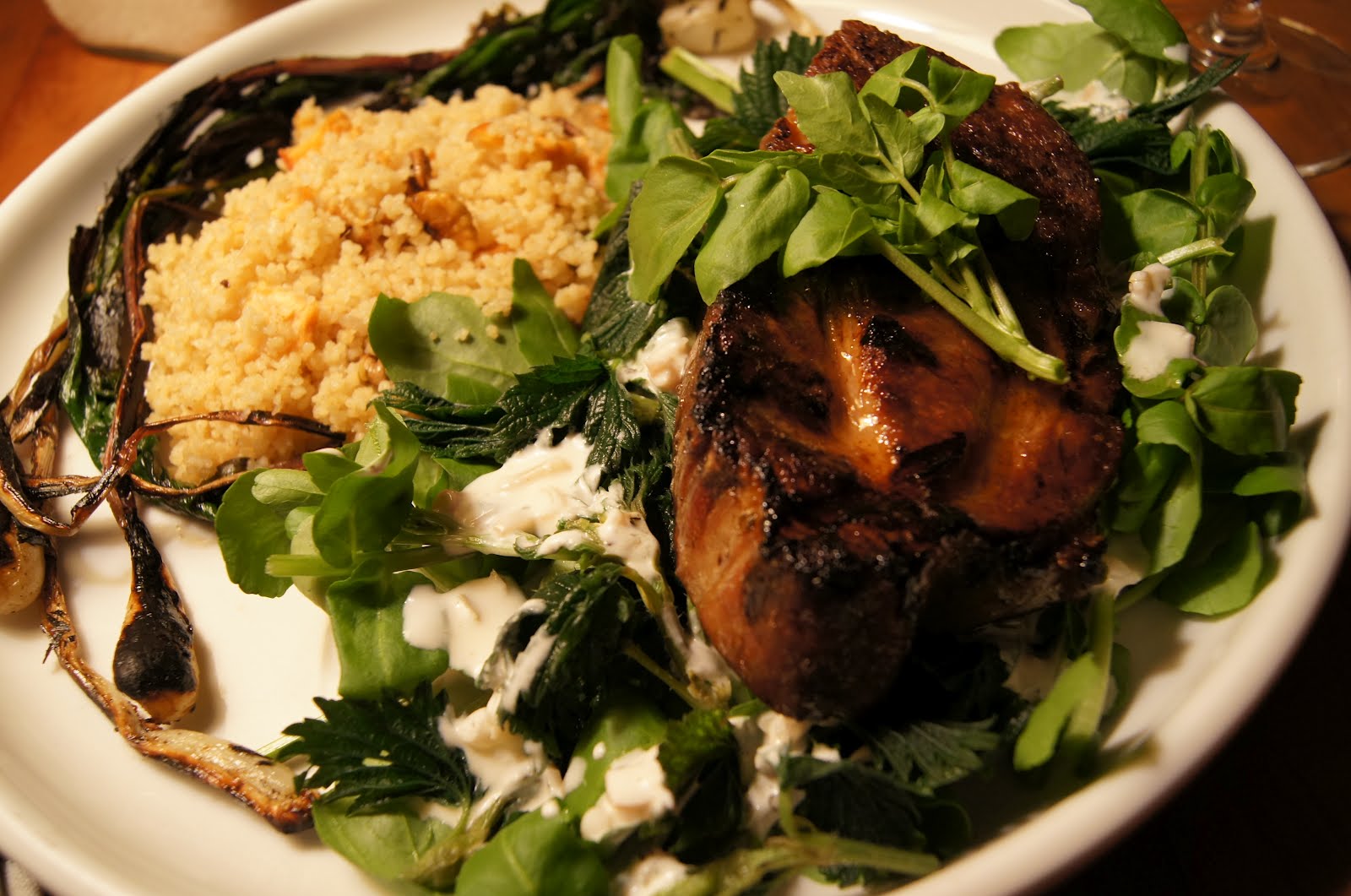
To round out the plate we served couscous that we started by sautéing a little shallot in a small saucepan, along with some chopped dried apple.  After the couscous steamed we mixed in some of those wonderful hickory nuts, toasted.  And finally, a few flash-grilled ramps, which were excellent:


The ramps were tossed with olive oil, lemon juice (suppose I could have used rhubarb...), salt and pepper, at least 30 minutes prior to cooking.  Then they just went on the very hot grill for a couple of minutes.  Even the blackest parts were delicious; the parts that were really and truly burnt just powdered away.

Here concludes the tale of a wonderful dinner, via a roundabout route with many detours and a few cul-de-sacs.  A lot of words for one plate of food, some would say, but hey, that's what we do here.

Cheers.

______________________________
* David Bouley's East of Paris, is in this same category for me; interestingly, Amy Thielen worked for Bouley in New York, and worked on East of Paris.


** And what about the possibilities of sorrel juice--sorrel being rhubarb's green cousin?  I always wish the sorrel sauce I serve with grilled or fried trout could be more sorrel-y, and I'll bet an injection of sorrel juice would do the job.


Text and photos copyright 2012 by Brett Laidlaw

Tuesday, May 1, 2012

There's Rhubarb and Ramps in the Ranch, and Nuts in the Couscous! (part one)


The goofy title of today's dispatch comes courtesy of the fact that, well, I'm not at all sure how to start describing the adventures that led up to a particularly splendid local and seasonal supper of a pork shoulder cutlet prepared à la "sauna sous vide," then grilled with a rhubarb-maple glaze, perched atop a salad of stinging nettles and watercress in a rhubarb-ramp ranch dressing, with whole wheat couscous tossed with local hickory nuts and Bide-A-Wee dried apples.  Oh, and blackened ramps on the side.

The trail leads through a rhubarb renaissance, a marvelous market, a grand gourmet graze, some fun fruitful foraging, and...probably some other alliterative antics that slip my mind at the moment.  I think this particular meal has inspired me to point of giddiness because it perfectly represents what I might somewhat pompously describe as the Trout Caviar Ethos:  taking the best of local, seasonal ingredients from a variety of sources and preparing them in fresh and creative ways that combine far-flung influences and homegrown ingenuity, the culmination of which is a truly expressive plate of food, artful even if it is not art, and satisfying in every way food can be.  And you lick your plate.  We might as well start with the rhubarb.


Rhubarb Renaissance

This is, it appears, the rhubarb moment.  The homely red avatar of tartness that adorns the corners of many country gardens is having its diva turn.  Kim Ode's fascinating and appetizing new book, Rhubarb Renaissance (from MHS Press, a force to be reckoned with in culinary literature!) is the prime example, but not the only one.  I don't know whether Kim is setting the tone or riding the wave, but rhubarb seems to be everywhere these days, and she is surely one of its most enthusiastic advocates.  The current fascination with this old-fashioned staple seems to me in keeping with the way that other throw-back ingredients and methods have been rediscovered in recent years--the sudden sexiness of brussels sprouts, kale, and beets, the enthusiasm for fermenting, smoking, canning, and other DIY food preservation techniques.  We're re-examining a lot of things we've come to take for granted, and finding beauty in humble northern products.  It's all good, very good indeed.


Me, I am good and ready to jump on the rhubarb bandwagon, as we have inherited a robust mound of the stuff at our new Wisconsin home.  Also, I have deep, fond memories of rhubarb from childhood:

We had a big rhubarb plant in the back corner of the garden, and on hot summer days we would sit in the shade on the stoop by the back door, bare feet on the cool concrete, and eat those crimson stalks raw, dipping them into a bowl of sugar. I can taste that sweet-tart-astringent explosion of flavors even now. Perhaps a sense of gourmandise was born there.

On a recent dinner in Madison, Wisconsin, I had a pork chop served over a bed of vegetables liberally anointed with a rhubarb-ramp ranch dressing.  It was phenomenal.  I knew I had to try to recreate it.


Grand Graze

The restaurant was Graze, sibling restaurant of the legendary L'Etoile.  Mary and the dogs and I were in Madison for a book signing at The Kitchen Gallery cooking store (well, I was there to sign books; Mary was dog sitting, and the dogs, they were being dogs; and they were very, very good dogs the whole trip).  We arrived Friday afternoon, checked in to our canine-friendly room at the Econo-Lodge out on the dismal strip, and went in to explore the town.  I had been to Madison exactly once previously, on a college-scouting visit 35 years ago.  Ahem.  That is just a little painful to write, but there you go.  I won't wait 35 years to go back.

The city is beautiful, largely constructed on the isthmus (love that word: just try not to sound like Daffy Duck when you say it) between Lake Mendota and Lake Monona, and a canal connects them.  On a cool but sunny April evening, the whole place seemed idyllic, urban and sophisticated, but mellow.  We were instantly charmed--until we had to go back to the Econo-Lodge, but let's just say that the contrast made the good parts that much sweeter....

The food scene in Madison is dynamic.  We got our first literal taste of that at Graze, which looks upon the capitol from a grand and soaring space.  Picture = 1,000 words:


The Graze  menu celebrates local products and producers without whacking you over the head with their righteousness, or boring you to tears with an endless recitation of sources.  I started with beef marrow bones cut the long way, served with a fabulous sort of beef jam made from oxtails and short ribs, just barely lightened by a few slices of pickled shallots, and Mary ordered crawfish beignets with a lovely remoulade sauce, tart and creamy.  She then went for bibimbap with pork, and for me, that pork chop.  The bed of vegetables beneath the beautifully grilled chop was described as asparagus panzanella; there were a few token croutons here and there, so the analogy to the classic tomato and bread salad is a stretch--but the croutons were nothing special, so I didn't lament their scarcity.  What impressed me, and mightily, was the way all the flavors on the plate came together into something comforting but surprising, robust but nuanced.  And I love to eat grilled meat on top of salad.  The pork chop had a sweet and sour glaze, and at the corners where the char was deepest and the glaze the thickest, it reminded me in the most remarkable and unexpected way of the sweet and sour spareribs my mother used to make, probably my favorite of her signature dishes.  I suspected that rhubarb figured in the glaze, though the menu didn't say so.  That piquant flavor of spring was also detectable in the "ranch" dressing, balanced by the ramp flavor that played through the creamy base.  One of the best restaurant meals I've had in a long time.


Marvelous Market

The Dane County Farmers' Market is one of the biggest and best in the country. The vendors set up on the broad sidewalks of the capitol square, and the market stretches all the way around that grand structure, spills down side streets, as well. We were there for opening day of the outdoor market, and thanks to the extraordinarily warm March weather, there was abundant produce: asparagus, rhubarb, lettuce, chard, mustard, radishes, sorrel; overwintered spinach, leeks, and parsnips; cellared celery root, beets, potatoes, squash; foraged morels, ramps, and nettles. I checked my wallet before we started our circuit, and found $80--more than enough, I thought. And when I reached in there to pay for our last purchase...purt near empty. We went away with a rabbit, morels (I'm not ashamed to say that I'll sometimes pay for it...), lovely fingerling potatoes, a couple celery roots, asparagus, dried shell beans, and hickory nuts.


Hickory nuts! I thought I had tasted hickory nuts in the past. Having tasted the ones we purchased at the Madison market, I conclude that I had not. These were a revelation, amazingly good, as buttery as pecans, but lighter, more subtle, with a finely textured crunch. I'm a convert to the church of the hickory nut. The vendors with hickory nuts also had butternuts (I tasted those for the first time this winter; they are also great), and black walnuts (we have a tree in the yard of the new house; black walnuts have always intimidated me, but I'll have to get over that).  The hickory nuts were pricey, around $20 a pound, but the flavor is so rich, a few bites really makes an impact.

And oh, oh, oh!  Pre-market we passed by Graze again.  They were selling coffee and pastries in the restaurant's courtyard.  When you had made your purchase you could go inside to eat, or stroll the market with breakfast in hand.  On this chilly morning we went inside with coffee and a chocolate croissant and a "ham & swiss market bun."  The croissant was dandy, and the ham and swiss bun was out of this world, like a croque monsieur wrapped in croissant dough.  Maybe the best savory pastry I've ever eaten.  That place has it going on.  I don't think I've ever done anything remotely approaching a restaurant review here, and I don't plan to make a habit of it, but I found Graze, the market, the whole Madison vibe to be inspiring.  Worth going on about, for a bit.

It was a slam-bang trip, into town Friday evening, on the way back home mid-afternoon Saturday (after lunch at Merchant, another very good farm-to-table restaurant just off the market/capitol square).  Less than 24 hours in Mad City, lots of great eating, market browsing, dog walks, a book signing--and to top it off, I got to meet   Sara of  "Put Your Shovel Where Your Mouth Is"  (I think of her as Ol' Shovelmouth, but don't tell her I said that; it has absolutely nothing to do with her appearance, I assure you) and her husband, Donn, a delightful couple; and the vibrant Erika Janik, who produces the  WPR essay series Wisconsin Life, to which I have contributed a couple of pieces, and who writes  a highly literate, always interesting blog.

We were pretty beat by the time we arrived back at the farm, so dinner was a simple repast, omelets with the wonderfully fresh eggs we get from our neighbor Tina, steamed asparagus, and sautéed morels.  Nothing stupendously gourmet about it, but this is one of my favorite ways to enjoy those distinctive spring flavors.


Phew.  Next time, details of the meal that our Madison adventure inspired.

Sunday, April 22, 2012

Sichuan Nettles Salad with Charred Ramps Dressing


My ramp explorations this spring have been taking me down Chinese roads. The oily ramp cakes started me thinking that way. For a bachelor dinner the night I whipped up those cakes I marinated some sliced pork shoulder, chopped up a mess of ramps, shredded a bit of cabbage, stir-fried it all up, sauced it with a mix of soy sauce, vinegar, rice wine, sugar, and cornstarch, served it over a bowl of rice. The ramp flavor permeated the dish utterly, and this one-off dish was one of the most Chinese tasting things I've made in a long time--and I know Chinese, having lived, taught, and traveled in Sichuan province for a total of more than a year in the late 80s-early 90s. By Chinese tasting I mean: not like Leeann Chin's.


That ramps convey a Chinese flavor is not really that surprising. Their closest domestic analog, to me, is garlic chives, sometimes called Chinese chives, and often used in Chinese sauces, dumpling fillings, and the like. In this dressing the chopped ramps are lightly charred in oil, bringing out their sweet side, along with a smoky edge. This combination of sweet, sour, salty, hot, and rampy would make your pooch's rawhide chews palatable; on blanched young nettles it's a springtime combination made in heaven...or Chengdu.

This is what I call a nettles "tip""--the top leaves with a couple inches of stem attached.  Tender and delicious, once blanched, on young stinging nettles plants.


Sub other types of salad greens for the nettles, if you like, or use the dressing on blanched green beans, fava beans, or asparagus.


Sichuan Nettles Salad with Charred Ramp Dressing

2 medium ramps, chopped to 1/4-inch pieces, about 1/3 cup
3 cups loosely packed young stinging nettle tips and leaves

1 tablespoon hot chile oil (or add 1 teaspoon of sambal chile paste and a little more oil when you cook the ramps)
1 tablespoon soy sauce
2 teaspoons cider vinegar
1 teaspoon sugar
1 1/2 tablespoons canola or peanut oil
ground roasted Sichuan pepper, optional

Rinse the nettles very well in several changes of water, especially if they were gathered from a sandy area.  Bring a pot of water to a boil, add the nettles, and cook for 1 minute.  Drain the nettles and shock in cold water.  Drain well--save the cooking water for tea or broth, if you like--or spin in a salad spinner to remove excess water.  Place the nettles in a mixing bowl.

Heat the canola or peanut oil in a small saucepan.  When it is hot add the ramps and cook over high heat for 1 minute, until some of the ramp pieces look a bit charred. Remove from heat.  Add the chile oil, soy sauce, vinegar, and sugar and mix well.  Add this dressing to the nettles and mix well.  Sprinkle with the Sichuan pepper, if you like, and serve.


Text and photos copyright 2012 by Brett Laidlaw

Thursday, April 19, 2012

Oily Ramp Cakes


I logged on to the excellent 3 Foragers blog a couple of days ago, and was admiring an appetizing ramp photo collage. As my eyes wandered to the upper right corner I uttered the archetypal "Doh!", and might have even slapped my forehead. The stimulus for this Homeric response was a comely shot of Chinese scallion cakes. Except, of course, they weren't scallion cakes, but ramp cakes. I've been making scallion cakes for, maybe, three decades, gathering ramps for the better part of a score of years. Never did it occur to me to make ramp cakes. Doh.


I call mine Oily Ramp Cakes, which might not sound so appetizing, but I learned my version from the recipe in Mrs Chiang's Szechwan Cookbook, which I've owned since the early 1980s, and she calls them Oily Scallion Cakes. The Chinese name, in pinyin, is cong you bing--cong means scallion, you is oil, bing is a sort of pancake or flatbread.  I imagine the you here might just indicate that it's fried.  But I'll always think of the original as Oily Scallion Cakes, so Oily Ramp Cakes it must be.

They're not that greasy.  They're chewy, savory, very fragrant, a fine vehicle for that pungent springtime flavor.  Make them as an appetizer or cocktail snack, or as part of a dim sum spread.  Or have them, as I did recently, for lunch, along with a wild Sichuan nettles salad with charred ramp dressing (recipe coming soon).


Oily Ramp Cakes (after Mrs Chiang's Szechwan Cookbook, with thanks to The 3 Foragers for the inspiration)

1 1/2 cups all-purpose flour*
1/2 cup water
1/2 teaspoon salt
1 teaspoon dark sesame oil
1 teaspoon cooking oil (peanut, canola, or the like)
1 cup chopped ramps, white and greens, approx. 1/4 inch chop (the number of ramps required will vary radically depending on size--10 to 12 small ramps, perhaps only 4 or 6 large ones)

Mix the flour and water to make a stiff dough.  Knead briefly, let it rest for 10 minutes, knead again for a minute or two, cover and let rest for 30 minutes.  Divide the dough in two and form into balls.  Roll and stretch each ball out into an 8-inch square.  Spread 1/2 teaspoon each of the sesame and vegetable oils onto each square, then sprinkle with 1/4 teaspoon salt and half the chopped ramps.  Roll the dough up, jelly roll style, and pinch closed the ends.  Cut each roll in half, again pinching the exposed ends closed, and flatten into discs, sort of hockey puck shape.  Let rest 15 minutes.

When you're ready to cook,  roll the cakes out to circles 6 to 7 inches in diameter.  Heat a heavy skillet and add cooking oil to a depth of about 1/8 inch.  Cook each cake for a total of 6 minutes over medium heat,  turning every minute or so.  The first side will brown much more evenly than the second, unless you use quite a bit more oil in the frying.  Drain on paper towels.  Add a bit more oil for each cake.

Eat hot, plain, or with hoisin sauce for dipping, or this honey-soy-chili sauce I concocted because I had just warmed some crystalized honey to empty the jar, and the bowl was sitting near the stove:

1 tablespoon soy sauce
2 teaspoons honey
1 teaspoon cider vinegar
1/2 teaspoon sambal

Combine and mix well.


Rolled out and ramped--note that I made rectangles here, not squares as in the recipe; but after making them this way I realized an 8-inch square would work better.  Not that big a deal.


Rolled up, cut and pucked.


Rolled flat pre-frying.


Cooked.


________________________________________

* I like to use something with a little character, like the Gold & White from Natural Way Mills in Minnesota, which is milled with the germ included.  With plain grocery store AP flour, I would add a couple tablespoons of whole wheat flour as part of the one cup.


Text and photos copyright 2012 by Brett Laidlaw