Showing posts with label Bide-A-Wee. Show all posts

Thursday, May 3, 2012

Mighty Morchella


It is a mighty mushroom indeed that compels the sort of fanatical pursuit that morchella esculenta inspires. It's a rite of spring that sends hordes out into the ticky woods to scour the underbrush for the chance to spy that unique honeycomb cap in the moss or pushing through brown leaves.  A lot of morel hunters don't bother to hit the woods for any other mushroom, or any other wild food.  The spring pursuit is their only foraging interest.  I attribute this to the fact that 1) It is a rite of spring, a ceremony of the season, 2) Morels can be fairly predictable, 3) Morels can be extremely abundant, 4) Morels are easily preserved by drying, and 5) They are easily identified, with no really harmful look-alikes.  I don't think that it's because they are fantastically delicious.  They're good, sure, but on my list they fall below chanterelles, black trumpets, and hen of the woods.  For me, the hunt is the thing, and it is incredibly thrilling to slog over steep terrain, poke under currant bushes, probe beneath peeled bark, and finally be rewarded with the sight of that unique shape.  I keep going back, even though I rarely have much success.


This year is looking like a very good one for morels here in Minne'Sconsin (I may have to edit that moniker somehow, now that I live in Wisconsin full-time--Wis'Sota?).  I know it's a good year, because even I am finding them.  I've brought home a couple of pounds from the Bide-A-Wee woods so far.  My main haul came from a dead elm on a south-facing slope.  I look for trees that have been dead long enough that the bark is starting to peel quite a bit.  If I do spot a morel, then I step very carefully, and scan the ground assiduously, for a morel can seem to disappear from view even as you are looking at it.  From the base of the tree out to the edge of the dripline is where the morels will sprout; this Bide-A-Wee tree was a good example of that.  They were mostly downhill from the tree.  I went back a couple of times after my first find, and continued to find morels.  In fact, I managed to find a couple that I apparently had stepped on without noticing it on a previous foray:


And one that was completely hidden under a slab of bark:


I have always heard that morels are often found near apple trees, which I consider very good news indeed, because there are apple trees all over the Bide-A-Wee land; the bad news was that I had never once found a morel anywhere near an apple tree.  Until yesterday.  I was on my way back to the cabin, sweaty on an unexpectedly hot afternoon, prickly ash- and bramble-scratched, and I turned up that particular hillside just to stay in the shade.  Luckily I was still in ground-scanning mode, and the morels were quite conspicuous.  I wasn't really consciously looking and I stepped right over a couple of large morels, before noticing a couple of nice ones in the moss near the trunk.


Then I went and checked under the other apple trees in the area. Nada. Morels are just that way.

Collateral benefits to the morel hunt include spotting the first showy trilliums blooming on our land:


And a nice stand of wood nettles, one of my favorite greens of the spring.  Delicious and non-stinging at this size, though when mature, they sting worse than stinging nettles, go figure:


The entire young plant, stem and all, is delicious simply steamed  and  tossed with  butter.


One thing we have done with this spring's finds, a rabbit and morel hash on fried polenta:


The recent warm wet weather will add an air of urgency to the hunt.  Conditions for morel emergence are perfect, but in the hot and damp they won't last long out there.  Get 'em while you can.


Text and photos copyright 2012 by Brett Laidlaw

Wednesday, February 15, 2012

We Bought the Farm


Well, we bought a farm. Sort of a farm. It's definitely farmish--sheds, a pole building, barbed wire fences, a heated cattle watering dealio, and some kind of animal feeding station that looks like a playground carousel. We are as surprised as anyone.

We had been planning a move to the country for some time, but until last November Plan A involved building a house on the Bide-A-Wee land. We had a hilltop site in mind, we had talked to a house designer, then an architect. Things seemed to be coming together until.... Until all of a sudden they didn't seem to be coming together. We weren't thrilled with the designs, we couldn't see the whole picture--it was a vision thing, and a practical thing, a philosophical thing, a money thing. From heights of elation and anticipating ground-breaking in the spring, we were back to zero, or maybe sub-zero. We were bummed.

But late last summer a house had come up for sale, literally a mile down the road from Bide-A-Wee. An old house, several times added-on, with some attractively rustic outbuildings, at the foot of a steep hill. The lower part of the hill was planted in corn or soybeans; higher up it turned to mature hardwood forest. On the west side of the house were tall cottonwood trees, so the place was shaded on hot summer afternoons. The whole set-up seemed extremely pleasant; I had often admired it as we drove by.

On the deck, evidence of internal destruction, which began the day we bought the house.

Still, we resisted looking at it. Our goal was to build our own house at Bide-A-Wee, we said; why waste our time, the realtor's time, looking at some house we knew we weren't going to buy. Well, in fact, at one point we made an appointment to see it, then cancelled it. Then a couple of weeks later the realtor--the sister of one of the owners--called us back. If we had any interest in the house, she said, why didn't we just go have a look. By this time all the coming-together-ness had come un-together. We went to see the house the day after Thanksgiving.

The outbuildings: I see a brick oven in the pole building at right, and gardens adjacent.

It wasn't love at first sight, but it was definitely like. The main floor rooms--kitchen, living room, bedroom--were spacious (though the decor needed some updating). The upper level was a warren of cozy rooms with slanted walls, dormer windows, painted plank floors--a seaside cottage feel in rural Dunn County. And there were those sheds. Red ones. Two deer stands. A black walnut tree. Plus 33 more acres, 20-plus of mature hardwood forest--oak, maple, cherry.

Who doesn't love a red shed with a corrugated roof?

Maybe the clincher was the fact that when we stood on the Bide-A-Wee hill and looked down the valley, what we saw at the end of the valley, that was this property, what I've come to think of as Harlson Hill.

Cutting to the chase: We made an offer in early December, went through a little back and forth, reached a deal. Went through various inspections--for a while there, no one could find the septic tank; troubling. We got it all sorted out on a pretty short timeline, and closed on the place on January 30.

Griffon heaven.

We've still got some work to do on the "new" place before moving in. We had a new maple floor laid in the kitchen there, and existing wood floors refinished, this week; at the same time, we were having stairs refinished in Saint Paul--all of which left me exiled, dog-sitting, at Bide-A-Wee, as griffon hair and wet polyurethane are best kept well apart. Not such a dismal fate, but I was eager to get on with...everything. We're still hoping to be installed at the new country estate by the end of this month. There will still be a fair amount of work to do inside the house, and then garden planning, the anticipation of foraging in our new woods--a brave new world, all round!

So now you know why communications in these pages have been a bit sparse of late, and likely will be so for a while. Once things are a bit more settled, there will be much to report.

Friday, December 30, 2011

2011 Highlights: Vite, Vite! The Rest

This is it, the ultimate post for 2011, an eventful year indeed for us. Quicky, quickly, the final list of highlights:


I continued refining my method for micro-batch canning and pickling. The basic brine I describe in the book ( and here ) I put into use to preserve a pint here, a half-pint there--green beans, asparagus, snow peas, ramps, shallots, fiddleheads. Whatever I had a surplus of, I'd just pack into a jar (with perhaps a quick blanching first), make up a little brine (seasoned as I saw fit, garlic always, and a bit of chile, maybe some Sichuan peppercorns, allspice, a couple cloves, a point or two of star anise; herbs like tarragon or thyme), pour it over, cap, stick it in the fridge, check on it in a few days, a few weeks, or perhaps even a few months. At Thanksgiving I had a lovely variety of tart and briny things to put out on the relish tray. As martini garnish, a tip of pickled asparagus is delightful.


The specific dishes that really stayed with me were those where I took a deeply local approach. The ceviche above, from last July, combined raw Lake Superior whitefish with green apple juice and our own cider vinegar, green prickly ash berries (related to Sichuan peppercorns), seeds and chopped leaves of honewort (aka "wild chervil"), and brined milkweed flower buds. It tasted amazing, and unlike anything I've eaten before. It's a direction I fully intend to pursue in the coming year.

Another delightful concoction employing the fruits of our land and the market was the caponata-inspired relish shown below , made with eggplant, apple, cider vinegar, maple syrup, a few aromatics, and a sprinkling of those milkweed bud "capers" again.


Mary and I left the dogs at the East River Road Kennel (aka Mary's mom's house), and spent a weekend on the South Shore of Lake Superior at the end of August. The photos from that trip have disappeared. We enjoyed many excellent meals on the trip, from the fried whitefish livers and broiled fresh lake trout and whitefish at the Village Inn in Cornucopia, to fantastic fish tacos post-bike ride at the Beach Club on Madeline Island, to a lakeside brunch of smoked fish, goat cheese, local apples and rye bread, washed down with the delicious water from the Corny artesian well.


And of course we loaded up with fresh fish from Halvorson Fisheries in the Corny marina. Also into the cooler for the trip back to the cities went a package of fresh whitefish livers. Though we always seek out this local delicacy in South Shore restaurants (I think of them as "South Shore sweetbreads"), I had never cooked with them before. I soaked them in milk, seasoned them well with salt and pepper and sambal, gave them a light breading and fried them up with onions. Served them with something I called "apple marmalade"; I have no memory of how I made that, but the combination was fantastic. Again, from humble ingredients, such a feast. We followed that first course with pan-seared lake trout in red wine sauce with a stew of local shell beans, bacon, and leeks.


The possibilities of ground meat are vast and enticing. While I do love a good cheeseburger, the most memorably delicious meat patty meal was this  stew of grilled ground lamb meatballs with beets, eggplants, and subtle middle eastern seasoning:


In late September we roasted a whole lamb over the coals at Bide-A-Wee. Jean-Louis constructed an excellent spit for the occasion, and oversaw the grilling process. The lamb came from our friend Tina, who lives just up the road from Bide-A-Wee (though we joke that she lives in "southern Wisconsin," since she's on the other side of highway 64). It was a much larger animal than I had expected, pretty much filled the cargo compartment of our Jetta wagon when I picked it up at the processor. It easily fed the assembled crowd, and continues giving to this day: I'm simmering some of the leftovers for a lamb, beans, and greens stew that will be our New Year's Day supper.


And just about every day, we realized anew that eating locally and seasonally is not a challenge, but an outright joy. It's a familiar topic in these pages, I know, but one I'm happy to repeat again and again.  And  I'm not planning to stop.

Bar 5 duck confit with pan-seared squash, apples, and cabbage


Lake Superior whitefish, cabbage, leek, chestnut braise, soft polenta with pumpkin seed oil
May your 2012 be filled with great meals, friendship, and fine adventures.


Text and photos copyright 2011 by Brett Laidlaw

Thursday, December 29, 2011

2011 Highlights: Les Oeufs Sauvages

There's still time to get your entries in for the Trout Caviar book giveaway --leave a comment about one of your 2011 LOCAL! food highlights by January 1; be specific, be evocative, regale and entice us!
____________________________________________________


Early this year things got pretty intense with the final push to finish the book--well, one of the final pushes; like a Hollywood slasher flick, the work on the Trout Caviar book had a lot of false endings. I had a big deadline at the beginning of February, or was it the end? At some point I took the approach of "Shannon can't read everything all at once," and I started sending things in piecemeal. Shannon is Shannon Pennefeather, whom I certainly hope I have mentioned before, my editor on the book, and managing editor of the Minnesota Historical Society Press.

Shannon is also a kind and talented person endowed with considerable insight and an even greater gift of patience. I acknowledge her in the book by saying that she "worked very hard to turn an enthusiastic mess into something a good deal less messy, while leaving all the enthusiasm in." Hmmm, and yet somehow she let me end that sentence with a preposition. I suppose she would have found it presumptuous to edit her own acknowledgment. The truth of the matter is that my book would not be the book it is without her thoughtful editing and brilliant organization. And just so as not to leave anyone wondering: I am very, very happy with my book (leaving room for some after-the-fact picky self-criticism; whatever's wrong with the book is pretty much my fault).


Then as long as we're on the topic of highlights, I'd say that working with Shannon was one of the bright spots of 2011 for me. So thanks to that lengthy digression, this post is two-fer.

Back to the supposed "final days" of work on the manuscript: I took several writing retreats out to the cabin in January and February, me and the dogs. In the snowy, silent countryside there were few distractions other than stoking the fire. After hours of editing recipes I could clear my head with a snowshoe walk around the hilltop or a turn on the skis. There were a lot of fun things about working on the book; editing recipes was not one of them.


But in the midst of tweaking and editing existing dishes, I was coming up with new ones at the same time. This one, called "Hens and Eggs and Bacon" in the book, is my take on a delightful bit of Burgundian comfort food, oeufs en meurette--poached eggs in a red wine sauce. I gave it an air of the wild with the addition of hen of the woods mushrooms. I believe I've gone on record as saying that hens are the bacon of mushrooms, so this is a sort of bacon-on-bacon-on-egg dish, and how could that be bad?


Serve one egg per person for a first course; a two-egg portion, along with good crusty bread and a salad, makes a satisfying winter supper. The version pictured here was a Bide-A-Wee lunch during one of those writing retreats, and a better lunch for a snowy day, I can't imagine. It gave me the strength to pick up the editing pen again and tackle the eternal question, "Should that be thinly sliced, or sliced thin?"


Text and photos copyright 2011 by Brett Laidlaw

Wednesday, December 14, 2011

Along the Fencelines


The Europeans have their ancient, charming hedgerows, and New Englanders their stone walls to divvy up the countryside, but it's barbed wire that tamed and partitioned the American west--and that includes western Wisconsin.  Those fencelines that follow the town and county roads can be a northern forager's last resort to gather some wild foods before the weather gods realize we're staring hard at the winter solstice, and
let the other shoe drop (this week's damplish thaw even allowed me to harvest more fresh greens from my garden; this won't last).

Ploughs and ditch-cutters both must leave a little leeway along the wavering barbed wire fences, and that small margin gives hope and a chance to a variety of wild food plants--asparagus, plum, grape vines, hazelnuts, jerusalem artichokes, black cherry, elderberry, and nannyberry, to mention a few.  It was an unexpected glut of nannyberries that caught my eye last weekend along a Dunn County road.  Clusters of black fruit still remained on several shrubby trees that I passed on the way back to Bide-A-Wee from picking up a newspaper in town (said paper contained a really nice account of Lily's and my recent hunt with Saint Paul Pioneer Press outdoors writer Dave Orrick).


Nannyberries, with a vine that is probably...

I pulled over and slopped through several inches of dirty snow to have a look, and a taste.  This far into December, I didn't expect that the berries would be good for much, so I was surprised at how sweet and flavorful the flesh was.  There's a reason, I guess, that another common name for them is "wild raisin."  I filled a small sack and took them back to the cabin to see what I could do with them. 

At another spot I was fooled by a nannyberry look-alike:

...a type of smilax; edible but, according to one wild foods expert "probably icky."

I wasn't sure what this was--thought it might be Carolina moonvine (a wild guess), but couldn't find corroborating evidence on that.  That's when it's nice to have a true wild food expert in the address book:  my friend Teresa Marrone wrote back right away, nailing the ID as a type of smilax, or greenbrier .  (If I had had Teresa's excellent Wild Berries and Fruits Field Guide close to hand, I wouldn't have had to bother her, but it's nice to break up the day with a little email banter.)  Teresa described the smilax berries as "edible but rubbery and distasteful when fresh."  Ever the scrupulous researcher, she went on to speculate that in their desscated state they were "Probably icky."  Now my curiosity is piqued, and I'll have to give them a taste if I come across them again.  She also said that in spring the young shoots were edible and enjoyable, and noted that Sam Thayer  writes about smilax in one of his books; I have those books, of course, but everything is in Wisconsin, while I write from Saint Paul.

Each year as the foraging season winds down to its last dribs and drabs, just before everything becomes well and truly frozen or buried in snow, I like to find some unlikely remnant, a little something to see out the

The beak-y protrusion at the ends of nannyberry branches are distinctive.

season on an up note--a few dried prickly ash berries to flavor a fruit sauce for duck; some blackberry leaves or late sprouting nettles to steep into tea; dandelions or sheep sorrel that green up in a December rain, as we're seeing now.  This year the nannyberries were my last best hope, it seemed.

I started by sorting through them and separating berries from stems, discarding especially gnarly looking berries, or ones the birds had pooped on.  I wound up with a generous cup of berries from my small harvest, and those I placed in a small saucepan with water to cover, covered the pan, and set it on the woodstove to simmer.  I didn't really time it.  I checked on it every now and then, added a bit of water as the level cooked down.  As they cooked they gave off a layered aroma, of fruit, of tea, of bramble leaves--reminiscent of haw berries simmering.

When it seemed that they were soft-ish I poured them into a sieve, keeping the water, and mashed at the fruit with the back of a wooden spoon.  I wasn't able to get too much pulp out this way, so back in the pan the mashed nannies went, more water to cover, and back on the Haggis to simmer.  In another 15 to 20 minutes I gave it another go--much better this time.  All that remained in the sieve were the skins and the large flat seeds, much like a watermelon seed, that come one to a berry.


I chopped a few slices of dried apple and added these to the nannyberry...slurry, I guess it was, thicker than juice, thinner than a paste.  I wanted the apple for texture, and also for tartness to balance the nannies' sweet, rather bland taste.  When fresh and just ripened, nannyberries have an appealing date-like texture and a flavor that reminds me of dates and banana.  The dried ones were less subtle, some nuance lost as they dried along the fencelines.  I hoped the apple would perk up and round out the flavor of the concoction as a whole.

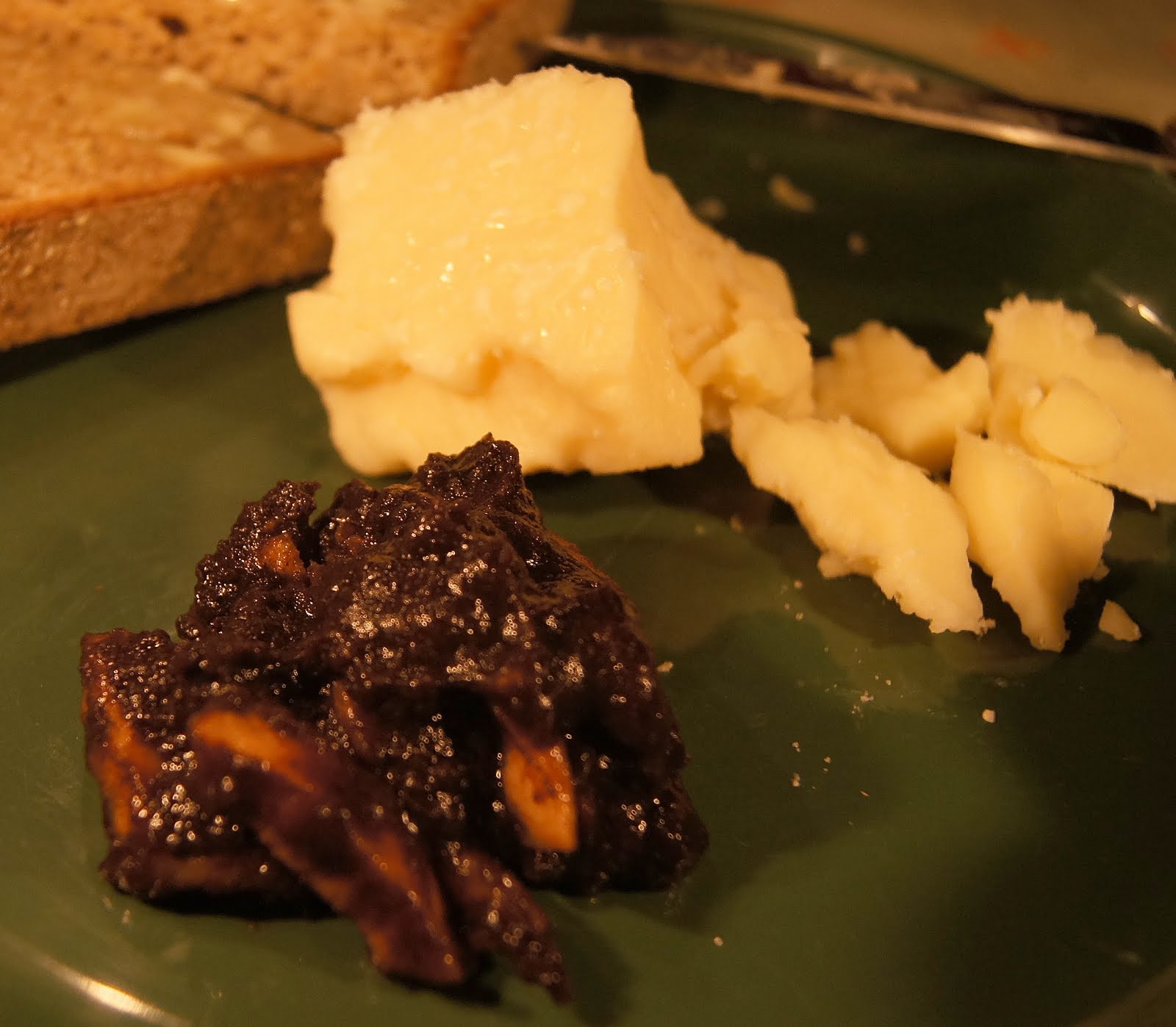
I just happened to have a chunk of sweet and salty, dense and crumbly ten-year-old Wisconsin white cheddar in the cooler.  I was thinking of quince paste, or a mild chutney, that would complement but not upstage the cheese.  I considered a bit of spice, or heat, or an allium element, shallot or garlic.  In the end I let it be, just the nannyberries, apple, and a pinch of salt.


The compote did not want to be photographed; something about the glossy sheen confounded the focus every time.

I considered it a quiet triumph.  The cheese and my nanny-apple compote got along very nicely.  The no-name cheese--a "commodity cheese," it might be called, but what a ludicrous misnomer--came from Bolen-Vale, for around $12 a pound.  And now, it's not that I think the $20-plus-per-pound farmstead cheddars are over-priced, it's just that, having tried a few, I find that none please me as much as this modest over-achiever. 

I've said enough.  A slice of grilled sourdough and a glass of wine, raised in a solitary toast to what may have been (or may not be) the end of the foraging season, made a very satisfactory Bide-A-Wee bachelor supper, and pleased me very much.

Text and photos copyright 2011 by Brett Laidlaw

Thursday, December 8, 2011

On Woodcock


One of the most fascinating and endearing creatures that inhabits our Wisconsin property is the American woodcock, scolopax minor.  It's a migratory bird that makes epic, apparently solitary journeys from the northern U.S. and southern Canada to more temperate climes--notably the Louisiana bayou country--in autumn, and back again in spring.  Considering that woodcock use their elongated bills to probe soft soils for insects, they return to our region remarkably early, often when there is still snow on the ground, and only the south-facing slopes have melted.  It's a curious strategy, it would seem, that leaves them vulnerable to late snows and cold snaps.  We've sometimes seen the weak, dazed birds staggering along the shoulder of the road, too feeble to fly, after a March or April storm has swept through.  Well, there must be some wisdom in nature's plan, as the species does manage to survive.

Once we've observed the first returnees in  March, we look forward to a spectacle that makes these birds both endearing and thrilling, comic as well as marvelous.  It's the mating behavior of the male woodcock (if you break the name down etymologically, it seems odd that there would be female woodcock, but there you go; I don't think I've ever heard or read the term woodhen).  Almost immediately upon arriving in their northern breeding grounds, the males of the species stake out territory in an open space.  It is here that, each night through the spring--sometimes into early summer--Mr Woodcock does his mating dance.


It's a circular dance, somewhat arduously accomplished in the dry grasses in our fields, the moreso because a woodcock is a rather stout, short-legged creature.  That adds to the comic aspect.  Then there's the peenting.  I didn't make that word up.  Peent is the term that ornithologists have come up with to describe the sound the woodcock makes as he toodles along in his roundabout dance.  It's a nasal utterance somewhere between a quack and a croak--well, just say the word peent, and give it a good Dylanesque twang.  Before we were aware of the source of this odd sound, we often heard it coming from the field on moonlit nights, and invented a mythical Bide-A-Wee beast, the duck-frog, to explain it.

But now for the thrilling part.  At some point in his dancing, peenting frenzy, the woodcock decides it's time for a change of strategy.  He takes flight with the twittering wing-flitter sound familiar to upland bird hunters, and streaks into the dusk; he follows a circling path in his flight, as well, soaring out of sight far up into the darkening sky.  And then he stops; stops at the apex of this climb, almost directly over the spot from which he flew, and descends, fluttering back and forth like a falling leaf, producing yet another sort of sound--what to call it, a sort of undulating whistle, fwoot fweet fwoot fweet fwoot fweet.  And he lands where he started from, and begins again.

Last spring one woodcock established his dancing ground on the hill just above our cabin, and I was able to creep up on him and observe his tottering progress through the grass.  More exciting still, his flight path on his ascent took him directly past the cabin's deck, so we could sit out and see him go past, try to follow his progess up into the evening sky, wait for the sound of the return to earth.  Perhaps I'm easily amused, but I couldn't get enough of it.

This behavior is supposed to stop, I suppose, when the woodcock attracts a mate--that's the whole point of it, after all, unless woodcock enjoy this sort of virtuosity for its own sake; and you know, now having mentioned that, I really hope they do, unlikely though it seems.  Well, our Bide-A-Wee woodcock, it appeared that he was destined to remain a lonely bachelor, for his peenting and dancing, his nightly flights, went on for weeks, both in the evening, and then again in the morning--it's brought on by a certain quality of the dusk and dawn light.  On nights of bright moon, it sometimes continued through the night.  At some point it stopped; whether he did attract a mate, or just felt his chance had passed, we'll never know.

Through the summer we rarely encounter woodcock on our property.  I assume they're still there, hiding back in the impenetrable thickets.  We come across them again in the fall, when the leaves start to drop, the meadow grasses to dry and recede.  And then of course, in the fall, it's hunting season.

We don't hunt birds on our land, though we have woodcock, grouse, the occasional pheasant and transitory turkeys.  We prefer to think of our little plot, just 20 acres, as a gamebird refuge--the partridge and timberdoodles need only deal with their natural enemies, foxes, owls, hawks, and what-have-you.  The flesh of these birds is delectable, but the pleasure of encountering them throughout the year exceeds even the delights of an excellent meal.


But we do hunt them, of course, in the public hunting grounds with which western Wisconsin is amply endowed.  I believe that the birds we find, in much the same cover that ruffed grouse frequent, are migrants.  As the winds turn to the north and temperatures drop, they come through in waves, and though they travel singly, from what I've read, they tend to congregate in liminal terrain at the edges of woods and marshland, or creek bottoms where damp soil provides them the nutrition needed to fatten up for the long flight south.  For a bird whose behavior and movements are famously mysterious, you can come across quite a lot of them in a day of hunting, especially with a pointing dog to assist.

I did not come across a lot of them this year, however.  Various circumstances conspired against my spending much time in the woods before the woodcock season ended in early November.  I shot one woodcock, one.  We made a point to savor it.


I'm a firm believer in the concept of terroir; I believe that the food of a place carries the taste of that place (I almost called this blog Taste of the Place, before switching to the more esoteric title).  And I believe that foods that occupy the same space, even if, say, one is a bird, and one comes from a tree, have a certain simpatico, partake of a sort of sympathetic magic that can create great synergy in the pot and on the plate.  Hence:  grilled woodock glazed with birch syrup.

I'd been trying for a couple of years to make birch syrup, which is produced in exactly the same manner as maple syrup.  In outline, it's simple--tap a tree, gather sap, boil it down, voila, birch syrup.  But birch trees aren't as free with their sap as maples, in my experience, and they run later than maples, too.  The warmer weather can bring problems--bugs in the sap, or spoilage if you don't check the bags frequently.  Last spring I finally gathered enough sap--just a couple of gallons--to boil down for birch syrup.


The sugar in birch sap is less concentrated than maple sap, therefore, more boiling down.  More boiling down means more heat applied to the sugars.  The result is something nearly as dark as molasses, though not so thick.  My entire yield of birch syrup, in two boilings, was probably shy of a cup, but intense stuff it was, once I tasted it.  It's nearly as sweet as maple syrup, but with an appealing, very slight bitterness, as of caramel just starting to burn.  There are also vegetal notes, a slightly spicy tingle, and a hint of menthol. 

I'm so accustomed to the taste of maple syrup, I don't really taste the wildness in it anymore.  But the taste of the wild is pronounced in birch syrup, and that, along with the darkness of it, took my mind's palate to another season, the autumn, bird hunting season, and I imagined the woodcock riding the lashing north winds down from Canada and into our region, finding a respite in our charismatic coverts, the scrappy edges of woods and marsh, among the dogwood, prickly ash, alders and hazel, flanked by islands of tall white pine, oak savannah remnants.  And I thought, if a woodcock or two wound up in my game pouch, that a fitting seasoning would be a brushing of birch syrup, an appropriately northern condiment, and suitably wild, to match the dark, gamy meat of the woodcock.

I do love a recipe with a nicely conceptual, geographical and seasonal basis.  I rarely sit down to write about food without recalling Lévi-Strauss:  Food is not only good to eat, but good to think about, as well.


Getting on to the food, then: the remnants of the  previous night's grouse dinner provided a very nice starter to our woodcock delectation (I can't really call it a feast, since one woodcock provides but a few bites of meat).  I diced up the leftover grouse breast, combined it with what was left of the potatoes and cabbage, added stock: a delicious soup that tasted like anything but leftovers.

To accompany the woodcock I made chestnut mash.  These beautiful chestnuts from Iowa are available at local co-ops now, and I can't get enough of them.  For this dish I:

Roasted, peeled, and coarsely chopped 15 chestnuts;
Sautéed a chopped shallot and 2 tablespoons of finely diced celery root in 1 tablespoon butter until the shallot was translucent;
Added the chestnuts, along with 1 tablespoon dried apple minced, and 1 small potato peeled and diced;
Then 3/4 cup of unsalted chicken stock and a generous pinch of salt.

I simmered that, covered, for around 40 minutes, then removed the lid and cooked it gently until most of the liquid was gone.  I should have a food mill out at Bide-A-Wee--it's a great, non-electric kitchen tool.  But I don't have one there yet, so my "purée" was produced with the back of a fork, leaving an appropriately rustic texture.  You could use a blender or food processer, too.

Then on to the woodcock, which I halved, simply seasoned with salt and pepper, and put on the grill.  It took just a few minutes per side, little bird that it was, and on the final turns I brushed it a couple of times with the birch syrup, which gave the skin an appealing burnish.


And when it came to eating, did it live up to all the forethought and verbiage?  You couldn't taste the birch so much on the breast portion, though it did lend a subtle sweetness.  On the legs, my favorite part of a woodcock, the flavor was more pronouced, and it was wonderful--both sweet and a little bitter, melding wonderfully with the fatty skin and savory meat.  This is the definition of a delicacy, to me.  There's a book out recently detailing the last-dinner-on-earth requests of famous chefs; they didn't ask me, dang it, but this would be mine: a plate of grilled woodcock thighs with birch syrup glaze.

Next time, next year, if all goes well, I'll have another try at this dish.  I would do it pretty much the same way, although I think I would reduce the syrup a bit to make a stronger glaze.  It's nice to have something to look forward to.

Here's a pretty good overview of all things timberdoodle.

Text and photos copyright 2011 by Brett Laidlaw

Monday, November 28, 2011

A Very Bide-A-Wee Thanksgiving


Martha took most of these excellent photos at the first Bide-A-Wee Thanksgiving gathering.  She and Tom were among the small group of pilgrims who travelled through the Wisconsin countryside resonating with rifle reports as the firearm deer season continued.  Also joining us were Jean-Louis and Nina, and their dog Georgia.  We started with Tom's delicious turkey paté and a relish tray that helped me thin the inventory in my pickle museum--spicy snow peas, soy sauce flat beans, asparagus, sweet gherkins, and cornichons. Then we feasted on confit of turkey legs and wings (salted and spiced then slow roasted in duck fat), maple-herb cured turkey breast cooked on the Bide-A-Wee fire with red wine-port sauce (none dare call it gravy!); pommes boulangère courtesy of Jean-Louis, chestnut-sausage stuffing, rutabaga remoulade (both mine), Tom's fresh cranberry-orange relish, and brioche nanterre au levain.  Then after a walk around the hilltop as dusk was coming down, we finished up with Martha's luscious pumpkin pie (recipe on the Libby's pumpkin filling can, she claims), and a beautiful apple tart on homemade puff pastry by (who else?) Jean-Louis. 

The turkey was a broad-breasted bronze, raised just down the road by our neighbors Mandy and Jeremy Berg. And even this turkey non-enthusiast must admit that it was a damned tasty bird.

By the end of the day we were sated, glowing, grateful, and exhausted as our guests started homeward under a sky full of stars as brilliant as any we've seen at Bide-A-Wee.  We hope your Thanksgiving feast was equally enjoyable.

The pilgrims:

Jean-Louis and Nina.

Mary with a better shot of J-L.


Tom holds forth.


Fearless fotog Martha; blurry but the best I got of her.


The pitmaster.


Groovy reflection shot with most of us.


Canine contingent:

Georgia, Nina, and Lily.


Annabel in standard dozing mode.


Lily, the great hunter.


A little local color.


The feast:
Tom has been working on perfecting his turkey paté for three years; I'd say he's just about there.


Country loaf, levain brioche.

The maple-herb-cured breast on the grill. It was grilled & smoke-roasted.


Rutabaga remoulade, with apple, sorrel, a mayo, sour cream, cider vinegar dressing.


Confit turkey legs and wings and chestnut dressing warm on the Haggis.


Cutting up the confit...


...and the breast.


Tom's cranberry orange relish.


Diverse libations enlivened the day.


A flavorful plate.


And another.

We forgot to take pictures of dessert.


Aftermath.

A delicious and memorable day.