Showing posts with label birch. Show all posts

Thursday, April 7, 2016

Happy Birch Days


The Bide-A-While birch syrup family portrait.


It may very well be that we have reached peak birch here at Bide-A-While.  The sap goes on, though sluggishly, with afternoon highs just scraping up into the mid-30s.  Yesterday I gathered “ice birch”—the sap in the bags and containers was half frozen, so I poured the liquid portion into my collection container and left the ice behind, thinking that the liquid sap was probably more concentrated in sugar.  It’s on the woodstove now, and getting right down there.

I’ve also been reading a good bit about birch syrup making, though sources are not abundant.  There are some commercial producers in Alaska, and there have been some official studies of best practices.  It’s all pretty interesting, and useful, since I’ve been proceeding on a trial and error basis, leaning toward the latter.  This is a good compendium of articles on birch.

Pour the sap into a cauldron and light a small fire....

I would have thought that Magnus Nilsson’s massive new tome, The Nordic Cook Book, would show some traditional or novel uses for birch syrup; instead, it has no mention of it, at all.  But in Nilsson’s Fäviken cookbook he does include a “recipe” for birch syrup, along with a couple of interesting observations.  One, he notes that part of the distinctive taste of birch syrup comes from the fact that not only the sugars, but also the trace minerals found in the sap are concentrated in the syrup making process—and since birch sap must be reduced twice, or more, as much as maple sap, that’s bound to have an impact.  I think it’s part of what contributes to the savory edge that birch syrup has, even while it is intensely sweet.  The other, technical note Nilsson makes is that birch syrup contains carboxylic acid, which gives it “outstanding freshness.”  You can’t miss that acidic edge in tasting birch syrup; I just didn’t know what the particular acid was called. 


Oddly, none of the recipes in the rest of the book includes birch syrup.  Nilsson says that he uses it as one would balsamic vinegar, and I’d been thinking along similar lines, wondering what birch syrup would taste like drizzled over vanilla ice cream, as reduced balsamic is sometimes used.


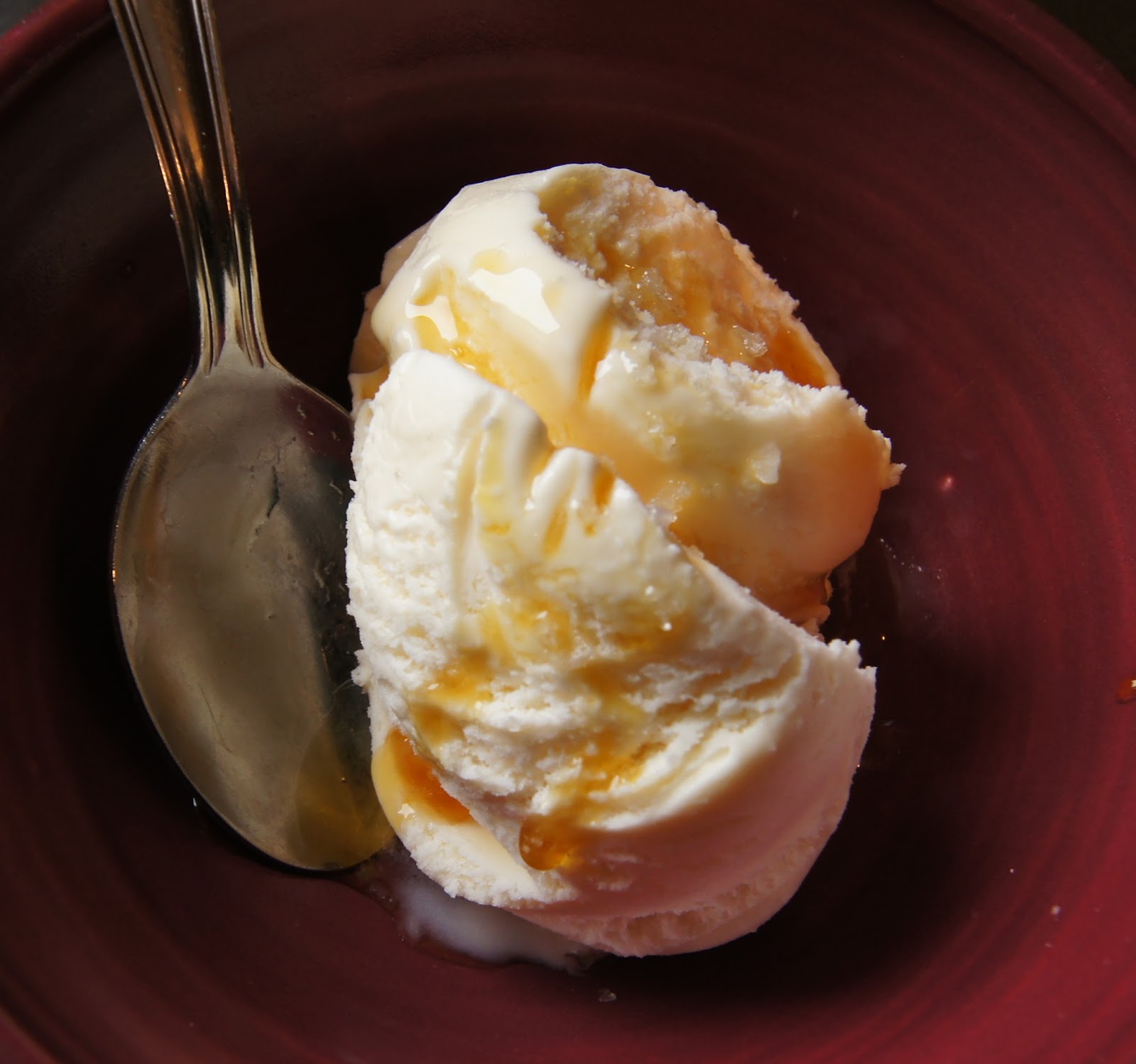
Well, I need wonder no longer.  I fixed up a little late breakfast snack of vanilla ice cream (nothing special, just Wisconsin favorite Cedar Crest) anointed with a couple teaspoons of birch syrup and then a few grains of coarse gray sea salt.  Oh, my.  Why didn’t I think of this sooner?  It was really superb, with elements both of a root beer float and a butterscotch sundae.  If you can get your hands on some birch syrup, this would be the perfect way to end an elegant dinner party.  Your guests will surely have tasted nothing like it.  This was actually my first foray into using birch syrup in a sweet/dessert preparation.  I’m eager for more explorations.

R to L:  2016 no-boil, 2016 stove-boiled, 2013 woodfired.  Amazing range of colors.

If you’re interested in making your own birch syrup, you should pay attention to just how big an impact the way you reduce the sap makes on the final product.  In my first attempts I had rather a lot of sap, and I started the reduction in my homemade evaporator (the legendary half-assed sap contraption).  It really boiled hard, and sap caramelized (not to say burned, though probably some did) on the sides of the pan as the sap reduced, and this caramel got washed back into the sap, adding color and a variety of flavors.  As a result, that syrup was molasses-dark and very strong in flavor.  One of the articles I found online cautioned against making birch syrup this way, saying it would come out with a scorched flavor.  But I don’t think my dark syrup tastes bad or scorched.  It is very, very different from the lighter syrups I’m making this year, but it has its uses, too.


This year, with moderate sap flow and thus manageable amounts of sap to deal with, I’ve done all the reduction inside, first on the woodstove, then on the range, as previously mentioned.  And then with a few gallons I did in entirely on the woodstove, so that it never boiled at all, just slowly, slowly reduced as the water evaporated from the sap.  You can see what a difference that makes in the color of the final syrup.  The taste, as well, is mellower, but it still has that fresh acidity and good complexity.

Three 2016 batches.  I should start a paint line of birch syrup hues....

Fun stuff!  I feel like a bit of a pioneer in upper Midwest small batch birch syrup making.  If anyone else out there has tried his or her hand at this, I’d love to here about your experiences.  I will keep the home fires burning in the ever busy woodstove, and carry on with kitchen explorations, as well.  If you have any thoughts about how to deploy birch syrup in cooking, I love to hear those, as well.


Text and photos copyright 2016 by Brett Laidlaw

Friday, April 1, 2016

The Saps of Spring, 2016 Edition


March is a difficult month.  It promises spring, but often belongs equally, if not more so, to winter.  It makes you think of gardening, of growing things, but at our latitude all you can really do is pile potting mix into little pots, get the seeds of the earliest, cool season plants going—onions, leeks, lettuce, some herbs.   There are days of warm sun that tempt you to get out and till a plot, but when you turn one clump of frigid, sodden soil, you turn quickly to plan B.  Never mind, there’s always that minefield of winter-weathered dog treasures to clear, a perennial March activity that more or less sums up the spirit of the season….


Maybe this is why a lot of my March days since moving to the country have been spent drilling little holes in trees, gathering the cold, slightly sweet water that weeps out, and cooking it down to incomparable sweetness—tree syrups, both maple and birch, and even a bit of black walnut.  It’s nature’s little consolation prize for enduring these purgatorial weeks, equal parts reward and distraction.  Though sap season comes around every year, it’s always a little bit different.  And this year has been more different than most.

People on Twitter tend to get a little excited, you may have noticed if you frequent that world.  I think it’s the ability to communicate instantaneously with friends, acquaintances, and strangers alike, all across the planet, that tends to heighten reactions exponentially.  This year I saw a slew of ecstatic tweets proclaiming that the weather for the week ahead looked perfect for maple sugaring…in the middle of February.  But the trees weren’t looking at the daily highs and lows to decide how to proceed; no, the trees were still frozen solid.

I forget exactly which March Surprise this was; we had a few....

But it did transpire that warmish weather continued—there were days with record highs, with record high lows—and I did wind up tapping a few maples, as well as the big box elder (a type of maple) in our yard, and our one majestic black walnut tree, on February 21, because what the heck.  And within a few days I did have a little sap, emphasis on the little.  The trees ran sluggishly for about a day, then the weather turned seasonably cold again.  Six trees gave me about one gallon of sap, which didn’t take too long to simmer down on the wood stove into a half cup of syrup; and so began the season of passive, micro-batch syruping, which continues to this day, as I reduce another five gallons of birch sap on the woodstove and then on the range top.  I’m not going to wind up with a vast reserve of syrup, but then, I don’t really need one.  The birch, especially, is sparingly deployed, maybe a tablespoon or so at a time, in salad dressings and marinades, mainly for grilled pork.
 
Birch syrup on the final reduction.

With small amounts of sap—5 to 8 gallons at a time—I didn’t bother firing up the labor-and-smoke-intensive half-assed sap contraption I’ve used in years past.  Instead, since we’re still stoking the woodstove every day, at least in the mornings and evenings, I’ve been setting a hotel pan and our Big Blue Le Creuset dutch oven on the stove and letting the sap slowly reduce to a manageable amount, at which point I boil the dickens out of it on our kitchen range top.  You may wonder, Isn’t that a lot of humidity to be adding to your indoor environment?  Aren’t you producing great clouds of water vapor, steaming the wallpaper off the walls, and covering everything with a sticky film? 

Legitimate concerns, to which the answers are: yes, I guess it’s a fair amount of humidity, but things are generally dry this time of year, so we haven’t noticed any issues; and as we have no wallpaper on our walls, none to steam off!  Finally, no, our walls and ceiling bear no resemblance to a movie theater floor after being deluged with Mountain Dew during the kiddie matinee.  The whole idea, see, is that the sugary part remains in the pot as the water evaporates.  Even if some of the sugar escaped a furiously boiling pot, I don’t think it would go very far, the sugar molecules presumably being a good deal heavier than water vapor. 

The long and short of it is this:  I think it’s a myth, one which I myself may have helped to promulgate in the past, that cooking sap down inside has these undesirable side effects.  When I’m doing the fast, final boiling, I’ve got the vent hood running, a couple of windows cracked, and there’s no noticeable change in our indoor weather.  Also, I’ve kept checking the walls near the stove, the inside of the vent hood, for that legendary sticky film—none to be found.  Now, if I had a hundred, or even 40, 20 gallons to deal with at a time, I probably wouldn’t do it inside.  But with these small batches, it works fine.  It’s also really nice to get double duty out of the woodstove, heat for the home on chilly days, tasty syrups for the kitchen.

The Puddock hard at work, multi-tasking.

It has taken me a while, years, in fact, to start to feel comfortable using the birch syrup.  It’s completely unlike anything else I have in my pantry, so it didn’t slide easily into any particular niche.  People ask me what it’s like, and I can only give vague analogies or general descriptions that don’t capture the essence of the thing.  It’s dark, dark as molasses, and it has some molasses qualities, but it’s not thick—in its body, its “mouth feel,” it’s lighter and thinner than maple syrup.  And banish any thought that it’s like maple syrup just because it’s sugar that comes from a tree.  While maple syrup is composed of sucrose, like plain old granulated sugar, birch syrup is glucose and fructose (I think I’ve got that right).  The flavor of birch syrup is much…edgier.  There’s acidity to it, and often a little intriguing bitterness.  It’s very aromatic, with sweet, menthol, spicy, root beer type notes.  Really, if you’re interested in distinctive foods, particularly distinctive northern foods, you’ve got to try it.

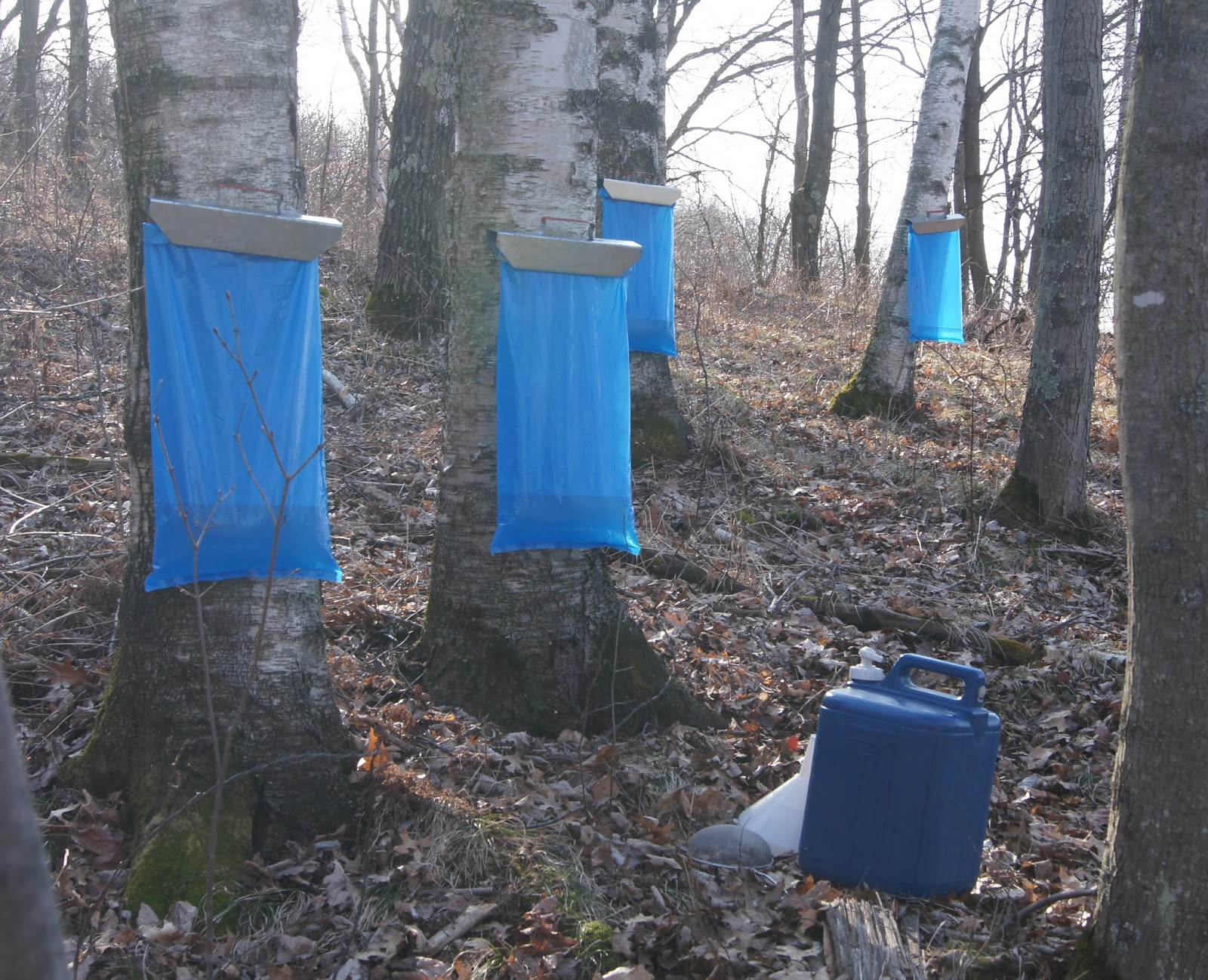
If you have access to a few birch trees, it’s easy enough to get, as long as, you know, nature cooperates.  You tap the trees exactly as you would for maple syrup, drill a little hole about 1 ½” deep, insert a tap, hang a bag, bucket, what have you, or attached food grade tubing to allow the sap to run into a container.  Then when you have a quantity, you cook it down.  And cook it down.  And cook it down….  Because, the thing about birch sap:  it’s generally less than half as concentrated in sugars as maple sap.  So if it typically takes from 30 to 40 gallons of maple sap to produce a gallon of syrup, with birch we’re talking about a roughly 80:1 ration.  Breaking that down into the smaller batches I’ve been doing, 10 gallons of sap gave me one scant pint of syrup.  

Syrup assortment: the small, very light one at center front is black walnut.

I’ve said this before, and I’ll say it again:  you can look at the numbers, even the relatively reasonable maple ratios, and think you get it, but until you actually do it, you can’t possibly understand.  Still, it’s worth it.  I go to a lot of trouble, tapping the trees, hauling the heavy sap down the hill (luckily I do get to haul it down the hill), cooking the sap down and down and down, but at the end I’ve got lovely local products to work with through the rest of the year.

And here’s a handy fact of nature:  the birch trees tend to start running as the maple run is coming to an end.  So if you have access to both kinds of trees, you can move your tapping equipment over to the birches when you’ve had your fill of maple sugaring, and the trees start to break bud, rendering the sap bitter and unusable.  Making syrup, especially birch syrup, is a labor of love, and a rite of the season, a perennial celebration of those immemorial cycles.  A lot of work and time, sure, but hey, it beats picking up dog crap….

Earlier reports from sap season:
 Sapped Out, 2013
The Sweetest Tree, 2013
Sweet Trees X3, 2015
Sweetness, Toil, and Smoke, 2010

How I have used birch syrup:

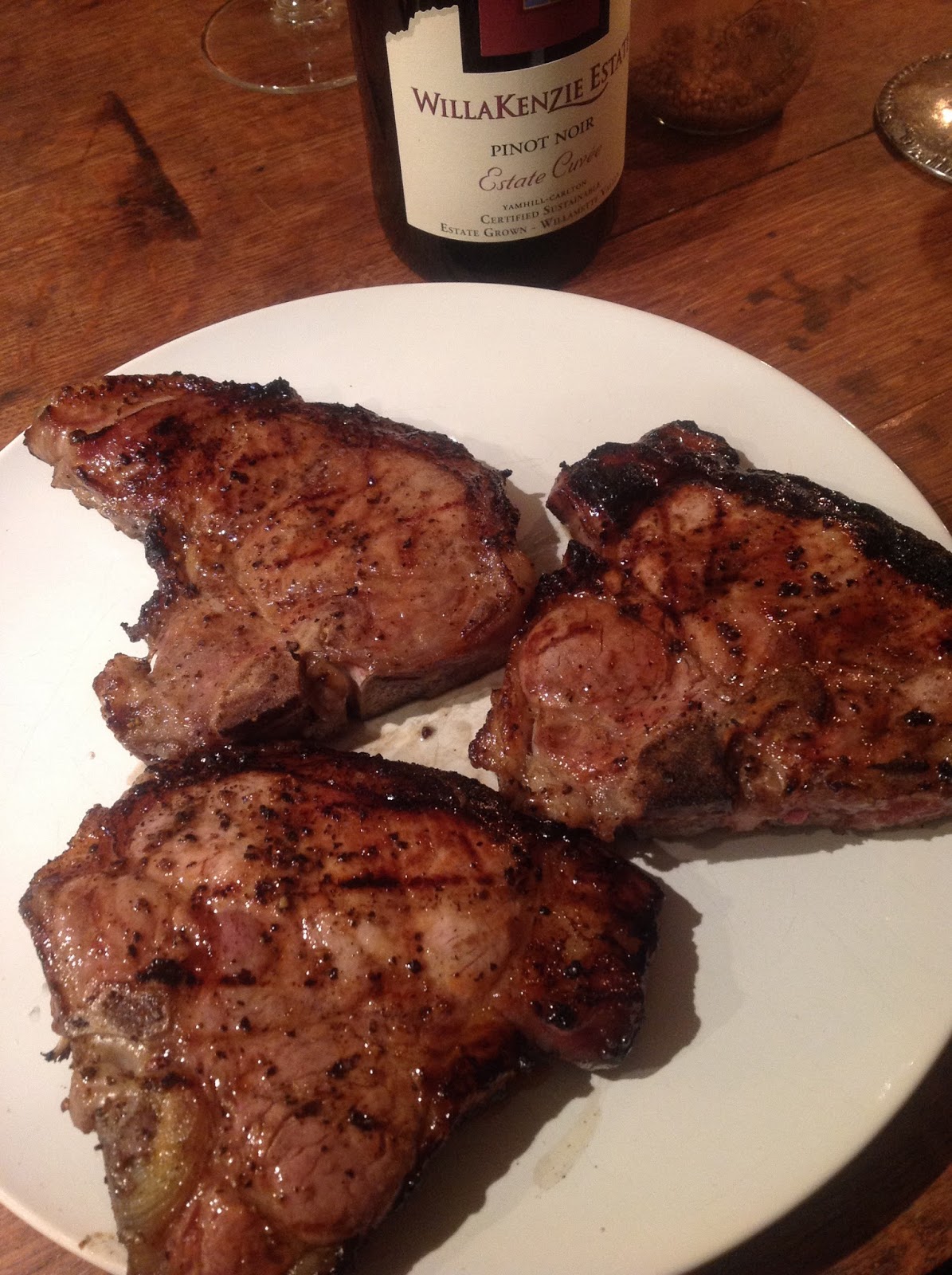
·        *  As a marinade for grilled or smoked meat:  it’s great brushed on a pork chop, which I then season simply with salt and pepper.  For some reason, the birch syrup doesn’t burn on the grill the way maple syrup or honey would.  Perhaps because the sugar composition is different.  I’ve also used it on grilled game birds, particularly woodcock.  And I’ve used it in the cure for smoked duck breast and venison with wonderful results.
Grilled red wattle pork chops in a birch syrup marinade; pork and birch have a delicious affinity.

*  In salad dressings:  just a teaspoon or two in a vinaigrette really makes its presence felt, and brings that distinctive, aromatic birch flavor to any kind of salad.

·         *  In cocktails:  1 teaspoon birch syrup, a few drops of lemon juice, 2 ounces Scotch, bourbon, or rye, stir it up, add ice, garnish with a lemon twist.  Or for the lemon substitute blood oranges in season for a cocktail I’ve dubbed “The Nasty Bruise.”  For a refreshing non-alcoholic drink, stir a couple teaspoons of birch syrup into sparkling water, add ice and perhaps a squeeze of lemon juice.

Those are the main applications I’ve found for birch syrup.  I’m having a decent year with the birch this spring, so I’ll have a good supply to experiment with through the year.  I repeat:  a little goes a long way with birch syrup.


Birch-Mustard Seed Carrot Salad

Two servings.  

1 large or 2 small carrots
2 tablespoons olive oil
2 teaspoons yellow mustard seeds
2 tablespoons lemon juice
1 tablespoon birch syrup
1 small garlic clove sliced very thin
A bit of chiffonade leek or scallion green, optional
Salt and pepper

Peel the carrots and slice them very thin—1/8” or less.   A Benriner mandoline is handy for this—watch your fingers!

Heat the oil over medium low and add the mustard seeds.  Stir them around until they just start to pop, then remove from the heat.  Add the lemon juice, birch syrup, and garlic and stir well.  Pour the dressing over the carrots, add a couple good pinches of salt and a few grinds of pepper, and stir well.  Let the salad sit for at least a half hour or up to several hours before serving.  Sprinkle the optional leek or scallion greens over top just before serving.

Maple syrup variation:  in place of the birch syrup, use 2 teaspoons of maple syrup and ½ teaspoon of Dijon mustard--I haven't actually tried this variation, but I don't see how it could be bad.


Here’s a brief record of weather, phenology, and such since syrup season began at the end of February:

Feb 27 record highs
Feb 29 1st ½ cup maple syrup done
March 1, “brittle and chill” and the trees aren’t producing sap
March 4, 3 inches of snow
March 8 red-winged blackbirds back & a scant half cup of black walnut syrup finished from 56 ounces sap—that’s all for black walnut, it didn’t produce enough sap after that to bother with
3/10 snow’s all gone and Mary notes, looking out the kitchen window, “It’s not winter anymore,” to which I reply, “It’s not spring, either.  It’s mud season.”
3/10 cooked down a tiny bit of box elder syrup, “single source”….
Shrimp on the barbie, definite grilling weather
3/11 picked garlic mustard along the Rush River at Brush Cr Rd; grilled pork chops; summery
3/12 summery; dinner at Tina’s, I wear shorts
3/16? 2” rain, thunder
3/14 woodcock return
3/17 SNOW again, grass covered
3/18 snow gone
3/22 tapped birches and they were running; seemed pretty vigorous, but didn’t get much for a few days
3/23 SNOW again! 3-4”.
3/24 snow gone!
3/27 finished the last maple, moved over to birch
3/28 5 gallons birch mostly cooked down
3/29 another 5 gallons birch gathered, mostly cooked down; sunny and warm, in shorts again
3/30 It didn’t seem that there was much sap flow, but the eight birch gave around four gallons total, which reduced gently on the woodstove overnight
3/31 The house is starting to smell birchy with the sap on the woodstove getting right down there.  It’s raining now, but the forecast is for an inch of snow by the end of the day.  April Fool!

Text and photos copyright 2016 by Brett Laidlaw


Thursday, April 16, 2015

Sweet Trees X3


Boiling birch on the left, maple on the right.

Sugaring season came to an end this week.  The birches were running pretty good for a few days, but with afternoons in the sunny 60s the sap doesn’t keep.  The maples slowed and then dried up a good week ago, and are now breaking bud.  I also tapped our one big black walnut this year, but not soon enough to get much sap—enough to cook down to maybe a third of a cup, which isn’t bad, considering I only had about a half gallon of sap.  My minimal experience with black walnut tells me that the sap is at least as concentrated in sugar as maple, and that it probably starts running at about the same time.  Since our black walnut tree is always extremely late to leaf out, I had assumed the sap would run late, too.  Not so.

I took a very low-key approach to sugaring this year.  I tapped about five maples, exactly two birches, and the one black walnut.  I left my half-assed sap contraption in mothballs, and just reduced the sap on our woodstove, very gradually, and did the final brief boiling on our gas cooktop.  The result was not any great quantity of anything, but the process did produce some observations.

Shades of maple: from left, first to fourth boilings of 2015 syrup, and one from 2014 at right.
The maple syrup was the lightest in color that I’ve ever made.  Even the fourth and final batch, from sap gathered just before the trees dried up, is medium amber at most—the last syrup is usually very dark, verging on what sometimes is sold as “grade B”.  So there’s less of a caramel taste to the maple, but it’s delicious just the same.

Slow birch 2015.
The “slow birch” also made a much lighter, more delicate syrup than hard-boiled versions I’ve done in the past.  It's a gorgeous color, reddish mahogany. There’s still an edge of acidity to it, but it’s rounder, without the aggressive, almost bitter bite of the darker stuff.  I suppose you could liken it to different roasts of the same coffee bean, from light to Vienna, French, espresso.  Actually, I think you could very much liken it to that.  I could see using the lighter stuff to drizzle over grilled or roasted vegetables, where the darker version works better combined with other ingredients, in vinaigrettes, marinades, or glazes.
Hard-boiled 2014 birch.


Finally, the walnut.  As I say, I wound up with about half a cup.  It’s much more like maple syrup than birch, which makes sense—maple and walnut trees are more closely related to each other than they are to birches, aspens, etc.  Also, I believe, though I don’t know for sure, that walnut syrup is composed of sucrose, as is maple syrup, while birch syrup contains mainly fructose and glucose.  I’m just going from taste, and common sense(?) on that.

Black walnut syrup.
The main thing I was aware of with the walnut syrup was trying NOT to describe its aroma or flavor as “nutty.”  I resisted that characterization mightily, and in the end, I failed.  The finished product definitely has a slight, but undeniable, aroma of toasted nuts to it, and a maple-level sweetness.  

There you go.  That’s the sugaring report.  I think all three kinds of syrup are worth making if you have access to a few trees.  And as with my previous explorations of micro-batch pickling and preserve making, I hope I’ve shown that you can have fun with DIY foods without going overboard into tedious mass production.  Sometimes a taste is enough.

Birch in the final reduction.
Next time it’s on to the nettles and other wild greens.  ‘Tis the season.  And it’s been mild enough of late that I think I’ll hit the garden today and plant some radishes, mache, lettuce, and peas.

The Bide-A-While tree syrups family portrait, 2015.

Tuesday, May 7, 2013

Sapped Out


I'm doing the last boil of the sugaring season today, cooking about 10 gallons of birch sap down to what will probably be around a pint of syrup.  It has been a long, satisfying, at times grueling, few weeks--tapping the trees, awaiting the sap run, at first reluctant, then rising to a spate; checking the taps, hauling the sap, cutting firewood, and boiling, boiling, boiling.  All this in the midst of one of the most remarkable stretches of springtime weather...I was going to say "in memory," but I don't think anyone remembers such a season, as such a one has not occurred before, not in my time.

That's because water has been falling from the skies--mainly as snow--just as steadily as it has been pulsing up through the capillary systems of the maples and birches.  We thought that the April of storm after storm was remarkable, until we experienced a historic May weather event, a two day-plus storm that dropped around 16 inches at our house.  The Twin Cities record for a May snowfall was around three inches--and that record held, because the cities were on the rain side of the line.  Three inches is not a lot of snow, but then, May is supposed to be a spring month.  Well, so is April, for that matter. 

May 4, 2013, Ridgeland, Dunn County, Wisconsin

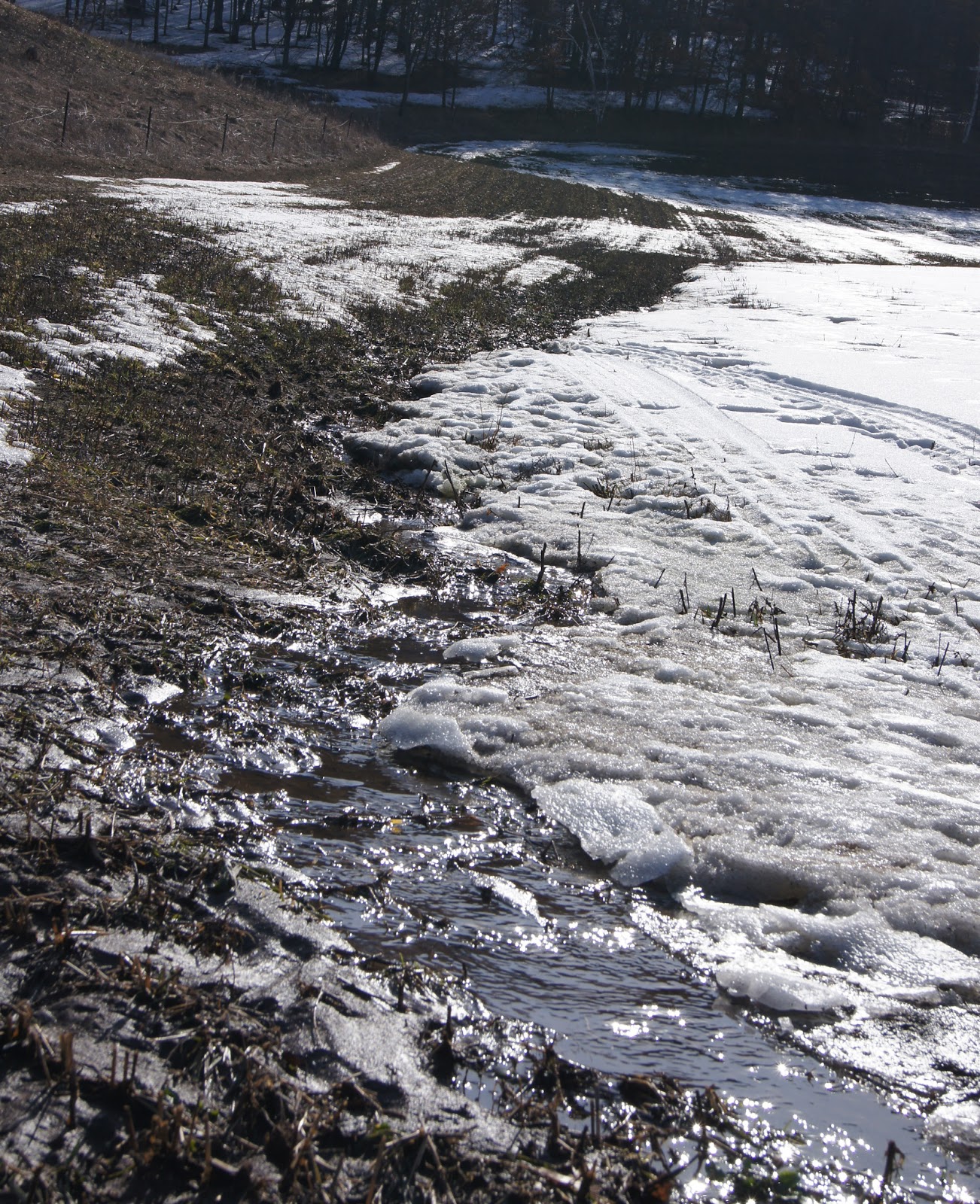
As the snow melts water flows down our hayfield hill, around the corner of the yard (and right across where I dug our garden last year, bad planning), and pools up in a low spot north of the garage.  From this holding area it then trickles out to form a perfect little brook past the lone pine tree behind the garage, and out into the pasture.  It's a good distance from there to the corner of our property at the crossroads of the county road and our town road, where tiny Hay Creek makes a hard southward turn, but some of those snowflakes from our hilltop surely make it to the creek, which meanders through some very pretty countryside about 15 miles, crow-wise, and who knows how many crooked stream miles, to the Red Cedar River.

The Red Cedar takes a more direct route south and empties into the Chippewa River south of Downsville (in summer we ride our bikes on the state trail that follows the Red Cedar down to this confluence).  The Chippewa in springtime is a mighty river, at some spots it can seem as broad as the Mississippi; until, of course, you see the Mississippi where the Chippewa enters, a shining, stirring inland sea--Lake Pepin--from which greening bluffs, grander than castles, rise on the western shore in Minnesota.


And the Mississippi, of course, it goes to the Gulf, where a warm wind picks up water molecules from the salty surface, and perhaps on some strange May day (or it could be March, December) a driven jolt of northbound air carries that laden breeze back up the course of the great river in an anomalous weather system that sets up a stationary line of torrential snow from Iowa into southeastern Minnesota, across west central Wisconsin, dropping nearly a foot-and-a-half of snow on a hilltop in northern Dunn County.  Did some of those snowflakes start here, years ago?  Seems crazy, but it's possible.  Clearly, I'd like to think that they did.

All this water coming down, water gushing down, the gathering of the streams, the boiling of the sap, it's had me thinking about accretion, and reduction.  All that water from the skies, gathering on our hilltops, in the woods, in our yards--in everybody's yards, forest, fields.  It comes down drop by drop, or flake by flake.  When you get down to where the Chippewa joins the Mississippi, you wouldn't have thought just a few snowflakes, a few raindrops, could amount to all that.  If all you see is the mighty flow, I think you're missing the bigger picture, which, oddly, only comes into focus when you start with a snowflake.

Accretion, it's kind of an odd word, but the one which, to me, sums it up (no pun intended).  Things gathering together, things piling up. "Any gradual increase in size, as through growth or external addition."  It's how every little bit helps, and every litter bit hurts, how the extra Christmas cookie, one more beer, or french fry, amounts in time to...self-loathing.  A garden is an accretion, created one seed at a time, then one leaf at a time until, there it is, a verdant expanse.  Since I've started cutting wood for next winter (and that wet, heavy snow has given me lots of broken limbs to cut up for the pile), I see the woodpile as an accretion, one split, one stick at a time until, by the time the frost returns (think not of that...), we'll have a winter's worth of heat, and cooking fuel, and dark nights' cheer stacked up to see us through.

A good novel is an accretion of detail and incident and image, all adding up to something marvelous, and all compiled one word at a time.  And running accretion backwards, in an abstract but very, very meaningful way, that's the phenomenon of moments slipping by, it seems to me, of time past and not to be regained--Proust can search all he wants.  More positively, what is life but an accretion of moments, experience, memory?  Whatever it is that's piling up, it's all happening in time, so a snowflake falling is a tick of the clock, and as the meltwater drips out of our ephemeral pond, it's a sort of liquid hourglass--though we won't be turning it over.


With the wet snow coming down, the saps coming up, we started to feel inundated from all sides.  When the snow stopped and the sun came out (it did, a couple of times in the last six weeks), things seemed better, but in another way it only sped the spate--the water flowed down the hill, the creek filled to the banks; the sap gushed from both maples and birches.  I couldn't keep up with it.  I dumped gallons and gallons of sap on the ground--I don't know why it felt wasteful, it was going to wind up there eventually, and the trees had all the sap they wanted.

Meantime, with all that accretion going on downstream, I was going against the tide, a few gallons at a time, engaged in the frantic race toward reduction--take 10 gallons of maple sap, 20 of birch, 80 or 160 pounds of liquid, turn it into something you can hold in your hand.  Pour on your pancakes, use to flavor a salad dressing.  Drop by drop, in wisps of steam, or through gentler evaporation in the final reduction on the woodstove overnight, as the fire gradually died down, I was sending all that water back into the air.  To harvest an essence, a distillation.  Some sweet stuff.  Here taking away everything extraneous, which is in fact all you could really see was there, the watery part, to leave something of which we only had the vaguest insinuation, that fleeting sweetness on the tongue.  An act of faith, in its modest way.

The pros at this business probably philosophize less and boil a lot more than I do, so in this bountiful year for sap I've seen syrup offered at $25 a half gallon, cheaper if you buy more and bring your own containers. 

________________________________

I recorded the first drops from our maple taps on March 25.  With the back-and-forth spring going mostly back, it was a couple of weeks before I had enough sap to boil.  Thanks to Twitter, I'm able to report with utter accuracy that our first boil was on April 5: "My half-assed homemade sap contraption did a fantastic job on its maiden boil."  Thus I tweeted.  It went pretty steadily from there, reaching full spate by mid-April, wearing out my willingness to spend the day bathed in wood smoke by about the third week of April.

At which time I drilled an inch into a big birch, and sap came pouring forth.  Here we go again.

It's pretty easy to see how people started making maple syrup.  Although maple sap is clear as water, still it tastes faintly sweet to the tongue.  To the squirrels the sap that dries on maple trees, naturally flowing out from cracks in the bark or broken branches, definitely has a sugary appeal, and perhaps that's how aboriginal people figured out that there was something good here, from observing how the squirrels lapped it up.  Then there were probably a few steps involved, and a lengthy evolution, before getting to maple syrup and maple sugar, but the end result was reliable and delicious.

It's much harder to understand how birch syrup came to be.  A birch tree in a good year can provide an astonishing amount of sap, but when you taste it, it doesn't seem sweet, containing only about half the sugar of maple sap.  Perhaps I should modify that:  It doesn't taste sweet to me.  It doesn't taste sweet to the contemporary American palate, bombarded with sweetness from every side, sugar hidden in just about every processed food from salad dressing to crackers.  But maybe to a purer palate, way back when, the sweetness of birch sap was detectable, and desirable.  It you had a lot of birch sap, and firewood, and time, it was probably worth it.


As my last batch of birch sap boils away, with a pint of finished syrup in the fridge, I'm asking myself if it was worth it, and mainly coming down on yes, now that it's nearly over.  It's a fascinating product, unlike anything I've tasted before.  It's dark, dark, dark--more like molasses or sorghum syrup than even grade B maple.  And I'm not sure what accounts for this, but it is quite acidic, too, with a spiciness dominated by a menthol or wintergreen note, and a smokiness that may literally be from wood smoke wafting across the surface of the pan as it cooks.  But also, perhaps because of that acidity, it has a fruitiness, almost a wininess, that maple syrup lacks.  At first taste, I must say, it's not immediately likeable--it takes you aback and sits you up straight.  But part of what I like about it is that sense of extremity--that it is difficult to make, not easy to like, and that it requires some thought to determine how best to use it.

Here's what I've done with it so far, and how these preparations turned out:


Birch-cured whitefish gravlax.  I followed the method I used for maple-cured lake trout gravlax (in the book), but:  then I forgot about it in the back of the fridge for over a week.  Oops.  I was afraid it would be spoiled; instead, it is just very, very salty.  But the flavor, other than the oversalting, is good, and the texture is excellent, which I attribute to the birch syrup.  So I'll use it as I would salt cod, probably make something like a brandade, the Provencal dish of salt cod pureed together with potatoes, lots of garlic, olive oil or butter.  Maybe I'll work in some other seasonal things like ramps and watercress.


Pork chops marinated in birch syrup, ramps, and Sichuan pepper.  A couple hours ahead of cooking I brushed the chops with a couple of tablespoons of birch syrup, added chopped ramps, salted and peppered liberally, also a good sprinkling of roasted, ground Sichuan pepper (hua jiao).  On the grill, medium coals, 10 to 12 minutes total--excellent, and the interesting thing was, the birch syrup didn't burn as another sweetener would.  I'll look into this phenomenon further.


As a salad dressing component, birch syrup (you don't know how many times I've typed bitch while writing this post, and had to correct...) is superb, especially with assertive greens like watercress.  Since it brings both sweetness and acidity, you don't need vinegar or lemon juice in the dressing.  I've simply been mixing the birch, some sunflower oil, a wee bit of mustard, salt and pepper--terrific.  Shown here as the base for pan-fried trout with sauteed ramps and lardons, duck fat potatoes.

You experience the land and the season in a different way when you take up sugaring, and I'm as glad to have done it as I am that it's over.  I probably won't make birch syrup every year, and with three gallons of maple syrup in the pantry, I likely won't have to do as much next year.

On the other hand, I recently saw a link on Twitter to an article about making syrup from black walnut sap.  Oh, why did I have to look...?


Text and photos copyright 2013 by Brett Laidlaw

Thursday, December 8, 2011

On Woodcock


One of the most fascinating and endearing creatures that inhabits our Wisconsin property is the American woodcock, scolopax minor.  It's a migratory bird that makes epic, apparently solitary journeys from the northern U.S. and southern Canada to more temperate climes--notably the Louisiana bayou country--in autumn, and back again in spring.  Considering that woodcock use their elongated bills to probe soft soils for insects, they return to our region remarkably early, often when there is still snow on the ground, and only the south-facing slopes have melted.  It's a curious strategy, it would seem, that leaves them vulnerable to late snows and cold snaps.  We've sometimes seen the weak, dazed birds staggering along the shoulder of the road, too feeble to fly, after a March or April storm has swept through.  Well, there must be some wisdom in nature's plan, as the species does manage to survive.

Once we've observed the first returnees in  March, we look forward to a spectacle that makes these birds both endearing and thrilling, comic as well as marvelous.  It's the mating behavior of the male woodcock (if you break the name down etymologically, it seems odd that there would be female woodcock, but there you go; I don't think I've ever heard or read the term woodhen).  Almost immediately upon arriving in their northern breeding grounds, the males of the species stake out territory in an open space.  It is here that, each night through the spring--sometimes into early summer--Mr Woodcock does his mating dance.


It's a circular dance, somewhat arduously accomplished in the dry grasses in our fields, the moreso because a woodcock is a rather stout, short-legged creature.  That adds to the comic aspect.  Then there's the peenting.  I didn't make that word up.  Peent is the term that ornithologists have come up with to describe the sound the woodcock makes as he toodles along in his roundabout dance.  It's a nasal utterance somewhere between a quack and a croak--well, just say the word peent, and give it a good Dylanesque twang.  Before we were aware of the source of this odd sound, we often heard it coming from the field on moonlit nights, and invented a mythical Bide-A-Wee beast, the duck-frog, to explain it.

But now for the thrilling part.  At some point in his dancing, peenting frenzy, the woodcock decides it's time for a change of strategy.  He takes flight with the twittering wing-flitter sound familiar to upland bird hunters, and streaks into the dusk; he follows a circling path in his flight, as well, soaring out of sight far up into the darkening sky.  And then he stops; stops at the apex of this climb, almost directly over the spot from which he flew, and descends, fluttering back and forth like a falling leaf, producing yet another sort of sound--what to call it, a sort of undulating whistle, fwoot fweet fwoot fweet fwoot fweet.  And he lands where he started from, and begins again.

Last spring one woodcock established his dancing ground on the hill just above our cabin, and I was able to creep up on him and observe his tottering progress through the grass.  More exciting still, his flight path on his ascent took him directly past the cabin's deck, so we could sit out and see him go past, try to follow his progess up into the evening sky, wait for the sound of the return to earth.  Perhaps I'm easily amused, but I couldn't get enough of it.

This behavior is supposed to stop, I suppose, when the woodcock attracts a mate--that's the whole point of it, after all, unless woodcock enjoy this sort of virtuosity for its own sake; and you know, now having mentioned that, I really hope they do, unlikely though it seems.  Well, our Bide-A-Wee woodcock, it appeared that he was destined to remain a lonely bachelor, for his peenting and dancing, his nightly flights, went on for weeks, both in the evening, and then again in the morning--it's brought on by a certain quality of the dusk and dawn light.  On nights of bright moon, it sometimes continued through the night.  At some point it stopped; whether he did attract a mate, or just felt his chance had passed, we'll never know.

Through the summer we rarely encounter woodcock on our property.  I assume they're still there, hiding back in the impenetrable thickets.  We come across them again in the fall, when the leaves start to drop, the meadow grasses to dry and recede.  And then of course, in the fall, it's hunting season.

We don't hunt birds on our land, though we have woodcock, grouse, the occasional pheasant and transitory turkeys.  We prefer to think of our little plot, just 20 acres, as a gamebird refuge--the partridge and timberdoodles need only deal with their natural enemies, foxes, owls, hawks, and what-have-you.  The flesh of these birds is delectable, but the pleasure of encountering them throughout the year exceeds even the delights of an excellent meal.


But we do hunt them, of course, in the public hunting grounds with which western Wisconsin is amply endowed.  I believe that the birds we find, in much the same cover that ruffed grouse frequent, are migrants.  As the winds turn to the north and temperatures drop, they come through in waves, and though they travel singly, from what I've read, they tend to congregate in liminal terrain at the edges of woods and marshland, or creek bottoms where damp soil provides them the nutrition needed to fatten up for the long flight south.  For a bird whose behavior and movements are famously mysterious, you can come across quite a lot of them in a day of hunting, especially with a pointing dog to assist.

I did not come across a lot of them this year, however.  Various circumstances conspired against my spending much time in the woods before the woodcock season ended in early November.  I shot one woodcock, one.  We made a point to savor it.


I'm a firm believer in the concept of terroir; I believe that the food of a place carries the taste of that place (I almost called this blog Taste of the Place, before switching to the more esoteric title).  And I believe that foods that occupy the same space, even if, say, one is a bird, and one comes from a tree, have a certain simpatico, partake of a sort of sympathetic magic that can create great synergy in the pot and on the plate.  Hence:  grilled woodock glazed with birch syrup.

I'd been trying for a couple of years to make birch syrup, which is produced in exactly the same manner as maple syrup.  In outline, it's simple--tap a tree, gather sap, boil it down, voila, birch syrup.  But birch trees aren't as free with their sap as maples, in my experience, and they run later than maples, too.  The warmer weather can bring problems--bugs in the sap, or spoilage if you don't check the bags frequently.  Last spring I finally gathered enough sap--just a couple of gallons--to boil down for birch syrup.


The sugar in birch sap is less concentrated than maple sap, therefore, more boiling down.  More boiling down means more heat applied to the sugars.  The result is something nearly as dark as molasses, though not so thick.  My entire yield of birch syrup, in two boilings, was probably shy of a cup, but intense stuff it was, once I tasted it.  It's nearly as sweet as maple syrup, but with an appealing, very slight bitterness, as of caramel just starting to burn.  There are also vegetal notes, a slightly spicy tingle, and a hint of menthol. 

I'm so accustomed to the taste of maple syrup, I don't really taste the wildness in it anymore.  But the taste of the wild is pronounced in birch syrup, and that, along with the darkness of it, took my mind's palate to another season, the autumn, bird hunting season, and I imagined the woodcock riding the lashing north winds down from Canada and into our region, finding a respite in our charismatic coverts, the scrappy edges of woods and marsh, among the dogwood, prickly ash, alders and hazel, flanked by islands of tall white pine, oak savannah remnants.  And I thought, if a woodcock or two wound up in my game pouch, that a fitting seasoning would be a brushing of birch syrup, an appropriately northern condiment, and suitably wild, to match the dark, gamy meat of the woodcock.

I do love a recipe with a nicely conceptual, geographical and seasonal basis.  I rarely sit down to write about food without recalling Lévi-Strauss:  Food is not only good to eat, but good to think about, as well.


Getting on to the food, then: the remnants of the  previous night's grouse dinner provided a very nice starter to our woodcock delectation (I can't really call it a feast, since one woodcock provides but a few bites of meat).  I diced up the leftover grouse breast, combined it with what was left of the potatoes and cabbage, added stock: a delicious soup that tasted like anything but leftovers.

To accompany the woodcock I made chestnut mash.  These beautiful chestnuts from Iowa are available at local co-ops now, and I can't get enough of them.  For this dish I:

Roasted, peeled, and coarsely chopped 15 chestnuts;
Sautéed a chopped shallot and 2 tablespoons of finely diced celery root in 1 tablespoon butter until the shallot was translucent;
Added the chestnuts, along with 1 tablespoon dried apple minced, and 1 small potato peeled and diced;
Then 3/4 cup of unsalted chicken stock and a generous pinch of salt.

I simmered that, covered, for around 40 minutes, then removed the lid and cooked it gently until most of the liquid was gone.  I should have a food mill out at Bide-A-Wee--it's a great, non-electric kitchen tool.  But I don't have one there yet, so my "purée" was produced with the back of a fork, leaving an appropriately rustic texture.  You could use a blender or food processer, too.

Then on to the woodcock, which I halved, simply seasoned with salt and pepper, and put on the grill.  It took just a few minutes per side, little bird that it was, and on the final turns I brushed it a couple of times with the birch syrup, which gave the skin an appealing burnish.


And when it came to eating, did it live up to all the forethought and verbiage?  You couldn't taste the birch so much on the breast portion, though it did lend a subtle sweetness.  On the legs, my favorite part of a woodcock, the flavor was more pronouced, and it was wonderful--both sweet and a little bitter, melding wonderfully with the fatty skin and savory meat.  This is the definition of a delicacy, to me.  There's a book out recently detailing the last-dinner-on-earth requests of famous chefs; they didn't ask me, dang it, but this would be mine: a plate of grilled woodcock thighs with birch syrup glaze.

Next time, next year, if all goes well, I'll have another try at this dish.  I would do it pretty much the same way, although I think I would reduce the syrup a bit to make a stronger glaze.  It's nice to have something to look forward to.

Here's a pretty good overview of all things timberdoodle.

Text and photos copyright 2011 by Brett Laidlaw