Showing posts with label cheese. Show all posts

Thursday, January 14, 2016

Simply Superior Soup (or "Effing French Cooking Magic")


It’s the last week of December 2015 as I (begin to) write this, 2016 looming just days away, and for cooking options we are decidedly into the winter larder.  On December 6 we were amazed to eat, and very much enjoy, the last garden tomato.  The last leaves of fresh kale were part of a festive Christmas dinner:  seared venison loin (harvested from the Bide-A-Wee property last year) with a rich, savory red wine and port reduction; lima beans simmered with stock and aromatics, then pureed, a surprisingly luxurious result from a humble dried bean; then the kale, braised with chestnuts and garden leek, a splash of our homemade cider vinegar.  Though we haven’t really celebrated Christmas in any traditional way for some years, I’m not going to let an opportunity for a festive dinner go by.  And anyway, we think of it as a continuation of our solstice festivities—especially appropriate here, as Mary’s birthday occurs during the same time.

Once those last leaves of kale vacated the crisper, dinner planning turned a page.  It’s true that there’s still quite a bit of “fresh” produce, from both garden and farmer’s market stock-ups, in our cellar, in the fridge.  But the term fresh doesn’t really mean the same when applied to storage carrots, cabbage, squash, and onions, as it does when describing a handful of beans or a bowl of tender lettuce harvested from the garden to be prepared and served minutes later.  Those winter stand-bys are fresh in the sense of not being frozen, dried, pickled, fermented, etc., but…you know what I mean.  It’s not the same as throwing dew-dappled snap peas in the wok or snipping fragrant dill into a dressing.  Our vocabulary fails us in efficiently denoting that crucial difference:  there’s fresh produce, and then there’s fresh produce. 

This is not to disparage the stalwart vegetables of winter, not at all.  Like reliable character actors, they show up and fill their roles with unfailing professionalism, year after year, decade after decade, while the fad for arugula fades, or a trendy heirloom cucumber turns out to be just another pickle, after all.  Cabbage, potatoes, carrots, squash, onion, leek, turnip, beets--the roster might at first glance suggest daily supper at the gulag:  bung it all in a kettle, boil until done.  But there’s a saying I like (and as far as I know, I came up with it), goes like this:  There’s meat, and then there’s cooking.  Which is to say:  It’s not always only about the ingredients, but often as much or more about imagination and skill in preparation.  Today’s soup, which we had as a first course on Christmas night, is a perfect example.

If it hadn’t come with a sexy French name, I might never have tried it.  Puréed cabbage and potato soup sounds, you must admit, a good deal less appealing than Crème de Choux aux Beurre de Roquefort.  The source is Madeleine Kamman’s In Madeleine’s Kitchen.  There are three remarkable and surprising things about this recipe:

1)  In spite of the cream—crème—in the title, there’s no cream in the soup.
2)  In spite of the fancy-sounding title, the list of ingredients is short and plain.
3)  In spite of the short, plain ingredient list, the resulting soup is delicious, even luxurious, the result of “Fucking French cooking magic,” as I described it, enthusiasm overwhelming decorum, in a tweet.


There are a couple of secret ingredients:  walnut oil, and confit fat.  But I think you could do without those if you don’t have them, substituting good butter for the confit fat, olive oil for the walnut oil.  However:  if you haven’t tried French walnut oil, it is well worth seeking out.  A commonly available brand, and the one we always buy, have even brought back from Paris in the past, is J. Leblanc.  It’s pricy, but a little goes a long way.  For me, a salad of fresh tender lettuces straight from the garden, dressed with nothing more than walnut oil and a bit of fleur de sel is one of life’s simple luxuries.  But I’m getting ahead of the season.  Just one more note on the walnut oil:  the French stuff is made from lightly toasted walnuts, so it’s amber in color and has that nutty fragrance and flavor.  The golden walnut oil often sold at “health food stores” and co-ops is not the same.  The French walnut oil should not be used for cooking, only dressings and seasoning.  (NB: the English name is in small print on the bottle, so you’re looking for a bottle labeled “Huile de Noix,” as above.  For Mpls/St Paul readers, Cooks of Crocus Hill carries it, but are currently out of stock in all stores.)


The basis of the soup is potatoes, cabbage, and water.  It gets a smoky depth of flavor from bacon.  Not a lot of bacon, either, less than an ounce per person in Kamman’s recipe (she actually calls for pancetta).  No cream or milk, as noted above.  No stock, just water (you can call it Chateau Sink, as Jacques Pepin sometimes jokes, or perhaps Domaine du Tappe, to French it up).  There’s a bit of garlic, whose presence is felt.  The beurre de Roquefort is simply blue cheese and soft butter mashed together, a few grinds of coarse black pepper—a simple compound butter; it’s worth making extra, for it’s nice to have around, to smear on a burger, say.


And that, my friends, is it, the ingredient list in its entirety.  You gently render off small cubes of the bacon or pancetta, add potatoes and garlic, then the cabbage.  This sweats for a few minutes (“mellows,” in M Kamman’s version), then you add water and simmer until the cabbage is very tender.  The well mellowed vegetables and bacon are then whizzed up in a blender (I used a food processor, carefully spooning out the solids, adding liquid gradually; an FP is really not the best appliance for pureeing soups, I’ve learned from bitter experience).


And get this:  it suffers not at all from being made a day ahead and reheated just before serving.  On Christmas Eve I added a little crunchy garnish, chopped goose skin cracklings—yeah, I happened to have some lying around; don’t hate me because I’m beautiful—from the goose we cooked for our first solstice celebration.  When I made it again for lunch I toasted some small croutons in olive oil—it’s really about the textural contrast, that crunch to perk up the creamy soup.  (See:  "It's all about the garnish".)


Coming back around to my earlier point and seasonal eating and the winter larder:  this is a fabulous dish that you would never make in the summer, but which is perfect for the cold months when, you know, you have a lot of potatoes and cabbage around.  It also reminded me how absolutely lovely and civilized it is to start a meal with a soup, so elegant and yet so comforting.  A fading tradition I hope to start reviving in our house.
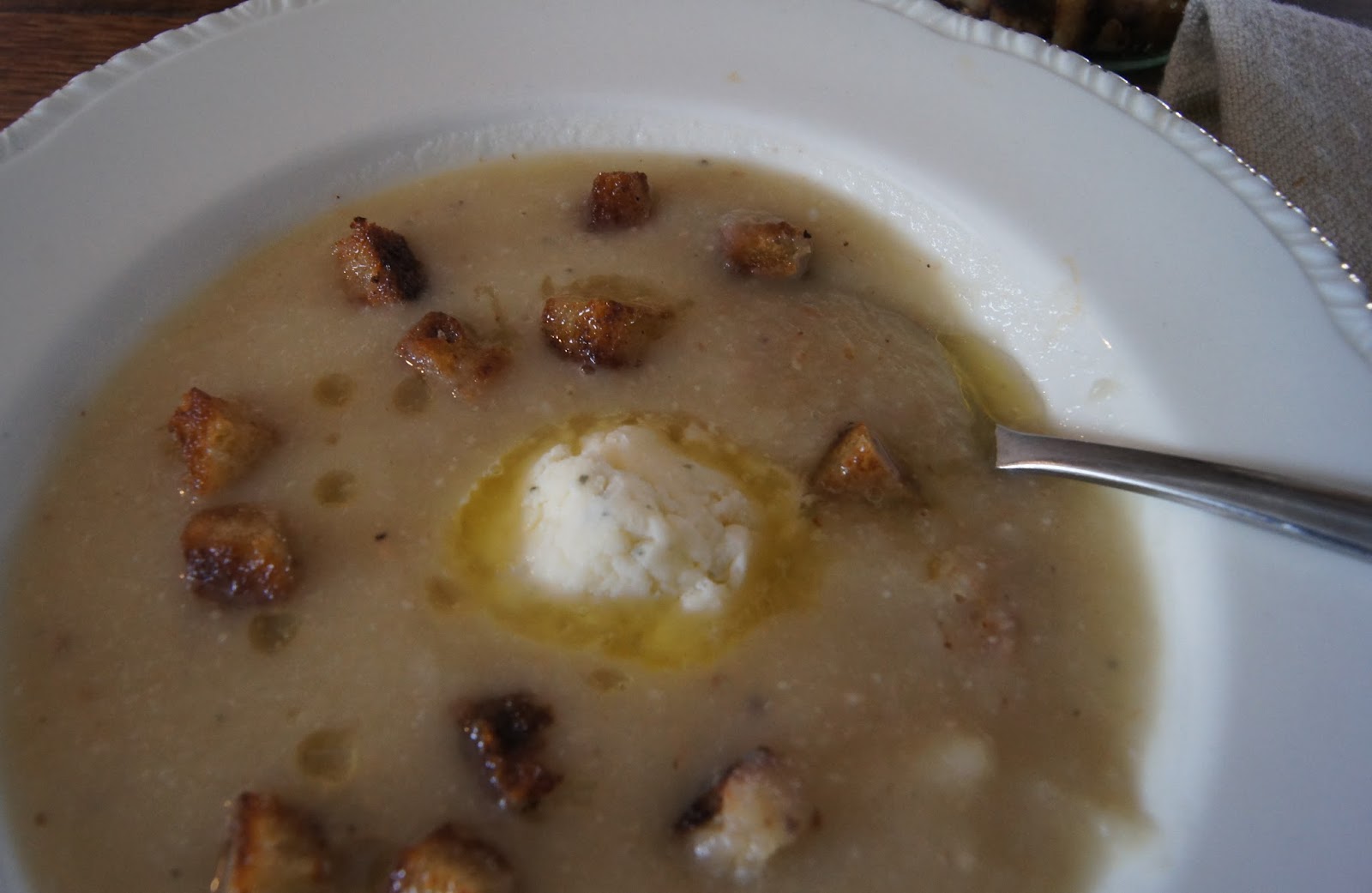

My adaptation of Madeleine Kamman’s recipe:

Creamy Bacon, Potato, and Cabbage Soup with Blue Cheese Butter

Serves four as a first course, two to three as a main course—add salad and crusty bread to make it a meal

2 ounces bacon or pancetta, preferably in one chunk
1 tablespoon duck confit fat or butter
1 medium or 2 small potatoes, 6-7 ounces total
1 large or 2 small cloves garlic
¼ of a green cabbage, about 12 ounces
1 tablespoon walnut oil, plus additional for garnish*
Salt and freshly ground black pepper

For the blue cheese butter:
2 ounces unsalted butter at room temperature
2 ounces blue cheese

Croutons or cracklings, optional but highly recommended

In a small bowl, mash the butter and blue cheese together with a fork until well blended.

Cut the bacon or pancetta in small dice, about ¼-inch.  Peel the potatoes and cut them into smallish cubes, about ¾-inch.  Shred the cabbage into ½-inch strips.

Heat a medium saucepan and add the confit fat or butter, then the bacon.  Cook over medium-low heat.  As the bacon renders its fat and begins to brown, add the potatoes, tossing them in the fat, then cook, stirring occasionally, until they become a little bit brown, 4 to 5 minutes (you’re just looking for a golden color, not deeply browned as for hash browns).  Stir in the garlic and cook for another minute or two, then add the cabbage, a couple generous pinches of salt, and several grinds of black pepper.

Turn the heat to low, cover, and let the cabbage sweat (“mellow” is the term M Kamman uses) until well wilted, about 5 minutes.  Add 3 cups water, bring to a boil, turn down to a simmer, and cook partly covered until the cabbage and potatoes are very soft, 15 to 20 minutes.

Let the soup cool for a few minutes before pureeing.  If using a food processor, separate the solid from the liquid parts of the soup and purée the solids first, then gradually add in the liquid.  When everything is in the FP, purée for about a minute.  At the end of the minute, drizzle in the walnut oil.  Return the soup to the saucepan.  Reheat just before serving.  (Note:  Kamman directs you to strain the soup back into the pot after puréeing; I did not bother with this step, finding the soup smooth enough to my taste without straining.  Straining would no doubt produce an even more velvety and elegant purée, if that's what you're after.)

To serve:  heat the soup and taste for salt; you will probably want to add another pinch or two.  Ladle the soup into bowls, and to each add about a tablespoon of the blue cheese butter.  Add croutons or cracklings, as you please, drizzle a small amount of walnut oil over the surface of the soup, and serve.

*If you don’t have/can’t find walnut oil, use a flavorful olive oil—or, perhaps pumpkin seed oil, such as Wisconsin’s own Hay River Pumpkin Seed Oil.  And, how about this—if using pumpkin seed oil, think about substituting butternut squash for all or part of the potatoes, then garnish with toasted pepitas instead of the croutons/cracklings.

Happy soupage!

Wednesday, July 10, 2013

A Midsummer Night's Smørrebrød


You don’t have to be Danish to appreciate smørrebrød, those open-face sandwiches—knife and fork sandwiches—composed upon dense, buttered rye bread, usually containing appropriately Nordic ingredients like pickled herring, beets, and pork paté. If you like bread, and noshy food in that tapas mode, you’ll like smørrebrød. As a summer evening meal it has the additional virtue that most of the toppings can be prepared ahead—or are themselves commercially prepared foods of the very best sort, like cheese, smoked fish, cured meats, etc. Finally, because finishing preparation is so simple, these mini-canvases beg to be decorated to the full extent of your garnishing imagination.


Bready. Noshy. Easy. Pretty. What, I ask, is not to like in that combination?


It’s usually this time of year, when we’ve just slipped past the solstice, and the gardens are really starting to produce, the market stalls are burgeoning as the plants make the most of that vital sunshine, that my appetite turns to smørrebrød. It’s an elegantly rustic (or is it rustically elegant?) kind of meal to enjoy in those long twilights as the strong sun softens on descent, spreading welcome shadows, and the heat of the day begins to mellow.


That pretty well describes the evening last weekend when we prepared a smørrebrød repast at the house and packed it in a cooler for a picnic on the hill. It was a bit warm and muggy in the valley, but we caught a nice breeze as we headed up the hill. I’d been cleaning up a little impromptu sort of dump at the edge of the woods this spring, hauling down old car batteries, car seats, beer cans and bottles, what have you. Then I ran the lawn tractor up there to mow a small picnic area. Among the detritus I’d found a piece of sheet metal and some cinder blocks, and these we turned to better purpose as a makeshift picnic table (pleasantly, though very rustically, reminiscent of a Parisian zinc bar). It was, I dare say, one of the best picnics ever.


We settled in very comfortably (so did the dogs, eventually) to enjoy the view of the green, green hills, mist-shrouded in the distance. The aspen leaves overhead kept up a  calming kerfuffle. There was even a floor show, of sorts, as the neighbor who rents our hayfield came to bale up the last few rows of the oats and grass they cut last week. Urban al fresco dining has its pleasures, but when was the last time you saw a John Deere tractor and baler on the Nicollet Mall?


As we ate our smørrebrød and sipped our pinot gris and watched the sun pass out of sight behind the western hills—though it would still be light for a couple of hours—I had a thought about terroir—you know, that idea that foods and wines can taste distinctly of the place they came from, express some quality of the soils in which they grow, the waters that sustain them, and the human cultures that have nurtured them through time. My idea had something to do with how a cuisine is shaped by the sense of the seasons experienced by the people who create it. And how, for us specifically and for northern peoples in general, our long annual journey from the abyss of winter’s frigid darkness to midsummer’s almost too abundant light and warmth, and back again, how this must have as great an impact on the savor of our food as the molds in the caves of Roquefort, or the chalky soils of Sancerre.


It profoundly affects what we eat, how we eat it, what we want to eat, and how we experience it in the context of the year. A midsummer picnic at 45 degrees north latitude must taste different from the same meal consumed in Florida or southern California; in those places, their own seasonal context would shape their experience of what they eat.  For me, high summer dining has meant that I’ve hardly wanted to look at a piece of red meat—give me vegetables, salads, simply prepared fish, cheese and bread. Oh, and maybe a glass of wine.


I made a small rye loaf that included a little birch syrup. You want a pretty dense bread, with a close crumb--not something like a baguette that's full of holes.  Then top to your heart's desire.  I don't let myself be constrained by any rules, but rather see the smørrebrød concept as the base for using the best of the local and seasonal.  One of my favorite, oft-repeated mantras--Ninety percent of good cooking is good shopping--is on full display here.  That is not to say, of course, that you should hie thee to a high-end supermarket, but rather that best ingredients make for best results.

The Superior shore was well represented in fresh herring from Cornucopia, smoked whitefish from Port Wing, cheese from Bayfield.  The Menomonie farmers market gave us snap peas, onions, beets, turnips, potatoes, and asparagus, and our garden contributed, too, with radishes, chives, and mustard greens.  There was a bit of home-smoked bacon in the potato and asparagus salad, and the yogurt cheese was home-cultured using wonderful fresh milk from just down the road.  Oh, and the mayo, also homemade, using eggs from our neighbor Tina's chickens, and Minnesota sunflower oil Smude.

On Wisconin! was surely the theme of this meal, especially as the sandwiches were literally presented on Wisconsin.  A more thorough description of the various toppin's below.


Smoked whitefish salad combined about four ounces of flaked smoked whitefish with roughly three tablespoons of peas—we shelled some sugar snaps—two ounces of Wisconsin hickory nuts, chopped and lightly toasted in a dry skillet. (The nuts were a generous gift from my buddy Lucas “The Beard” Madsen; hickory trees grow in his part of southeastern Wisconsin, though they’re scarce here. Other local, wild alternatives would be black walnuts or hazelnuts; a good storebought option would be pecans.) To the fish, peas, and nuts I added some sliced red onion and about three tablespoons of mayonnaise—homemade in this case, and for a dinner like this I think it’s really worth the effort. Garnish with a little more red onion and thin slices of sugar snaps.


I was inordinately pleased with my checkboard composition of roasted baby beets and turnips. The base was fresh yogurt cheese (with just a dollop of chevre added in for body, and flavor) mixed with chopped chives and lots of coarsely ground pepper. Lay down a good bed of the cheese mixture, and decorate to your heart’s content. You can leave the vegetables round and create a fish-scale effect. I really liked the geometrical drama of the squares—just cut straight down around the sides of each little beet or turnip, and then slicing across produces squares.


Asparagus and potato salad was originally going to be oyster mushroom and potato sauté, but the little critters had honeycombed my ‘shrooms, so it was Plan B, which was just delightful. The potatoes were preroasted (along with the beets and turnips). Wash and slice the asparagus bite-size.  Dice up some good bacon fairly coarse, begin to render, then add the asparagus. Then add a couple of generous pinches of caraway seeds, about half as much cumin seed, and…mustard seed! About a teaspoon. Add the cut-up potatoes to warm and brown just a bit, and absorb the other flavors. This I served atop a generous spread of that homemade mayo.


Brie and radishes. A study in simplicity and the wonder of felicitous combinations. This one was just delicious. The cheese was one you probably haven’t heard of, but of which I predict you’ll be hearing quite a bit in the near future. It was Happy Hollow Creamery's “Snowy Spring Brie,” which we picked up at Ehler’s store in Cornucopia on the shore recently. Happy Hollow lists a Bayfield, WI address. This cheese, beautifully ripened, was exquisitely flavorful. Not even terribly expensive. If you happen to come across it, just buy it. Their Lazy Daisy raw milk cheddar is also excellent. As I say, I predict you’ll be hearing more about these cheeses and this creamery. For the sandwich: butter, cheese, radish, pepper, boom.


Last but surely not least, grilled Superior herring atop mustardy mustard greens. I’ve said plenty about this superb fish, which never disappoints—we usually get it hours after it’s been caught, so that’s a good start. I’ll have more to say in a future post about the greens preparation, which combines oil, mustard or other strongly flavored greens, more mustard—a good, strong Dijon style—a bit of honey, some vinegar, salt and pepper. This is going to be a standard greens preparation at our house right through the summer and fall. Butter, mustardy mustard greens, a piece of grilled fish, and a radish flower—yep, radish flower, you knew? They’re a bit sweet and a bit peppery at the same time.


Partly what inspired us to climb the hill for supper was a story we heard on  WPR's new show 45 North .  Last week Anne Strainchamps interviewed the British adventurer and writer Alastair Humphreys , who has bicycled around the world, run a marathon in the Sahara, and rowed the Atlantic, and now (maybe because he's tired...) is promoting the idea of "micro-adventures," mini-excursions in one's own backyard.  He's encouraging people just to get outside, and outside one's usual comfort zone--just grab a sleeping bag, a sandwich, and a bottle of wine, and go sleep on a hill, look at the stars, watch the sun come up.  I think it's just a brilliant idea whose simplicity is at the heart of its brilliance, and while we retired down the hill with the last fading light to all the comforts of home, we did feel as if we'd been away for a while, even if our adventure was, literally, in our own back yard.

And the food, if I need to say it, was good to the last pea.


Text and photos copyright 2013 by Brett Laidlaw

Thursday, November 15, 2012

There and Here (Avocado with Black River Blue Dressing)


In spite of my mother’s best efforts to cultivate an avocado forest in Eden Prairie, Minnesota, in the 1960s and '70s, impaling the smooth round pits on toothpicks and suspending them in water-filled juice glasses on the kitchen window sill, I still have yet to taste a Minnesota- or Wisconsin-grown avocado.  Amazingly, those gargantuan seeds did sprout roots, then sent up spindly leaders, which produced a few leaves, and then…who knows their fate?  Perhaps a few got potted, but I don’t recall alligator pears drooping from any of Mom’s houseplants. So, no, avocadoes can’t be counted among the delights of local and seasonal eating in the northland.

Which does not mean that I don’t eat them.  I do.  Lots of them.  They’re among those non-local foods that are regulars in our kitchen, but which I rarely mention here, preferring to focus on the local, but perhaps that gives a weirdly skewed version of our diet.  I would say that probably 90 per cent of our diet is locally sourced—all our meat and most of our fish, all our grains except for rice, pretty much all our vegetables and fruits.  Dairy?  It would be kind of absurd to look outside America’s Dairyland for milk, cream, butter, and cheese, wouldn’t it?  

Still, I would find myself pinched in the kitchen without imported rice, lemon, olive oil, black pepper and other spices.  Our condiment cupboard is not terribly local, with its soy sauce, sambal, rice wine, sesame oil, canola oil, Chinese vinegar—though things have improved there with the relatively recent appearance of local pumpkin seed and sunflower oils; and I am going to figure out how to make my own sambal, with homegrown chiles, next year.  I rarely take a sip of orange juice anymore, and I think I might have forgotten how to peel a banana, but my morning cup is tea from afar, and I enjoy a cup of coffee every once in a while.  

In the pantry I find ketchup made from homegrown tomatoes, honey from hives a few miles down the road, wild blackberry jam distilled from Bide-A-Wee berries, and our very own maple syrup; there is pasta from North Dakota, but also from Italy, China, Japan, and Vietnam.  We should be producing good tofu in our region, but I’m not aware that any is made here.  It’s a staple ingredient in our house, the basis for one of our most common one-dish meals, Sichuan mapo doufu.  I don’t know if I’ve ever mentioned that, nearly five years into writing Trout Caviar.  I should have.


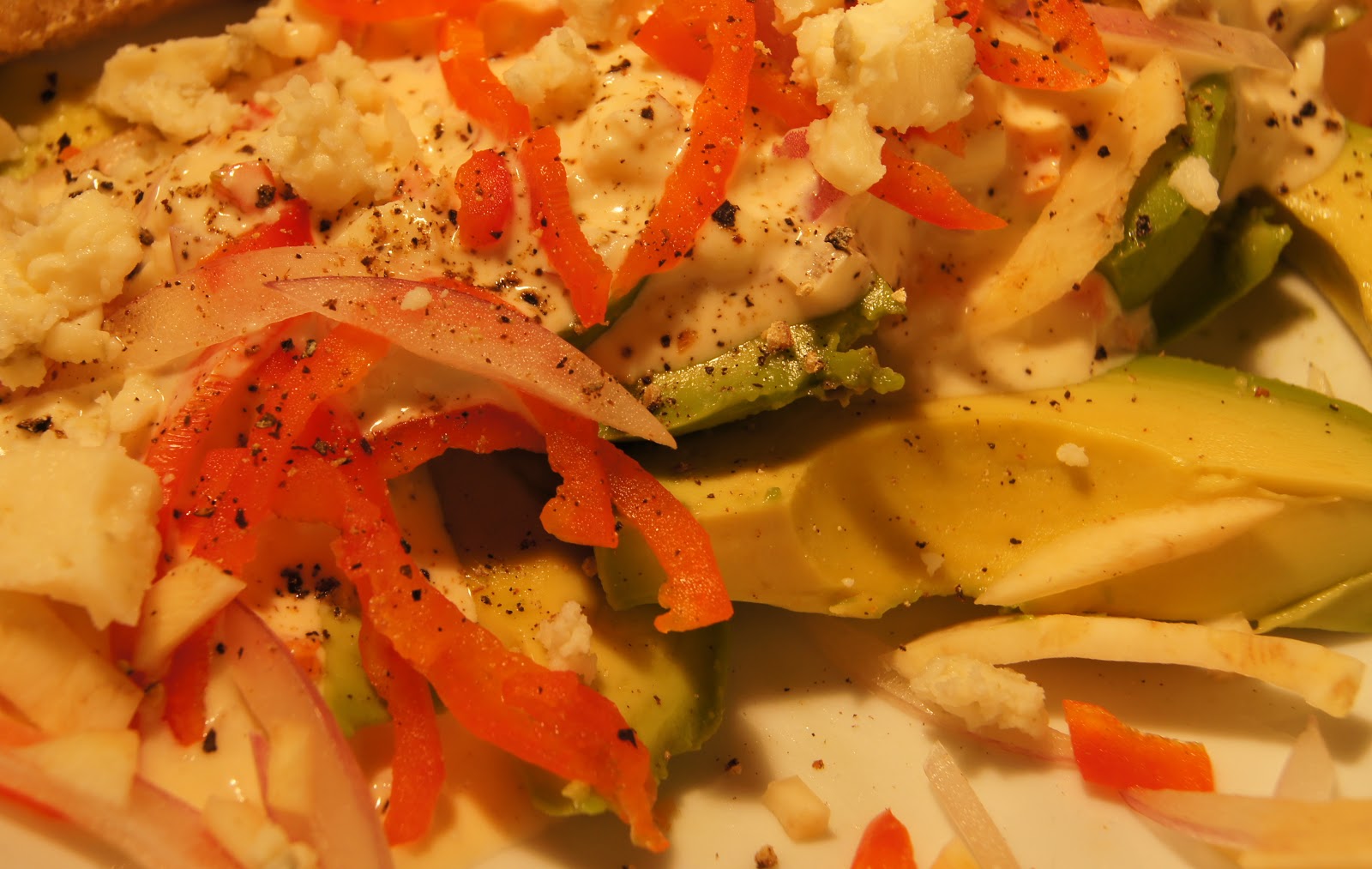
My point here, I guess, is that even as I become more impressed, year by year, with the ever growing breadth, depth, and quality of our local food sources, I don’t agonize over trying to make x-percent of my diet local, and I don’t apologize if a drop of Coke passes my lips from time to time, or a lobster from a distant sea finds its way into my pot.  I think it’s fair to say that my kitchen is locally based, and globally garnished, as this salad supper of avocado with blue cheese dressing illustrates. The proportions might seem reversed here, but there are more local ingredients in this than imported.

Avocado, mayonnaise, and blue cheese has been one of my favorite combinations since way back in my vegetarian days.  It’s sort of a study in close textural contrasts with wonderfully diverse flavors.  For the dressing I combined these local ingredients:

Wisconsin Black River blue cheese (1/2 cup crumbled?)
Minnesota Cedar Summit cream (2 tablespoons?)
Minnesota Smude sunflower oil (1 tablespoon?)
Wisconsin Menomonie Farmers Market red bell pepper and red onion and Wisconsin celery root from the co-op (about a tablespoon each minced for the dressing, more thinly sliced for garnish)
Menomonie market garlic, a medium clove minced

And these imports:

Hellmann’s mayo (couple tablespoons)
Sambal oelek (about a teaspoon)
Squeeze of lemon juice (I sometimes wind up with naked lemons after the rind has been stripped off bit by bit to garnish martinis….)
A few grinds black pepper

Mix well and adjust seasoning with sambal, lemon, pepper, and thickness with cream and oil—it should just flow. Unless you’re an absolute salt fiend, added salt is not necessary.

Spoon over sliced avocado—or over poached or sautéed shrimp; a nice grilled steak; any kind of salad; a sliced pear or apple; a hearty pasta like penne or rigatoni.

Serve with toast (from bread made with my nearly 10-year old house leaven, MN and ND flours) spread with Minnesota Hope Creamery butter.  Or serve on toast.  Not a bad breakfast using morning-after dressing.


Eat locally, think globally; shop thoughtfully, cook vibrantly, and have fun.

Monday, October 22, 2012

Quel Fromage! (Warm Rush Creek Reserve with Coal-Roasted Vegetables)


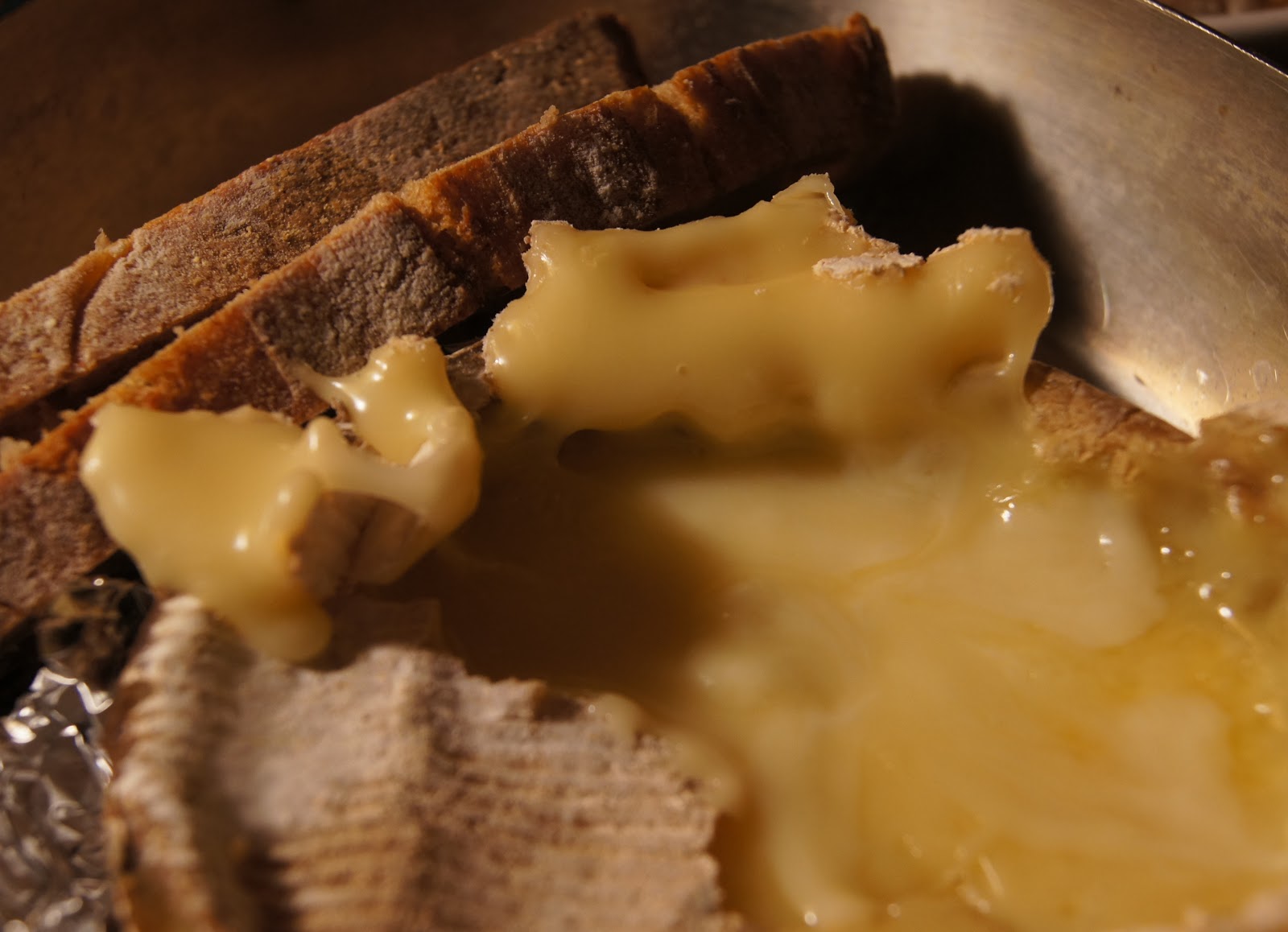
This is one from the "90 percent of good cooking is good shopping" file.  Serving a warm Rush Creek Reserve, the soft, young, raw milk cheese from  Uplands Cheese Company in Dodgeville, Wisconsin, with roasted vegetables wasn't even my original idea--I got it from the Big Cheese himself, Uplands's head cheesemaker Andy Hatch.  I was fortunate to be invited on the Cheese, Spirits, and Brews Tour sponsored by the Wisconsin Milk Marketing Board  last week, and while I wasn't able to join the group for the first couple days of the four-day tour, I lucked out in being able to visit two of my favorite Wisconsin cheesemakers, Uplands and Crave Brothers,  near the town of Waterloo, last Thursday and Friday.  It was a really inspiring--and delicious--couple of days, about which I will have more to say in the near future.  For now, let us simply delight in the wonder that is gooey cheese:


Really my only contribution to this utterly satisfying repast--other than being able to recognize a great idea when I hear it--was to build a fire and roast the vegetables in the coals, giving them some very appealingly rustic char and complex flavors of smoke and caramelization.


The cheese was the star (even if it didn't stand alone...), molten when we started to eat, cooling through a spectrum of flavors and textures as it gradually congealed--and even at the end we were scraping bits off the bottom of the dish.  The roasted vegetables and good bread were the perfect companions--the turnips were especially good, sweet, soft, and just a little bit pungent.  The beets were also lovely.  Cornichons were too tart for this sweet-tempered cheese, although it carries a bit of its own tang.  Apple was also out of place here; I think slices of pear might have gone well.


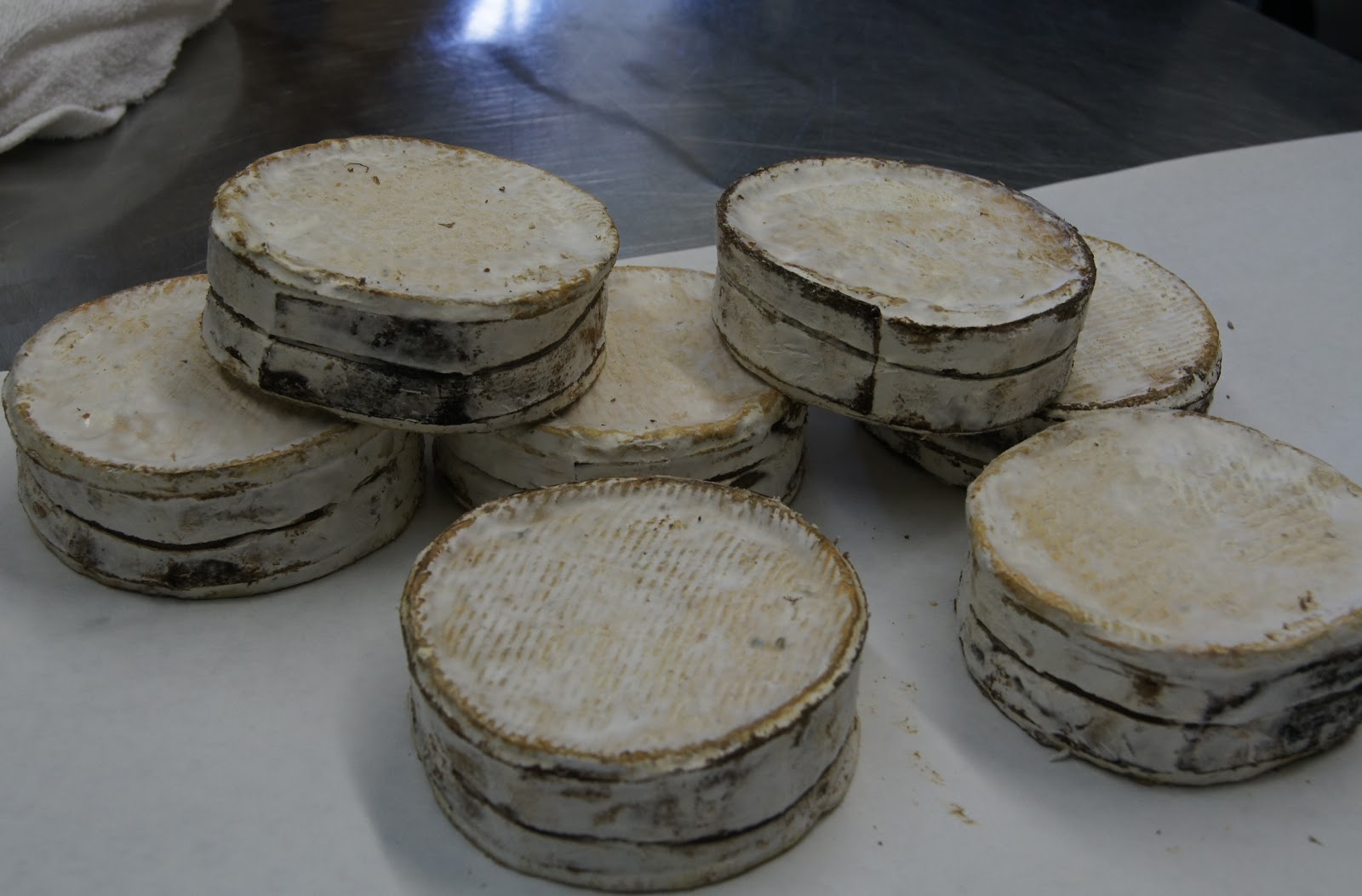
Produced from raw milk in late summer, Rush Creek Reserve is a seasonal cheese.  Aged for just under the legally required 60 days before being shipped, this washed-rind cheese continues to ripen in the store or in your fridge, and Andy Hatch said it's at its best for the next 30 days.  The interior becomes softer in that time, the aroma stronger--but I've had a Rush Creek Reserve aged past 90 days, and it never became as assertive as something like a Muenster or Epoisses.  The cheese we ate was fresh out of the gate, released on October 17.  I'll be looking to pick up another one in the next couple of weeks to see how it develops over a month's time.


To cook the vegetables--leek, potato, carrot, little onions, squash, beet, and turnip--we just wrapped them in foil and nestled them into the coals.  You don't have to wrap each vegetable individually--we did a couple small potatoes together, three small turnips lined up and foiled together, big beet cut in half and both halves wrapped in one sheet of foil, etc.  Turn every 10 minutes or so, and use your asbestos fingers to give the packets a squeeze for tenderness when you think they're getting done.  And do note that you want a nice bed of glowing coals, not a raging fire, which will burn the outside of the vegetables before the inside is cooked.  Of course you could simply do your vegetables in the oven, tossed with a bit of oil and roasted until nicely brown and tender.


To warm the cheese, we baked it, the bottom wrapped in foil to keep it from all melting away (a precaution which proved unnecessary), at 300 for about 20 minutes.  That gave us quite molten cheese to start with, and if this somewhat Cheez Whiz-like consistency offends any connoisseurs, I make no apologies.  The flavors of the cheese still came through, and the fragrance of roasty vegetables and richly flavorful cheese produced a kind of aroma-therapy of a very delectable sort.

Rush Creek Reserve at the factory, ready to be wrapped; each cheese is bound with a strip of spruce.

I purchased this particular cheese at the Driftless Depot , a delightful market, deli, and café in Spring Green, just a few miles up the road from Uplands.  If you're visiting Wisconsin's enchanting driftless area, this is the place to fill your picnic basket.  (Am I sounding a little like the southern Wisconsin tourist board?  Well, chalk it up to the convert's zeal, and be assured that my enthusiasm is heartfelt and warranted.)


The Uplands website has  a map showing where to buy their cheeses, which seems not very complete or up-to-date, as it shows only three sources in the Twin Cities, and I know it's more widely available than that.  Check with your local cheese store or co-op.  Rush Creek and Pleasant Ridge Reserve are also available on-line direct from Uplands.


Text and photos copyright 2012 by Brett Laidlaw

Thursday, October 11, 2012

Ma Poutine


When they write the history of popular food in the Twenny-Tens (if there’s anyone with enough arterial fortitude to survive it and write it), I imagine this moment, glistening with bacon fat and given gravitas by the six-pound cheeseburger, will likely go down—way, way, down—as The Age of Wretched Excess, and looking back through the haze of time and spattered fry grease, future food historians will recognize the imposing figure of Monsieur Poutine as one of our era’s most august ambassadors.

This French-Canadien concoction of french fries topped with gravy and smothered in cheese curds has somehow escaped the ghetto of post-hockey game Québécois bar food to become a poster child for the too-much-is-never-enough philosophy (if you will) of our food truck-obsessed culture (if you stacked up all the pulled pork sandwiches topped with runny mayo-slicked cole slaw served in America’s food trucks in a day, I imagine they’d reach to the moon and back a couple of times, though they probably wouldn’t stack very well, on account of all the grease…).  Martin Picard, of the fat-flecked Montreal abattoir-cum-gastro-temple Au Pied de Cochon, is likely responsible for bringing poutine into the foodie world, with his beyond decadent foie gras-topped version.


Not that there’s anything wrong with that.  As my friend Tom said recently after a home-based poutine foray went deliciously awry:  Poutine, always a good idea, always a bad idea.  Thing is, for me, poutine had always been just an idea.  Prior to constructing my own version as a Bide-A-While bachelor dinner the other night, I had never tasted the stuff.  Imagine that.  The idea just never held that much appeal to me—all I could imagine of the typical version was starchy, previously frozen french fries, poorly cooked, topped with indifferent gravy and obliterated by too-salty cheese.  Now, I’m a guy who grows sweaty-palmed and anxious when I pull my last piece of home-smoked bacon from the freezer, who always has a little pot of pork fat beside the stove—you know, for emergencies—but that image was too much even for me. 

Well, I guess it wasn’t so much the grease factor that put me off, but rather the uninspired monolithicness (just made that word up) of it.  After two bites, what would there be to taste?  Still, perhaps because of my Canadian heritage, or because I used to spend a night or two in bars after hockey games, the idea of poutine has always intrigued me, and I’ve cooked many a mental dish of it in the past few years.  This week, I finally put it on the plate.


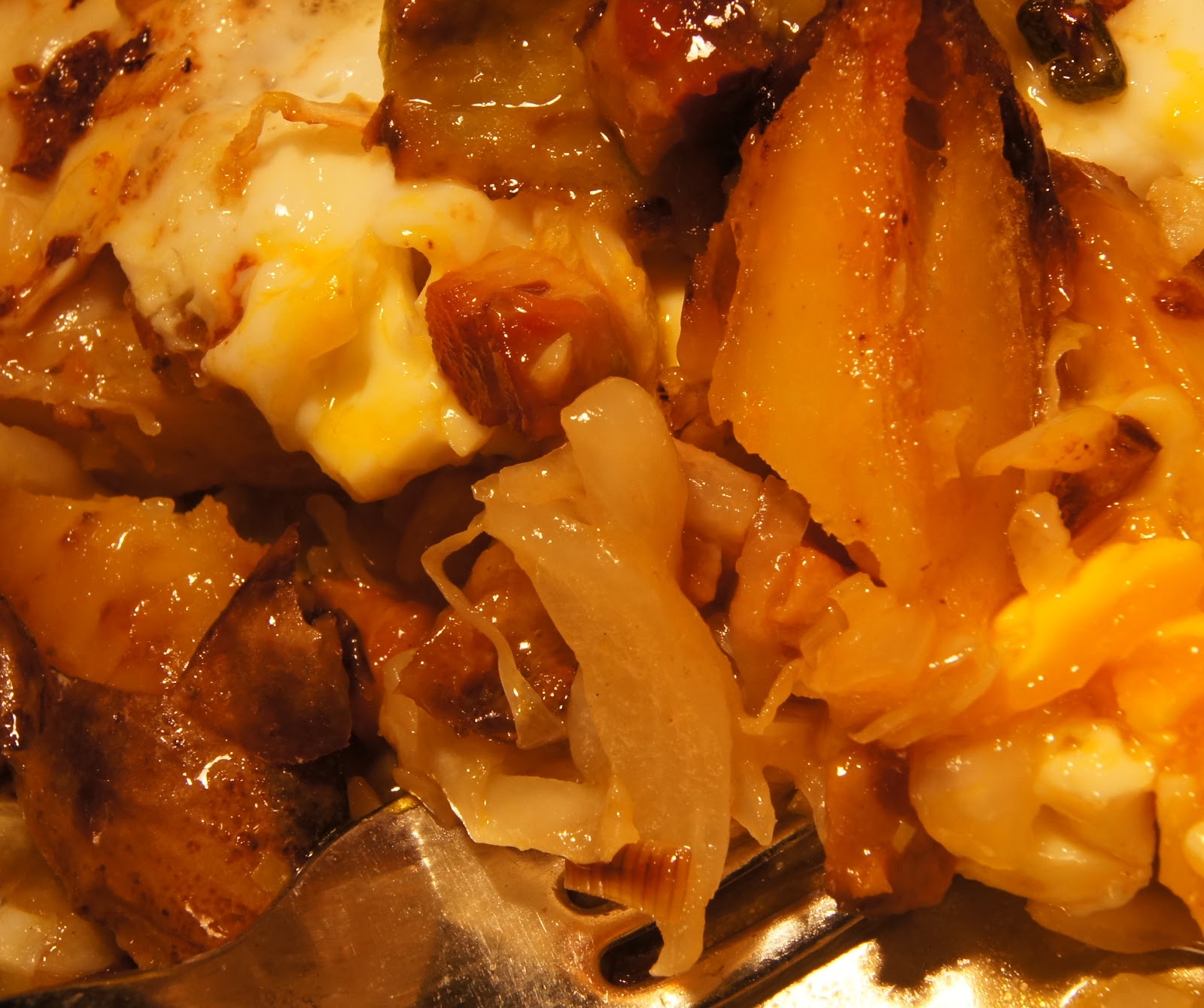
I’m sure some chapters of the Confrèrie de Poutine would run me out of town on a rail for it, but I wanted vegetables.  Specifically, I wanted highly flavored vegetables, both tart and savory.  So homemade sauerkraut, rinsed and squeezed, formed a crisp and tangy bed for my poutine.  Celery root, one of the most umami-packed forms of produce, has been part of every poutine I’ve imagined, so a fine dice of that went into my gravy.

The base of my gravy:  bacon.  Duh.  And the potatoes were not deep-fried shoestrings, but rather wedges of wonderful, coal-roasted homegrown fingerlings browned well in that bacon fat.  This is sounding pretty good, isn’t it?  Adding more depth to the gravy were leek, garlic, and sambal.


To add a little wholesome heft—this was my dinner, after all—I fried an egg in the remaining bacon fat, and along with it I cooked a couple slices of under-ripe Green Zebra tomatoes, along with some thinly sliced jalapeno and shallots—nothing monolithic about the flavors of this dish.

La cuisine minceur?  Mais mon.  But neither was this a regrettable gut-bomb, and I cleaned my plate—well, gratin dish—happily.  I’ll make this again, but not for a while.  Some winter night when a wolfish wind howls down the valley and the stars overhead are so insanely clear and profligate in their splendor that it stirs something deep in my Canadian soul, I’ll look around the kitchen to see what we have, and remembering Tom’s dictum I’ll think, Poutine, that sounds like a good idea….


Ma Poutine


Serves one:

1 ½ ounces excellent slab bacon cut in 1/3-inch dice
3 tablespoons chopped white of leek
2 tablespoons finely diced celery root
2 cloves garlic, crushed and coarsely chopped
1 ½ teaspoons sambal
2 teaspoons flour
2/3 cup chicken stock (or another type of stock—mine was actually chicken-duck stock)

2 medium fingerling potatoes, pre-roasted, quartered the long way

1 ½ ounces white cheese curds sliced

A bit of butter
1 egg
2 slices green tomatoes
Thinly sliced jalapenos and shallots, optional

2/3 to ¾ cup excellent sauerkraut, rinsed in a couple changes of water, squeezed to remove excess liquid

Salt and pepper

Heat oven to 425.

In a medium skillet slowly cook the bacon until it is lightly browned and has rendered most of its fat. Remove and reserve the bacon. Pour off and reserve half the fat.  Brown the potatoes evenly in the fat that remains in the pan.  Spread the sauerkraut in the bottom of a gratin dish and place the potatoes on top of it.

Return the bacon to the skillet along with the reserved fat.  Add the leek and celery root and cook over medium until the leek is wilted.  Add the garlic and sambal and cook for a minute or two.  Sprinkle the flour into the skillet and stir and scrape with a wooden spatula for about a minute.  Add the stock a little at a time, stirring and scraping to deglaze the pan and dissolve the flour.  Add salt and pepper to taste.

Sprinkle half the cheese curds over the potatoes and kraut.  Top with gravy.  Wash the skillet and heat it with a bit of butter.   Fry the egg sunny-side-up, along with the tomatoes, jalapeno, and shallot.  Place the egg and tomatoes on top of the gratin, and sprinkle on the other half of the curds.  Place in the preheated oven until the cheese is melted.  Remove, top with the jalapeno, shallot and any fat remaining in the pan.  Open a beer, eh?  Dig in.

Tuesday, October 9, 2012

"One Can Dine Very Well on Potatoes"


You travel to France to see the Eiffel Tower and the Arc de Triomphe, to sip an espresso at a sidewalk café and munch on tangy saucisson sec while you quaff a glass of Beaujolais in view of the vineyard from which it sprung.  You travel for the expected sights and pleasures, but of course it's the unexpected encounters that make a trip truly memorable.

I think of our visit to a tourist office in the town of Villefranche, in Beaujolais.  We came in speaking French, Mary in the lead--or perhaps I went first, to make Mary look good by comparison.  The petite, dark-haired woman working there listened to our request for info on restaurants and wineries in the area, and scurried about the office amassing a pile of brochures and pamphlets.  She and Mary chatted while the woman reached into cabinets and leafed through stacks of materials.  The woman seemed distracted, and was becoming more animated, even agitated, all the time.

When finally it appeared that she might burst with excitement, she overcame that deep-seated Gallic reserve which makes it nearly impossible to ask a direct question of a stranger, and dared to ask us where we were from.  We said we were American.  Not French at all?  Not a bit.  Alors.  What had the woman flustered was that she couldn't place Mary's form of French; her accent was so good, she thought she must be French, but....  The implication was that her grammar didn't quite match the accent.  What she finally concluded, she told us, was that Mary must have been a French woman who had moved to America, and forgotten how to speak French! It was probably the most endearingly backhanded compliment the woman could have offered.  And after that dish of quenelles de brochet has faded in memory, and the Delacroix and David and Géricault we admired in the Louvre start to blur together, that's the sort of landmark of a trip that stays with you for years and years.


The title of today's post comes from another such encounter, during our first trip to France in 2001.  We went in early October, less than a month after the September 11 attacks, and shortly after the U.S. invaded Afghanistan.  This was in that honeymoon phase when much of the world drew together in sympathy with America over the shock and horror of those events.  I can't recall how many French people spontaneously mentioned the 9-11 attacks, and expressed their condolences, and incidentally thanked us, retrospectively, for America's role in saving France during World War II.  The French have a longer historical memory than we have (who doesn't?), and it was remarkable to be the recipients of this kind of outpouring of emotion, simply because we were American.

Well, the Frenchman who inspired today's post wasn't quite so sentimental.  We met him about a week into our trip, which started in Brittany and took us down the Atlantic coast to the mouth of the Loire, then up that splendid river into the Touraine, the area around the city of Tours.  We wound up staying a few days near Chaumont sur Loire, home to a lesser chateau, which at any rate we were only able to view from behind the locked gates, à cause de la grève--"because of the strike," the public workers' rolling strike over...I don't recall what. A cause de la grève we couldn't visit the chateaux, à cause de la grève we couldn't get into the Rodin museum. etc.  It became the tagline to our trip, not that we were much put out.


But with the chateau in Chaumont closed, we were looking for amusement, so we went to the tourist office in town--which also served as baguette depot on days when the boulangerie was closed.  There we met M. Guérand, in his early 30s I'd guess, longish dirty blonde hair and a three-day beard, cowl-neck sweater--so very French looking.  If he didn't have a Gauloise perched on his lower lip at all times, he should have.  Typical he was, in appearance at least, but not your typical tourist office worker in almost every other respect.  He wasn't from the area and didn't really know it very well.  He was from Paris, a graphic designer, unemployed, and they'd shipped him out here to the boondocks to fill a vacancy at the tourism office.  Waving at the rack of brochures was about as helpful as he could be in helping us find lodging for the night.  And as for sights worth seeing, well, in his view, one thing was as good as another. Merci, bien.


But we got to talking, about...just about everything.  He was pretty bored, so little tourist traffic in the area, since it was the off season, and à cause de la grève.  And probably Mary and I were just a wee bit sick of each other's exclusive company after many days on the road.  We spoke mostly in French, as his English was poor, and we covered 9-11 and its immediate aftermath, the Afghanistan invasion, the American media and its lack of intellectual depth (when we got home I sent him a package of the "better" U.S. current affairs magazines, to show him there was some intelligent life in America, and never got a reply).  It got philosophical at some point, as we pondered together why so many people spent their lives chasing after money, and never stopping to realize that money is just a medium, not an end in itself, and if you thought it was an end in itself, you could never have enough to be satisfied.  Deep stuff.  He also confided to us that he really could see no point to existence itself.  Shrug.  Fire up a Gauloise....

Eventually we came back around to our immediate needs:  a place to sleep that night, somewhere to eat.  By sheer luck we pulled a brochure that led us to a very odd but perfectly wonderful auberge, Chateau de la Haute Borde.  As for dinner, well, there were some restaurants in town, but this was Monday, and most were closed.  Furthermore, he wasn't really supposed to recommend specific restaurants, and anyway, he didn't eat out much.  He didn't care about food, himself, and seemed slightly exasperated with his countrymen and -women for their obsession with this trivial chore, feeding oneself.  To top it off, here in the land of charcuterie, in a sea of rillettes and rillons and foie gras, he was a vegetarian.  It was a healthier and more humane sort of existence.

Pause.

"I find that one can dine very well on potatoes."


He must have said it in French, but I have no idea how to construct that sentence.  We understood, we nodded.  We thanked him and said how much we had enjoyed our conversation, and made our way out into a gorgeous October afternoon in the storied Val de la Loire.  After checking in to La Haute Borde and confirming that their restaurant was closed, we drove into the city of Amboise and enjoyed a splendid dinner at a restaurant called La Comédie, where local young people came for pizza, and we ate sausage, duck, rabbit, as well as gratin dauphinoise--so yes, we dined very well on potatoes, among other regional delights.

Another thing you learn from travel, a cliché perhaps, but not a dreary one, is that sometimes it's the destination that delights, but often it's more about the journey.  An old verity appropriate to this shaggy dog story (histoire drôle sans queue ni tête!) about a dinner inspired by pommes de terre, though not composed exclusively of them.


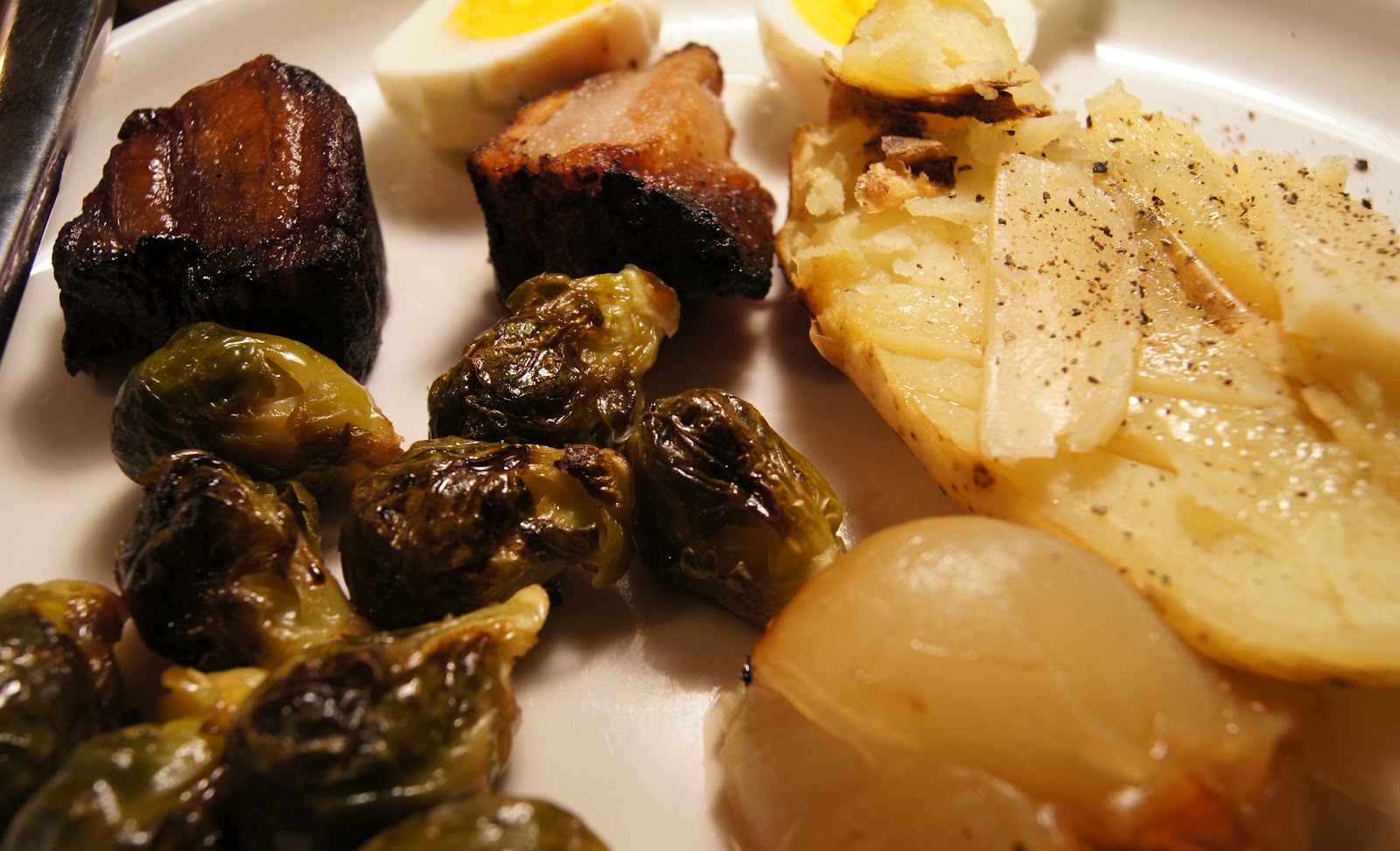
I dug our potato bed this week, and I knew we must dine on them.  I plucked the first brussels sprouts from the garden, too.  Those things, along with some beautiful cippolini-type onions from the market we wrapped up in foil--a little salt and oil in the sprouts and potatoes--and into the coals of a fading fire they went.

Foraging in the fridge I found a piece of pork belly that I had brined as for bacon, but roasted in the oven instead of smoking.  To add variety to the plate, and for the hell of it, I put a couple of eggs in the coals for ten minutes at the very end.  I've never done eggs this way before, and they came out beautifully--yolk sunny yellow and set, white silky, not a hint of sulfurishness about them.


Then cheese, since we are in Dairyland--Marieke gouda both aged and smoked, Roth-Kase gruyère-style.  Hope butter, a sort of creme fraiche ersatz made by combining Cedar Summit cream and goat yogurt, some minced shallot added to that.  Pickles, since this was a sort of faux raclette meal.


This is how we dine on potatoes around here, and we dined very well, indeed.  Happy travels to all.


Text and photos copyright 2012 by Brett Laidlaw