Showing posts with label salads. Show all posts

Saturday, May 2, 2015

Celery Root Buttermilk Rampoulade


Seasonal eating in the North Country in spring often involves a collaboration between the root cellar and the first wild greens.  So it was with this version of celery root remoulade spiked with pungent chopped ramps.


Nothing fancy, a simple roster of ingredients.  While my standard celeri remoulade uses sour cream, the buttermilk employed in this version brings a tangy lightness--and combined with the onion-garlic-chive flavors of the ramps, it creates a sort of ranch dressing feel, but subtle, even elegant.


Celery root requires a lot of cleaning up to be presentable.


Using the medium-fine side of a Microplane box grater produces delicate celery root snow--neige de celeri, bien sur!


Chop the ramps fine, including a little bit of the green.


Mix it all up.  A squeeze of lemon juice perks it up and brings all the flavors together.  It's good when made at least a few hours ahead, so the flavors blend.


Celeri buttermilk rampoulade

serves 2 to 3 

4 ounces trimmed celery root
2 good pinches salt
6 tablespoons buttermilk
1 tablespoon mayonnaise
A squeeze of lemon juice
3 ramps, white, red and a bit of the green, finely chopped

Grate the celery root fairly small--the medium-fine side of a Microplane box grater is ideal.  Add all the other ingredients and mix well.  Taste for salt.  Allow to sit in the fridge for a few hours before serving; it can be made a day ahead, too.

This salad is our standby with steak tartare, of late.  It also accompanies smoked fish nicely, and would go well with anything off the grill.


Friday, March 20, 2015

Greeting Spring Greenly


It seems every bit appropriate to write about first fresh, green harvest of the year, watercress, on the first day of spring.  I generally gather the year's first cress from a lovely Dunn County spring that seeps from a modest limestone outcropping and slides a dozen long paces before it freshens a sweet little stream; the stream has a name, but I’ve forgotten it.  It’s one of those myriad trout streams, as designated by the State of Wisconsin DNR, which, when you look at the published map showing all such waters, could fool you into thinking that our neighborhood would be a trout fisher’s paradise.  Northern Dunn and southern Barron Counties are as thickly veined with trout streams—color-coded blue, red, yellow, and green—as a diagram of the circulatory system.  But few are worth the trouble to explore; shallow, sandy, alder-choked or simply so tiny that a flycaster would need a marksman’s precision just to land a fly on the water.  But I digress.  It happens.  Have you been here before?


The stream whose name I know not is nonetheless a pretty stream with lots of character, riffle water, bends, promising pools for local kids to either drop a worm into or wade and splash in on a hot summer day.  As winter departs the spring, perhaps 10 feet wide, becomes carpeted with glistening cress, variegated light and darker green, with intimations of reddish veining and browned patches, scars from the last hard freezes.  I mentioned picking cress, but really I snip it—if I’ve had the forethought to bring a pair of scissors.  By snipping the upper leaves I disturb the roots as little as possible, making it a sustainable harvest.  If I don’t have scissors I use my pocket knife to trim the top rosettes.  Half a plastic grocery sack provides plenty of cress to work with for a few meals.


First and best is simply to eat it raw, and lightly dressed (if you’re eating raw cress be sure it comes from a spring or headwaters that hasn’t run through grazing land, particularly where sheep abide).  A straight-up watercress salad is often extremely assertive, but in early spring its peppery pungency is usually tolerable—and a welcome wake-up call to taste buds somewhat dulled by root cellar dining.

Watercress can be used as an herb.  In my cookbook I use it in a pesto with ramps, and to give green relief to celeri remoulade.  The first thing I did with this year’s first snipping was to make a watercress mayonnaise.  Though I almost always make mayo the old-fashioned way, with a bowl and a whisk, I used an immersion blender for this one, for three reasons:

1)      Laziness
2)      So as to really puree the cress into the mayo, and
3)      The immersion blender is a fairly new toy that I haven’t done much with


We smeared the mayo on bread to make bacon sandwiches, and also kept the extra on hand to dunk oven fries from garden potatoes.  In the manner of the old lady who swallowed a fly, the story of this simple, but rather labor-intensive meal, was this: 

I snipped the cress 
to make a mayo
to dress the fresh bread
that made a bed
for the bacon I smoked
from belly that bathed
in maple I tapped
from our own trees
a year ago, or so.

So, how are we doing with the old “eat local challenge” concept that well-meaning folks trot out to promote local produce, usually in September, when eating locally is at its least challenging?  Well, the bread was homemade and leavened with our now 12-year-old sourdough starter and all MN and ND flours; the bacon from MN-based Pastures A’Plenty pork belly cured in our own maple syrup and foreign salt; the mayo contained that Dunn County cress, Ridgeland eggs (Chicken Creek Ranch on county AA), Smude MN cold-pressed sunflower oil, and foreign salt and lemon juice; oven fries from our garden potatoes cooked in duck fat we rendered and more of the Smude oil; carrot slaw with local grower Kate Stout’s wonderful carrots, some of our garden shallots, Smude oil, our cider vinegar.


I would say we’ve met the challenge.  I go through this list not to gloat about how localler-than-thou our diet is, but to illustrate the fact that local eating year-round is eminently doable, even here in the frozen north.  You just keep a very local pantry, is all, and seek out your local producers.  It’s not that hard.  They’re not hiding, and actually want to be found, so they can sell you stuff!  Co-ops of course are a great place to start in shopping local, and there are many farmers markets that keep going through the winter, as well.

None of this is anything new.  I myself have made the point about a thousand times in various ways.  But as I reboot Trout Caviar I’m embracing the perennial, roundabout, here-we-go-again nature of, well, nature, and seasonal eating, which expresses nature in a very intimate and, I hope, delicious way.

The nose knows....

If you want to make watercress mayonnaise you could take as simple an approach as obtaining some watercress, mincing it well, and mixing it into prepared mayonnaise.  I am not opposed to storebought mayo, in fact am on record as a Hellmann’s devotee for many uses (including eating it right off the spoon).  But I think Hellmann’s has too strong a flavor profile, and would drown out the cress which, while very assertive when eaten straight, can get lost in a rich base like mayo.  So a homemade mayo with a milder oil (sunflower, canola; probably not EVOO, or with only a little of it) is the best way to appreciate the tonic bite of springtime cress.  For this particular one, made with the immersion blender, I more or less followed the method I found on this blog.. 

But I found that:

1)      I had to add a fair amount of oil right at the beginning, just to get the blending started;
2)      In the end, with 2 yolks to a cup of oil, it made a much stiffer mayo than I like; I’d try it next time with a whole egg and a yolk, or maybe just the whole egg.  At any rate, it made a mayo that is NOT going to break.  EVER.

Happy spring.


Text and photographs copyright 2015 by Brett Laidlaw

Wednesday, July 10, 2013

A Midsummer Night's Smørrebrød


You don’t have to be Danish to appreciate smørrebrød, those open-face sandwiches—knife and fork sandwiches—composed upon dense, buttered rye bread, usually containing appropriately Nordic ingredients like pickled herring, beets, and pork paté. If you like bread, and noshy food in that tapas mode, you’ll like smørrebrød. As a summer evening meal it has the additional virtue that most of the toppings can be prepared ahead—or are themselves commercially prepared foods of the very best sort, like cheese, smoked fish, cured meats, etc. Finally, because finishing preparation is so simple, these mini-canvases beg to be decorated to the full extent of your garnishing imagination.


Bready. Noshy. Easy. Pretty. What, I ask, is not to like in that combination?


It’s usually this time of year, when we’ve just slipped past the solstice, and the gardens are really starting to produce, the market stalls are burgeoning as the plants make the most of that vital sunshine, that my appetite turns to smørrebrød. It’s an elegantly rustic (or is it rustically elegant?) kind of meal to enjoy in those long twilights as the strong sun softens on descent, spreading welcome shadows, and the heat of the day begins to mellow.


That pretty well describes the evening last weekend when we prepared a smørrebrød repast at the house and packed it in a cooler for a picnic on the hill. It was a bit warm and muggy in the valley, but we caught a nice breeze as we headed up the hill. I’d been cleaning up a little impromptu sort of dump at the edge of the woods this spring, hauling down old car batteries, car seats, beer cans and bottles, what have you. Then I ran the lawn tractor up there to mow a small picnic area. Among the detritus I’d found a piece of sheet metal and some cinder blocks, and these we turned to better purpose as a makeshift picnic table (pleasantly, though very rustically, reminiscent of a Parisian zinc bar). It was, I dare say, one of the best picnics ever.


We settled in very comfortably (so did the dogs, eventually) to enjoy the view of the green, green hills, mist-shrouded in the distance. The aspen leaves overhead kept up a  calming kerfuffle. There was even a floor show, of sorts, as the neighbor who rents our hayfield came to bale up the last few rows of the oats and grass they cut last week. Urban al fresco dining has its pleasures, but when was the last time you saw a John Deere tractor and baler on the Nicollet Mall?


As we ate our smørrebrød and sipped our pinot gris and watched the sun pass out of sight behind the western hills—though it would still be light for a couple of hours—I had a thought about terroir—you know, that idea that foods and wines can taste distinctly of the place they came from, express some quality of the soils in which they grow, the waters that sustain them, and the human cultures that have nurtured them through time. My idea had something to do with how a cuisine is shaped by the sense of the seasons experienced by the people who create it. And how, for us specifically and for northern peoples in general, our long annual journey from the abyss of winter’s frigid darkness to midsummer’s almost too abundant light and warmth, and back again, how this must have as great an impact on the savor of our food as the molds in the caves of Roquefort, or the chalky soils of Sancerre.


It profoundly affects what we eat, how we eat it, what we want to eat, and how we experience it in the context of the year. A midsummer picnic at 45 degrees north latitude must taste different from the same meal consumed in Florida or southern California; in those places, their own seasonal context would shape their experience of what they eat.  For me, high summer dining has meant that I’ve hardly wanted to look at a piece of red meat—give me vegetables, salads, simply prepared fish, cheese and bread. Oh, and maybe a glass of wine.


I made a small rye loaf that included a little birch syrup. You want a pretty dense bread, with a close crumb--not something like a baguette that's full of holes.  Then top to your heart's desire.  I don't let myself be constrained by any rules, but rather see the smørrebrød concept as the base for using the best of the local and seasonal.  One of my favorite, oft-repeated mantras--Ninety percent of good cooking is good shopping--is on full display here.  That is not to say, of course, that you should hie thee to a high-end supermarket, but rather that best ingredients make for best results.


The Superior shore was well represented in fresh herring from Cornucopia, smoked whitefish from Port Wing, cheese from Bayfield.  The Menomonie farmers market gave us snap peas, onions, beets, turnips, potatoes, and asparagus, and our garden contributed, too, with radishes, chives, and mustard greens.  There was a bit of home-smoked bacon in the potato and asparagus salad, and the yogurt cheese was home-cultured using wonderful fresh milk from just down the road.  Oh, and the mayo, also homemade, using eggs from our neighbor Tina's chickens, and Minnesota sunflower oil Smude.

On Wisconin! was surely the theme of this meal, especially as the sandwiches were literally presented on Wisconsin.  A more thorough description of the various toppin's below.


Smoked whitefish salad combined about four ounces of flaked smoked whitefish with roughly three tablespoons of peas—we shelled some sugar snaps—two ounces of Wisconsin hickory nuts, chopped and lightly toasted in a dry skillet. (The nuts were a generous gift from my buddy Lucas “The Beard” Madsen; hickory trees grow in his part of southeastern Wisconsin, though they’re scarce here. Other local, wild alternatives would be black walnuts or hazelnuts; a good storebought option would be pecans.) To the fish, peas, and nuts I added some sliced red onion and about three tablespoons of mayonnaise—homemade in this case, and for a dinner like this I think it’s really worth the effort. Garnish with a little more red onion and thin slices of sugar snaps.


I was inordinately pleased with my checkboard composition of roasted baby beets and turnips. The base was fresh yogurt cheese (with just a dollop of chevre added in for body, and flavor) mixed with chopped chives and lots of coarsely ground pepper. Lay down a good bed of the cheese mixture, and decorate to your heart’s content. You can leave the vegetables round and create a fish-scale effect. I really liked the geometrical drama of the squares—just cut straight down around the sides of each little beet or turnip, and then slicing across produces squares.


Asparagus and potato salad was originally going to be oyster mushroom and potato sauté, but the little critters had honeycombed my ‘shrooms, so it was Plan B, which was just delightful. The potatoes were preroasted (along with the beets and turnips). Wash and slice the asparagus bite-size.  Dice up some good bacon fairly coarse, begin to render, then add the asparagus. Then add a couple of generous pinches of caraway seeds, about half as much cumin seed, and…mustard seed! About a teaspoon. Add the cut-up potatoes to warm and brown just a bit, and absorb the other flavors. This I served atop a generous spread of that homemade mayo.


Brie and radishes. A study in simplicity and the wonder of felicitous combinations. This one was just delicious. The cheese was one you probably haven’t heard of, but of which I predict you’ll be hearing quite a bit in the near future. It was Happy Hollow Creamery's “Snowy Spring Brie,” which we picked up at Ehler’s store in Cornucopia on the shore recently. Happy Hollow lists a Bayfield, WI address. This cheese, beautifully ripened, was exquisitely flavorful. Not even terribly expensive. If you happen to come across it, just buy it. Their Lazy Daisy raw milk cheddar is also excellent. As I say, I predict you’ll be hearing more about these cheeses and this creamery. For the sandwich: butter, cheese, radish, pepper, boom.


Last but surely not least, grilled Superior herring atop mustardy mustard greens. I’ve said plenty about this superb fish, which never disappoints—we usually get it hours after it’s been caught, so that’s a good start. I’ll have more to say in a future post about the greens preparation, which combines oil, mustard or other strongly flavored greens, more mustard—a good, strong Dijon style—a bit of honey, some vinegar, salt and pepper. This is going to be a standard greens preparation at our house right through the summer and fall. Butter, mustardy mustard greens, a piece of grilled fish, and a radish flower—yep, radish flower, you knew? They’re a bit sweet and a bit peppery at the same time.


Partly what inspired us to climb the hill for supper was a story we heard on  WPR's new show 45 North .  Last week Anne Strainchamps interviewed the British adventurer and writer Alastair Humphreys , who has bicycled around the world, run a marathon in the Sahara, and rowed the Atlantic, and now (maybe because he's tired...) is promoting the idea of "micro-adventures," mini-excursions in one's own backyard.  He's encouraging people just to get outside, and outside one's usual comfort zone--just grab a sleeping bag, a sandwich, and a bottle of wine, and go sleep on a hill, look at the stars, watch the sun come up.  I think it's just a brilliant idea whose simplicity is at the heart of its brilliance, and while we retired down the hill with the last fading light to all the comforts of home, we did feel as if we'd been away for a while, even if our adventure was, literally, in our own back yard.

And the food, if I need to say it, was good to the last pea.


Text and photos copyright 2013 by Brett Laidlaw

Friday, June 21, 2013

When the Market Gives You Radishes and Kohlrabi

 
You know it's been a sluggish growing season when, at the farmers market two days before the summer solstice, you greet the appearance of kohlrabi with...excitement isn't the right word.  Joy is too strong.  Glee? Nah.  It's, you know, kohlrabi.  How about interest?  That'll do.  It's something different, at least, adding a mild variety to the growers' tables which, since late May, have held monotonous tableaux of rhubarb, asparagus, spinach, lettuce, and spring onions.  Oh, and radishes, absolute rock stars compared to the other blah offerings.

Now, I'm not actually knocking any of those lovely spring delicacies.  The first salad of real fresh lettuce after the long white winter is an absolute delight, something to be celebrated.  It's just that, you know, it's supposed to be summer now, it's the freakin' solstice, is it too much to ask for some peas, a strawberry, even new potatoes?  The market in Menomonie has been a pretty sleepy spot so far this year, I'm afraid.

But, you make the best of what you have, don't you, and with the proper attitude and some good supporting players, that can be damn good.  What I love about this salad is that the title, "Radish and Kohlrabi Salad with Yogurt Chive Dressing," contains the entire list of ingredients, other than salt and pepper (and after I made this I wished I'd omitted the pepper; I only mention it because you can see it in the picture, so you might wonder, Hey why didn't he mention the pepper? if I hadn't).

The chives are a bit droopy this morning after last night's pummeling rain.


Chives!  I love chives.  They are usually the first thing to appear in the garden in spring, and they are an absolutely reliable perennial.  To my utter astonishment, our garlic chives failed to make it through last winter.  Our sorrel also perished, equally astounding.  But the chives soldiered through, as did what must be the world's hardiest tarragon plant--the true fragrant French tarragon, transplanted last year from our former house in Saint Paul.  It was in a container on the deck, too, making its survival all the more remarkable.

Anyway:  chives.  I love the flavor of chives, I love the blue of chive flowers.  The chives are usually up with the ramps, and when the ramps are all done, the chives are still going strong.  Chives are excellent in a tart dairy dressing based on buttermilk or sour cream.  In this case I used some wonderful yogurt that Mary cultured using fresh whole milk from our friend Renee's farm.

The sweet kohlrabi goes well with the bitey radishes.  The dressing, simple as it is, is both mellow and perky, and, of course, wicked chivey.  This salad would go well on a picnic or barbecue buffet.  You don't want a lot of it, but it's a lovely accent dish.  We had it as part of a noshy dinner that included superb charcuterie from the Underground Butcher in Madison (they do mail order, too, and their stuff is great), Marieke gouda (one of those cheeses which, as many times as I've eaten it, blows me away every time I try it), a green salad with market lettuce (our will be ready in a few days), and some simply boiled new potatoes (from Madison, again; they had strawberries down there last week, too, so it's on the way).  And of course some of our homemade sourdough bread.

Looking over the table I was so impressed with how various and delicious our local foods are, even if the market isn't booming yet.  And I was reminded of how simple is the answer to the question of how to keep a local diet: Well, just buy local stuff, that's all, or grow/make your own.  And as summer progresses, it will become easier and easier.


Radish and Kohlrabi Salad with Yogurt Chive Dressing

Serves two

6 radishes
1/2 a small kohlrabi
A fistful of chives (or a few chives more, for Sergio Leone), chopped
About 3 tablespoons excellent yogurt
Salt
Chive flowers for garnish

Slice the radishes into coins, not too thin, maybe six coins per radish.  Quarter the half a kohlrabi and then cut the pieces crosswise into wedges--you want the kohlrabi pieces roughly the same size as the radishes.  Combine the veggies in a bowl and toss with a couple good pinches of salt.  Add the yogurt and mix.  Stir in the chives.  Put it in a pretty bowl (mine from Theresa of Utile Mud, who appears to have moved from the Twin Cities to Everett, WA, I didn't know that).  Garnish with chive flowers.  We're done.

Happy Solstice to all.


Text and photos copyright 2013 by Brett Laidlaw
 

Thursday, November 15, 2012

There and Here (Avocado with Black River Blue Dressing)


In spite of my mother’s best efforts to cultivate an avocado forest in Eden Prairie, Minnesota, in the 1960s and '70s, impaling the smooth round pits on toothpicks and suspending them in water-filled juice glasses on the kitchen window sill, I still have yet to taste a Minnesota- or Wisconsin-grown avocado.  Amazingly, those gargantuan seeds did sprout roots, then sent up spindly leaders, which produced a few leaves, and then…who knows their fate?  Perhaps a few got potted, but I don’t recall alligator pears drooping from any of Mom’s houseplants. So, no, avocadoes can’t be counted among the delights of local and seasonal eating in the northland.

Which does not mean that I don’t eat them.  I do.  Lots of them.  They’re among those non-local foods that are regulars in our kitchen, but which I rarely mention here, preferring to focus on the local, but perhaps that gives a weirdly skewed version of our diet.  I would say that probably 90 per cent of our diet is locally sourced—all our meat and most of our fish, all our grains except for rice, pretty much all our vegetables and fruits.  Dairy?  It would be kind of absurd to look outside America’s Dairyland for milk, cream, butter, and cheese, wouldn’t it?  

Still, I would find myself pinched in the kitchen without imported rice, lemon, olive oil, black pepper and other spices.  Our condiment cupboard is not terribly local, with its soy sauce, sambal, rice wine, sesame oil, canola oil, Chinese vinegar—though things have improved there with the relatively recent appearance of local pumpkin seed and sunflower oils; and I am going to figure out how to make my own sambal, with homegrown chiles, next year.  I rarely take a sip of orange juice anymore, and I think I might have forgotten how to peel a banana, but my morning cup is tea from afar, and I enjoy a cup of coffee every once in a while.  

In the pantry I find ketchup made from homegrown tomatoes, honey from hives a few miles down the road, wild blackberry jam distilled from Bide-A-Wee berries, and our very own maple syrup; there is pasta from North Dakota, but also from Italy, China, Japan, and Vietnam.  We should be producing good tofu in our region, but I’m not aware that any is made here.  It’s a staple ingredient in our house, the basis for one of our most common one-dish meals, Sichuan mapo doufu.  I don’t know if I’ve ever mentioned that, nearly five years into writing Trout Caviar.  I should have.


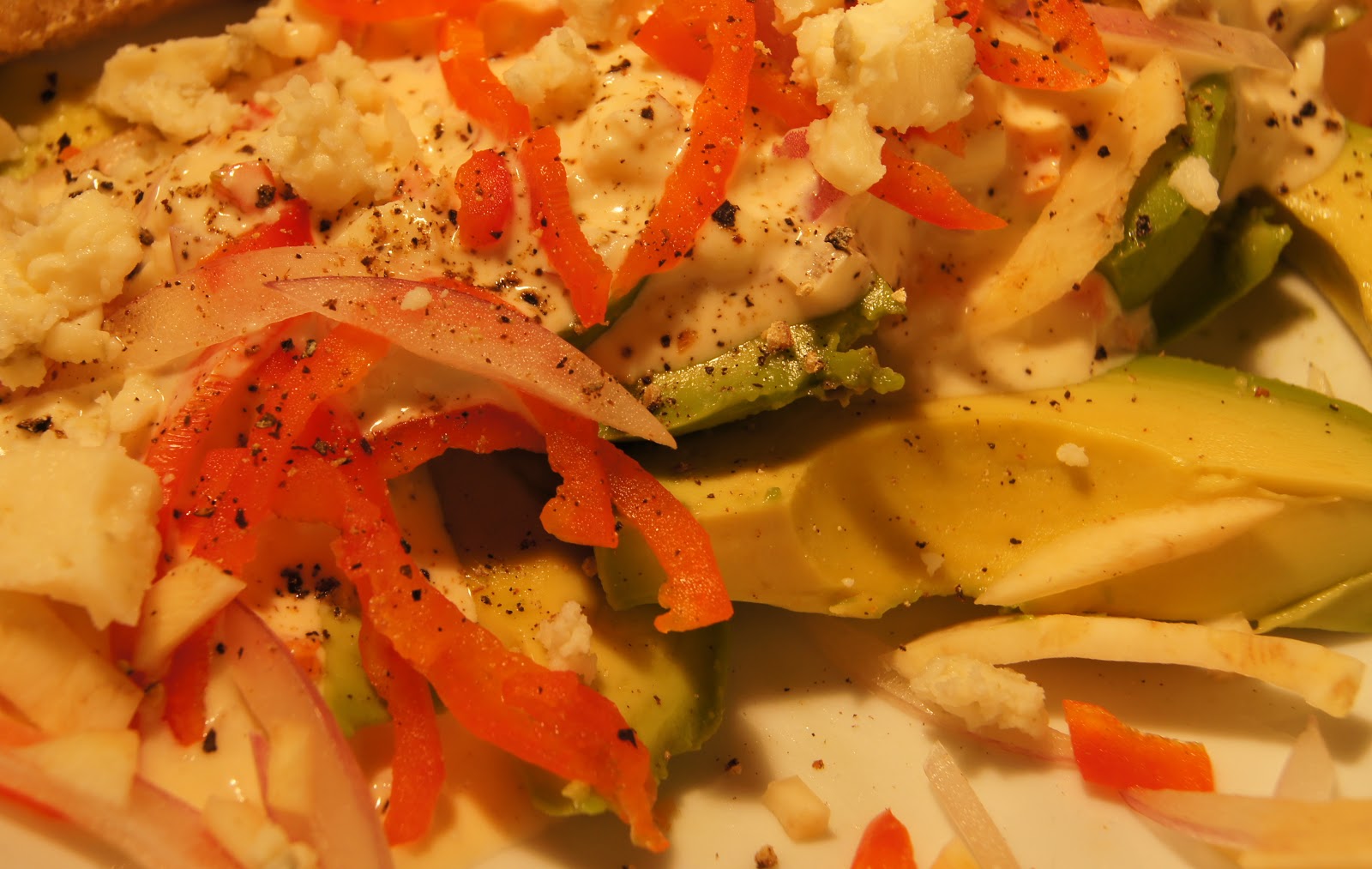
My point here, I guess, is that even as I become more impressed, year by year, with the ever growing breadth, depth, and quality of our local food sources, I don’t agonize over trying to make x-percent of my diet local, and I don’t apologize if a drop of Coke passes my lips from time to time, or a lobster from a distant sea finds its way into my pot.  I think it’s fair to say that my kitchen is locally based, and globally garnished, as this salad supper of avocado with blue cheese dressing illustrates. The proportions might seem reversed here, but there are more local ingredients in this than imported.

Avocado, mayonnaise, and blue cheese has been one of my favorite combinations since way back in my vegetarian days.  It’s sort of a study in close textural contrasts with wonderfully diverse flavors.  For the dressing I combined these local ingredients:

Wisconsin Black River blue cheese (1/2 cup crumbled?)
Minnesota Cedar Summit cream (2 tablespoons?)
Minnesota Smude sunflower oil (1 tablespoon?)
Wisconsin Menomonie Farmers Market red bell pepper and red onion and Wisconsin celery root from the co-op (about a tablespoon each minced for the dressing, more thinly sliced for garnish)
Menomonie market garlic, a medium clove minced

And these imports:

Hellmann’s mayo (couple tablespoons)
Sambal oelek (about a teaspoon)
Squeeze of lemon juice (I sometimes wind up with naked lemons after the rind has been stripped off bit by bit to garnish martinis….)
A few grinds black pepper

Mix well and adjust seasoning with sambal, lemon, pepper, and thickness with cream and oil—it should just flow. Unless you’re an absolute salt fiend, added salt is not necessary.

Spoon over sliced avocado—or over poached or sautéed shrimp; a nice grilled steak; any kind of salad; a sliced pear or apple; a hearty pasta like penne or rigatoni.

Serve with toast (from bread made with my nearly 10-year old house leaven, MN and ND flours) spread with Minnesota Hope Creamery butter.  Or serve on toast.  Not a bad breakfast using morning-after dressing.


Eat locally, think globally; shop thoughtfully, cook vibrantly, and have fun.

Monday, September 10, 2012

这 些不是中国菜 / Ceci n'est pas un repas chinois / This is not a Chinese meal


I honestly feel that the most important tool in my cook’s virtual knife kit is not any twist of technique, nor depth of knowledge gained from reading about cuisines around the world and avidly eating from Strasbourg to Roanoke, Tofino to Chengdu, nor skill attained from picking up the chef’s knife every day to slice, dice, mince, chop, julienne, chiffonade, and brunoise. No, the number one weapon in my kitchen arsenal these days is the ability to go with the flow.  ‘Twas not always so.  Back in the day I’d get a notion in my head—lobster-stuffed potstickered wontons with black bean sauce, say, or a salad of peaches and beets—and doggedly pursue the wildest hare to the bitter end, no matter if that involved blood, sweat, tears, and a disappointing dinner.  Well, often that approach yielded good results—the wontons were excellent (the peach-beet salad, less so).  But it was stressful, and if affairs in the kitchen went amiss, the evening could go completely off the rails.  Nowadays, when I let ingredients lead my cooking more than any overwrought conceit, things tend to turn out better, perhaps because I’m more willing to enjoy how things turn out.  It’s a culinary version of the old, “Wherever you go, there you are.”  Maybe I’ve embraced the zen of cooking, and maybe my standards have just slipped.  Whatever.


A case in point was last night’s dinner, which was supposed to be brunch, which might have become Chinese supper, which it was not, although it was eaten with chopsticks and rice bowls.  That might require a little bit of explanation. 

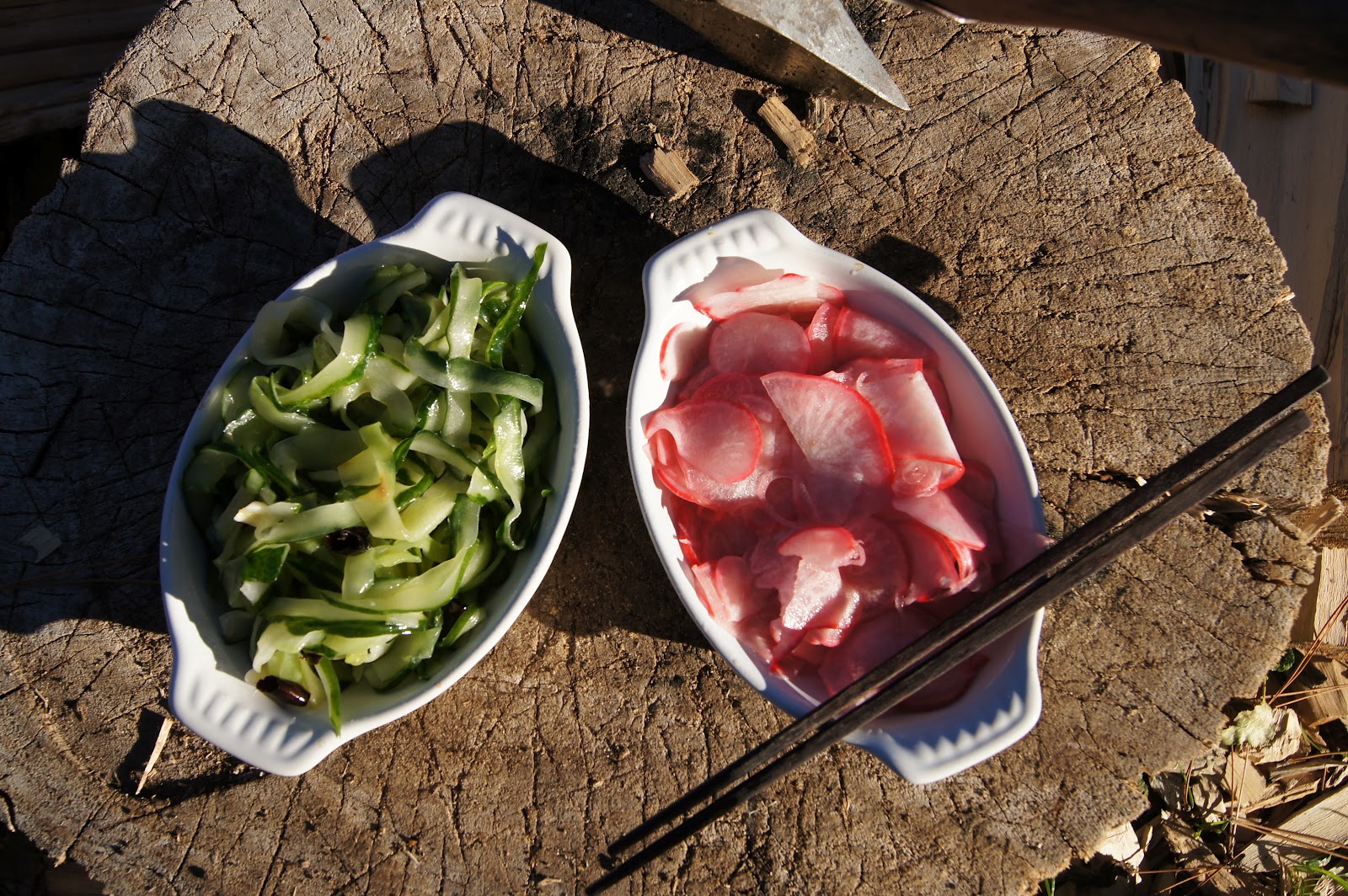
We had friends visiting at the farm and Bide-A-Wee this past weekend, and Sunday morning I started preparing some salads to have on a brunch buffet.  I was thinking of something a bit smorgasbord-ish:  there would be corn pancakes as the main event, and homemade herbed yogurt cheese, pickled beets, that sort of thing.  Maybe open a can of kippers. I found a couple of overgrown radishes in the garden which nonetheless were still firm and not too strong, and which sliced up into beautiful pink-and-white coins on the Benriner.  A couple of lovely Suyo Long cucumbers I also shaved into thin planks, and then sliced into veggie noodles, tossed those with a pretty hot chile-garlic oil, with just a splash of cider vinegar.  This could have been a Sichuan dish, except for the context.  Things were coming together nicely in my head for a delightful brunch.


But when Tim and Melinda came down the hill from Bide-A-Wee, it turned out they’d already had some yogurt and granola for breakfast, had enjoyed a walk around the Bide-A-Wee meadows, and were just about ready to head back to town.  No time or belly space for brunch.  No problem.  The salads could chill ‘til dinner.  We saw our friends on their way back home, then hopped in the car to do some shopping errands in Rice Lake.  On the way we stopped at the Crossroads Café in Cameron for Sunday dinner—Mary had the country fried steak, and I had chicken dinner (dark meat).  Both dinners came with a scoop of decent mashed potatoes, kind of soggy but still very tasty stuffing, and niblets corn (or you could have had Jell-O).  Mary’s gravy was white and specked with pepper; mine was chicken-dinner yellow.  Service was friendly and brisk.  My chicken was good, but not as good as the fall-off-the-bone version at the Sand Creek Café.  Mary’s country-fried steak was better, and she let me sample a generous portion.  After lunch we headed to Menard’s well-fed and content.  On the way to the checkout we were drawn to the looming Salted Nut Roll display, thinking that Nut Goodies would be nearby, but there were none to be found.  We settled for a Snickers (Mary) and Hershey’s Milk Chocolate with Almonds (me).   Why am I telling you this?

Okay.  Back home, little nap, some minor chores, a walk.  Radishes and cucumbers do not a supper make, but as lunch had been substantial, we didn’t want anything heavy.  Indeed, with our counters constantly covered in produce, and more, so much more in the gardens coming ripe, we think of vegetable centerpieces to our meals more than meat.  So some of the lovely corn we picked ourselves from a field near Sand Creek (with the farmer’s permission and supervision, of course!), which was originally going to garnish pancakes, that I simmered with onion, jalapeno, garlic, ginger, sage, lemon, and plenty of butter.  I had some eggplants from the market, and a big basket overflowing with patty pan squash from the garden.  My only thought with those was to grill them, toss them with minced shallots.  The thought evolved:  add some Hay River  pumpkin seed oil,* garlic, then a couple pinches of quatre-épices, cumin, and finally some piment d’espelette.  This turned out to be the star of the show.  A recipe worth writing down, passing on, repeating very soon.


And we served it all with rice, and ate with chopsticks, because that seemed elegant and appropriate, although this was not a Chinese meal.  But why not?  The cucumbers, as I say, could easily have passed on a Chinese table, and the radishes too; the eggplant-squash dish, with its mild heat and cumin fragrance, would have drawn compliments but raised no eyebrows as part of a meal in northwest China, along the silk road, where the food can seem Middle Eastern, Indian, or even Mexican.  And the corn was pretty much the same combination of ingredients that I stir-fry together for yumi chao lajiao—corn with chiles—and happily serve in Sichuan meals.  Only the butter—and maybe the sage—took it away from Chinese territory.  And yet, the combination of dishes, and the overall context, made this seem more French than Chinese.  Although it started out Scandinavian.  And it occurred to me in the course of the meal that it was a bit like the banchan dishes—kimchi, salads, and other little bites—that precede and accompany a Korean meal.


Scandinavian-French-Chinese-Korean-American tapas.  That’s what I’d call it.  With chopsticks.**

We drank a French vouvray from Champalou, a longtime favorite wine; always beautifully aromatic, ranging from dry to slightly sweet depending on the vintage.

Good things happen when you go with the flow.


Grilled Eggplant and Summer Squash with Pumpkin Seed Oil and Exotic Spice

Serves two as a side or part of a SFCKAT meal

2 Asian eggplants
2 small zucchini, same size as the eggplant, or a medium patty pan or yellow summer squash
Olive oil
Salt
1 ½ tablespoons pumpkin seed oil
1 tablespoon sunflower oil
1 small garlic clove, minced fine
1 small shallot, minced
2 small pinches quatre-épices 
2 generous pinches ground cumin
1/8 teaspoon piment d’espelette (or another aromatic, mildly hot ground chile that you like)
Good squeeze of lemon juice
Freshly ground black pepper

Remove the peel from the eggplants on two sides, remove stem and trim bottom, then slice the eggplants in half the long way, through the skin, so you have planks with the flesh exposed on the broad sections and strips of skin on the sides.  If that makes sense.  Slice the squash how you like to do for grilling.  Toss both eggplant and squash with a generous amount of olive oil, and salt generously as well.

Grill the vegetables until nicely brown, perhaps a bit charred, and very soft.  Chop them into ¾-inch chunks.  Mix the remaining ingredients, along with another pinch of salt and a few grinds of pepper, and toss with the vegetables.  Garnish with a few very thin shallot slices, if you like.
_____________________________________________________
* This dish turned out to be my favorite-to-date use for our Ken and Jay's wonderful Hay River pumpkin seed oil.  Though the oil's flavor took a backing role to the fragrant spices, the oil's texture gave a real depth and heft to this all-veggie dish.  I don't know why unctuous often has negative connotations; this dish, which actually used three different oils, had a savory unctuousness that was extremely appetizing.


**All of which made me think of  this excellent article by (Dear) Dara Moskowitz Grumdahl on the sense of the authentic in contemporary cuisine, "culinary imperialism", and the Twin Cities Asian restaurant boom--which is much more the real deal than the so-called Scandinavian restaurant boom, which consists of one high-end restaurant and a lunch spot in the American Swedish Institute....


Monday, August 13, 2012

Cool As


There’s that old saying that in summer’s dog days you can sit by a country road and hear the corn grow.  Along those same lines, I do believe that I could sit myself down in a corner of my garden right about now and watch the cucumbers swell.  Not that I have the patience for that, nor do I mean to imply that our rural life is quite that somnolent.  We do have Dish TV, you know, and the New York Times, and fairly active minds.

However, it is certainly true that a pinkie-sized cuke the evening before can easily grow to kosher dill-size by the next morning.  Also, as all you gardeners will have observed, some cucumbers possess a sort of stealth technology that allows them to escape detection until they have reached near football size.  As diligently as one might rummage in the prickly leaves, a few fruits always get away, until one day when you reach in and your hand latches on to a cucumber as big around as your forearm.  Honestly, how does this happen?  It’s a phenomenon that has perplexed me over decades.


Cucumbers are easier to find, easier to pick, and more pleasant to behold when they are growing up a trellis.  We have this sort of rotty white wooden fence that I screwed a metal grid onto, and both cucumbers and beans have happily ascended it.  I have two kinds of cucumbers in my garden—Burpee Pickler and my favorite cucumber, the Suyo Long.  I used to seek out French cornichon cucumber seeds, until I realized that a cornichon is just a little cuke.  If you pick the Burpees at 2-inch size, they work just fine for those vinegary pickles, tel mignon, which must accompany a slice of terrine.  I’m not picking the babies this year, though, as I still have a good stock of cornichons in the fridge from last year.
 

I’m letting the picklers grow a bit more, and they’ll get fermented in a simple brine with dill, garlic, and chilies to make Russian-style (or is it Jewish?) sour dills.  Oh, how I love those pungent, fragrant cukes, slightly piquant, sour and salty.  I could eat a bowl at a time, but I help myself judiciously, to make sure they last me through the winter.  The trick of adding currant, oak, grape, or cherry leaves to the brine to ensure crispness really does work.

Now about the Suyo Long, a type of cucumber I first encountered in China, where this is the standard cuke.  How long is a Suyo Long?  Pretty darn long.  The one spanning the frame below would be a good 16 inches if straightened out, and they’ll go a few inches longer than that.  Growing them on a trellis causes them to grow straighter.  If they’re lying on the ground they tend to curl up.


The virtues of this type of Asian cucumber are many.  Let me count them:  First, although they come from the vine very prickly indeed, once the spines are washed off the skin is quite tender, and not bitter.  Then, while by no means seedless, they have fewer seeds, and less tough, than the typical cuke.  And the flesh seems less watery, with a slight fragrance of watermelon rind.  They really are a total taste of summer for me.  They’re my favorite for bread & butter pickles, sliced into a classic salad with sour cream or yogurt dressing, chopped for a cool and hot salsa.

And of course they make me nostalgic for the time I spent in China, where I would sit with my fellow teachers or my Chinese students in one of the little open-air restaurants along the narrow grubby streets just outside the university gates on warm, hazy evenings and order up mapo doufu (tofu in spicy pork sauce), hui guo rou (twice-cooked pork), and often a dish of liang ban huang gua, cucumbers in a dark, spicy dressing with plenty of garlic.  Indeed, cucumbers and garlic are one of those classic combinations found in cuisines all over the world.  There’s another Sichuan cucumber salad, suan ni huang gua, in which the dressing consists of little but very finely minced garlic.  Not for the faint of heart, or first-daters.

Printed on cheap, cheap paper, poorly bound, Selected Sichuan Recipes 1 & 2 from the Sichuan Culinary College are among the most cherished volumes in my cookbook collection.
Like the French, the Chinese often cook cucumber, pairing it in stir-fries with cubed chicken or pork.  If you haven’t tried it, cooked cucumber is a delightful surprise.  It retains some of its iconic coolness even while hot, and pairs wonderfully with the numbing and hot (ma la) flavors of Sichuan cooking.  The recipes below are copied directly from handouts for Sichuan cooking classes I taught a long time ago, almost no changes.  They worked then, they should work now.  Have a try.
  

Cucumber Salad (Liang Ban Huang Gua)

The Chinese don’t eat many raw vegetables, for a variety of reasons.  But this cucumber “salad” is a common summer dish in Sichuan.  Serve it right along with the other dishes in a multi-dish Chinese meal.  With the potent flavors of chili oil and pulverized garlic, it will hold its own.

2 medium cucumbers, about a pound

With tender summer cucumbers, leave the skin on.  With winter grocery store cukes, peel them entirely or just mostly, leaving some thin strips of the skin for color.  Cut them in half lengthwise, scrape out the seeds, and cut each half lengthwise again.  Smack these quarter strips with the side of a cleaver or heavy knife a couple of times—this opens the flesh up a bit to take in more of the sauce.  Cut the strips into 1-inch pieces. 

3 cloves garlic  

Peel the garlic, then smash each clove flat with the side of a cleaver or heavy knife.  Mince and scrape the garlic on your cutting board till it is nearly a paste.  Adding a little bit of  salt will help this process but is not necessary.

2 scallions, minced        
2 Tbl soy sauce
1 Tbl Chinese dark vinegar       
2 tsp sugar
1 Tbl chili flakes in oil    
1/2 tsp sesame oil
1/2 tsp ground Sichuan pepper

Mix the garlic and the rest of the sauce ingredients.  Pour the sauce over the cucumbers and mix well.  Serve.


Chicken with Cucumbers (Huang Gua Ji Ding)

Cucumbers are often cooked in Chinese cuisine.  They must be treated rather delicately, cooked just enough to take away the raw flavor, but not so much that they lose their crispness.  This simple recipe combines diced cucumber with chicken, chilies, and a copious dose of garlic. [This is also very good with pork subbed for the chicken, and a bit of sugar (1/2 tsp?) and soy sauce (2 Tbl?) added to the marinade.]

1 medium cucumber                  
1/2 tsp salt

Peel the cucumber, cut it in half lengthwise, and scoop out the seeds.  Cut the cucumber into 1/2-inch dice, put them in a bowl, and mix in the 1/2 tsp salt.  Let it sit for 20 minutes or so, while the salt draws off some of the moisture from the cucumber.  Then drain the cucumber, squeezing to remove as much liquid as you can.

6 oz boneless, skinless chicken breast or thigh meat, cut in 1/2-inch dice
1 Tbl rice wine or dry sherry
1/2 tsp salt
2 tsp cornstarch 
1 tsp sesame oil

Mix the chicken with the rice wine, salt, cornstarch, and sesame oil.  Let marinate at least 20 minutes.

1 1/2 Tbl minced garlic
4 whole dried red chilies (or more, to taste), broken in half
2 Tbl vegetable oil
1/4 tsp ground roasted Sichuan pepper

Heat a wok or fry pan over high, then add the 2 Tbl oil.  When the oil is very hot add the chilies and stir-fry until they begin to darken, about 30 seconds.  Then add the garlic and stir-fry for just 10 seconds.  Add the chicken and stir-fry until the chicken is white and firm, about 1 minute.  Add the cucumbers and stir-fry for 1 minute. 

 Remove to a serving plate, sprinkle with the Sichuan pepper, and serve.


Text and photos copyright 2012 by Brett Laidlaw