Showing posts with label corn. Show all posts

Monday, September 10, 2012

这 些不是中国菜 / Ceci n'est pas un repas chinois / This is not a Chinese meal


I honestly feel that the most important tool in my cook’s virtual knife kit is not any twist of technique, nor depth of knowledge gained from reading about cuisines around the world and avidly eating from Strasbourg to Roanoke, Tofino to Chengdu, nor skill attained from picking up the chef’s knife every day to slice, dice, mince, chop, julienne, chiffonade, and brunoise. No, the number one weapon in my kitchen arsenal these days is the ability to go with the flow.  ‘Twas not always so.  Back in the day I’d get a notion in my head—lobster-stuffed potstickered wontons with black bean sauce, say, or a salad of peaches and beets—and doggedly pursue the wildest hare to the bitter end, no matter if that involved blood, sweat, tears, and a disappointing dinner.  Well, often that approach yielded good results—the wontons were excellent (the peach-beet salad, less so).  But it was stressful, and if affairs in the kitchen went amiss, the evening could go completely off the rails.  Nowadays, when I let ingredients lead my cooking more than any overwrought conceit, things tend to turn out better, perhaps because I’m more willing to enjoy how things turn out.  It’s a culinary version of the old, “Wherever you go, there you are.”  Maybe I’ve embraced the zen of cooking, and maybe my standards have just slipped.  Whatever.
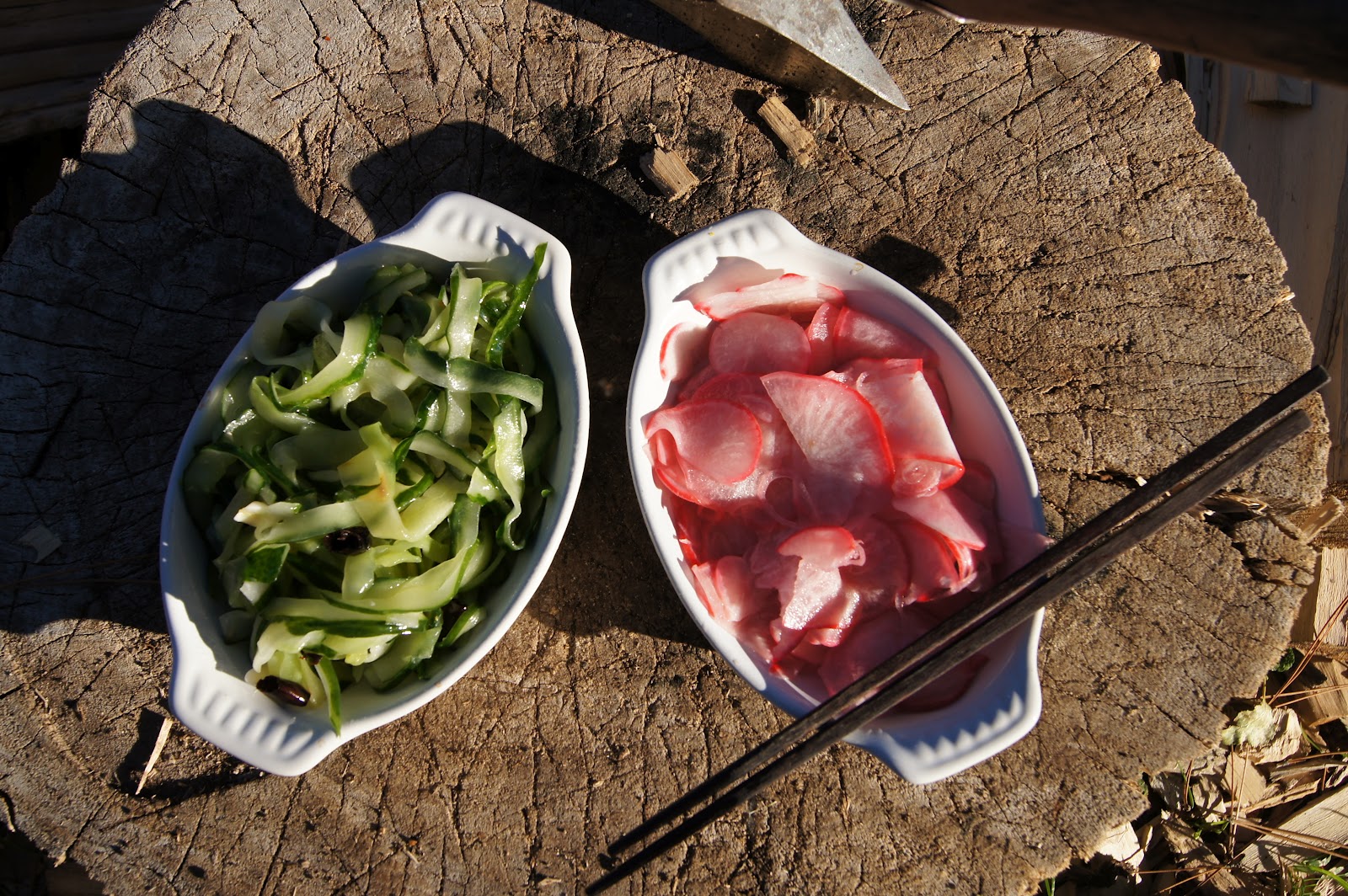

A case in point was last night’s dinner, which was supposed to be brunch, which might have become Chinese supper, which it was not, although it was eaten with chopsticks and rice bowls.  That might require a little bit of explanation. 

We had friends visiting at the farm and Bide-A-Wee this past weekend, and Sunday morning I started preparing some salads to have on a brunch buffet.  I was thinking of something a bit smorgasbord-ish:  there would be corn pancakes as the main event, and homemade herbed yogurt cheese, pickled beets, that sort of thing.  Maybe open a can of kippers. I found a couple of overgrown radishes in the garden which nonetheless were still firm and not too strong, and which sliced up into beautiful pink-and-white coins on the Benriner.  A couple of lovely Suyo Long cucumbers I also shaved into thin planks, and then sliced into veggie noodles, tossed those with a pretty hot chile-garlic oil, with just a splash of cider vinegar.  This could have been a Sichuan dish, except for the context.  Things were coming together nicely in my head for a delightful brunch.


But when Tim and Melinda came down the hill from Bide-A-Wee, it turned out they’d already had some yogurt and granola for breakfast, had enjoyed a walk around the Bide-A-Wee meadows, and were just about ready to head back to town.  No time or belly space for brunch.  No problem.  The salads could chill ‘til dinner.  We saw our friends on their way back home, then hopped in the car to do some shopping errands in Rice Lake.  On the way we stopped at the Crossroads Café in Cameron for Sunday dinner—Mary had the country fried steak, and I had chicken dinner (dark meat).  Both dinners came with a scoop of decent mashed potatoes, kind of soggy but still very tasty stuffing, and niblets corn (or you could have had Jell-O).  Mary’s gravy was white and specked with pepper; mine was chicken-dinner yellow.  Service was friendly and brisk.  My chicken was good, but not as good as the fall-off-the-bone version at the Sand Creek Café.  Mary’s country-fried steak was better, and she let me sample a generous portion.  After lunch we headed to Menard’s well-fed and content.  On the way to the checkout we were drawn to the looming Salted Nut Roll display, thinking that Nut Goodies would be nearby, but there were none to be found.  We settled for a Snickers (Mary) and Hershey’s Milk Chocolate with Almonds (me).   Why am I telling you this?


Okay.  Back home, little nap, some minor chores, a walk.  Radishes and cucumbers do not a supper make, but as lunch had been substantial, we didn’t want anything heavy.  Indeed, with our counters constantly covered in produce, and more, so much more in the gardens coming ripe, we think of vegetable centerpieces to our meals more than meat.  So some of the lovely corn we picked ourselves from a field near Sand Creek (with the farmer’s permission and supervision, of course!), which was originally going to garnish pancakes, that I simmered with onion, jalapeno, garlic, ginger, sage, lemon, and plenty of butter.  I had some eggplants from the market, and a big basket overflowing with patty pan squash from the garden.  My only thought with those was to grill them, toss them with minced shallots.  The thought evolved:  add some Hay River  pumpkin seed oil,* garlic, then a couple pinches of quatre-épices, cumin, and finally some piment d’espelette.  This turned out to be the star of the show.  A recipe worth writing down, passing on, repeating very soon.


And we served it all with rice, and ate with chopsticks, because that seemed elegant and appropriate, although this was not a Chinese meal.  But why not?  The cucumbers, as I say, could easily have passed on a Chinese table, and the radishes too; the eggplant-squash dish, with its mild heat and cumin fragrance, would have drawn compliments but raised no eyebrows as part of a meal in northwest China, along the silk road, where the food can seem Middle Eastern, Indian, or even Mexican.  And the corn was pretty much the same combination of ingredients that I stir-fry together for yumi chao lajiao—corn with chiles—and happily serve in Sichuan meals.  Only the butter—and maybe the sage—took it away from Chinese territory.  And yet, the combination of dishes, and the overall context, made this seem more French than Chinese.  Although it started out Scandinavian.  And it occurred to me in the course of the meal that it was a bit like the banchan dishes—kimchi, salads, and other little bites—that precede and accompany a Korean meal.


Scandinavian-French-Chinese-Korean-American tapas.  That’s what I’d call it.  With chopsticks.**

We drank a French vouvray from Champalou, a longtime favorite wine; always beautifully aromatic, ranging from dry to slightly sweet depending on the vintage.

Good things happen when you go with the flow.


Grilled Eggplant and Summer Squash with Pumpkin Seed Oil and Exotic Spice

Serves two as a side or part of a SFCKAT meal

2 Asian eggplants
2 small zucchini, same size as the eggplant, or a medium patty pan or yellow summer squash
Olive oil
Salt
1 ½ tablespoons pumpkin seed oil
1 tablespoon sunflower oil
1 small garlic clove, minced fine
1 small shallot, minced
2 small pinches quatre-épices 
2 generous pinches ground cumin
1/8 teaspoon piment d’espelette (or another aromatic, mildly hot ground chile that you like)
Good squeeze of lemon juice
Freshly ground black pepper

Remove the peel from the eggplants on two sides, remove stem and trim bottom, then slice the eggplants in half the long way, through the skin, so you have planks with the flesh exposed on the broad sections and strips of skin on the sides.  If that makes sense.  Slice the squash how you like to do for grilling.  Toss both eggplant and squash with a generous amount of olive oil, and salt generously as well.

Grill the vegetables until nicely brown, perhaps a bit charred, and very soft.  Chop them into ¾-inch chunks.  Mix the remaining ingredients, along with another pinch of salt and a few grinds of pepper, and toss with the vegetables.  Garnish with a few very thin shallot slices, if you like.
_____________________________________________________
* This dish turned out to be my favorite-to-date use for our Ken and Jay's wonderful Hay River pumpkin seed oil.  Though the oil's flavor took a backing role to the fragrant spices, the oil's texture gave a real depth and heft to this all-veggie dish.  I don't know why unctuous often has negative connotations; this dish, which actually used three different oils, had a savory unctuousness that was extremely appetizing.


**All of which made me think of  this excellent article by (Dear) Dara Moskowitz Grumdahl on the sense of the authentic in contemporary cuisine, "culinary imperialism", and the Twin Cities Asian restaurant boom--which is much more the real deal than the so-called Scandinavian restaurant boom, which consists of one high-end restaurant and a lunch spot in the American Swedish Institute....


Friday, August 26, 2011

Got Corn?


Parcelling out the year into meaningful seasons can sometimes require keen observations of subtle natural signs--the buds breaking on apple trees, hen of the woods beginning to emerge on oak stumps, the slight shrinkage of the leaves that occurs after dog days' swelter breaks. 

Or, it may simply require that you keep your eyes open while you're driving country roads, where, this time of year, the signs of a much anticipated confluence of culture and agriculture spring up in glorious, homespun exuberance:  Get your sweet corn here!


Corn season was slow to arrive this year--a cool, wet spring kept a lot of farmers out of the fields, and slowed growth once they were able to plant.  The steamy July helped the crop to catch up.  It was
astounding to see how quickly the stalks ascended along the road to Bide-A-Wee once the hot weather hit.  We shook our heads in sympathetic dismay at the spindly sprouts of late June, which by the end of July were miraculously over our heads.

We haven't done much fancy with the sweet corn this year.  Boil it briefly or, preferably, put it on the grill, those have been our main method.  I've used it in a stir-fry or two, and yesterday I put up a couple of pints of a corn relish with eggplant, tomatoes, and cherry
peppers.  To grill corn, I've learned that the simplest method is the best.  I used to peel back the husks and pull out as much of the silk as I could, wrap it back up and then put it over the coals.  At a
cookout with the Bartz family last summer (they run the Bolen-Vale dairy and cheese shop on highway 64 in Connorsville, and grow sweet corn), I learned that the de-silking is unnecessary.  Renee just put whole ears in the husks, previously soaked in water, right on the grill.  Now I dispense with the soaking, too.  In the process of cooking, the delicate silk basically disappears, or is easily removed along with the husks, post-cooking, and there's plenty of moisture in the husks of really fresh corn to keep it from burning up.  I turn the corn until the husk is black all around, and it's perfectly done.

That's all the cooking advice I'm going to offer here.  Instead, I'd like to know how you best enjoy high summer's sweet corn bounty, and how you like to preserve it for the colder months, if you do.  Freeze, dry, pickle?  On the cob, or off?  In return for your kind suggestions, I'm going to dig around in the recipe books for a really good sweet corn spoon bread I came up with a few years ago.  Mary remembers it very fondly.  I'm hoping she can also remember where I put it....


Text and photos copyright 2011 by Brett Laidlaw

Saturday, July 30, 2011

Our Own Private Chengdu


The hot and soupy weather we've been swimming through the last few weeks has at least one fringe benefit for me--it reminds me strongly of the year (1989-90) I spent teaching English at Sichuan University (sichuan daxue, Chuanda for short) in Chengdu, the capital city of Sichuan province in southwestern China.  It also makes my kitchen intensely fragrant with the scent of hua jiao, Sichuan pepper, that I keep in a bamboo container in a cupboard.  When it's this humid and warm, every time I open my cupboard I'm just about knocked over by that tart, citrusy smell.

The guide books characterize Chengdu's climate as "subtropical monsoonal"--so now you know how to describe this summer in a nutshell.  Whether the cuisine of Sichuan evolved as a response to the climate, or through other factors, it's certainly true that the vibrantly flavored food of Sichuan is just the thing to boost the appetite on sticky hot evenings.  Sichuan cooking--and Chinese cooking in general--also allows you to perform a leisurely prep of your ingredients (perhaps while sipping a cold beer), then finish the cooking--generally stir-frying--in just a few minutes (then pop another brew to drink with dinner).

The distinctive flavor combo of Sichuan food is the yin-yang duo of ma la: ma for numbing, from fragrant Sichuan pepper, la for spicy hot, from chile peppers.  In addition, Sichuan dishes are often quite salty, from soy sauce and fermented bean paste, and brightly piquant with vinegar, usually a pungent dark vinegar that gives Sichuanese liang ban dishes--salads, basically--a unique and exotic kick.


Of the dishes shown here, two are standard dishes that I and my friends and colleagues at Chuanda would order at the little open-fronted restaurants that lined the alleys just outside the university gates.  I'm swooning in memory to recall the full-sensory assault that a slow walk through those narrow lanes entailed on a warm damp evening:  the strangely pungent smell of raw rapeseed oil--the standard cooking oil--turning from repellent to appetizing as it heated in a wok; the funkily delicious aromas rising from bins of bean paste, dried shrimp, and other aromatic goods at a vendor's stall; the savory scents wafting from a hot pot restaurant where bubbling cauldrons, topped with a slick of fiercely red oil, held highly aromatic broth, the secret ingredient of which, so it was said, was an opium poppy seed pod.  There were less appealing olfactory elements, as well--a breeze from the east would bring the air off the river, far from pristine; a passing bicycle cart carrying a container of nightsoil left a fetid wake--it was my year-long nightmare that I would some day collide on my bicycle with one of these ripe vehicles that carried dilute human waste to fertilize the vegetable fields just outside the city (and there's your explanation for why the Chinese do not eat leafy green salads...).


Seated at a small table in one of the very basic restaurants, we would order tea and pijiu, beer, and never bother to look at a menu, which, at any rate, we couldn't read, since it was entirely in Chinese characters.  The thing is, the Chinese customers didn't bother with a menu, either, and it was about two-thirds of the way through my year in Chengdu that I discovered that my favorite small restaurant, "The Sisters," even had a written menu.  Instead, we just ordered according to the ingredients we saw displayed at the cook's station--if there was eggplant we'd get yu xiang qiezi, fish-fragrance eggplant; if there were fava beans, liang ban can dou, a salad dressed like the cucumbers shown here.  Always you could get mapo doufu, the wickedly ma la Sichuan tofu in meat sauce (which is never nearly ma enough at any American Sichuan restaurant--it should set your mouth tingling to where you think your tongue has swelled to twice its normal size), or shui zhu rou pian, perhaps the hottest Sichuan dish of all--pork slices stir-fried with hot bean paste, simmered in water, poured over vegetables in a small casserole, then topped with absurb amounts of ground dried chile and Sichuan pepper which is set sizzling when anointed with smoking hot oil; its name translates, innocuously, as "water-cooked meat slices."


Well, I could go on.  But on to the dishes here displayed, a simple, nearly vegetarian meal we put together on a recent, extremely Chengduvian evening.  First the cucumber salad, liang ban huang gua.  When I was in Chengdu I ate this at least once a week while cucumbers were available, but I've never seen it on a menu here, even though there are now several authentic Sichuan restaurants in the area (as for what passed for Sichuan cooking up until recently, the less said, the better).  There's often a cucumber dish on the appetizer menu, but it's often cooked--which is fine--and bland--not so fine.  This salad is one of my favorites, and especially good if you have the long, ridged Asian cukes, but fine with any kind.

Sichuan Cucumber Salad (Liang Ban Huang Gua)
Liang Ban means "cool, mixed", and generally denotes a salad

1 medium cucumber

If the skin is tender, leave it on; if it seems tough, remove all or part.  Trim off the ends, then halve it the long way, and if it is very seedy, remove some or all of the seeds--the Asian cukes tend to have fewer and smaller seeds than the typical American slicer.  Cut each half in half again, the long way, and with the side of a cleaver or chef's knife, whap these long pieces a few times--assertively, but not vindictively.  This opens up the flesh a bit to take in more dressing.  Now cut the cucumber strips crosswise into roughly 3/4-inch pieces.

The dressing:

2 large cloves garlic (or more, to taste--there's a sort of variation on this salad called suan ni huang gua, which is cucumbers in a sea of puréed garlic)
1 tablespoon soy sauce
2 teaspoons Chinese dark vinegar (see picture)
This is the brand of Chinese dark--not black--vinegar I buy
1 1/2 teaspoons sugar
2 teaspoons chile flakes in oil (or to taste; use some sambal if you don't have the chile oil)
1 teaspoon ground roasted Sichuan pepper
1 scallion, chopped fine
sesame oil, optional

Peel the garlic, crush it with the side of a cleaver or big knife, then mince it very fine.  Combine the garlic with all the other ingredients except the scallion and sesame oil.  Toss the cucumber pieces with the dressing and transfer to a serving dish.  Sprinkle with the scallions and a few drops of sesame oil, if you like.

This will serve two to four, depending on how many other dishes you make.  The two of us polished this off easily on the night in question.


Corn in China is called yu mi, or "jade grain"--and in these pictures I think you can really see why. This dish is yumi chao lajiao, corn stir-fried with chile (or sometimes qing jiao yumi, green chile corn).  Corn, needless to say, is not native to China--but then, neither are chiles, which virtually define Sichuan cooking in most people's minds.  But corn is fairly common in Sichuan and Yunnan, and this simple stir-fry with chiles fresh and dried, garlic, and whole Sichuan peppercorns, is its most common manifestation. 

Sichuan Stir-Fried Corn with Chiles (yumi chao lajiao or qing jiao yumi)

2 ears corn, kernels stripped from the cobs
2 fresh chiles, halved, seeded, cut into 1/2-inch pieces--anaheim, hungarian wax, banana, a not-too-hot jalapeno
3 cloves garlic, peeled, roughly chopped
3 scallions, white and green, cut into 1/2-inch pieces
3 dried red chiles, broken in half
1 teaspoon whole, untoasted Sichuan peppercorns
1/8 teaspoon salt
2 tablespoons oil (peanut, canola)
sesame oil, optional

Get a wok very hot.  Add the cooking oil, and as it just starts to smoke, add the dried chiles and the Sichuan pepper.  Swirl these in the oil, then add the corn, fresh chiles, garlic, and salt.  Stir-fry over highest heat for 2 to 3 minutes--watch that the garlic doesn't burn.  Add the scallions and stir-fry for another minute or two--some of the corn should be getting a bit brown on the edges.  Transfer the corn to a serving dish, and sprinkle on a few drops of sesame oil, if you like.

This dish can be made with frozen corn, thawed, patted dry with paper towels.  A little bit of sugar can be added if the corn isn't very sweet.


The third dish, chanterelles with bacon and garlic chives, was my own concoction, and while decent (it has home-smoked bacon, and chanterelles...), it's not one I'd make again.  The bacon overpowered the chanterelles--it might actually be better with something like oyster mushrooms, and more chile.

We always serve steamed jasmine rice in a small bowl for each person, and pretty much always drink beer with Sichuan food.  We take the Chinese approach of dipping into the communal bowls with chopsticks (though a spoon helps with the corn).

I'll pull out a Sichuan recipe--and reminiscence--from time through the rest of the summer, while the market stalls are full of produce begging to be stir-fried, and the hua jiao is at its most fragrant.

Text and photos copyright 2011 by Brett Laidlaw