Showing posts with label smorrebrod. Show all posts

Friday, May 13, 2016

Pheasant Back, Ramp & Wood Nettle Pâté


I’m usually pretty confident when I start to put together a new dish, because I’ve been cooking for a long time, and because, let’s face it, most “new” dishes are usually just a tweak or two on an old dish.  You swap out an unusual ingredient for a familiar one, turn an exotic dish local or wild, that sort of thing.  You have a basic template and play around with the elements within it.  The last time I recall coming up with something truly, stunningly original was when Iaccidentally burned some honey, and then decided to throw some rhubarb juice in the pot.  The result was something remarkable, delicious, and unlike anything I’ve ever tasted.

And, I’ve never made it again.  I should.  I think even I’m a little afraid of bringing honey to the burning point, though really the worst thing that could happen is that I would burn a little honey.  Well, maybe ruin a pan, fill the house with smoke.... Maybe my reluctance is wise.

Pheasant back mushrooms tops.  They also go by the fanciful name "Dryad's Saddle."  Dryads are not as common in our woods as they once were, so I haven't had a chance to examine their saddles lately....
Anyway:  the story of this pâté was this:  I had a mess of pheasant back mushrooms, which have been abundant this spring (they grow on dead trees, including elms, so you’ll often find them while not finding morels…).  These mushrooms are a polypore, like boletes, the family that includes porcini, but their flavor is very mild, just sort of vaguely mushroomy.  When young and tender, their texture can be excellent, and then they’re fine just sliced and sautéed.  I like to do them in butter, add a little garlic and a splash of soy sauce when they’re about done.  

Tops and bottoms; note the tiny pores of this fungus whose Latin name is polyporous squamosus.
But as they mature, they become chewy, then inedibly tough.  Sometimes you can trim the outer rim of a larger one and find it sufficiently tender.  The thing I’ve learned is that if my pocket knife blade doesn’t slide through the flesh almost effortlessly, don’t bother.  Move along, keep looking, you’ll find more.  On this evening most of my pheasant backs could have been eaten simply sautéed, but that wasn’t working for me as a topping for smorrebrod, those Danish-inspired open face sandwiches, which was the dinner plan.  Pâté came to mind, a sort of ersatz chopped liver. 


I chopped the mushrooms pretty small, threw them in a pan with some butter.  As they released moisture and started to shrink, I added chopped ramps.  Then as cooking neared completion, I splashed in some soy, for umami depth, and to make it more pâté-like, a glug of red wine (I considered cognac or sherry, but thought that would be gilding the lily).  It was smelling pretty good at this point—I had added dried thyme, and a pinch of chile flakes—but there wasn’t a lot of it, and I also was dubious about what the texture of ground-up pheasant backs alone would be like.

For both bulk and texture, wood nettles came to the rescue.  They’d just started coming up in our woods, so they were in prime condition, edible and tender pretty much from bottom to top.  I roughly chopped a cup or so, added them to the pan with a little water, steamed briefly.

After removing the lid from the pan and letting most the liquid evaporate, I let the mixture cool, then transferred it to a mini-chop food processor.  From here I took the chopped liver approach of working in as much butter as conscience would allow.  Tasting along the way, adding some salt and a good bit of black pepper, I was more and more impressed.

Smorrebrod dinner leftovers make a lovely lunch.  Closewise from top: smoked trout with goat yogurt cheese and chives; wood nettle-ramp pesto with local goat feta; the pâté; wild asparagus and homemade mayonnaise.
I’ll spare you the suspense and simply say that it was excellent, and distinctive, though built on a familiar chassis.  I will definitely make this again.  Most other shrooms—button, oyster, hen of the woods—could be used in it, and other greens, wild or not.  WARNING: the recipe below is my best estimate of the quantities of ingredients used.  Since I considered it quite possible that the resulting dish would be going in the trash rather than on the dinner table, I wasn’t writing things down as I went along.   But this is in the ballpark, and y’all are clever; you’ll figure it out.


Pheasant Back, Ramp & Wood Nettle Pâté

Makes about a cup

1 generous cup chopped pheasant back mushrooms
3 plump ramp bulbs, chopped
1 generous cup (loosely packed) wood nettles, young leaves and tender stems, roughly chopped
4 tablespoons butter, divided
1 tablespoon soy sauce
1/4 cup dry red wine
1/4 cup water
1/2 teaspoon dried thyme or a couple good sprigs of fresh, leaves stripped off
Pinch red chile flakes, optional
Salt and pepper

Melt 1 1/2 tablespoons of butter in a skillet and add the mushrooms and a pinch of salt. Cook over medium heat for 4 to 5 minutes, until they start to give up some liquid and shrink a bit, then add the ramps. Sauté another 2-3 minutes, until the ramps are translucent and soft. Add the soy sauce, wine, thyme, and chile. Cook, stirring, until the liquid is mostly gone. Add the wood nettles and 1/4 cup water, cover, and simmer for 2 minutes.

Remove the lid and continue cooking until most of the liquid is evaporated. Remove the pan from the heat and set it aside to cool.

When the mixture is no longer hot, transfer it to a mini food processor or blender. Taste for salt and add if needed. Add a few grinds of black pepper. Add a couple of teaspoons of butter and begin to process. After a few seconds, stop the machine, scrape down the sides, and add a bit more butter. Repeat this process until all the butter is incorporated, then process for another 15-20 seconds. We're looking for a fairly smooth texture to the pâté.

Taste again for seasoning, adding more salt or pepper if you like. I like a pâté to be well seasoned. Transfer the pâté to a ramekin or small jar, and serve as you would chopped chicken livers and the like--lovely on crackers or toast rounds as a cocktail nosh or first course, or as one element in a buffet or smorrebrod-type meal.
 
Text and photos copyright 2016 by Brett Laidlaw

Friday, December 13, 2013

Back With More Sandwiches


Where would this blog be without smorrebrod?  This year, at least, it would be pretty sparse.  Pretty sparser.

The open-face sandwich idea intrigues and delights me for three main reasons:

As a baker, I love pretty much any meal based on bread, and I enjoy the challenge of coming up with breads that work particularly well with this kind of dish.  In this case the bread was a sourdough rye to which I added some part-fermented apple cider and some Wisconsin sorghum syrup.  I used some starter I had sitting around on the kitchen counter for a while, not very well refreshed, so the dough was very, very slow to rise, especially now that the temperature in our kitchen is generally in the low 60s.  I decided to embrace the idea of slow bread.  I let the dough proof for over 24 hours, then put it in loaf pans where it rose at a glacial pace for several hours more.  And then I baked it in quite a slow oven, 350 if I recall correctly, adding steam both in the form of ice cubes tossed in at the beginning and middle of baking, along with a pan of water set on a rack under the stone.  It baked for around an hour, and the end result was a notable success, though I say so myself.  It just begged to be presented in an elegant Nordic fashion, so here we are.


As a cook, I find smorrebrod gratifying because of the way the bread canvas invites creativity in the toppings, which are not hidden as the filling in a regular sandwich would be.  Pretty much anything can serve as smorrebrod topping--vegetable salads, smoked or pickled fish, eggs, cheese, various sorts of charcuterie.  There's really no wrong topping except maybe PB&J, and someone could probably find a clever way to make that work, too.  This versatility makes smorrebrod ideally suited to local, seasonal eating, from early spring's first flush of wild foods through the garden glut of summer, harvest abundance, root cellar and pickle cabinet foraging.  The three sandwiches on the plate here all are based on meat:  a rustic paté of pork with chicken livers, bacon, and hickory nuts; a silky, rich chicken liver mousse; and wonderful venison backstrap roasted to medium rare in a salt dough.


And last, as an inveterate garnisher, I love the opportunity that smorrebrod provides to come up with finishing touches that complete the dish in both pretty and appetizing ways.  We have a joky saying here, "It's all about the garnish!"  And while plate prettifying can quickly turn precious, I think there's a serious point there.  In some ways it's the care taken in finishing touches that make the difference between a bowl of grub to be scarfed down and a plate of food that delights at many levels.  Garnishing, to me, really is an important part of cooking, and something quite different from slapping a sprig of parsley and a slice of lemon on every plate that leaves the kitchen.


For the venison, I more or less followed this recipe for venison baked in a salt-dough crust.  I didn't bother with searing the meat, and I skipped the sauce--though I did preserve the juices that gathered at the bottom of the crust, which I thinned with a bit of chicken stock to make a little jus in which I bathed my meat prior to placing it on the bread.  Before I wrapped the meat up in the salt dough, I rubbed it with a paste composed of garlic, thyme, parsley, black pepper, some home-ground chile powder, and sunflower oil.  I baked it at 375 for about 25 minutes, let it rest in the crust for 30 minutes or so after baking.  It was superb, and I would definitely do it again.  The salt from the crust permeated the meat without making it overly salty, and seemed to carry the other flavors from the rub deep into the meat.  The garnish here is a pesto of flat leaf parsley from our garden--the last fresh harvest before the brutal cold came down a couple of weeks ago--garlic, of course, lemon, Minnesota sunflower oil, and toasted hickory nuts.


The nuts were a delightful, surprising find, picked up at the little market in Ridgeland, the town nearest to us.  As we were checking out one day I noticed this plastic zip bag on the counter near the cash register and, ever-curious forager that I am, I took a closer look.  Turned out the bag was full of beautiful hickory nut halves, harvested from the market owner's in-laws' tree near Tomah, WI.  The bag held a pound of nuts for the amazing low price of $9.99.  Sold.  We've been enjoying these rich, sweet nuts in lots of different ways.  The flavor is like pecans but better, to my taste.


The chicken liver mousse I prepared following (again, more or less; I almost always stray from a recipe somewhere along the way) a recipe from Madeleine Kamman's In Madeleine's Kitchen.  It's an unctuous concoction of livers, a good bit of butter, shallots, onions, a splash of scotch whisky (my substitute for the called-for brandy), finished with some cream and sour cream that have been whipped together.  For seasoning I added thyme, a pinch of that home-ground chile powder mentioned above, Sichuan pepper (hua jiao), and a pinch or two of cumin.  The garnish here is all about our tree crops:  I combined chopped dried apple with apple cider vinegar and our maple syrup, set it on the warming ledge at the back of our woodstove for the apples to soften and take up the sweet and sour flavors.  Then I added chopped fresh apple and a pinch of two of salt, and a little more of that chile powder (it's so wonderfully sweet and fragrant, with a definite but not overpowering heat, I find myself putting it in everything).  It's a simple sort of relish or chutney, which cuts the richness of the mousse and complements its flavor wonderfully.  Big win.


The pork paté is a variation on this one I made a couple of years ago.  I used more of the hickory nuts in this one, in lieu of the chestnuts.  I skipped the breadcrumbs, used a bit more chicken liver, an additional egg yolk.  I put all the meats through the coarse grinder on my KitchenAid twice, then through the fine blade once; the texture of the paté is excellent, just what I'm looking for, and nothing that anyone would dare to call meatloaf.  The garnish here was a pre-made one, pickled cabbage and peppers from The Joy of Pickling.  It's kind of a sweet and sour pickle, made pretty much the same way as bread & butters.  With the rich and savory paté it was a nice change from the traditional cornichons.


We've been enjoying this little frenzy of charcuterie making for a week or so now, and at lunch today we inaugurated the freshly painted upstairs room where we had skylights installed last summer.  We just recently got trim put on the skylights, everything primed, then painted, including the very rustic floor.  We've done a lot to this house since we moved in, nearly two years ago now, but this room has probably seen the greatest transformation, from a veritable cave of a room to this light-filled space, cheering even on a dull gray day like today.  There's never an end to the projects with an old house like this, but it's gratifying to put on own stamp on our home.  In many ways it's already unrecognizable from the house we bought in early 2012; and yet, so much more to do....  Well, one thing at a time.


Text and photos copyright 2013 by Brett Laidlaw


Wednesday, July 10, 2013

A Midsummer Night's Smørrebrød


You don’t have to be Danish to appreciate smørrebrød, those open-face sandwiches—knife and fork sandwiches—composed upon dense, buttered rye bread, usually containing appropriately Nordic ingredients like pickled herring, beets, and pork paté. If you like bread, and noshy food in that tapas mode, you’ll like smørrebrød. As a summer evening meal it has the additional virtue that most of the toppings can be prepared ahead—or are themselves commercially prepared foods of the very best sort, like cheese, smoked fish, cured meats, etc. Finally, because finishing preparation is so simple, these mini-canvases beg to be decorated to the full extent of your garnishing imagination.


Bready. Noshy. Easy. Pretty. What, I ask, is not to like in that combination?


It’s usually this time of year, when we’ve just slipped past the solstice, and the gardens are really starting to produce, the market stalls are burgeoning as the plants make the most of that vital sunshine, that my appetite turns to smørrebrød. It’s an elegantly rustic (or is it rustically elegant?) kind of meal to enjoy in those long twilights as the strong sun softens on descent, spreading welcome shadows, and the heat of the day begins to mellow.


That pretty well describes the evening last weekend when we prepared a smørrebrød repast at the house and packed it in a cooler for a picnic on the hill. It was a bit warm and muggy in the valley, but we caught a nice breeze as we headed up the hill. I’d been cleaning up a little impromptu sort of dump at the edge of the woods this spring, hauling down old car batteries, car seats, beer cans and bottles, what have you. Then I ran the lawn tractor up there to mow a small picnic area. Among the detritus I’d found a piece of sheet metal and some cinder blocks, and these we turned to better purpose as a makeshift picnic table (pleasantly, though very rustically, reminiscent of a Parisian zinc bar). It was, I dare say, one of the best picnics ever.


We settled in very comfortably (so did the dogs, eventually) to enjoy the view of the green, green hills, mist-shrouded in the distance. The aspen leaves overhead kept up a  calming kerfuffle. There was even a floor show, of sorts, as the neighbor who rents our hayfield came to bale up the last few rows of the oats and grass they cut last week. Urban al fresco dining has its pleasures, but when was the last time you saw a John Deere tractor and baler on the Nicollet Mall?


As we ate our smørrebrød and sipped our pinot gris and watched the sun pass out of sight behind the western hills—though it would still be light for a couple of hours—I had a thought about terroir—you know, that idea that foods and wines can taste distinctly of the place they came from, express some quality of the soils in which they grow, the waters that sustain them, and the human cultures that have nurtured them through time. My idea had something to do with how a cuisine is shaped by the sense of the seasons experienced by the people who create it. And how, for us specifically and for northern peoples in general, our long annual journey from the abyss of winter’s frigid darkness to midsummer’s almost too abundant light and warmth, and back again, how this must have as great an impact on the savor of our food as the molds in the caves of Roquefort, or the chalky soils of Sancerre.


It profoundly affects what we eat, how we eat it, what we want to eat, and how we experience it in the context of the year. A midsummer picnic at 45 degrees north latitude must taste different from the same meal consumed in Florida or southern California; in those places, their own seasonal context would shape their experience of what they eat.  For me, high summer dining has meant that I’ve hardly wanted to look at a piece of red meat—give me vegetables, salads, simply prepared fish, cheese and bread. Oh, and maybe a glass of wine.


I made a small rye loaf that included a little birch syrup. You want a pretty dense bread, with a close crumb--not something like a baguette that's full of holes.  Then top to your heart's desire.  I don't let myself be constrained by any rules, but rather see the smørrebrød concept as the base for using the best of the local and seasonal.  One of my favorite, oft-repeated mantras--Ninety percent of good cooking is good shopping--is on full display here.  That is not to say, of course, that you should hie thee to a high-end supermarket, but rather that best ingredients make for best results.


The Superior shore was well represented in fresh herring from Cornucopia, smoked whitefish from Port Wing, cheese from Bayfield.  The Menomonie farmers market gave us snap peas, onions, beets, turnips, potatoes, and asparagus, and our garden contributed, too, with radishes, chives, and mustard greens.  There was a bit of home-smoked bacon in the potato and asparagus salad, and the yogurt cheese was home-cultured using wonderful fresh milk from just down the road.  Oh, and the mayo, also homemade, using eggs from our neighbor Tina's chickens, and Minnesota sunflower oil Smude.

On Wisconin! was surely the theme of this meal, especially as the sandwiches were literally presented on Wisconsin.  A more thorough description of the various toppin's below.


Smoked whitefish salad combined about four ounces of flaked smoked whitefish with roughly three tablespoons of peas—we shelled some sugar snaps—two ounces of Wisconsin hickory nuts, chopped and lightly toasted in a dry skillet. (The nuts were a generous gift from my buddy Lucas “The Beard” Madsen; hickory trees grow in his part of southeastern Wisconsin, though they’re scarce here. Other local, wild alternatives would be black walnuts or hazelnuts; a good storebought option would be pecans.) To the fish, peas, and nuts I added some sliced red onion and about three tablespoons of mayonnaise—homemade in this case, and for a dinner like this I think it’s really worth the effort. Garnish with a little more red onion and thin slices of sugar snaps.


I was inordinately pleased with my checkboard composition of roasted baby beets and turnips. The base was fresh yogurt cheese (with just a dollop of chevre added in for body, and flavor) mixed with chopped chives and lots of coarsely ground pepper. Lay down a good bed of the cheese mixture, and decorate to your heart’s content. You can leave the vegetables round and create a fish-scale effect. I really liked the geometrical drama of the squares—just cut straight down around the sides of each little beet or turnip, and then slicing across produces squares.


Asparagus and potato salad was originally going to be oyster mushroom and potato sauté, but the little critters had honeycombed my ‘shrooms, so it was Plan B, which was just delightful. The potatoes were preroasted (along with the beets and turnips). Wash and slice the asparagus bite-size.  Dice up some good bacon fairly coarse, begin to render, then add the asparagus. Then add a couple of generous pinches of caraway seeds, about half as much cumin seed, and…mustard seed! About a teaspoon. Add the cut-up potatoes to warm and brown just a bit, and absorb the other flavors. This I served atop a generous spread of that homemade mayo.


Brie and radishes. A study in simplicity and the wonder of felicitous combinations. This one was just delicious. The cheese was one you probably haven’t heard of, but of which I predict you’ll be hearing quite a bit in the near future. It was Happy Hollow Creamery's “Snowy Spring Brie,” which we picked up at Ehler’s store in Cornucopia on the shore recently. Happy Hollow lists a Bayfield, WI address. This cheese, beautifully ripened, was exquisitely flavorful. Not even terribly expensive. If you happen to come across it, just buy it. Their Lazy Daisy raw milk cheddar is also excellent. As I say, I predict you’ll be hearing more about these cheeses and this creamery. For the sandwich: butter, cheese, radish, pepper, boom.


Last but surely not least, grilled Superior herring atop mustardy mustard greens. I’ve said plenty about this superb fish, which never disappoints—we usually get it hours after it’s been caught, so that’s a good start. I’ll have more to say in a future post about the greens preparation, which combines oil, mustard or other strongly flavored greens, more mustard—a good, strong Dijon style—a bit of honey, some vinegar, salt and pepper. This is going to be a standard greens preparation at our house right through the summer and fall. Butter, mustardy mustard greens, a piece of grilled fish, and a radish flower—yep, radish flower, you knew? They’re a bit sweet and a bit peppery at the same time.


Partly what inspired us to climb the hill for supper was a story we heard on  WPR's new show 45 North .  Last week Anne Strainchamps interviewed the British adventurer and writer Alastair Humphreys , who has bicycled around the world, run a marathon in the Sahara, and rowed the Atlantic, and now (maybe because he's tired...) is promoting the idea of "micro-adventures," mini-excursions in one's own backyard.  He's encouraging people just to get outside, and outside one's usual comfort zone--just grab a sleeping bag, a sandwich, and a bottle of wine, and go sleep on a hill, look at the stars, watch the sun come up.  I think it's just a brilliant idea whose simplicity is at the heart of its brilliance, and while we retired down the hill with the last fading light to all the comforts of home, we did feel as if we'd been away for a while, even if our adventure was, literally, in our own back yard.

And the food, if I need to say it, was good to the last pea.


Text and photos copyright 2013 by Brett Laidlaw

Friday, February 22, 2013

Smokey Deer


We’ve been on a steady venison diet here lately, thanks to one happy occurrence—the generous gift of a leg of venison from a friend—and one less fortunate one—the freezer dying on our spare fridge in the basement.  The venison had been in our freezer since it was passed along to me last fall, and as I was going to have to thaw it out all at once, I was waiting for the right moment.  But sometimes you choose your moment, and sometimes it is thrust upon you.  Hence, necessity being the mother of invention and all that, I got to work processing.  I was not a very experienced deer meat cook when I walked upstairs with that dripping, leg-shaped package; I’m a much more confident one now.

In the last three weeks I’ve prepared venison goulash, seared rye-crusted medallions, and that pan roast, which I’ve put to use in numerous ways.  But by far the most interesting and delectable preparation was this smoked venison “pastrami”.


I started by breaking the leg down into its component muscle groups.  Not all cuts of meat consist of a single muscle, of course—many are cross-sections of several groups.  But I don’t have a meat saw, and taking it apart at the seams, as it were, was the easiest, most logical thing to do.  I wound up with about a pound and a half of the dense meat from the shank, and several nice lean pieces from the upper leg, each around a pound and a half, also.  What looked at first like an enormous hunk of deer flesh yielded 8 or 9 pounds of usable meat—oh, and another pound-plus of trimmings, which the dogs greatly enjoyed.


To see what I was dealing with, I sliced off a small piece from each chunk and fried them briefly to assess the flavor and texture.  There were variations—this one a little more tender, this one a bit livery, etc.—but all were relatively tasty and tender.  They were, in effect, no different from something like the sirloin or top round cuts of beef.  The shank meat was destined for goulash.  From the other pieces I selected one to do the pan roast, and set a long, tenderloin-shaped cut aside to make medallions, and the last piece, more or less rectangular and about two-inches thick in the middle, I decided to smoke.

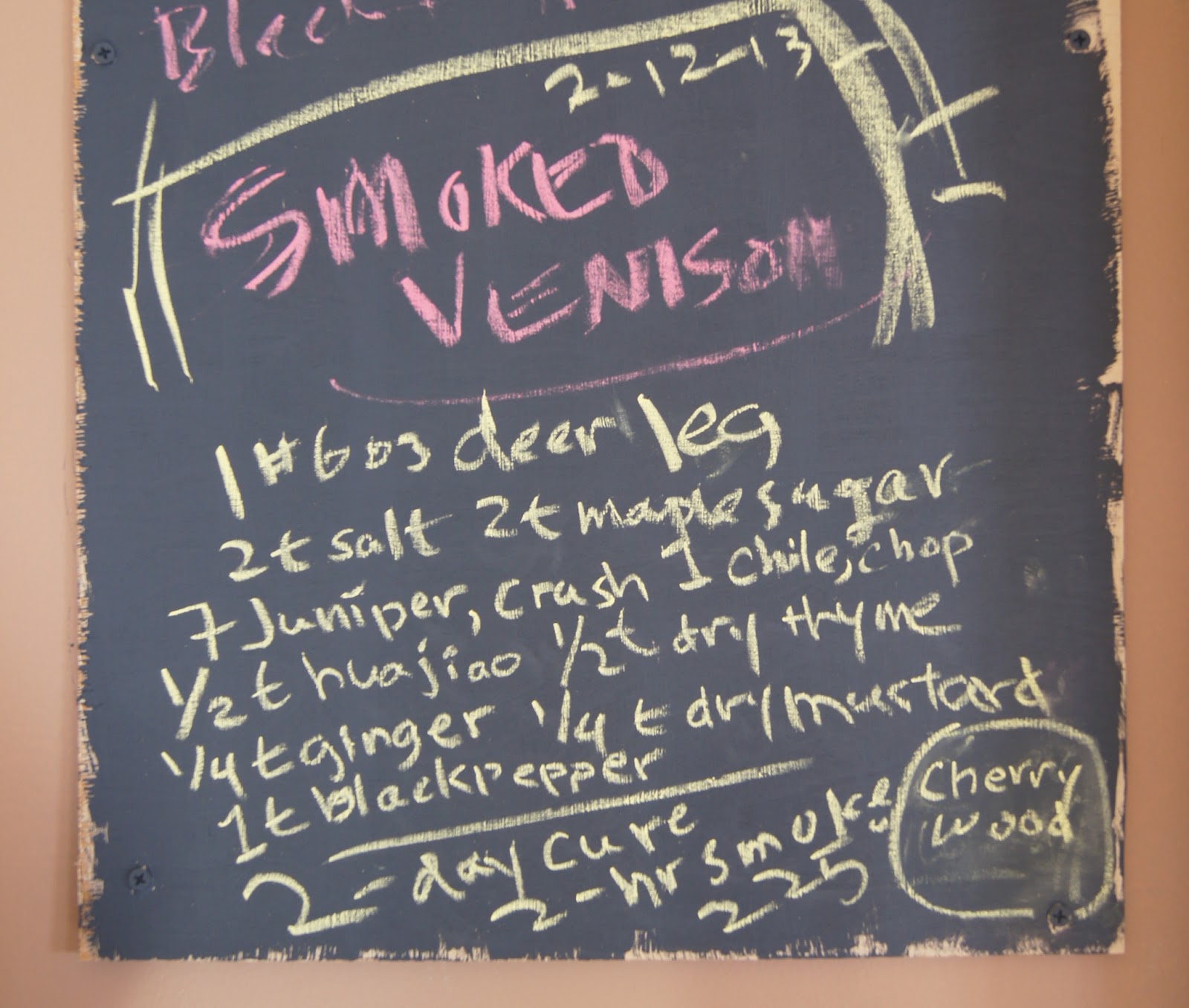
I cured it with a dry rub, and went for some fairly aggressive seasonings.  Here’s the recipe (chalkboard paint is fun…):


Hua jiao, once again, is Sichuan pepper, in this case the dry-roasted and ground up kind.  Ginger is the dry spice, chile a dried red one.  I used locally produced maple sugar, but you could substitute brown sugar in the same amount, or maple syrup, say 1 ½ tablespoons.  I massaged the meat with the seasonings and stuck it in the fridge for a couple of days, turning it several times.  Not a lot of liquid came off. 

Then I smoked it in my trusty Meco grill for about two hours at about 225, and I used wild black cherry as the main smoking wood, something I haven’t tried before. The end result was a delightful confluence of happenstance and experiment. I had no idea what the final product would look or taste like.  It smelled fantastic coming off the grill, and when I cut into it I was amazed at the color.  The taste is deep, layered, mysterious, and wild, but with a delicate texture that makes it seem refined, as well.  Really cool stuff.  What it reminded me of most was pastrami, which is smoked corned beef, so I guess that makes sense.


I have cooked slices to serve with eggs and polenta, and that was good, but I think it’s best straight up, on a slice of toasted country bread.  The sauce gribiche variation I came up with to accompany it doesn’t detract.  This is a really good time of year to dip into the pickle pantry for fresh and crunchy flavors.  The rhubarb pickles I made last summer have mellowed really nicely.  The sauce is composed of:

A grated hard-cooked egg
Dollop of Hellmann’s mayonnaise
A minced pickled ramp and a little of the pickling brine
Same amount minced pickled rhubarb
6 or 7 minced milkweed bud “capers”
A half teaspoon or so of sambal

I’ll run down the other preparations in another report.  All were worth recreating.

Text and photos copyright 2013 by Brett Laidlaw


Thursday, August 2, 2012

Yogurt Cheese, Incidental Smørrebrød, and the Open-Face Sandwich Conundrum


I made yogurt cheese for the first time last night.  What a revelation, and how insanely easy!  All I was really trying to do was remove a bit of whey from the yogurt so the dressing for my cucumber salad wouldn't be so watery.  I dumped some yogurt into a cheesecloth (really a scrap of worn-out dish towel I use for fine straining) and let it drip.  I took what I wanted for the salad, and the rest of it sat out overnight.  I tasted it in the morning; I was stunned.  Tangy, creamy, savory—I would not have thought something so rich and wonderful could have come from plain old yogurt.  I made fresh cheese recently with a method that involved culturing, cutting curd, cooking, and straining.  Much more involved, and in the end most of the milk went away as whey; more than that, the end product, while perfectly fine, was not nearly as interesting as the yogurt cheese.  Labneh, it’s called in parts of the Middle East; David Chang likes it, it turns up in the Momofuku cookbook. 

I think I’ve got myself a new hobby, coming up with different ways to flavor the basic cheese.  Furthermore, my days of buying chèvre may be over.  Obviously, the quality of the yogurt is paramount in determining the quality of the strained product.  I am sure that our wondrously rich Wisconsin milk from happy grass-fed cows makes all the difference (but Cedar Summit is fabulous, too).

So then, just a little while ago as I passed through the kitchen on the way to pick blackberries, I beheld that cheese still nestled in the strainer, and next to it a container of tomatoes, and beyond that the bread board.  I would need sustenance for my fruit harvesting efforts, and so this incidental smørrebrød was born.  I thought it was pretty, and that you would enjoy to see it.


Smørrebrød, a beautiful thing, and what a joy to the baker’s heart, a meal based upon bread.  But the open-face sandwich is a curious concept, is it not?  Oxymoronic perhaps, for does not the very essence of the sandwich involve the presence of enveloping components, the bottom, then the top, between which the sandwiched item or items is/are sandwiched?  The open-face sandwich might be construed as an aberration, a perversion of nature, wherein the intimate embrace of sandwiching and sandwiched is violated, the that-which-should-be-hidden is laid bare, exposed to the pitiless scrutiny of an indifferent universe.

Or is it, on the other hand, like the koan of the sound of one hand clapping, a philosophical puzzle for us to contemplate in hermetic solitude?

And is it open-face, or open-faced, and is the hyphen required?  Each variation carries subtle implications all its own.

Questions, questions.  Perhaps I will try to answer them after lunch.  And then I still have to get up to Bide-A-Wee and pick those berries.  I got a little distracted....


Text and photos copyright 2012 by Brett Laidlaw