Showing posts with label Bolen Vale. Show all posts

Wednesday, December 14, 2011

Along the Fencelines


The Europeans have their ancient, charming hedgerows, and New Englanders their stone walls to divvy up the countryside, but it's barbed wire that tamed and partitioned the American west--and that includes western Wisconsin.  Those fencelines that follow the town and county roads can be a northern forager's last resort to gather some wild foods before the weather gods realize we're staring hard at the winter solstice, and
let the other shoe drop (this week's damplish thaw even allowed me to harvest more fresh greens from my garden; this won't last).

Ploughs and ditch-cutters both must leave a little leeway along the wavering barbed wire fences, and that small margin gives hope and a chance to a variety of wild food plants--asparagus, plum, grape vines, hazelnuts, jerusalem artichokes, black cherry, elderberry, and nannyberry, to mention a few.  It was an unexpected glut of nannyberries that caught my eye last weekend along a Dunn County road.  Clusters of black fruit still remained on several shrubby trees that I passed on the way back to Bide-A-Wee from picking up a newspaper in town (said paper contained a really nice account of Lily's and my recent hunt with Saint Paul Pioneer Press outdoors writer Dave Orrick).


Nannyberries, with a vine that is probably...

I pulled over and slopped through several inches of dirty snow to have a look, and a taste.  This far into December, I didn't expect that the berries would be good for much, so I was surprised at how sweet and flavorful the flesh was.  There's a reason, I guess, that another common name for them is "wild raisin."  I filled a small sack and took them back to the cabin to see what I could do with them. 

At another spot I was fooled by a nannyberry look-alike:

...a type of smilax; edible but, according to one wild foods expert "probably icky."

I wasn't sure what this was--thought it might be Carolina moonvine (a wild guess), but couldn't find corroborating evidence on that.  That's when it's nice to have a true wild food expert in the address book:  my friend Teresa Marrone wrote back right away, nailing the ID as a type of smilax, or greenbrier .  (If I had had Teresa's excellent Wild Berries and Fruits Field Guide close to hand, I wouldn't have had to bother her, but it's nice to break up the day with a little email banter.)  Teresa described the smilax berries as "edible but rubbery and distasteful when fresh."  Ever the scrupulous researcher, she went on to speculate that in their desscated state they were "Probably icky."  Now my curiosity is piqued, and I'll have to give them a taste if I come across them again.  She also said that in spring the young shoots were edible and enjoyable, and noted that Sam Thayer  writes about smilax in one of his books; I have those books, of course, but everything is in Wisconsin, while I write from Saint Paul.

Each year as the foraging season winds down to its last dribs and drabs, just before everything becomes well and truly frozen or buried in snow, I like to find some unlikely remnant, a little something to see out the

The beak-y protrusion at the ends of nannyberry branches are distinctive.

season on an up note--a few dried prickly ash berries to flavor a fruit sauce for duck; some blackberry leaves or late sprouting nettles to steep into tea; dandelions or sheep sorrel that green up in a December rain, as we're seeing now.  This year the nannyberries were my last best hope, it seemed.

I started by sorting through them and separating berries from stems, discarding especially gnarly looking berries, or ones the birds had pooped on.  I wound up with a generous cup of berries from my small harvest, and those I placed in a small saucepan with water to cover, covered the pan, and set it on the woodstove to simmer.  I didn't really time it.  I checked on it every now and then, added a bit of water as the level cooked down.  As they cooked they gave off a layered aroma, of fruit, of tea, of bramble leaves--reminiscent of haw berries simmering.

When it seemed that they were soft-ish I poured them into a sieve, keeping the water, and mashed at the fruit with the back of a wooden spoon.  I wasn't able to get too much pulp out this way, so back in the pan the mashed nannies went, more water to cover, and back on the Haggis to simmer.  In another 15 to 20 minutes I gave it another go--much better this time.  All that remained in the sieve were the skins and the large flat seeds, much like a watermelon seed, that come one to a berry.


I chopped a few slices of dried apple and added these to the nannyberry...slurry, I guess it was, thicker than juice, thinner than a paste.  I wanted the apple for texture, and also for tartness to balance the nannies' sweet, rather bland taste.  When fresh and just ripened, nannyberries have an appealing date-like texture and a flavor that reminds me of dates and banana.  The dried ones were less subtle, some nuance lost as they dried along the fencelines.  I hoped the apple would perk up and round out the flavor of the concoction as a whole.

I just happened to have a chunk of sweet and salty, dense and crumbly ten-year-old Wisconsin white cheddar in the cooler.  I was thinking of quince paste, or a mild chutney, that would complement but not upstage the cheese.  I considered a bit of spice, or heat, or an allium element, shallot or garlic.  In the end I let it be, just the nannyberries, apple, and a pinch of salt.
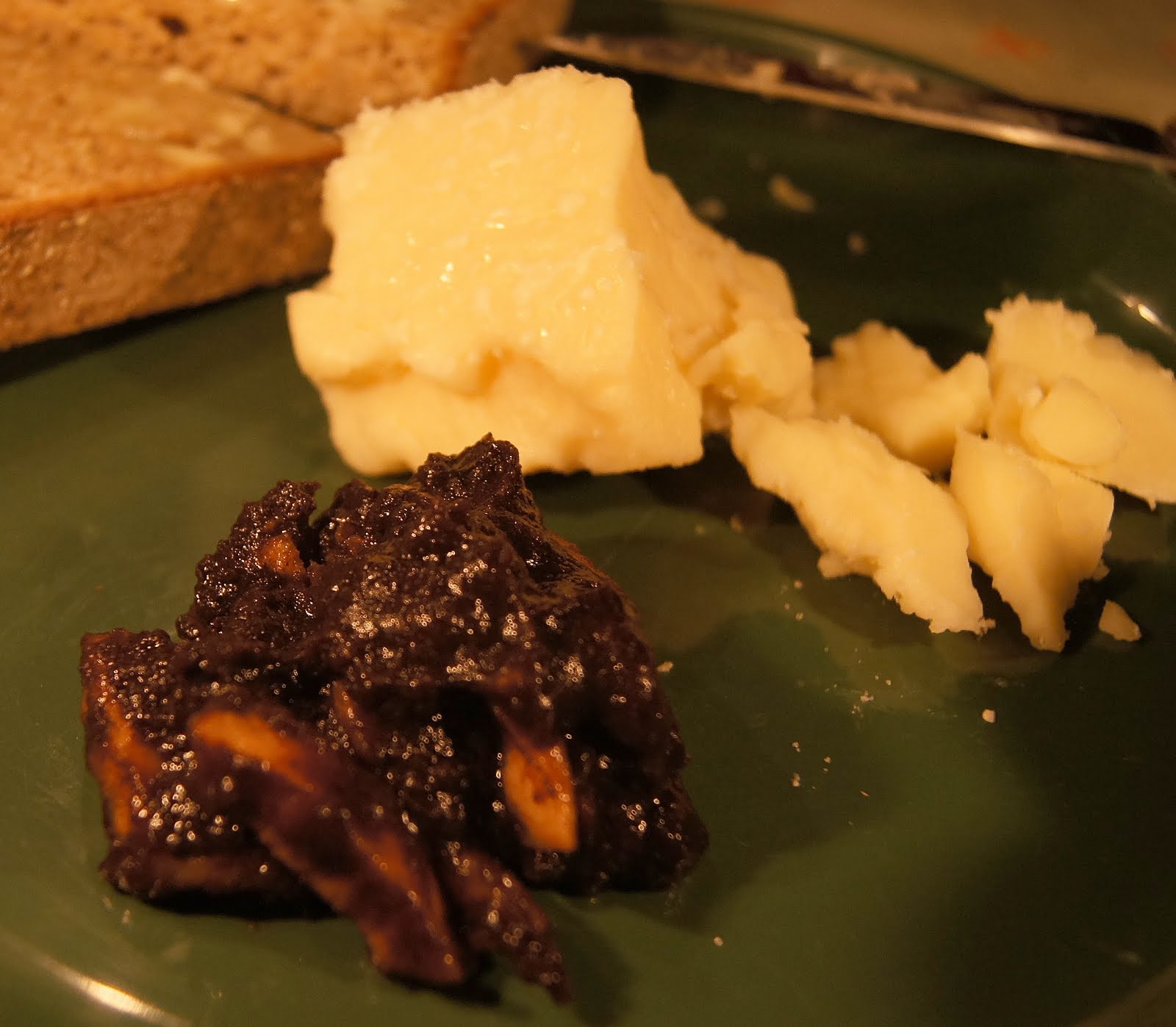

The compote did not want to be photographed; something about the glossy sheen confounded the focus every time.

I considered it a quiet triumph.  The cheese and my nanny-apple compote got along very nicely.  The no-name cheese--a "commodity cheese," it might be called, but what a ludicrous misnomer--came from Bolen-Vale, for around $12 a pound.  And now, it's not that I think the $20-plus-per-pound farmstead cheddars are over-priced, it's just that, having tried a few, I find that none please me as much as this modest over-achiever. 

I've said enough.  A slice of grilled sourdough and a glass of wine, raised in a solitary toast to what may have been (or may not be) the end of the foraging season, made a very satisfactory Bide-A-Wee bachelor supper, and pleased me very much.

Text and photos copyright 2011 by Brett Laidlaw

Tuesday, November 8, 2011

A Dinner Too Far / The Sirloin Strikes Back


Today's double feature showcases the struggles, hardships, and eventual heart-swelling triumph of a much-anticipated Bide-A-Wee supper in the first act; and in the second part of the double bill, the thrilling tale of how a modest piece of beef overcame an overly conceptualized side dish to win the admiration of hungry diners.

To put it another way:

In a world where overwrought home cooks obsess over the local and seasonal, and go to torturous extremes to distill gold from the dross of roots and grains, how can a humble piece of sirloin rise above the fray and stake its claim on the lawless frontier of dinner...on a plate...on, uh, the table?

Well, let's start with the wheatberries.  I've had this notion, a long time brewing, of a rich and satisfying risotto-like dish, based not on rice (which doesn't grow around here) but on wheatberries, which do--the wheatberries (wheat seeds, in reality) in my Bide-A-Wee cupboard come from just a few miles down the road in Connorsville, grown on the Bartz farm .  An earlier attempt at such a dish foundered on the shoals of underdone wheatberries.  I learned from that attempt that the wheatberries must either be cooked a very long time, or sprouted for a couple of days prior to cooking. 

I'm against the idea of a "risotto" that cooks for hours, and I like the idea of sprouting, which sort of precooks the berry, sans heat, and creates a natural sweetness in the grain.  Sprouting grains is the first step in malting, a process used in the production of whisky, beer, and, of course, malted milk balls.  As the seeds sprout, the starches therein are converted to sugars.  The soaking process also allows the hard seed to absorb water, so that after being kept nice and moist for two or three days the sprouted seed is quite edible--just like beans sprouts or alfalfa sprouts, though a good deal more al dente.

So: my idea was to sprout wheatberries for a couple of days, then combine them with some sautéed onion, a fine dice of celery root, chicken stock, herbs, a suitable amount of butter, and finally, some hen of the woods mushrooms.  This was to occur on Saturday night at Bide-A-Wee.  We would serve it with a piece of grilled sirloin we'd picked up at Seward Co-op .  Seemed eminently do-able.


But you know how things that seem eminently do-able in the encouraging light of morning can come to seem, by the end of that day, in the fading evening light, not so do-able anymore, and as delicious as that anticipated meal sounds, it would sound way better if someone else were making it?  That was where I was on Saturday evening, after a morning radio interview, family luncheon get-together, packing-up-driving-out-unpacking, fire lighting organizing, pour a drink and--hey, can we call out for pizza?

Well, at Bide-A-Wee, no, we cannot.  You just have to down that martini, buck up, and get on with it.  The first thing that went out of the picture was the grilling.  It was after seven, it was dark, and I had no desire to be going in and out of the cabin to tend a fire.  The woodstove was blazing away.  We would sear the steak in a cast iron skillet atop it.  I got going on the "risotto" of wheatberries.  I chopped a small onion and made a very small dice of half a small celery root--about 2/3 cup once diced.  In a saucepan atop the Haggis I melted a tablespoon or so of butter, added the onion, and as it began to wilt, the celery root.  As that took on a little color I dumped in the sprouted wheatberries.  That was half a cup to begin with, now swelled to a generous cup, so it appeared.  Stir that a bit, add salt and pepper, then around a cup of chicken stock.  When that got to a simmer I covered it and let it cook very slowly.  I figured that it wouldn't need to be stirred as often as a proper risotto.  I checked back in five minutes.  Didn't look like the wheatberries had taken up any stock.  Gave it another five. Same deal.  Ten more.  No real change, though the berries did taste like they were softening.

What I eventually learned from this round of wheatberry risotto experimentation was:

1) I should stop trying to make risotto out of things other than rice, and
2) When wheatberries sprout, converting starch to sugar, then the starch is no longer there to thicken the dish.

What I wound up with, in the end, was a sort of a brothy pilaf, and I let that cook uncovered while the steak cooked, to reduce the stock and intensify the flavor.  (A side note:  Originally I had planned to add some frozen sweet corn--also from Connorsville!--to the "risotto," but the wheatberries themselves had a crisp vegetable sweetness quite like corn, so I left it out--it went into the next night's lamb stew, instead.)

And so we turned to the steak.  I put the cast iron skillet on the stove, added wood and worked the bellows to get it really hot.  I salted and peppered the steak and brushed it with a little oil.  It was a Hill & Vale bone-in sirloin from the butcher's case at Seward.  You don't see bone-in sirloin that often.  It has always been one of my favorite cuts of beef.  It doesn't get the kind of press that a marbled ribeye or strip steak does, but the flavor can be extraordinary.  So I had high hopes, though I also knew that a simply cooked piece of meat can often be overshadowed by a meticulously planned side dish like the one that was...currently failing to materialize on the woodstove.


The skillet wasn't as hot as I would have liked when the steak went in.  On the turnover the sizzle was largely gone.  We added wood, we bellowed.  I figured this was going to be one that we would write off to experience.  Planning simple meals for the first night at the cabin was supposed to have been a cardinal rule by now, but, you know, you get cocky....

About this time I remembered the hen of the woods mushrooms that I was going to put in with the wheatberries.  They were precooked--in fact, they'd been roasted off in some pork fat rendered from a piece of belly I'd braised earlier in the fall--and they were--well, they were hen of the woods roasted in fresh pork fat, what more do I need to say?  As the sirloin rested (preparing to strike back!) I deglazed the pan with a little red wine, added some more chicken stock and the mushrooms.  That reduced quickly and wonderfully.  We served it up.


For a meal that bore little relation to what I had originally had in mind--no, strike that:  Without qualification, it was superb.  Let's start with the steak:  chewy-tender, deeply beefy, with a compelling tang and savor to it--the best piece of beef I've eaten in a long time, and not diminished at all for not having been grilled.  The mushrooms with their porky undertones provided a complementary meatiness and texture.

And then the wheatberries and celery root:  the wheat was sweet and slightly crunchy, the celery soft and savory.  Neither risotto nor pilaf, but a beautiful autumnal dish that I'll make again, and I'll just call it:  sprouted wheatberries simmered with celery root.


This is a lot of verbiage expended on one Saturday supper, I realize.  But in doing interviews to promote the cookbook, I've been asked about my approach to cooking, this expanded sense of "foraging" that I'm trying to shove down the public gullet(!), and what it means for cooking to be "ingredient-driven."  Well, I think this sort of goes to all those topics.  For what it's worth.

Text and photos copyright 2011 by Brett Laidlaw

Wednesday, June 22, 2011

Solstice Aioli


Going back to that idea of honing a finer sense of the seasons , I can report that it's the season of setting fruit out at Bide-A-Wee.  Last year was a dismal one for our apples, as well as for most of  the wild fruits, except for the wild plums, which seem to come through every year.  This year the hawthorns, black cherries, chokecherries, and serviceberries are all setting up nice crops.  In spite of a cool pollinating season, the apples look good--the largest are already an inch-and-a-half across, and reddening.  We have one more gallon of sweet cider in the freezer--maybe barely enough to get us through to a first pressing of this year's fruit if we ration it carefully.  A couple swallows in the morning is enough to start the day off on a happy note.

It's haying time, too--our friend Renee Bartz told us this weekend that they'd cut their second crop of hay, and now hoped for a few dry days to get it baled (not looking like that wish will come true).  You see this age-old practice taking place all across the Dairy State countryside.  Where one day there was a field of tall grass, the next there's a shorn landscape looking something like a very rustic golf course, except dotted across it are the cylindrical bales of hay, a lovely sort of order brought out of the unruly growth, entropy reversed.

With the cows out on new grass, the raw milk we get from the Bartz's Bolen-Vale farm is the richest of the year.  Last weekend we skimmed the cream from the top of the jar and spooned it over the first strawberries of the summer, and we swooned.


And at the market, the season is that of the first summer vegetables.  The leafy things were pleasant enough, asparagus delightful, but it's greatly heartening--and appetizing--to see the next wave coming in, in this case young beets, snap peas, and most gloriously, the first green garlic.  That market haul, and a successful outing on the trout stream (oh, really, they're all successful, whether I catch fish or not), set the scene for an aioli dinner to mark the summer solstice.  (For the mayo/aioli how-to click here.)


Please note that no adjective accompanies aioli here, nor ever will, unless to make the derisive point that none ever should.  Aioli is aioli is aioli.  Chipotle aioli?  Nah.  Lemongrass aioli?  Skip it.  Garlic, oil, egg yolk, a bit of mustard, a squeeze of lemon juice, a pinch of salt, that's what's in aioli.  Oh, now I've read that in Provence some local variations omit the egg yolk, using cooked potato or bread as the binder.  I've never tried it that way.  You could call it garlic mayonnaise and not be far off, except that aioli deserves a more prominent place at the table than is commonly accorded mayonnaise.  It needs to be seen and appreciated, inhaled, dolloped out in copious portions for dipping and dabbing--a clandestine schmear on a sandwich or burger doesn't do it justice.


See the two unctuous globs on the plate above?  The yellow one  on the left is aioli, of course, and the green one is sorrel-tarragon mayo, which only had some garlicky undertones because I chopped the herbs in the same place on the cutting board where I puréed the garlic for the aioli.  I did that on purpose.  To half a cup of mayo I added four smallish sorrel leaves and just a sprig of tarragon, the most assertive of herbs, to my taste.  A dandy combination--but not aioli, mais non.


As for the trout, it was poached in a court bouillon flavored with green onion tops, carrot, thyme, tarragon, cutting celery, black pepper, and some Breton bouillon flavoring containing sea salt, algae, fennel, and some other spices.  We picked it up at a small market in Brittany a good while back.  It seems to keep.


The beets (Menomonie farmers market) and potatoes (not local, I'm afraid), I roasted with olive oil, thyme, rosemary, fleur de sel, black pepper, and chopped green garlic, at 375, for 40 minutes covered, another

15 uncovered.  I peeled the beets first.  And then the asparagus and snap peas (stringed) were blanched in salted boiling water for two minutes.

An aioli plate is the ideal sort of meal for long summer evenings, and this was the longest of all.  We sipped a petit chablis, our glasses
appealingly misted in the humid evening.  The monsoon rains came and went, a downpour, a sunburst. I guess you could say it's summer.

Tuesday, September 7, 2010

A Delicious Failure: Wheat Berry "Risotto" with Hens and Squash, Cider-Thyme Cream


The report on wheat berry "risotto" is this: wheat berries do not make "risotto," no matter how many "quotation marks" you put around "risotto." I'll stop doing that now; I realize it's annoying....

And yet the dish was delicious, memorable, even. It had a concept, a conceit--hot cereal for supper--and that even worked. The picture I had in mind was of an island of, say, Red River cereal, hot and grainy, in a sea of milk. But in my savory version the grain mush would be studded with shreds of hen-of-the-woods mushrooms and nuggets of squash, napped about with a rich reduction of cream and cider, infused with thyme.


In a sense, the whole thing came about because of thrift, and Rene Bartz. As for the thrift, I had most of a pint of Cedar Summit heavy cream in the fridge, two weeks past freshness date but still remarkably good; I had to use it before it went. As for Rene Bartz, well, she's our friend who runs the Bolen Vale cheese shop at the family's dairy farm on highway 64 in Connorsville, Wisconsin. We pass the shop coming and going from Bide-A-Wee most weeks, and we buy most of our cheese from Rene. We also occasionally buy whole wheat flour, and wheat berries, which Rene grows. I often put the sprouted wheat berries in bread, and it occured to me recently that maybe you could use the whole grain in a risotto-type dish. Barley is sometimes substituted for rice in risotto, why not wheat?

So I forged ahead with plans for a dish that would be extremely local, seasonal, and perhaps a revelation. I have a deep and abiding affection for rice, any kind of rice. I love risotto, paella, pilafs, sushi, rice noodles, rice crust; a fragrant bowl of jasmine rice with a Chinese meal, or basmati with an Indian curry. But rice will never make it into a Trout Caviar recipe, because it is the farthest thing from a local product here. I think you'd have to travel to Louisiana, or North Carolina, to find the nearest rice field. Wild rice is wicked local, of course, but it's not rice. I didn't think it would make a tasty risotto.


Hence, wheat berries. But a wheat berry, it turns out, is just a little too unprocessed to make a creditable risotto. It's really a wheat seed--soak it in water for a couple of days, it will sprout; plant it, you'll grow a wheat stalk. Very Northern in its character, a wheat berry keeps to itself, discreet and a bit stoic. For surviving life on the cold plains, these are admirable traits; for making risotto, not so much.

To get to the point, separate the wheat from the chaff, as it were: The wheat berries in my risotto, even softened by a couple of days' soaking, did not give themselves starchily, creamily to the pot, as the grain in a good risotto must. After 10 minutes cooking they retained a resilient al dente texture, after 20 minutes, exactly the same, and after 25 or so, no change, and we said, "Hey, let's eat." Since the berries weren't opening to meld in the pot, the typical risotto method of stirring while adding small amounts of stock didn't work. I wound up just putting the lid on and steaming it.

In the end, our jaws got a workout, our tastebuds were delighted. The textural contrasts were intriguing--both the wheat berries and the mushrooms had a crunch to them, but different sorts of crunches; the squash, buttercup that we picked up at the Dallas Farmers Market, which I was afraid would go to mush, be lost in the mixture, provided a really welcome creamy component.

The cider-thyme cream was a total winner. I reduced the cream by about a third with a small handful of thyme sprigs, added the cider and reduced by a third to a half. It seemed a little sharp, on its own, I was afraid I'd used too much cider, but a little salt balanced the sharpness, and spooned around the fragrant, grainy, not-quite-mush, it was a lovely, lovely pairing. We cleaned our plates. A sprinkling of grated smoked Marieke gouda from Holland's Family Cheese just a little ways east of Bide-A-Wee down highway 29, didn't hurt a bit.

I would not make this again, not exactly this way. I'll keep working on a wheat berry preparation that comes closer to the risotto ideal--cook the berries longer before starting, make in a pressure cooker? Soak them, then whiz them in the FP a bit to open them up? The quest goes on. All suggestions welcome. Thank you very much.


Text and photos copyright 2010 by Brett Laidlaw