Showing posts with label roots. Show all posts

Thursday, January 28, 2016

Zesty, Rootsy Winter Pickles


With fresh local vegetables becoming more and more widely available to us year-round, even here in the Frozen North, there’s no reason that pickling season has to end with the first frost.  Co-ops and winter farmers markets are burgeoning these days with locally grown vegetables in great variety.  Yes, they’re mostly roots, but what an abundance and variety of roots, from black, watermelon, beauty heart, and daikon radishes, to turnips in several colors, rutabagas, beets red and golden, celery root, sweet potatoes, carrots, parsnips.   

What’s great about this is:  Fresh, locally grown produce, in the middle of frikkin’ winter!  What’s less awesome is:  They’re all pretty much radishes and turnips!


Personally, I like radishes and turnips, but a steady diet of them through the long cold months becomes pretty monotonous.  A little pickling is a good way to change up the flavors and textures of these hearty, assertive roots.  And for winter pickling, I tend to lean to the East.  So here are two easy Asian pickles to make in small batches and enjoy alongside a bowl of ramen, a rice bowl meal, or as part of a regular Chinese meal, or just to nosh on at will. 


The first, Sichuan Pao Cai (Pickled Vegetables) is something I’ve made off and on for a long time, and something I would often order at the little restaurants in the alleys outside the university gates when I taught English at Sichuan University in Chengdu, waaayyy back in 1989-90.  A little dish of pao cai would be served bathed in chile oil (hong you) and a dash of soy sauce.  The pickles in Chengdu were always pink, I’m not sure why.  Recently I came across a fabulous recipe for a chile oil scented with wonderful aromatics.  I’m now addicted to it, and here’s the recipe, from Elaine Luo's excellent China Sichuan Food website--you'll find the red oil (hong you) recipe in the larger wonton recipe.

The other is a super quick pickle of thinly sliced radish (but you could sub/add turnip or carrot or what have you) in a simple mixture of soy sauce, vinegar, and sugar, with a little ginger and garlic for added depth.  To me, the sweet/sour/salty flavor combination of sugar/vinegar/soy is crazy delicious.  I could drink it like broth, but it would do weird things to the inside of my mouth, I fear, so I enjoy it in moderation and in pickles. 

This can be whipped up at the last minute, or made a day or two ahead.  It loses some freshness if left to sit too long, but it’s not going to go bad.  I often make up a small quantity to liven up rice bowl dinners.  With small radishes I tend to slice them very thin on the Benriner, while with larger radishes like a big daikon, I might shred instead.


Sichuan Pao Cai (Pickled Vegetables)

Makes one quart

You can use pretty much any firm vegetables in this pickle.  In winter it’s going to be mainly roots—red beets are the only one I would probably avoid; they would take over the pickle, both in color and taste, and also, they’re just not very Chinese.  In summer you could use green beans, cucumbers, peeled, diced broccoli stems, the thick white center rib of napa cabbage or bok choi.  My veg mixture for this batch was black radish, daikon, rutabaga, kohlrabi, cabbage core, and another radish, the one that’s pink inside, I don’t know the name, a friend had picked it up for me.  

This recipe is adapted from Mrs Chiang's Szechwan Cookbook, a key book in my cooking history.

4 cups firm vegetables in ½-inch dice, about a pound
6 – ¼-inch slices ginger root
2 or more dried red chiles—I used 2, as these particular chiles are VERY HOT!!!
½ teaspoon whole hua jiao (Sichuan peppercorns)
1 ½ cups water
1 tablespoon salt
2 teaspoons sugar
1 tablespoon rice wine or dry sherry
1 tablespoon cider or rice wine vinegar

Combine everything except the diced vegetables in a small saucepan, and heat just to dissolve the salt and sugar.  In a quart jar, layer ginger slices, chiles, and vegetables.  Pour in the brine, put a lid on it, and allow to ferment at cool room temperature for 3 or 4 days. You’ll see the brine start to become cloudy, and bubbles will rise from the depths when you open the jar.  When they are fermented to your taste, refrigerate.  The pickles will keep indefinitely.


Soy-Pickled Radish Slices

A mild radish, such as daikon or watermelon, is best in this pickle, which can be used almost right away, or refrigerated to mellow for a few days.  I used my Benriner Japanese mandoline to slice the radishes, but you can also slice them very thin with a sharp knife.

About 2/3 cup thinly sliced small radishes, or shredded larger ones
1 teaspoon finely shredded ginger root
1 small clove garlic, crushed, optional
2 tablespoons soy sauce
1 tablespoon water
4 teaspoons cider or rice wine vinegar
2 teaspoons sugar

Combine the radish slices, ginger, and garlic, and place them in a small jar—half-pint will do.  Combine the rest of the ingredients, stirring well to dissolve the sugar.  Pour this mixture into the jar with the radishes, put the lid on, give it a little shake.  Let stand at least 30 minutes before serving, or refrigerate for later use.  Will keep at least a week.

Thursday, January 14, 2016

Simply Superior Soup (or "Effing French Cooking Magic")


It’s the last week of December 2015 as I (begin to) write this, 2016 looming just days away, and for cooking options we are decidedly into the winter larder.  On December 6 we were amazed to eat, and very much enjoy, the last garden tomato.  The last leaves of fresh kale were part of a festive Christmas dinner:  seared venison loin (harvested from the Bide-A-Wee property last year) with a rich, savory red wine and port reduction; lima beans simmered with stock and aromatics, then pureed, a surprisingly luxurious result from a humble dried bean; then the kale, braised with chestnuts and garden leek, a splash of our homemade cider vinegar.  Though we haven’t really celebrated Christmas in any traditional way for some years, I’m not going to let an opportunity for a festive dinner go by.  And anyway, we think of it as a continuation of our solstice festivities—especially appropriate here, as Mary’s birthday occurs during the same time.

Once those last leaves of kale vacated the crisper, dinner planning turned a page.  It’s true that there’s still quite a bit of “fresh” produce, from both garden and farmer’s market stock-ups, in our cellar, in the fridge.  But the term fresh doesn’t really mean the same when applied to storage carrots, cabbage, squash, and onions, as it does when describing a handful of beans or a bowl of tender lettuce harvested from the garden to be prepared and served minutes later.  Those winter stand-bys are fresh in the sense of not being frozen, dried, pickled, fermented, etc., but…you know what I mean.  It’s not the same as throwing dew-dappled snap peas in the wok or snipping fragrant dill into a dressing.  Our vocabulary fails us in efficiently denoting that crucial difference:  there’s fresh produce, and then there’s fresh produce. 

This is not to disparage the stalwart vegetables of winter, not at all.  Like reliable character actors, they show up and fill their roles with unfailing professionalism, year after year, decade after decade, while the fad for arugula fades, or a trendy heirloom cucumber turns out to be just another pickle, after all.  Cabbage, potatoes, carrots, squash, onion, leek, turnip, beets--the roster might at first glance suggest daily supper at the gulag:  bung it all in a kettle, boil until done.  But there’s a saying I like (and as far as I know, I came up with it), goes like this:  There’s meat, and then there’s cooking.  Which is to say:  It’s not always only about the ingredients, but often as much or more about imagination and skill in preparation.  Today’s soup, which we had as a first course on Christmas night, is a perfect example.

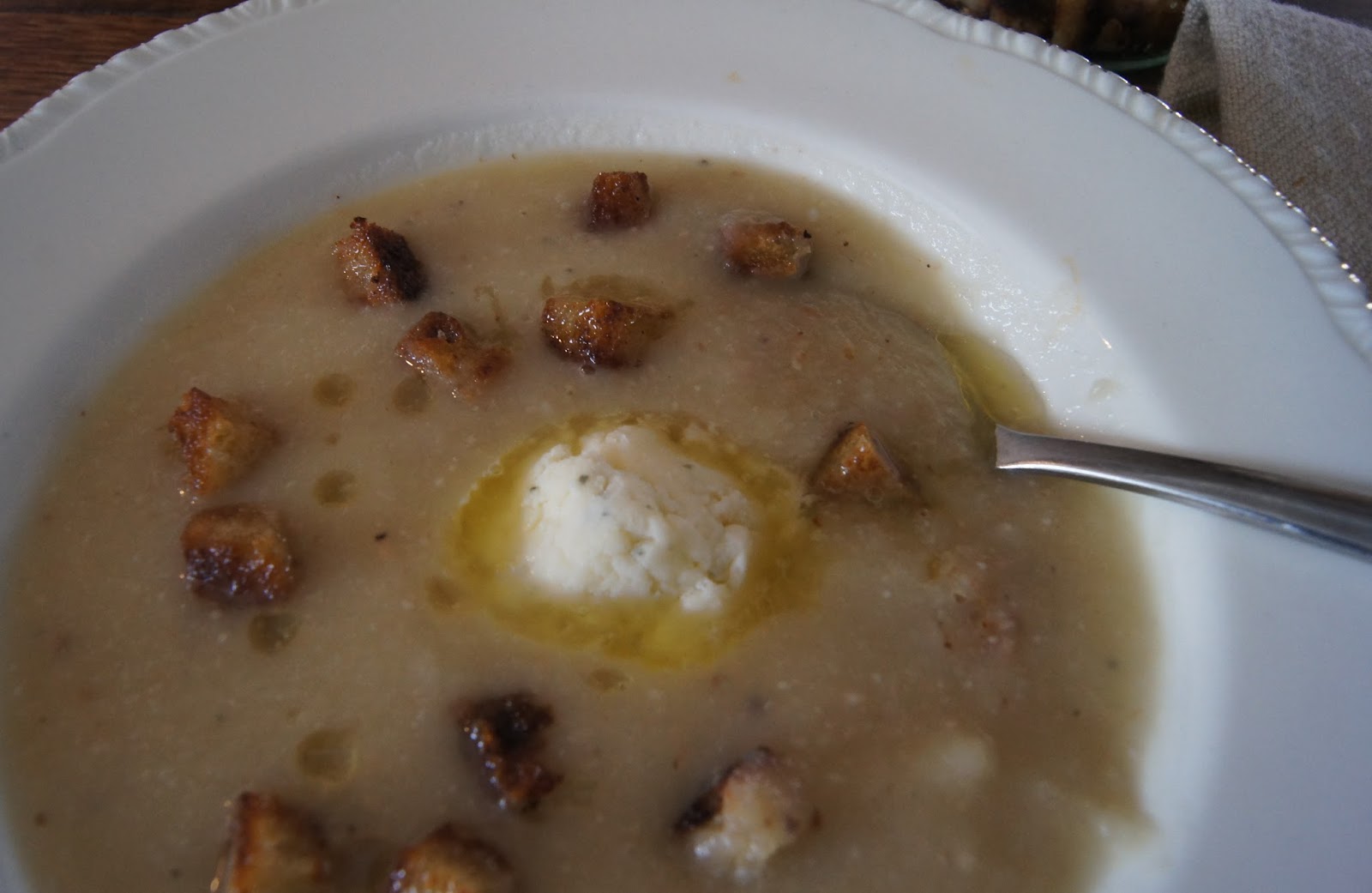
If it hadn’t come with a sexy French name, I might never have tried it.  Puréed cabbage and potato soup sounds, you must admit, a good deal less appealing than Crème de Choux aux Beurre de Roquefort.  The source is Madeleine Kamman’s In Madeleine’s Kitchen.  There are three remarkable and surprising things about this recipe:

1)  In spite of the cream—crème—in the title, there’s no cream in the soup.
2)  In spite of the fancy-sounding title, the list of ingredients is short and plain.
3)  In spite of the short, plain ingredient list, the resulting soup is delicious, even luxurious, the result of “Fucking French cooking magic,” as I described it, enthusiasm overwhelming decorum, in a tweet.


There are a couple of secret ingredients:  walnut oil, and confit fat.  But I think you could do without those if you don’t have them, substituting good butter for the confit fat, olive oil for the walnut oil.  However:  if you haven’t tried French walnut oil, it is well worth seeking out.  A commonly available brand, and the one we always buy, have even brought back from Paris in the past, is J. Leblanc.  It’s pricy, but a little goes a long way.  For me, a salad of fresh tender lettuces straight from the garden, dressed with nothing more than walnut oil and a bit of fleur de sel is one of life’s simple luxuries.  But I’m getting ahead of the season.  Just one more note on the walnut oil:  the French stuff is made from lightly toasted walnuts, so it’s amber in color and has that nutty fragrance and flavor.  The golden walnut oil often sold at “health food stores” and co-ops is not the same.  The French walnut oil should not be used for cooking, only dressings and seasoning.  (NB: the English name is in small print on the bottle, so you’re looking for a bottle labeled “Huile de Noix,” as above.  For Mpls/St Paul readers, Cooks of Crocus Hill carries it, but are currently out of stock in all stores.)


The basis of the soup is potatoes, cabbage, and water.  It gets a smoky depth of flavor from bacon.  Not a lot of bacon, either, less than an ounce per person in Kamman’s recipe (she actually calls for pancetta).  No cream or milk, as noted above.  No stock, just water (you can call it Chateau Sink, as Jacques Pepin sometimes jokes, or perhaps Domaine du Tappe, to French it up).  There’s a bit of garlic, whose presence is felt.  The beurre de Roquefort is simply blue cheese and soft butter mashed together, a few grinds of coarse black pepper—a simple compound butter; it’s worth making extra, for it’s nice to have around, to smear on a burger, say.


And that, my friends, is it, the ingredient list in its entirety.  You gently render off small cubes of the bacon or pancetta, add potatoes and garlic, then the cabbage.  This sweats for a few minutes (“mellows,” in M Kamman’s version), then you add water and simmer until the cabbage is very tender.  The well mellowed vegetables and bacon are then whizzed up in a blender (I used a food processor, carefully spooning out the solids, adding liquid gradually; an FP is really not the best appliance for pureeing soups, I’ve learned from bitter experience).


And get this:  it suffers not at all from being made a day ahead and reheated just before serving.  On Christmas Eve I added a little crunchy garnish, chopped goose skin cracklings—yeah, I happened to have some lying around; don’t hate me because I’m beautiful—from the goose we cooked for our first solstice celebration.  When I made it again for lunch I toasted some small croutons in olive oil—it’s really about the textural contrast, that crunch to perk up the creamy soup.  (See:  "It's all about the garnish".)


Coming back around to my earlier point and seasonal eating and the winter larder:  this is a fabulous dish that you would never make in the summer, but which is perfect for the cold months when, you know, you have a lot of potatoes and cabbage around.  It also reminded me how absolutely lovely and civilized it is to start a meal with a soup, so elegant and yet so comforting.  A fading tradition I hope to start reviving in our house.


My adaptation of Madeleine Kamman’s recipe:

Creamy Bacon, Potato, and Cabbage Soup with Blue Cheese Butter

Serves four as a first course, two to three as a main course—add salad and crusty bread to make it a meal

2 ounces bacon or pancetta, preferably in one chunk
1 tablespoon duck confit fat or butter
1 medium or 2 small potatoes, 6-7 ounces total
1 large or 2 small cloves garlic
¼ of a green cabbage, about 12 ounces
1 tablespoon walnut oil, plus additional for garnish*
Salt and freshly ground black pepper

For the blue cheese butter:
2 ounces unsalted butter at room temperature
2 ounces blue cheese

Croutons or cracklings, optional but highly recommended

In a small bowl, mash the butter and blue cheese together with a fork until well blended.

Cut the bacon or pancetta in small dice, about ¼-inch.  Peel the potatoes and cut them into smallish cubes, about ¾-inch.  Shred the cabbage into ½-inch strips.

Heat a medium saucepan and add the confit fat or butter, then the bacon.  Cook over medium-low heat.  As the bacon renders its fat and begins to brown, add the potatoes, tossing them in the fat, then cook, stirring occasionally, until they become a little bit brown, 4 to 5 minutes (you’re just looking for a golden color, not deeply browned as for hash browns).  Stir in the garlic and cook for another minute or two, then add the cabbage, a couple generous pinches of salt, and several grinds of black pepper.

Turn the heat to low, cover, and let the cabbage sweat (“mellow” is the term M Kamman uses) until well wilted, about 5 minutes.  Add 3 cups water, bring to a boil, turn down to a simmer, and cook partly covered until the cabbage and potatoes are very soft, 15 to 20 minutes.

Let the soup cool for a few minutes before pureeing.  If using a food processor, separate the solid from the liquid parts of the soup and purée the solids first, then gradually add in the liquid.  When everything is in the FP, purée for about a minute.  At the end of the minute, drizzle in the walnut oil.  Return the soup to the saucepan.  Reheat just before serving.  (Note:  Kamman directs you to strain the soup back into the pot after puréeing; I did not bother with this step, finding the soup smooth enough to my taste without straining.  Straining would no doubt produce an even more velvety and elegant purée, if that's what you're after.)

To serve:  heat the soup and taste for salt; you will probably want to add another pinch or two.  Ladle the soup into bowls, and to each add about a tablespoon of the blue cheese butter.  Add croutons or cracklings, as you please, drizzle a small amount of walnut oil over the surface of the soup, and serve.

*If you don’t have/can’t find walnut oil, use a flavorful olive oil—or, perhaps pumpkin seed oil, such as Wisconsin’s own Hay River Pumpkin Seed Oil.  And, how about this—if using pumpkin seed oil, think about substituting butternut squash for all or part of the potatoes, then garnish with toasted pepitas instead of the croutons/cracklings.

Happy soupage!

Thursday, November 15, 2012

There and Here (Avocado with Black River Blue Dressing)


In spite of my mother’s best efforts to cultivate an avocado forest in Eden Prairie, Minnesota, in the 1960s and '70s, impaling the smooth round pits on toothpicks and suspending them in water-filled juice glasses on the kitchen window sill, I still have yet to taste a Minnesota- or Wisconsin-grown avocado.  Amazingly, those gargantuan seeds did sprout roots, then sent up spindly leaders, which produced a few leaves, and then…who knows their fate?  Perhaps a few got potted, but I don’t recall alligator pears drooping from any of Mom’s houseplants. So, no, avocadoes can’t be counted among the delights of local and seasonal eating in the northland.

Which does not mean that I don’t eat them.  I do.  Lots of them.  They’re among those non-local foods that are regulars in our kitchen, but which I rarely mention here, preferring to focus on the local, but perhaps that gives a weirdly skewed version of our diet.  I would say that probably 90 per cent of our diet is locally sourced—all our meat and most of our fish, all our grains except for rice, pretty much all our vegetables and fruits.  Dairy?  It would be kind of absurd to look outside America’s Dairyland for milk, cream, butter, and cheese, wouldn’t it?  

Still, I would find myself pinched in the kitchen without imported rice, lemon, olive oil, black pepper and other spices.  Our condiment cupboard is not terribly local, with its soy sauce, sambal, rice wine, sesame oil, canola oil, Chinese vinegar—though things have improved there with the relatively recent appearance of local pumpkin seed and sunflower oils; and I am going to figure out how to make my own sambal, with homegrown chiles, next year.  I rarely take a sip of orange juice anymore, and I think I might have forgotten how to peel a banana, but my morning cup is tea from afar, and I enjoy a cup of coffee every once in a while.  

In the pantry I find ketchup made from homegrown tomatoes, honey from hives a few miles down the road, wild blackberry jam distilled from Bide-A-Wee berries, and our very own maple syrup; there is pasta from North Dakota, but also from Italy, China, Japan, and Vietnam.  We should be producing good tofu in our region, but I’m not aware that any is made here.  It’s a staple ingredient in our house, the basis for one of our most common one-dish meals, Sichuan mapo doufu.  I don’t know if I’ve ever mentioned that, nearly five years into writing Trout Caviar.  I should have.


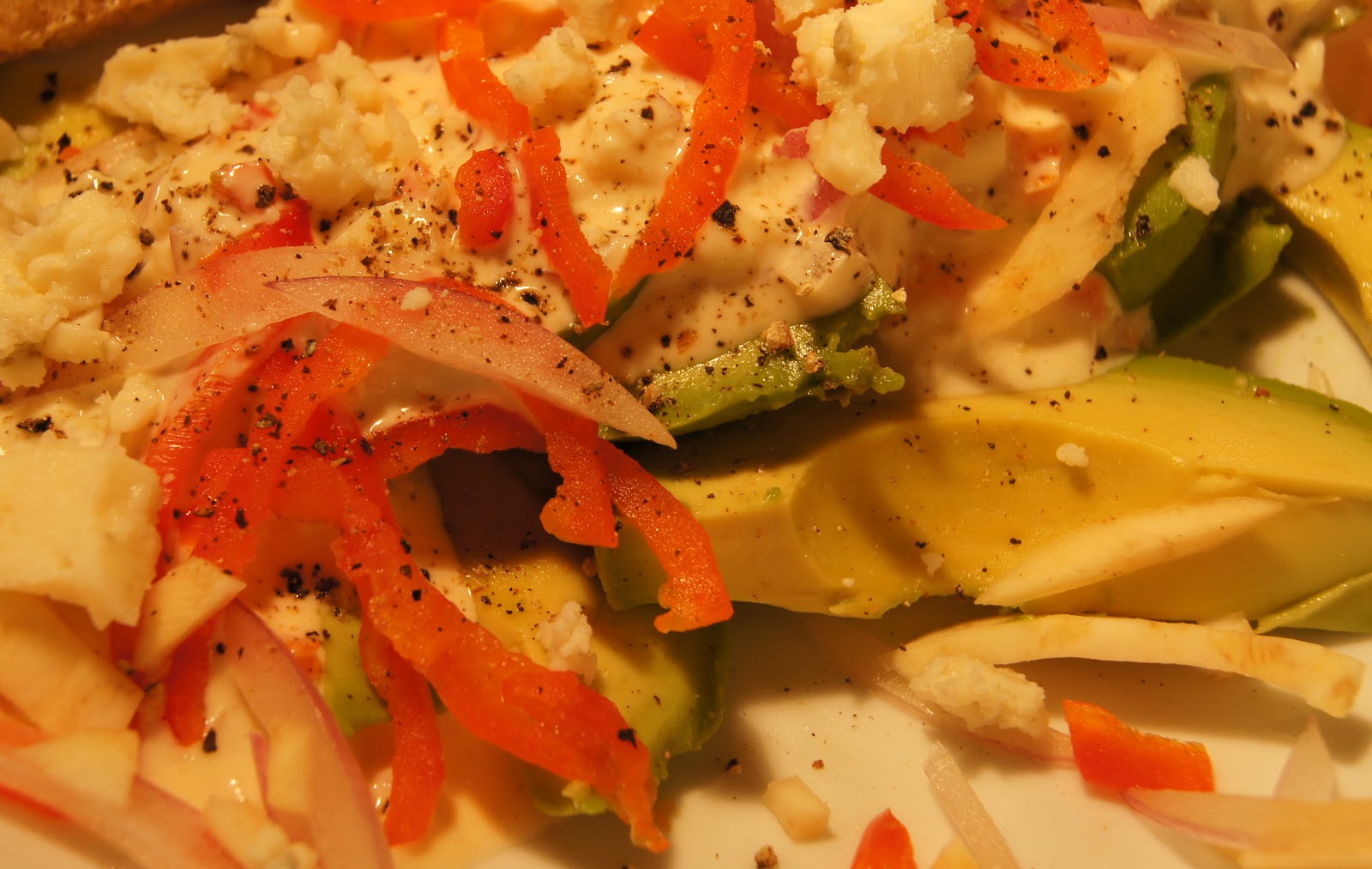
My point here, I guess, is that even as I become more impressed, year by year, with the ever growing breadth, depth, and quality of our local food sources, I don’t agonize over trying to make x-percent of my diet local, and I don’t apologize if a drop of Coke passes my lips from time to time, or a lobster from a distant sea finds its way into my pot.  I think it’s fair to say that my kitchen is locally based, and globally garnished, as this salad supper of avocado with blue cheese dressing illustrates. The proportions might seem reversed here, but there are more local ingredients in this than imported.

Avocado, mayonnaise, and blue cheese has been one of my favorite combinations since way back in my vegetarian days.  It’s sort of a study in close textural contrasts with wonderfully diverse flavors.  For the dressing I combined these local ingredients:

Wisconsin Black River blue cheese (1/2 cup crumbled?)
Minnesota Cedar Summit cream (2 tablespoons?)
Minnesota Smude sunflower oil (1 tablespoon?)
Wisconsin Menomonie Farmers Market red bell pepper and red onion and Wisconsin celery root from the co-op (about a tablespoon each minced for the dressing, more thinly sliced for garnish)
Menomonie market garlic, a medium clove minced

And these imports:

Hellmann’s mayo (couple tablespoons)
Sambal oelek (about a teaspoon)
Squeeze of lemon juice (I sometimes wind up with naked lemons after the rind has been stripped off bit by bit to garnish martinis….)
A few grinds black pepper

Mix well and adjust seasoning with sambal, lemon, pepper, and thickness with cream and oil—it should just flow. Unless you’re an absolute salt fiend, added salt is not necessary.

Spoon over sliced avocado—or over poached or sautéed shrimp; a nice grilled steak; any kind of salad; a sliced pear or apple; a hearty pasta like penne or rigatoni.

Serve with toast (from bread made with my nearly 10-year old house leaven, MN and ND flours) spread with Minnesota Hope Creamery butter.  Or serve on toast.  Not a bad breakfast using morning-after dressing.


Eat locally, think globally; shop thoughtfully, cook vibrantly, and have fun.

Sunday, November 21, 2010

Seasonal Soupage: Potato-Shallot-Sorrel


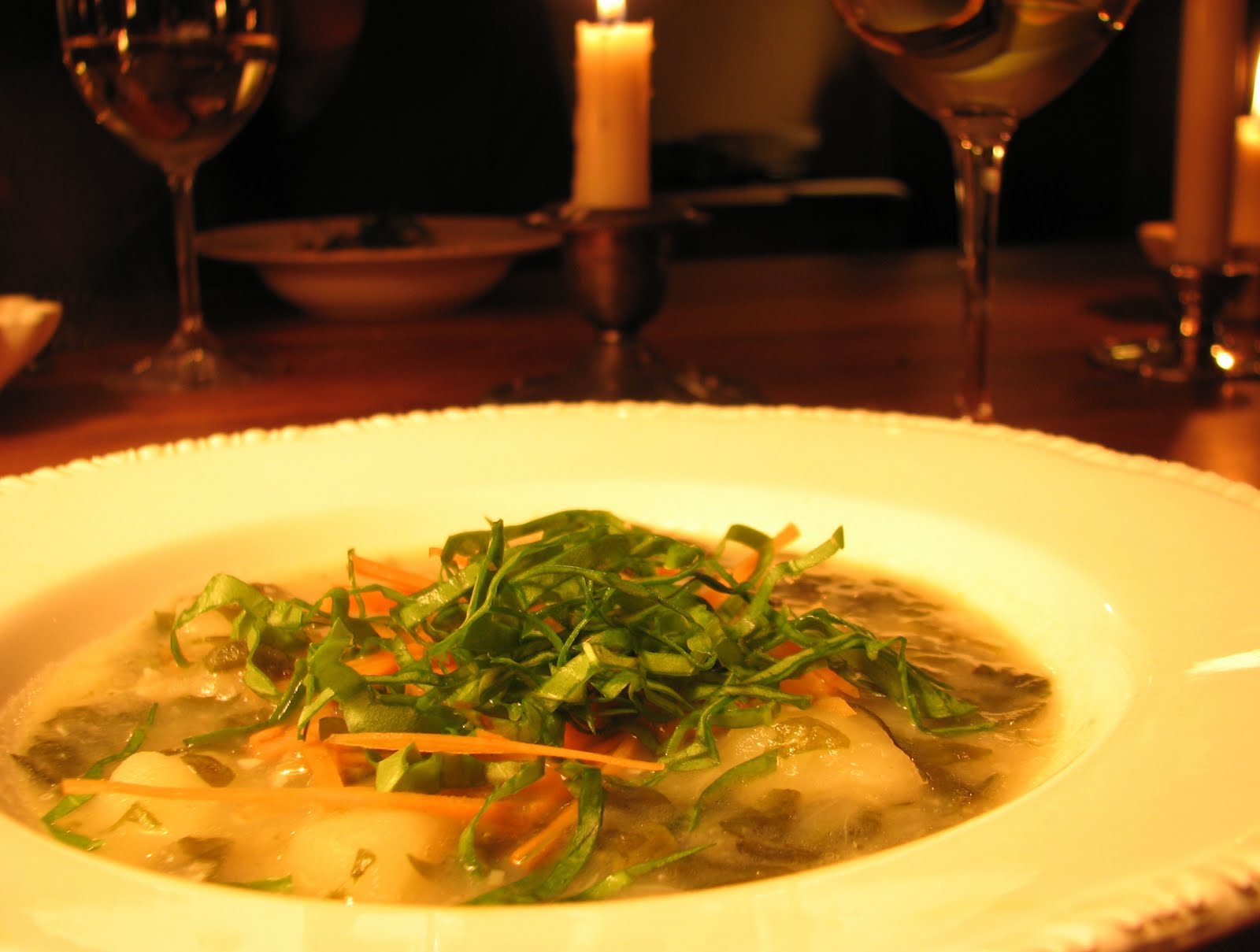
I "tweeted" recently that I was a-fixin' ta put some fine fresh root vegetables, picked up from some of our Bide-A-Wee neighbors, together in a soup with "snow-kissed" sorrel from our garden. When I came to examine the sorrel bed, I found that I was guilty of a bit of food-blogger poetic license. "Snow-kissed" turned out to be more a case of "glacially-encased." I pried back the lid of crusted snow to reveal the beautiful bed of green above. What about that does not make one think of spring--except the snow, I mean...? In fact sorrel, a hardy perennial related to rhubarb, is at its best in early spring and late fall. It's one of the first plants to emerge in the spring, and then its young leaves add delightful zing to salads.

Through the summer it grows tall and leggy, bolts at a sidewise glance. I cut back the flower heads when I think of it, but that's a purely cosmetic operation. Whether you deadhead or not, when the cold weather comes in, sorrel comes back in style. It's a classic in rich sauces for fish, like this one I made with brown trout. It's also lovely paired with starchy things in soup. After a few frosts the leaves of sorrel become more tender, and also more tart, it seems to me, its lemony quality pronounced. Yet it's a delicate, vegetal acidity these autumn leaves impart. I'm not even sure if you can find sorrel reliably in the stores. This would be another gardener's dish, or friend-of-the-gardener's. Ask around if you don't grow it and can't find it. It grows abundantly, and a little goes a long way, and any sorrel aficionado you find will surely be eager to share.

You could substitute watercress for the sorrel--a different, but kindred taste and concept.

Oh, and the source of all the great roots we picked up last weekend--carrots, parsnips, and potatoes from Kay and Ric in Prairie Farm, shallots, fingerling potatoes, and garlic from Evan near Turtle Lake, gorgeous braids of shallots and onions, and more potatoes, from Morgan and Ben, west of Ridgeland--we found these folks (some of whom it turned out we already knew)through the Hay River Transition Initiative, a fantastic group of people keeping the western Wisconsin countryside alive and lively. As part-time rural residents, we haven't done much with this group yet, but we're really looking forward to getting more involved in the future. It's the sort of grass-roots effort that really gives one hope.

A delicious bowl of soup is another thing that bucks me up:


Sorrel-Shallot-Potato Soup
Serves two

2 shallots, each the size of a small egg, chopped fine
2 large cloves garlic, sliced thin
12 ounces waxy potatoes (two medium), peeled, quartered, sliced 1/2-inch thick
2 Tbsp (1 oz.) unsalted butter
2 cups unsalted chicken stock, preferably homemade
1 whole clove
1 small allspice berry
1 small bay leaf
6 whole black peppercorns
salt
1 small bunch sorrel leaves (about 3 oucnes), thick stems removed, chopped (about 2 cups chopped)—hold back a few leaves to chiffonade for garnish
1 small carrot, shredded very fine or grated, for garnish, optional

In a medium saucepan, melt the butter over low heat, and add the chopped shallots and a pinch of salt. Cook gently, without browning, until they shrink and become translucent, about 5 minutes. Add the garlic and cook for 3 minutes more. Add the stock, the sliced potatoes, the spices, and 1/8 teaspoon salt. Bring to a boil over medium heat, and simmer gently for 30 minutes, until the potatoes are very tender—falling apart somewhat, not totally disintegrated.

The soup can be made to this point several days in advance. Just before serving, bring the soup to the simmer, add the chopped sorrel, and simmer for 10 minutes. Taste for salt. Serve garnished with the reserved sorrel chiffonade, and the carrots if you like.

Note: Mary didn't care for the raw carrot garnish, but I did.

This kind of soup often gets a creamy finish, and a swirl of heavy cream, dollop of sour cream or creme fraiche certainly wouldn't hurt. But this au naturel version would be my preference when you've got really good potatoes and homemade stock.

Wednesday, November 17, 2010

The Best Breakfast Ever...

...according to Mary, anyway, was this here:


Wonderfully fresh and flavorful eggs from a local farm (thanks Don and Joni for passing them along!), delicious gouda with mustard seeds, Marieke, and the main delicacy, in her view, a mixed-root pancake. Her contention: We don't get enough vegetables at breakfast. This is a preparation to right that wrong.

This went from dinner the night before--accompanied by a sort of "ranchy" sauce, preceded by a roasted cauliflower salad--to breakfast the next morning. It became something of a theme of that snowy weekend to keep one meal segueing into the next....


Quite simple, extremely tasty. I've dubbed them pancakes, but they're definitely more in the latke style pancake than the batter-y sort of usual breakfast 'cakes. The eggs and flours just barely hold the vegetables shreds together. You could call them flat fritters, I guess, but that does not seem so appealing... Careful not to grate your knuckles into the mix.

Root Veg Pancakes

1 large potato
1 large parsnip
1 carrot
1/2 small celery root
1 small onion
1 small leek

Peel and grate the first five; slice the leek very thin and add to the grated veg. Add:

2 eggs
2 Tbsp each all-purpose flour and cornmeal
salt and pepper to taste

Mix and let sit for at least 30 minutes.

Heat a heavy fry pan--cast iron is excellent--and add 1/8 inch fat--we used duck fat and a little canola. Stir up the mixture and spoon out 1/2-cup portions into the pan, pressing down with a spatula (alternately, you could make one big, full-pan-sized cake, and cut it into portions, though this will be more difficult to flip). Cook over medium heat for five minutes, then flip over. Continue to cook for a total of, say, 18 minutes, turning often so the insides will cook through without burning the outside--lots of natural sugar in the mix, so be careful of that.

Serve for breakfast just as is, or with a dollop of sour cream; at dinner we mixed a bit of mayo, half & half, cider vinegar, chopped red onion and minced garlic, salt and pepper, for that "ranchy" sauce. Could be a side dish to grilled meat, roast chicken.


Text and photos copyright 2010 by Brett Laidlaw