

It’s interesting that “poaching a fish” has those dual meanings. This is the legal, delicious sort of fish poaching, as easy as it is seemingly old-fashioned. It brings to mind whole poached salmon lacquered in aspic on a fancy buffet, silver serving pieces, white linen, and cucumber sandwiches. When you fry or grill, you're adding other flavors to the fish, but poaching gives you pretty much the pure fish flavor, with only a little influence from the seasoning in the poaching liquid. Therefore, I would only recommend poaching when you have utterly fresh, pristine fish. Which in this case was a whitefish fillet from my beloved Halvorson Fisheries in Cornucopia, Wisconsin.

I should like to point out that absolutely fresh doesn't have to mean fresh off the boat. This fillet was three days old--we picked it up on a trip to the South Shore on Wednesday, and prepared it on Saturday. But it had not acquired any off or "fishy" odors or flavors in that time. Freshly caught fish properly cleaned and treated will stay fresh for at least three or four days.

Makes you wonder how long some of the fish you buy, even from the top-end fish markets, has been sitting around. You can pay $20+ a pound for Copper River salmon or Pacific halibut, and sometimes I do, but I never wind up with better fish than when we make the trip to the shore and fill a cooler with whitefish, herring, and lake trout for a pittance (might as well carry on with the old-time lingo, since we're talking about a throw-back way of cooking). Even if you figure in the cost of gas, I think we come out ahead financially, and we absolutely win in terms of taste and pure enjoyment.

A classic sauce is de rigeur with poached fish. A beurre blanc would be lovely, or a green sauce fragrant with tarragon, parsley, and chervil. For this midsummer repast we made mayonnaise, and some of it I flavored with garlic--that's aioli--and to the rest I added herbs, tarragon and chives--that's not aioli, but rather herbed mayonnaise. I sort of have this peeve, you might recall from past rants, about every kind of flavored mayonnaise being called aioli, because while aioli is usually a type of mayonnaise (there are variations that don't use eggs), it is not a synonym for it. But, as usual, I digress....

The market this past weekend provided a good deal more than radishes and kohlrabi. Lovely new potatoes, snap peas, asparagus, baby beets and turnips (and strawberries for dessert).

We boiled all the vegetables separately, till just tender--the beets went last, lest our entire meal come dressed in pink. And for the fish I prepared a court bouillon, which consisted of:
Water, about a quart
White wine--what was left in a bottle of riesling that was hanging around, half a cup, say
The juice of 1/4 lemon, and then I threw the piece of lemon in, too
A couple of bay leaves, broken up
Some cracked black peppercorns
And the secret ingredient, this court-bouillon préparation:
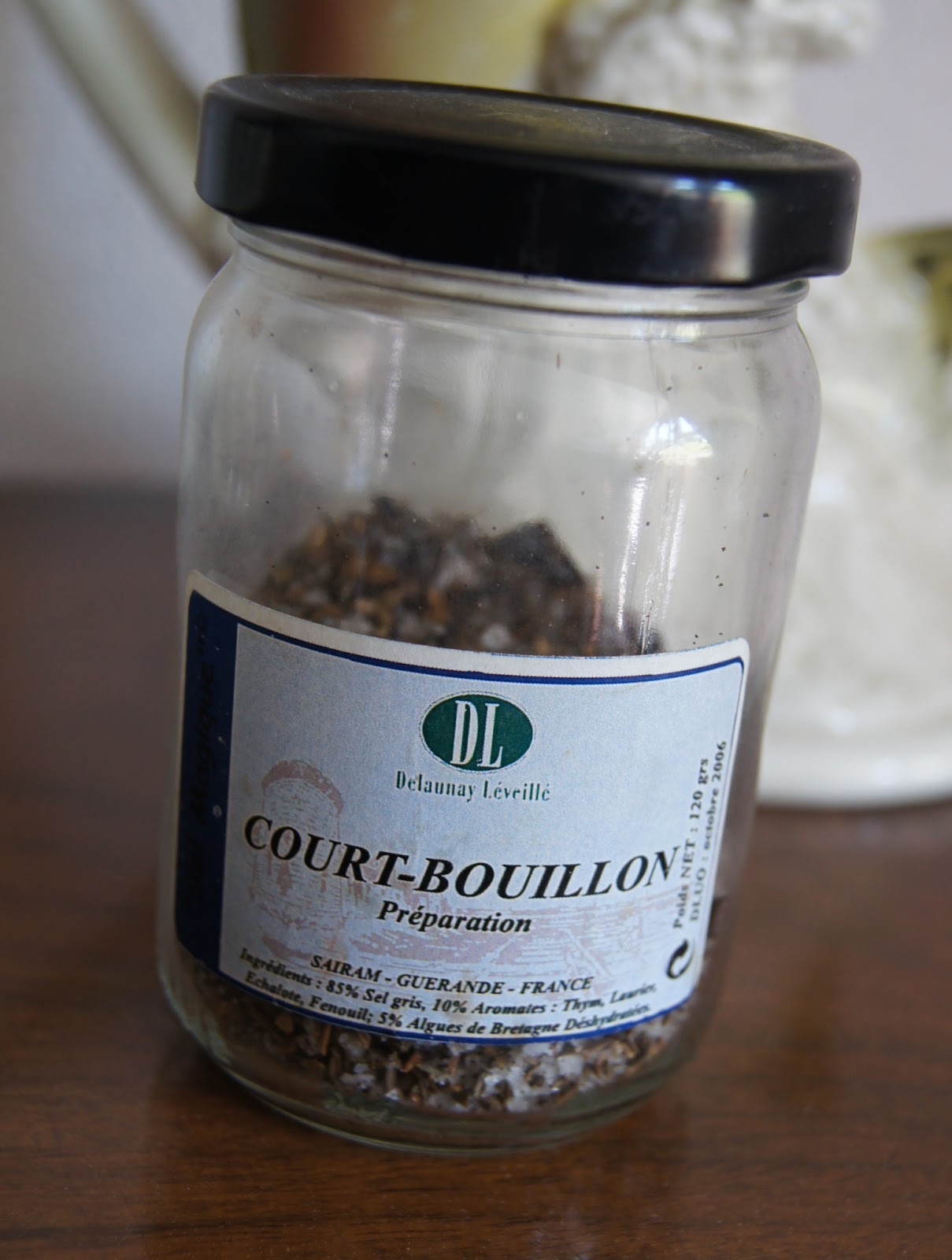
It's mostly gray sea salt, flavored with thyme, bay leaf, dried shallots, fennel seed, and seaweed. We picked it up in Brittany years ago; it keeps just fine, and it gives the bouillon a decidedly oceanic character. Whatever sort of thyme is in there is particularly potent, too. If you don't have something like this, just add the component parts separately. The seaweed aroma is nice, but not necessary. Combine everything in a saucepan large enough to hold your fish, bring it to a boil, and simmer for 15 to 20 minutes. Then turn the heat off, add the fish, cover, and set aside. The fish was probably cooked through within five minutes, but it didn't hurt it to sit in the bouillon as it cooled, absorbing some of the aromatics.

Service goes family style, the fish with a generous herbal garnish, the aioli and mayonnaise, the lovely vegetables prettily arranged by Mary and Melinda, our guest for the weekend, some crusty bread. Such a civilized meal, poacher's delight, indeed.
 |
| Melinda picked and arranged the flowers, wild meadow bouquets. |
Text and photos copyright 2013 by Brett Laidlaw

