Showing posts with label cocktails. Show all posts

Friday, April 1, 2016

The Saps of Spring, 2016 Edition


March is a difficult month.  It promises spring, but often belongs equally, if not more so, to winter.  It makes you think of gardening, of growing things, but at our latitude all you can really do is pile potting mix into little pots, get the seeds of the earliest, cool season plants going—onions, leeks, lettuce, some herbs.   There are days of warm sun that tempt you to get out and till a plot, but when you turn one clump of frigid, sodden soil, you turn quickly to plan B.  Never mind, there’s always that minefield of winter-weathered dog treasures to clear, a perennial March activity that more or less sums up the spirit of the season….


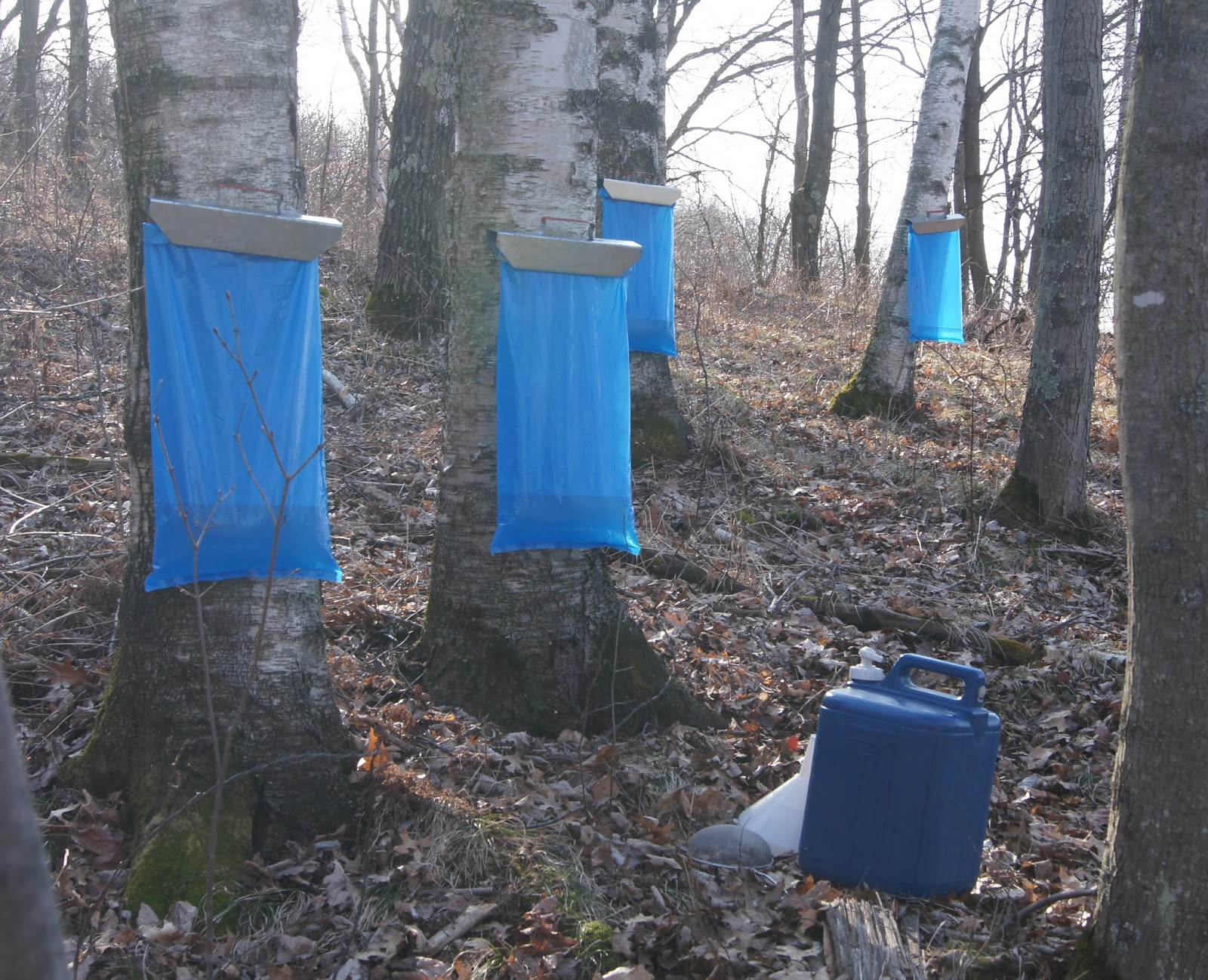
Maybe this is why a lot of my March days since moving to the country have been spent drilling little holes in trees, gathering the cold, slightly sweet water that weeps out, and cooking it down to incomparable sweetness—tree syrups, both maple and birch, and even a bit of black walnut.  It’s nature’s little consolation prize for enduring these purgatorial weeks, equal parts reward and distraction.  Though sap season comes around every year, it’s always a little bit different.  And this year has been more different than most.

People on Twitter tend to get a little excited, you may have noticed if you frequent that world.  I think it’s the ability to communicate instantaneously with friends, acquaintances, and strangers alike, all across the planet, that tends to heighten reactions exponentially.  This year I saw a slew of ecstatic tweets proclaiming that the weather for the week ahead looked perfect for maple sugaring…in the middle of February.  But the trees weren’t looking at the daily highs and lows to decide how to proceed; no, the trees were still frozen solid.

I forget exactly which March Surprise this was; we had a few....

But it did transpire that warmish weather continued—there were days with record highs, with record high lows—and I did wind up tapping a few maples, as well as the big box elder (a type of maple) in our yard, and our one majestic black walnut tree, on February 21, because what the heck.  And within a few days I did have a little sap, emphasis on the little.  The trees ran sluggishly for about a day, then the weather turned seasonably cold again.  Six trees gave me about one gallon of sap, which didn’t take too long to simmer down on the wood stove into a half cup of syrup; and so began the season of passive, micro-batch syruping, which continues to this day, as I reduce another five gallons of birch sap on the woodstove and then on the range top.  I’m not going to wind up with a vast reserve of syrup, but then, I don’t really need one.  The birch, especially, is sparingly deployed, maybe a tablespoon or so at a time, in salad dressings and marinades, mainly for grilled pork.
 
Birch syrup on the final reduction.

With small amounts of sap—5 to 8 gallons at a time—I didn’t bother firing up the labor-and-smoke-intensive half-assed sap contraption I’ve used in years past.  Instead, since we’re still stoking the woodstove every day, at least in the mornings and evenings, I’ve been setting a hotel pan and our Big Blue Le Creuset dutch oven on the stove and letting the sap slowly reduce to a manageable amount, at which point I boil the dickens out of it on our kitchen range top.  You may wonder, Isn’t that a lot of humidity to be adding to your indoor environment?  Aren’t you producing great clouds of water vapor, steaming the wallpaper off the walls, and covering everything with a sticky film? 

Legitimate concerns, to which the answers are: yes, I guess it’s a fair amount of humidity, but things are generally dry this time of year, so we haven’t noticed any issues; and as we have no wallpaper on our walls, none to steam off!  Finally, no, our walls and ceiling bear no resemblance to a movie theater floor after being deluged with Mountain Dew during the kiddie matinee.  The whole idea, see, is that the sugary part remains in the pot as the water evaporates.  Even if some of the sugar escaped a furiously boiling pot, I don’t think it would go very far, the sugar molecules presumably being a good deal heavier than water vapor. 

The long and short of it is this:  I think it’s a myth, one which I myself may have helped to promulgate in the past, that cooking sap down inside has these undesirable side effects.  When I’m doing the fast, final boiling, I’ve got the vent hood running, a couple of windows cracked, and there’s no noticeable change in our indoor weather.  Also, I’ve kept checking the walls near the stove, the inside of the vent hood, for that legendary sticky film—none to be found.  Now, if I had a hundred, or even 40, 20 gallons to deal with at a time, I probably wouldn’t do it inside.  But with these small batches, it works fine.  It’s also really nice to get double duty out of the woodstove, heat for the home on chilly days, tasty syrups for the kitchen.

The Puddock hard at work, multi-tasking.

It has taken me a while, years, in fact, to start to feel comfortable using the birch syrup.  It’s completely unlike anything else I have in my pantry, so it didn’t slide easily into any particular niche.  People ask me what it’s like, and I can only give vague analogies or general descriptions that don’t capture the essence of the thing.  It’s dark, dark as molasses, and it has some molasses qualities, but it’s not thick—in its body, its “mouth feel,” it’s lighter and thinner than maple syrup.  And banish any thought that it’s like maple syrup just because it’s sugar that comes from a tree.  While maple syrup is composed of sucrose, like plain old granulated sugar, birch syrup is glucose and fructose (I think I’ve got that right).  The flavor of birch syrup is much…edgier.  There’s acidity to it, and often a little intriguing bitterness.  It’s very aromatic, with sweet, menthol, spicy, root beer type notes.  Really, if you’re interested in distinctive foods, particularly distinctive northern foods, you’ve got to try it.

If you have access to a few birch trees, it’s easy enough to get, as long as, you know, nature cooperates.  You tap the trees exactly as you would for maple syrup, drill a little hole about 1 ½” deep, insert a tap, hang a bag, bucket, what have you, or attached food grade tubing to allow the sap to run into a container.  Then when you have a quantity, you cook it down.  And cook it down.  And cook it down….  Because, the thing about birch sap:  it’s generally less than half as concentrated in sugars as maple sap.  So if it typically takes from 30 to 40 gallons of maple sap to produce a gallon of syrup, with birch we’re talking about a roughly 80:1 ration.  Breaking that down into the smaller batches I’ve been doing, 10 gallons of sap gave me one scant pint of syrup.  

Syrup assortment: the small, very light one at center front is black walnut.

I’ve said this before, and I’ll say it again:  you can look at the numbers, even the relatively reasonable maple ratios, and think you get it, but until you actually do it, you can’t possibly understand.  Still, it’s worth it.  I go to a lot of trouble, tapping the trees, hauling the heavy sap down the hill (luckily I do get to haul it down the hill), cooking the sap down and down and down, but at the end I’ve got lovely local products to work with through the rest of the year.

And here’s a handy fact of nature:  the birch trees tend to start running as the maple run is coming to an end.  So if you have access to both kinds of trees, you can move your tapping equipment over to the birches when you’ve had your fill of maple sugaring, and the trees start to break bud, rendering the sap bitter and unusable.  Making syrup, especially birch syrup, is a labor of love, and a rite of the season, a perennial celebration of those immemorial cycles.  A lot of work and time, sure, but hey, it beats picking up dog crap….

Earlier reports from sap season:
 Sapped Out, 2013
The Sweetest Tree, 2013
Sweet Trees X3, 2015
Sweetness, Toil, and Smoke, 2010

How I have used birch syrup:

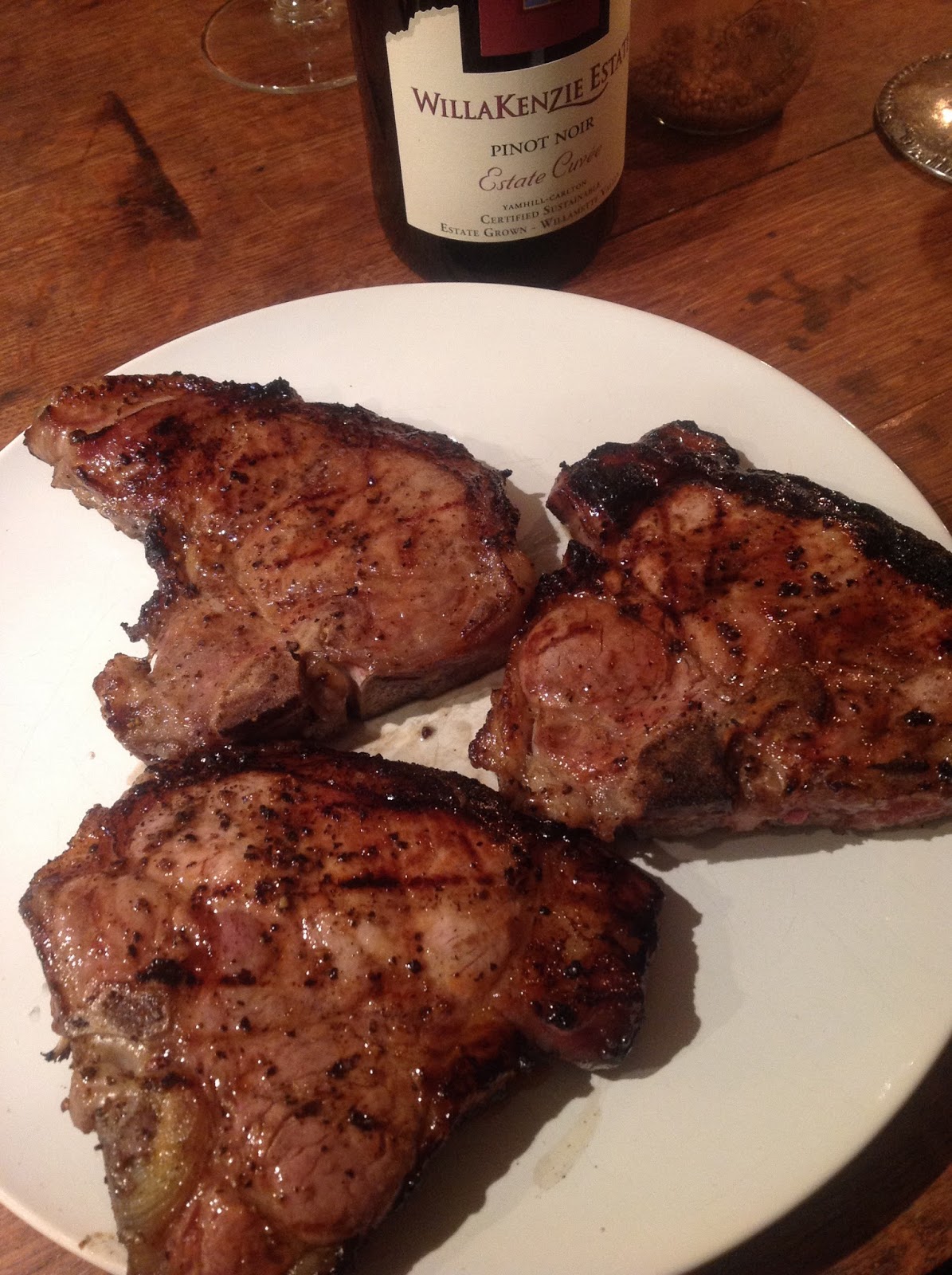
·        *  As a marinade for grilled or smoked meat:  it’s great brushed on a pork chop, which I then season simply with salt and pepper.  For some reason, the birch syrup doesn’t burn on the grill the way maple syrup or honey would.  Perhaps because the sugar composition is different.  I’ve also used it on grilled game birds, particularly woodcock.  And I’ve used it in the cure for smoked duck breast and venison with wonderful results.
Grilled red wattle pork chops in a birch syrup marinade; pork and birch have a delicious affinity.

*  In salad dressings:  just a teaspoon or two in a vinaigrette really makes its presence felt, and brings that distinctive, aromatic birch flavor to any kind of salad.
·         *  In cocktails:  1 teaspoon birch syrup, a few drops of lemon juice, 2 ounces Scotch, bourbon, or rye, stir it up, add ice, garnish with a lemon twist.  Or for the lemon substitute blood oranges in season for a cocktail I’ve dubbed “The Nasty Bruise.”  For a refreshing non-alcoholic drink, stir a couple teaspoons of birch syrup into sparkling water, add ice and perhaps a squeeze of lemon juice.

Those are the main applications I’ve found for birch syrup.  I’m having a decent year with the birch this spring, so I’ll have a good supply to experiment with through the year.  I repeat:  a little goes a long way with birch syrup.


Birch-Mustard Seed Carrot Salad

Two servings.  

1 large or 2 small carrots
2 tablespoons olive oil
2 teaspoons yellow mustard seeds
2 tablespoons lemon juice
1 tablespoon birch syrup
1 small garlic clove sliced very thin
A bit of chiffonade leek or scallion green, optional
Salt and pepper

Peel the carrots and slice them very thin—1/8” or less.   A Benriner mandoline is handy for this—watch your fingers!

Heat the oil over medium low and add the mustard seeds.  Stir them around until they just start to pop, then remove from the heat.  Add the lemon juice, birch syrup, and garlic and stir well.  Pour the dressing over the carrots, add a couple good pinches of salt and a few grinds of pepper, and stir well.  Let the salad sit for at least a half hour or up to several hours before serving.  Sprinkle the optional leek or scallion greens over top just before serving.

Maple syrup variation:  in place of the birch syrup, use 2 teaspoons of maple syrup and ½ teaspoon of Dijon mustard--I haven't actually tried this variation, but I don't see how it could be bad.


Here’s a brief record of weather, phenology, and such since syrup season began at the end of February:

Feb 27 record highs
Feb 29 1st ½ cup maple syrup done
March 1, “brittle and chill” and the trees aren’t producing sap
March 4, 3 inches of snow
March 8 red-winged blackbirds back & a scant half cup of black walnut syrup finished from 56 ounces sap—that’s all for black walnut, it didn’t produce enough sap after that to bother with
3/10 snow’s all gone and Mary notes, looking out the kitchen window, “It’s not winter anymore,” to which I reply, “It’s not spring, either.  It’s mud season.”
3/10 cooked down a tiny bit of box elder syrup, “single source”….
Shrimp on the barbie, definite grilling weather
3/11 picked garlic mustard along the Rush River at Brush Cr Rd; grilled pork chops; summery
3/12 summery; dinner at Tina’s, I wear shorts
3/16? 2” rain, thunder
3/14 woodcock return
3/17 SNOW again, grass covered
3/18 snow gone
3/22 tapped birches and they were running; seemed pretty vigorous, but didn’t get much for a few days
3/23 SNOW again! 3-4”.
3/24 snow gone!
3/27 finished the last maple, moved over to birch
3/28 5 gallons birch mostly cooked down
3/29 another 5 gallons birch gathered, mostly cooked down; sunny and warm, in shorts again
3/30 It didn’t seem that there was much sap flow, but the eight birch gave around four gallons total, which reduced gently on the woodstove overnight
3/31 The house is starting to smell birchy with the sap on the woodstove getting right down there.  It’s raining now, but the forecast is for an inch of snow by the end of the day.  April Fool!

Text and photos copyright 2016 by Brett Laidlaw


Wednesday, March 23, 2011

On the Reluctant Season & Plans for the Warm Months to Come (with a Whacking Good Maple-Calva Cocktail)

We were out pruning apples trees, clearing brush, and setting a few taps in the maple trees at Bide-A-Wee last weekend. The temps had hardly dropped below freezing all week, and the snow was melting steadily. We could watch the snowline creep down the southern exposures day by day. Problem was, there was so much snow accumulation over the winter, only those southern slopes were clear, and everywhere else the snow was close to knee-deep, and degraded by the warmth into corny, icy pellets, so walking without snowshoes was like slogging through a vast white Slushee . Even Lily, our five-year-old griff' and a gentle beast of prodigious strength, was having trouble getting around; senior dog Annabel, just a couple months shy of 13 years old now, struggled mightily, but she's a gamer and kept up throughout the day.

Besides the receding snow we noted other signs of the changing season: Saturday morning a vanguard pair of Canada geese flew honking right over the cabin, and while pruning we heard, though did not see, migrating tundra swans on the other side of the hill. We noted red-winged blackbirds trilling in the cattails of the marsh down the road. Most thrilling of all, Lily flushed several woodcock off one of those snow-free hillsides on the first day of spring. It seems remarkable that they return this early, dependent as they are on finding insects and worms in the barely thawed ground, probing with their elongated bills. And when a late-March snow descends, as it has today, I worry that they'll all perish. Thing is, this kind of storm in March, even into April, is not at all uncommon, and the timberdoodles have been dealing with this sort of thing for millenia, I reckon. You have to grant some wisdom in Great Nature's design. (Last year the male woodcock started their odd and charming mating dances on March 24. More on that annual ritual in a future post.)

And there were green things springing forth, though barely. Little sprouts of this and that, nothing I really recognized. Back at our house in Saint Paul I saw one thin sliver of sorrel pushing up, though half the bed was still in ice, and dandelions getting started. When we tapped the maples on Monday the sap flowed freely out the spiles, such a treat to taste that clear, cold liquid, just slightly sweet yet somehow distinctly maple-y (or perhaps I imagine...).

Other phenological observations, cultural and domestic, pointing toward the changing season: The Hay River Transition Initiative announced educational and support meetings on the topic of Lyme Disease as tick season impends, and I found that our composting toilet which resides in an unheated barn-red outhouse (the Tardis) had thawed. You've seen those backyard compost tumblers, big black drums that turn with a crank to speed the breakdown of yard and kitchen waste? Our composting loo works exactly the same way, except the drum is contained within something that looks like a very large, awkwardly shaped white toilet. When it gets cold in the fall the composting action stops, the contents freeze in winter, and that's probably TMI right there, but when spring brings the thaw to the loo, it's a day of joy.

As I write this I feel like I'm reminiscing about a happy time long past, as Great Nature has turned her bitter white back on us AGAIN, and the snow sweeps past the window, some flakes big and lacy, some small and pelty, and it piles up, and schools close, the freeways clog. With a forecast for below average temperatures for the next few days, it will be a week before we see substantial melting again (good news for those in the path of spring flooding; bad news for gardeners and everyonesickofthisfreakinendlesswinter).

Just a little patience is required now, dears. When spring does arrive I think it will arrive with a vengeance, with all the pent-up energy and inexorable vigor that that little spear of sorrel showed, slicing up through the frigid turf. With more winter calamity in the forecast I finally got around to sorting out my garden seeds and setting up my seed-starting table. The many packets of beans, melons, and squashes unplanted last year showed that my hobby farmer ambitions got well ahead of our capacities. I just planted one five-by-ten plot at Bide-A-Wee last summer, late, and hope to put another in this spring. Perhaps I'll do a little stealth guerrilla gardening out there, too, popping some melon seeds into the loamy mounds that the pocket gophers throw up all over the land, let the vines spread into the meadows where, perhaps, the critters will not find them. Hey, ya never know....

I'm going to be reasonable in what I plant here in Saint Paul, too, not crowd so much in that the whole thing becomes one big grotesque slug farm. We have wonderful farmers markets in town and in the country, and neighbors out there who really know how to grow, and charge too little for their produce. I'm happy to support that economy as we move gradually toward a greater self-sufficiency. But I would like to put up a hoop house at Bide-A-Wee, to extend the growing season a bit on either side. And we've put a hitch on our Jetta wagon so we can borrow Mary's folks' little trailer to get manure from our livestock-owning friends and neighbors, and really get the gardening going out there.

Regarding the aforementioned apple trees, we're in our fourth year of clearing, pruning, and assessing the dozens of severely overgrown trees that came with the property. And frankly it doesn't seem that we've gotten a hell of a lot done in that time, until I remind myself that the actual pruning is just the icing on a big gnarly cake that also involves scything through tough blackberry canes, pulling out encroaching prickly ash, and fightinig off the box elder jungle. After all that, we can almost reach the tree--all that's left is wriggling in to the trunk through a maze of broken branches, dead wood, grape and Virginia creeper vines. That process usually takes us until lunch, just one tree at a time. And after lunch, man, I need a nap....

So it goes a bit slowly, but it goes. Our big ambition for this year is to clear most of the brush around our North Meadow trees so we can scythe as the meadow plants start to grow, to create a sylvan glade of pastoral splendor. Mind you this is all done by hand, but we may try to find someone with power equipment to mow some paths around the land for us, and maybe mow the North Meadow, too.

We have big hopes for the apple crop this year, and not much we can do about it but wait. Our trees tend to be "on" in odd years, though some bear fruit every year. Last year, an even, "off" year, saw a hard frost in mid-May, reducing the crop even further. Luckily a few of our better trees did bear fruit (better meaning less susceptible to insect and disease, longer keeping), and we pressed enough cider that we still have fresh (from the freezer) and some keepers good enough for baking (getting to the end of those).

If this year is anything like 2009, the cider press will be humming from September into November. I want to ferment a lot of cider this year, and explore other areas of apple preservation and cookery, too. Apples were once such an important food crop in this country. In a 1990 Whole Earth Review article, Richard Sassaman wrote:

Americans today probably don't understand how much the early settlers appreciated apples, which in Price's words are now "relegated in normal modern diets chiefly to side dishes and casual eating." Apple butter would keep for winter use, apple brandy was a cash export sent downriver to New Orleans, apple cider a social favorite, and apple vinegar the basic pioneer preservative.

We'll never know for sure exactly what varieties of apples are growing on our land--and some, the wild seedling trees, are unique to Bide-A-Wee--but I'm eager to really get down to seeing what we have there and what the various apples are good for. This summer of 2011 will be our first without farmers market baking since 2003! I'm not sure that has quite sunk in for either Mary or me, but I think we're both eager to see what it's like.

Another goal of mine for this year is to delve deeper into the world of wild foods. With the help of the excellent books by local authors Teresa Marrone and Samuel Thayer (both are linked as "Bide-A-Wee Neighors & Friends" at right) I've expanded my knowledge of wild edibles quite a bit in the last few years. Flipping through their books, I realize how much I still have to learn--cattails, wild chervil, butternut, serviceberry, nannyberry, highbush cranberry, and I haven't even thoroughly explored the possibilities of the ubiquitous nettles. The forest starts to look like a splendid delicatessen! No need to take a number, just dig right in.

Phew. I'm thirsty now. With all the talk of apples, and given that it is maple syrup time, here's a lovely sip with local flavors. Make it with just maple syrup, lemon juice, and sparkling water, and it's a refreshing spritzer. Add a tablespoon to a shot of Calvados, the French apple brandy, and you've got something else altogether--a very tasty, very grown-up sort of apple juice. It'll make the blizzard outside seem a lot more tolerable.

Maple (Calva) Spritzer

Per drink:

2 tablespoons maple syrup
Lemon juice to taste
6 ounces sparkling water
Calvados or applejack, a tablespoon to 1 1/2 ounces, optional

Combine the maple syrup and sparkling water in a glass (& Calvados if desired). Add fresh squeezed lemon juice to taste. Drop in a couple of ice cubes and imbibe.


Copyright 2011 by Brett Laidlaw

Sunday, August 8, 2010

You Say Puh-MEN-uh, I Say PA-Minn-Ta...


Or, you might say:

puh-mintah
puh-me-un-toe

puh-min-a-too
puh-minnuh
Puh-MIN-a
p'menAHH
puh-men-ta
puh-mí-nuh
puh-min-A


Just a few pronunication options offered up by a Google search. And I can't resist adding this charming utterance, from Christy Jordan's "Southern Plate":

"They'd always ask 'Ya want some puh-men-ah cheese, baby?'”

What we're discussing here is pimento cheese. Pimento, as above; cheese, as in cha-ay-z.

It's a southern specialty that we first learned about, I think, from a New York Times article by Matt and Ted Lee. Hard to believe that was 10 years ago! In the meantime, we've come up with our own pronunciation--puh-MUHN chayz--our own evolved (or de-) version, and this toothsome glop consisting of cheese, mayo, canned pimento, and onion has become one of our go-to summer happy hour snacks. With a glass of scotch, by a campfire, preferably one overlooking Lake Superior, there is nothing better.

It was interesting to look back at the original recipe and see that it calls for cream cheese, which we never use, and that it does not call for onion, which we always add. Go figure. But we pretty much always have some cheddar and mayo in the house, cream cheese less often. I think we did make it originally with the cream cheese, but we found it difficult to mix in, while whomping up a mess of shredded cheddar and mayo takes no time at all--which is important when your scotch is getting watery....

For the version pictured here today I made my own mayonnaise, an intensely local mayo, too, using the Smude Minnesota sunflower oil that I've mentioned before, and just a touch of olive oil, and our own apple cider vinegar where I often would add lemon juice. But you know what? In the real world, not the local-seasonal-food blog world, I would suggest you use Hellmann's.

One little step to localize and seasonalize that I do endorse is roasting a bit of red chili, sweet or hot or both, instead of using the canned pimento bits that come in those cute little jars, you know, the ones you can never track down in the store, so you have to ask the stockboy, Where do you keep those...? And now I still can't recall if they live with the pickles, the olives, the vegetables.... You can put a jalapeno or similar right over the flame on your stove if you have a gas cooktop, or if you have the grill going anyway, roast it over the coals (because you might be getting ready to grill a steak, and this would be the ideal appetizer for that), and if neither of those situations applies, go for the stuff in the jar.

I found a couple ripe-ish chilies on a Bulgarian Carrot pepper I have in my garden. Picked it up on a whim at the farmers' market this spring, knowing nothing about this variety. Says on the ID spike that it is HOT and, Yessir!, it is hot--some web sources say it's as hot as an habenero, some say it's milder than a jalapeno, and I'd say it's somewhere in between; thank you, Internet. Beautiful bright orange color, hence the "carrot" in its name.

Anyway, the proper platform for puh-muhn chayz is definitely a Ritz cracker. Can you believe I actually considered making my own crackers, just for this post? Then I came to my senses. And then again, and this probably violates the whole spirit of puh-muhn chayz, but I had a few fresh-picked green beans lying around the kitchen, and it occured to me that they'd be good with a schmear, and I was right. So, that's another summery, healthy alternative, serve some crudités with your puh-muhn chayz. In the Lee's article it's described as a sandwich spread, which I'm sure would be good, too.

Finally, while this is clearly a down-home sort of preparation, and I wouldn't recommend using some $20-a-pound 10-year-old cheddar for this, the cheese does matter. Get a good, sharp, white Wisconsin cheddar, at least a couple of years old. We usually purchase our cheddar from Rene at Bolen Vale Cheese on highway 64 in Connorsville, Wisconsin. She offers cheddars from one to ten years old; we usually go for a six- or seven-year-old cheese for general consumption.


Puh-Muhn Chayz (with sincere apologies to any southern readers, but I once lived in Roanoke, Virginia for the better part of an entire year so I feel I'm at least somewhat entitled...do they still have that great butcher shop, Mason & Hannabass, down on the market square?)

2 Tbsp minced onion
5-6 ounces sharp cheddar, medium grate, about two cups
roasted red pepper or hot red chili, to taste,
--or--
half a jar of chopped pimentos
1/4 cup mayonnaise
paprika or cayenne to sprinkle on top

Ritz crackers to spread or raw vegetables to dip
Scotch whiskey, preferably Balvenie DoubleWood 12-Year-Old, on the rocks, optional

Mix everything together with a spatula. Let sit, refrigerated, a half hour or more for the flavors to blend. Bring out of the fridge at least one half hour before serving. Let it warm up a bit while you build your campfire, and pour your scotch.


Text and photos copyright 2010 by Brett Laidlaw

Tuesday, January 12, 2010

Cocktail Hour

Trout Caviar Sweepstakes, 2009 Local Food Highlights now in progress.


After a hard day toiling in the orchard or the sugar bush, a man needs a drink. A woman, too. I mean, yes, a man might need a woman, it's true, and a woman might need a drink. And a man. Or a fish. And a bicycle....as that old saying used to go, as you might remember.

Anyway, sometimes a man or a woman might need a drink, and fortunately, the land provides. I haven't quite settled on a name for this drink, but I'm leaning toward "Highway 64 Revisited." Wisconsin state highway 64 runs east and west across the state, from Hudson to Green Bay.
According to the Wisconsin Department of Natural Resources's reckoning, it divides the state into northern and southern sectors (according to my sense of things, too). It takes me to some of my favorite hunting grounds, and a number of fine trout waters.

More significantly, for our purposes here, it runs just south of Bide-A-Wee, which produces the maple syrup and apple cider that flavor the drink, and through New Richmond, where is made the 45th Parallel vodka that gives it its guts. This is good stuff, this Badger State vodka. I used to be of the opinion that "vodka is vodka," but I've had to admit that that was a benighted view. Now, I don't think vodkas are ever going to have the character or variety of single malt scotch, but I've come to recognize that there are significant differences in vodkas, and to my taste 45th Parallel is among the best. It's clean, crisp, and slightly sweet, slightly viscous on the tongue even when not iced. Just as important as what qualities it has is the one it lacks--that sinus-scorching cleaning fluid aroma often found in lesser vodkas. I don't mean to seem to damn with faint praise, not at all--when I want to sip iced vodka neat with my trout caviar on Tata's rye rounds, this will be the one.

Enough exposition, here's the drink:

Highway 64 Revisited
for each drink

2 ounces 45th Parallel vodka
2 Tbsp unfiltered fresh apple cider
1 tsp pure maple syrup
1 capful dry vermouth (I like Martini & Rossi)
1 sprig fresh thyme (optional but very nice)

Put some cracked ice in a martini shaker. Add all above. Shake or stir? Well, I kind of swirl, let sit a few seconds, swirl again. That's more like stirred, I reckon. I should try it shaken. Maybe tonight. Strain into a martini glass. I like to let a few shards of ice drift into the drink. Garnish superfluously with a slice of pickled crab apple, if you have it, or a wedge of fresh apple, or a maple leaf, whatever makes you happy. Sip and savor.

For added enjoyment and sophistication put on our friend Will Agar's wonderful classical guitar CD, Suenos Ibericos, definitely one of our musical highlights of 2009. Contact Will at willagar4@msn.com if you'd like to purchase a copy. Highly recommended.


Cheers.


Text and photos copyright 2009 by Brett Laidlaw

Wednesday, October 14, 2009

Fruitful


A few weeks ago, on a warm September morning, I took a pleasant amble around the land out at Bide-A-Wee. The meadows were full of glorious color, goldenrod and asters, and nearly every tree and shrub I saw held some tasty, brilliant bit of fruit for me to taste. Before noon I had sampled wild black cherries, blackberries, chokecherries, apples, crabapples, wild plums, hazelnuts, grapes, nannyberries, haws (the fruit of the hawthorn tree). The last three weren't ripe yet. The grapes were especially, tremendously, mouth-puckering (so maybe the fox was right!).


After lunch I felt I still had a little rambling in me, so I drove to a nearby woods, a small piece of state land where we hunt grouse and woodcock in the fall. Just a five-minute drive from our cabin, the terrain could hardly be more different. Where Bide-A-Wee's acreage is nothing but up and down, and the soil is heavy clay, and there's no water on the property, this pleasant woods is flat, sandy, wet and low, with boggy forest and a couple of small streams running through. A nice change of scenery. I found some mushrooms under a stand of jack pines, and to my fruit tally I added highbush cranberries, elderberries, and rose hips.


It has been, needless to say, quite a fruitful year in west central Wisconsin. We've been somewhat frantic trying to figure out what to do with all of it. Apples have gone to cider, crabapples and plums to jelly, blackberries to jam. We have sacks of black cherries in the freezer, waiting for the calm of November to be processed.

Many of these fruits I had never tasted before--notably nannyberries, which ripen to dark, shriveled, sugary nuggets that remind me mostly of dates; and haws, which taste absolutely awful before they ripen, but once ripe take on a fascinating, complex flavor, mildly sweet, slightly astringent, with a perfume which--I swear--reminds me of roses, to which they are related. More about those two fruits later.


And highbush cranberries: Well, I'd heard of them but had never seen or tasted one. Then over lunch that day between rambles, I was scanning my main resources for wild fruit identification, our friend
Teresa Marrone's books, and Sam Thayer's Forager's Harvest , paying particular attention to highbush cranberries (which are not actually related to cranberries, but are a type of viburnum). And dang if I didn't go out that afternoon and find some, in a wet area in the woods, bright red berries on a leggy shrub. Their flavor was tart and vibrant--easy to see why they're compared to cranberries.


I didn't get a lot of them, just enough to cook into a bit of syrup, adding some sugar, which I then stirred into iced vodka, thereby creating the first ever Bide-A-Wee Highbush Cran-Tini (or, perhaps, a "Bide-A-Wee-Breeze"?). Just the thing to refresh a weary forager after a long day in the woods.

Text and photos copyright 2009 by Brett Laidlaw