Showing posts with label aioli. Show all posts

Tuesday, July 2, 2013

Poacher's Delight


It’s interesting that “poaching a fish” has those dual meanings. This is the legal, delicious sort of fish poaching, as easy as it is seemingly old-fashioned. It brings to mind whole poached salmon lacquered in aspic on a fancy buffet, silver serving pieces, white linen, and cucumber sandwiches. When you fry or grill, you're adding other flavors to the fish, but poaching gives you pretty much the pure fish flavor, with only a little influence from the seasoning in the poaching liquid. Therefore, I would only recommend poaching when you have utterly fresh, pristine fish. Which in this case was a whitefish fillet from my beloved Halvorson Fisheries in Cornucopia, Wisconsin.


I should like to point out that absolutely fresh doesn't have to mean fresh off the boat.  This fillet was three days old--we picked it up on a trip to the South Shore on Wednesday, and prepared it on Saturday.  But it had not acquired any off or "fishy" odors or flavors in that time.  Freshly caught fish properly cleaned and treated will stay fresh for at least three or four days.  


Makes you wonder how long some of the fish you buy, even from the top-end fish markets, has been sitting around.  You can pay $20+ a pound for Copper River salmon or Pacific halibut, and sometimes I do, but I never wind up with better fish than when we make the trip to the shore and fill a cooler with whitefish, herring, and lake trout for a pittance (might as well carry on with the old-time lingo, since we're talking about a throw-back way of cooking).  Even if you figure in the cost of gas, I think we come out ahead financially, and we absolutely win in terms of taste and pure enjoyment.


A classic sauce is de rigeur with poached fish.  A beurre blanc would be lovely, or a green sauce fragrant with tarragon, parsley, and chervil.  For this midsummer repast we made mayonnaise, and some of it I flavored with garlic--that's aioli--and to the rest I added herbs, tarragon and chives--that's not aioli, but rather herbed mayonnaise.  I sort of have this peeve, you might recall from past rants, about every kind of flavored mayonnaise being called aioli, because while aioli is usually a type of mayonnaise (there are variations that don't use eggs), it is not a synonym for it.  But, as usual, I digress....


The market this past weekend provided a good deal more than radishes and kohlrabi.  Lovely new potatoes, snap peas, asparagus, baby beets and turnips (and strawberries for dessert).


We boiled all the vegetables separately, till just tender--the beets went last, lest our entire meal come dressed in pink.  And for the fish I prepared a court bouillon, which consisted of:

Water, about a quart
White wine--what was left in a bottle of riesling that was hanging around, half a cup, say
The juice of 1/4 lemon, and then I threw the piece of lemon in, too
A couple of bay leaves, broken up
Some cracked black peppercorns

And the secret ingredient, this court-bouillon préparation:
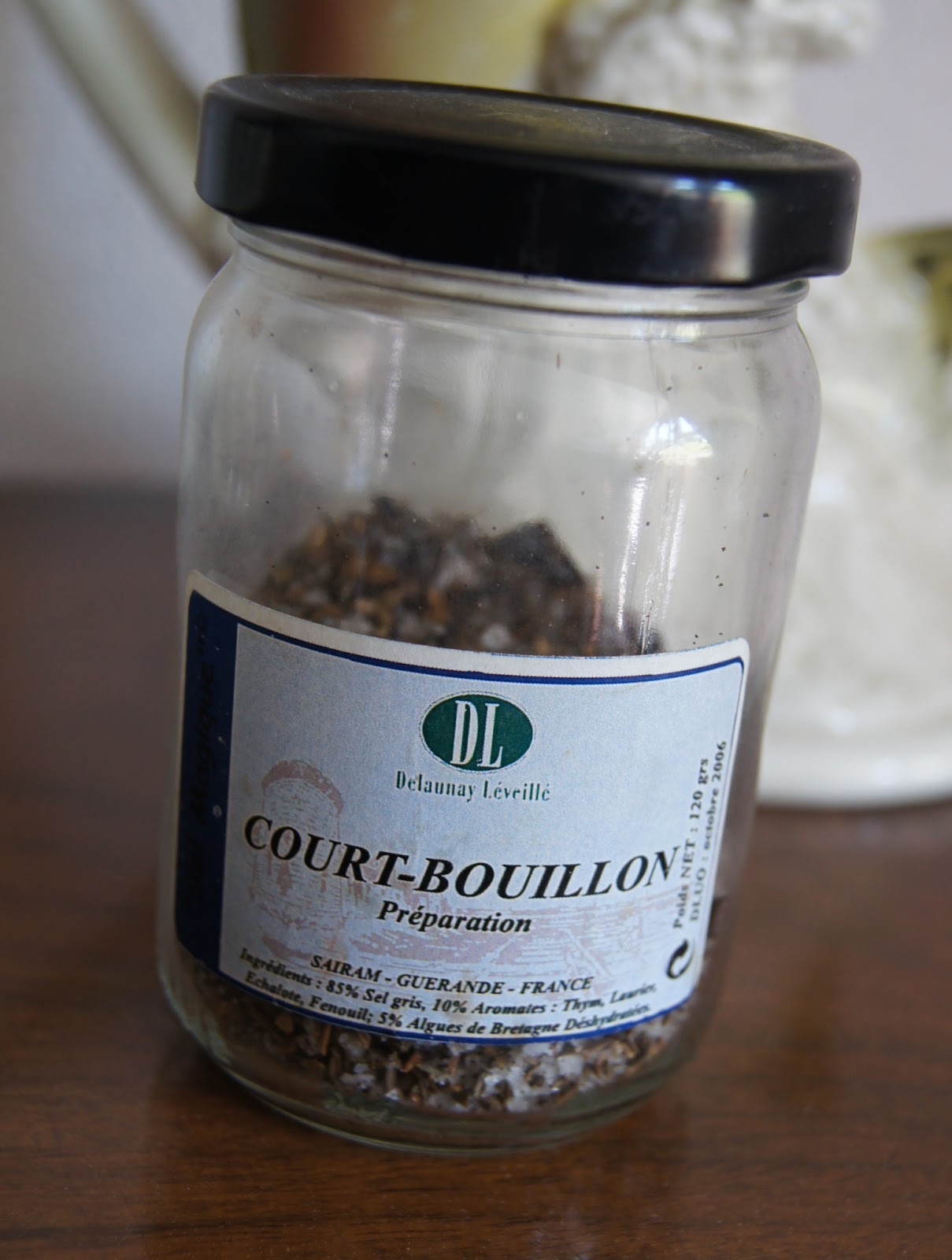

It's mostly gray sea salt, flavored with thyme, bay leaf, dried shallots, fennel seed, and seaweed.  We picked it up in Brittany years ago; it keeps just fine, and it gives the bouillon a decidedly oceanic character.  Whatever sort of thyme is in there is particularly potent, too.  If you don't have something like this, just add the component parts separately.  The seaweed aroma is nice, but not necessary.  Combine everything in a saucepan large enough to hold your fish, bring it to a boil, and simmer for 15 to 20 minutes.  Then turn the heat off, add the fish, cover, and set aside.  The fish was probably cooked through within five minutes, but it didn't hurt it to sit in the bouillon as it cooled, absorbing some of the aromatics.


Service goes family style, the fish with a generous herbal garnish, the aioli and mayonnaise, the lovely vegetables prettily arranged by Mary and Melinda, our guest for the weekend, some crusty bread.  Such a civilized meal, poacher's delight, indeed.

Melinda picked and arranged the flowers, wild meadow bouquets.


Text and photos copyright 2013 by Brett Laidlaw

Wednesday, June 22, 2011

Solstice Aioli


Going back to that idea of honing a finer sense of the seasons , I can report that it's the season of setting fruit out at Bide-A-Wee.  Last year was a dismal one for our apples, as well as for most of  the wild fruits, except for the wild plums, which seem to come through every year.  This year the hawthorns, black cherries, chokecherries, and serviceberries are all setting up nice crops.  In spite of a cool pollinating season, the apples look good--the largest are already an inch-and-a-half across, and reddening.  We have one more gallon of sweet cider in the freezer--maybe barely enough to get us through to a first pressing of this year's fruit if we ration it carefully.  A couple swallows in the morning is enough to start the day off on a happy note.

It's haying time, too--our friend Renee Bartz told us this weekend that they'd cut their second crop of hay, and now hoped for a few dry days to get it baled (not looking like that wish will come true).  You see this age-old practice taking place all across the Dairy State countryside.  Where one day there was a field of tall grass, the next there's a shorn landscape looking something like a very rustic golf course, except dotted across it are the cylindrical bales of hay, a lovely sort of order brought out of the unruly growth, entropy reversed.

With the cows out on new grass, the raw milk we get from the Bartz's Bolen-Vale farm is the richest of the year.  Last weekend we skimmed the cream from the top of the jar and spooned it over the first strawberries of the summer, and we swooned.


And at the market, the season is that of the first summer vegetables.  The leafy things were pleasant enough, asparagus delightful, but it's greatly heartening--and appetizing--to see the next wave coming in, in this case young beets, snap peas, and most gloriously, the first green garlic.  That market haul, and a successful outing on the trout stream (oh, really, they're all successful, whether I catch fish or not), set the scene for an aioli dinner to mark the summer solstice.  (For the mayo/aioli how-to click here.)


Please note that no adjective accompanies aioli here, nor ever will, unless to make the derisive point that none ever should.  Aioli is aioli is aioli.  Chipotle aioli?  Nah.  Lemongrass aioli?  Skip it.  Garlic, oil, egg yolk, a bit of mustard, a squeeze of lemon juice, a pinch of salt, that's what's in aioli.  Oh, now I've read that in Provence some local variations omit the egg yolk, using cooked potato or bread as the binder.  I've never tried it that way.  You could call it garlic mayonnaise and not be far off, except that aioli deserves a more prominent place at the table than is commonly accorded mayonnaise.  It needs to be seen and appreciated, inhaled, dolloped out in copious portions for dipping and dabbing--a clandestine schmear on a sandwich or burger doesn't do it justice.


See the two unctuous globs on the plate above?  The yellow one  on the left is aioli, of course, and the green one is sorrel-tarragon mayo, which only had some garlicky undertones because I chopped the herbs in the same place on the cutting board where I puréed the garlic for the aioli.  I did that on purpose.  To half a cup of mayo I added four smallish sorrel leaves and just a sprig of tarragon, the most assertive of herbs, to my taste.  A dandy combination--but not aioli, mais non.


As for the trout, it was poached in a court bouillon flavored with green onion tops, carrot, thyme, tarragon, cutting celery, black pepper, and some Breton bouillon flavoring containing sea salt, algae, fennel, and some other spices.  We picked it up at a small market in Brittany a good while back.  It seems to keep.


The beets (Menomonie farmers market) and potatoes (not local, I'm afraid), I roasted with olive oil, thyme, rosemary, fleur de sel, black pepper, and chopped green garlic, at 375, for 40 minutes covered, another

15 uncovered.  I peeled the beets first.  And then the asparagus and snap peas (stringed) were blanched in salted boiling water for two minutes.

An aioli plate is the ideal sort of meal for long summer evenings, and this was the longest of all.  We sipped a petit chablis, our glasses
appealingly misted in the humid evening.  The monsoon rains came and went, a downpour, a sunburst. I guess you could say it's summer.

Tuesday, November 30, 2010

Provencal Sunshine


I tend to think of the golden, garlicky glory that is aioli as a summer dish--a glistening bowl of it surrounded by raw or crisp-blanched vegetables straight from the garden, or a pungent spoonful melting over a piece of grilled chicken. But when I whipped up a batch recently, and served it with root vegetable oven frites (parsnip, celery root, carrot, potato), then with roast beets and sliced red onion, a sprinkling of toasted walnuts, I found a whole new appreciation for that grand emulsion.


Indeed, mixed-root oven fries with aioli is my new favorite dish. With summer vegetables, the bright flavors of aioli are almost redundant. But with the deep, caramelized, earthy, both sweet and savory flavors of the roasted roots, the aioli is a perfect match and counterpoint. With the beets, something similar occured, though less profound. There the garlic and the lemon tartness mellowed the dirt flavor of the beets, and tempered the sweetness. I owe the inspiration for that salad to our friend Tata, whose Russian version uses grated beets mixed with loads of oil, mayonnaise, chopped garlic and walnuts.


That steak wasn't bad, either, nice pan-roasted porterhouse with a red wine-shallot sauce, and when the sauce bled into the aioli on the plate, well, that was something rather special, too.

And maybe it seems silly to pay homage to a single egg yolk, but I do believe that the Blue Gentian Farm egg that went into that aioli made it one of the best I've ever made. That, and the wonderfully sharp, sweet garlic that we got from a young farmer named Evan (didn't get his last name) near Turtle Lake.

Beets, Menomonie Farmers Market, red onion from Morgan and Ben, walnuts, well, probably from California. We're local, but we're not dogmatic. I really like walnuts.

And in parting, let me offer a couple of aioli-mayo tips, recently discovered though I've been whipping together oil and eggs for years. I use 3/4 cup of oil to one egg yolk, and I like the oil to be 1/2 cup canola, 1/4 cup extra virgin olive. I whisk the egg yolk with a scant teaspoon of Dijon mustard, then start adding the oil. Instead of pouring the oil at the beginning, dip a spoon into the oil, straight up and down, and then just let whatever oil clings to the spoon drip off into the egg yolk as you whisk. Do that a few times until you see the emulsion starting to form. Then you can start pouring in the oil in a slow, steady stream as you whisk. I add lemon juice partway through the whisking, for flavor and to lighten the mix. I add the very finely chopped garlic--at least one very large clove--and salt at the end. Adding a bit of salt to the garlic as you chop it helps to break it down so you can produce a virtual puree of garlic.

Oh, and this time I made my aioli in one of our 8-quart stainless steel mixing bowls, and when I was finished I did not have to spend a half hour cleaning spattered oil from counter, walls, and myself. Ya lives some and ya learns some. Whisk on, friends.


Text and photos copyright 2010 by Brett Laidlaw

Friday, July 10, 2009

Eat Your Vegetables


So now, all you who dwell in northern climes, as we do, I suggest you fix this picture firmly in mind, to recall come next February, say, because one thing that is certain is that we will not be eating like this then. So fix picture in mind, then take that mental image down to your local farmers' market, or out to your garden, and gather the makings of this assiette de crudités served with a glistening bowl of aioli, Provencal garlic mayonnaise (I'm a bit pendantic about aioli, as can be seen
here).

The vegetables for dipping or slathering in the aioli should be whatever ones are fresh and appealing. On our platter, the yellow summer squash, zucchini, and radishes were raw, the green beans, snow peas, and carrots were blanched in boiling water for a couple of minutes, dunked into ice water to stop the cooking, then drained very well. I like to serve them at room temperature, not cold.

We served this as a first course, though of course you can make it the main event, as it usually is in Provence. In that case some kind of protein is usually part of the meal--chicken, beef, fish or other seafood, or all of the above. Boiled potatoes are also a common component, and with beautiful new potatoes in the market now, you should certainly go for those. Other vegetables you might add to the platter: fennel bulb, celery sticks, tomatoes, artichoke hearts, cauliflower, beets--whatever you like, whatever you think will be enhanced by a freshly made aioli pungent with the season's first garlic, like...cardboard, or shoe leather....

I make my aioli by hand, though you can make it in a blender, as well. Any decent Mediterranean cookbook should have a recipe for aioli. My favorite Provencal cookbook--one of my favorite cookbooks, period--is Mireille Johnston's
Cuisine of the Sun .

Here's my basic mayonnaise recipe. Add finely minced garlic at the end, according to taste and tolerance. I like about three good cloves for this amount of mayonnaise. Your Provencal grandmère would make this with a mortar and pestle, and I've done that a couple of times, but I find the whisk method generally more convenient.

1 egg yolk
1/2 tsp dry mustard, or 1 tsp dijon mustard
juice of 1/2 lemon
couple pinches salt
3/4 cup oil--half olive, half canola, or all olive
finely minced garlic to taste

In a bowl about 10 inches in diameter, whisk together the egg yolk and mustard. Whisking continually, steadily, but not furiously, begin to add the oil VERY VERY slowly, a couple of drops at a time to start with; this is tedious but necessary to keep the mayo from splitting. If you're not practiced at this, it will help to have someone else adding the oil at first while you whisk. Once you see the mayonnaise beginning to thicken, you can add the oil a little more quickly, a slow steady stream--but you never want to just glug it in. The final consistency depends on adding the oil slowly and steadily.

When the mayonnaise starts to thicken, it may become too thick to whisk easily. Squeeze in a little lemon juice to loosen it, continue adding oil, whisking, adding lemon juice to loosen the mayo and to taste, until you've added all the oil. Add a couple good pinches salt, and the minced garlic. Allow to sit in the fridge for at least a half hour for all the flavors to meld.

We served our first-course aioli assiette with crusty bread and a rosé from the south of France, and we had delightful friends to share it with, and one of them was even French, and didn't that just add to the Gallic zest of the evening! It was good.


Another night we tossed together most of the same ingredients with a simple creamy dressing. The chopped summer salad consisted of boiled new potatoes, snap peas, summer squash, carrots, sliced radishes, purple onions and that first green garlic from the market, some dill and thyme from the garden, a nice combination. Everything was raw except the potatoes. Mix this up an hour or two in advance to let everything settle well together.


Lemon-Mayo Dressing for Summer Chopped Salad

1/4 cup mayonnaise (you could make your own, but I used Hellmann's)
juice of 1/2 lemon
2 Tbsp olive oil
1/4 tsp salt
freshly ground black pepper to taste
1 heaping tsp dijon mustard
pinch piment d'espelette or cayenne

Mix all, toss with veg. It was little bit gloopy, but I wanted it that way. We served it with grilled lobster. I know they're not native to Minnesota's waters; sue me.

Text and photos copyright 2009 by Brett Laidlaw