Showing posts with label soup. Show all posts

Tuesday, April 26, 2016

The Ramps Report 2016


Those of us who have been tuned in to the world of local and seasonal eating for a while probably have a complex, somewhat complicated relationship with ramps.  Those “wild leeks” of springtime that have perfumed loamy woodlands and Appalachian kitchens for generations in relative obscurity leapt into the culinary limelight 20 or so years ago, and have been hogging center stage ever since.  I recall seeing them mentioned more and more often in reviews of New York restaurants in the late 1990s, then noticing them for sale (at what seemed like an exorbitant price) in Twin Cities food co-ops, and then came the big Ah-ha! moment when, walking the banks of a favorite trout stream, I was brought up short by a powerful garlic-chivey smell and looked around to find that I was standing in a veritable field of ramps, their crushed leaves under my wading boots sending up what was, to me, an incredibly appetizing aroma.


Thus began my journey along what one might call the stages of grief/stations of the cross for ramp lovers in the foodie 21st century.  Fascination and infatuation at first meeting, then falling big time for this humble but compelling new crush; then the skepticism, eye-rolling at the sudden bandwagoning crowds, the farmers market shoppers clamoring, the fancy chefs pandering; disillusionment—was I a fool to fall so fast, so hard, for a love that had turned fickle and trendy?; then acceptance: hey, it’s a stinking wild onion, it’s delicious, and when you pick it yourself, it’s free, and ridiculously abundant when you know where to look—get over it. 


I’ve reached acceptance now, indeed, a state of near ramps nirvana, if you don’t mind my mixing gastro-religious metaphors in reference to a common woodland weed.  I went fishing with my friend Tom during Minnesota’s opening weekend for the regular (i.e., kill ‘em & grill ‘em, hook ‘em & cook ‘em) trout season a week ago Sunday, and while the fishing was pretty good, the foraging was even better.  The warm start to spring meant that the ramps were already well up and sizable.  We each took home a sack, and I’ve been cooking with them nearly every day since.

Opening weekend trout stream rice bowl with ramps, cress, and of course, trout, brown.

While I’ve come up with a number of ramp-specific recipes over the years, now I tend to treat them like any other allium (that is, onion or lily family member, ramps being allium tricoccum), as a versatile aromatic.  So I’ve sautéed them to build a nice base for ramen stock, thrown a handful into a quesadilla, strewn slivers atop a pizza, sweated with other aromatics to flavor a pilaf—you get the idea.


Yesterday I did a little pickling, putting up one pint of ramp bulbs per this versatile method, setting a quart to ferment in a simple salt-water brine.  Looking through my blog index I find that I might have more recipes involving ramps than just about any other ingredient.  As far as that gnarly, evolving relationship with ramps goes, I guess I’m fully committed.


Charred Ramp and Watercress Soup


I used Madeleine Kamman’s cabbage cream soup as a template.  Serves 2 as a main course, 4 as a starter

2 ounces salt pork or pancetta, in 1/3” dice (or 2 tablespoons cooking oil)
10 good ramps, well cleaned
1 small potato, about 4 ounces, peeled, cut in small dice, and rinsed, and well drained
4 cups loosely packed watercress (about 4 ounces), leaves and stems, well rinsed (especially if it’s wild cress) and roughly chopped
3 cups chicken stock
Salt and freshly ground black pepper

Optional garnish: croutons, good yogurt, cream, or thinned sour cream

Separate the ramp greens from the stem-bulb sections and set aside.  Slice the stem-bulb sections crosswise into 1/4-inch pieces.

If using salt pork/pancetta, render the pork cubes gently over medium-low heat until they have given up much of their fat and started to brown.  Remove the cubes from the pan and set aside.  Pour off—but save!—the fat, and return 2 tablespoons to the pan.
If you don’t have salt pork or pancetta, heat 2 tablespoons oil.

Turn the heat to medium-high and add the chopped ramps, then the potato.  Cook, stirring frequently, until the potato begins to brown and the ramp pieces take on color—indeed, we are looking for some of the ramp bits to become quite dark, even black.  Just don’t burn the crap out of it so it all turns ashy and bitter.

Getting good color.

When the potato is golden, the ramps nicely colored/charred, add the chicken stock, then the cress, a couple good pinches of salt, and a few grinds of pepper.  Bring to a simmer, cover, and cook at a gentle bubble for 10 minutes, stirring occasionally.

Chiffonade (cut in thin ribbons) the ramp greens, and add half of them to the soup at the end of the 10-minute simmer.  Let the soup cool for a few minutes, then purée, using either an immersion blender, a regular blender, or, with great care and caution, a food processor.

The soup can be made to this point up to several days ahead.  Just before serving, reheat the soup and serve garnished with the recrisped salt pork/pancetta cubes, croutons from good, honest bread, perhaps a swirl of yogurt (I’m fond of goat yogurt), and the remaining ramp leaf chiffonade, or as you please.


Text and photos copyright 2016 by Brett Laidlaw

Monday, April 4, 2016

First Home Harvests 2016


One swallow does not a summer make, the saying goes, nor does a warm, sunny day or two in March guarantee that spring is here to stay.  April came in with cold, blustery winds, lashing snow squalls, all kinds of drama from the skies.  Then a day of mellow warmth, but overnight, a hard freeze, and in the forecast, more wintry weather.  It makes for lively conversation at the dump or the hardware store, but overall, it’s pretty much same as it ever was.  Maybe there are actually regions where spring slides mildly into place in a calm and predictable progression, but this ain’t one of them….


However:  there has been enough spring-like weather that the ground has thawed, and warmed enough to push forth a few greens shoots.  Chives are always the first things to come back in the herb garden, and stinging nettles take the vanguard among the wild edibles.  I was able to gather a handful of each last evening, and we added them to a simple dinner comprised of recombined leftovers:  lentils, some chickpeas in a spicy broth, to which I added some of the excellent German wieners that we picked up at the Chetek Café.


I started by dicing up and rendering off a some homemade salt pork, and to the drippings added diced potato, carrot, some chopped celery and shallot.  Browned off the sliced wieners and then in went the lentils, chickpeas and broth.  Simmered for 10 minutes, until the potatoes were just cooked through.  Then just before serving I brought it back up to a simmer and added the chopped nettles—baby nettle tips, really, the most delectable kind of nettles.

I enjoyed the fact that lentils and nettles are almost anagrams.  And we enjoyed immensely a warm and comforting plate of food that far transcended any usual notion of leftovers.  I sprinkled some chopped chives over the soup, and they added a fresh, vibrant pop—the first chives of the year are definitely the best.  They had me thinking a baked potato dinner later in the week might be a good idea.


Chives also went into a simple salad dressing along with—get this—Wisconsin-grown Meyer lemon.  You read that right.  On a quick getaway to Madison this past weekend we visited the Dane County winter farmers market.  And while this indoor market is a tiny fraction the size of the magnificent summer market that sprawls all around the capitol square, its grass-roots populism making a mockery of the craven shenanigans that miserably unfold beneath the capitol dome (ahem), there was still lots of great meat, cheese, and produce.  We didn’t buy a lot, but came away with some beautiful lettuce and a Meyer lemon that we purchased from a honey vendor.  It came from a tree that I think he said was planted in 1964, in a pot, of course, to shelter indoors during the Wisconsin winter.  Not exactly the kind of thing you expect to find at a northern winter farmers market, but a lovely surprise.  We were lucky to be at the market early enough to score one.


The first green harvests are always such a delight, even if they are small, scarcely more than garnish.  A chef writing in the New York Times recently, trying to sell the idea that hard, pink, winter tomatoes were worth your money and cooking efforts, went so far as to argue that we live in a “post-seasonal world."  Uhn-uhn, chef, you’re wrong.  Maybe you live in a non-seasonal food world, but only because you’re not looking, or trying, hard enough.  Out here in the frigid sticks, the "seasonal world" is pretty hard to avoid.  Not that I would want to.


Text and photos copyright 2016 by Brett Laidlaw

Thursday, January 14, 2016

Simply Superior Soup (or "Effing French Cooking Magic")


It’s the last week of December 2015 as I (begin to) write this, 2016 looming just days away, and for cooking options we are decidedly into the winter larder.  On December 6 we were amazed to eat, and very much enjoy, the last garden tomato.  The last leaves of fresh kale were part of a festive Christmas dinner:  seared venison loin (harvested from the Bide-A-Wee property last year) with a rich, savory red wine and port reduction; lima beans simmered with stock and aromatics, then pureed, a surprisingly luxurious result from a humble dried bean; then the kale, braised with chestnuts and garden leek, a splash of our homemade cider vinegar.  Though we haven’t really celebrated Christmas in any traditional way for some years, I’m not going to let an opportunity for a festive dinner go by.  And anyway, we think of it as a continuation of our solstice festivities—especially appropriate here, as Mary’s birthday occurs during the same time.

Once those last leaves of kale vacated the crisper, dinner planning turned a page.  It’s true that there’s still quite a bit of “fresh” produce, from both garden and farmer’s market stock-ups, in our cellar, in the fridge.  But the term fresh doesn’t really mean the same when applied to storage carrots, cabbage, squash, and onions, as it does when describing a handful of beans or a bowl of tender lettuce harvested from the garden to be prepared and served minutes later.  Those winter stand-bys are fresh in the sense of not being frozen, dried, pickled, fermented, etc., but…you know what I mean.  It’s not the same as throwing dew-dappled snap peas in the wok or snipping fragrant dill into a dressing.  Our vocabulary fails us in efficiently denoting that crucial difference:  there’s fresh produce, and then there’s fresh produce

This is not to disparage the stalwart vegetables of winter, not at all.  Like reliable character actors, they show up and fill their roles with unfailing professionalism, year after year, decade after decade, while the fad for arugula fades, or a trendy heirloom cucumber turns out to be just another pickle, after all.  Cabbage, potatoes, carrots, squash, onion, leek, turnip, beets--the roster might at first glance suggest daily supper at the gulag:  bung it all in a kettle, boil until done.  But there’s a saying I like (and as far as I know, I came up with it), goes like this:  There’s meat, and then there’s cooking.  Which is to say:  It’s not always only about the ingredients, but often as much or more about imagination and skill in preparation.  Today’s soup, which we had as a first course on Christmas night, is a perfect example.

If it hadn’t come with a sexy French name, I might never have tried it.  Puréed cabbage and potato soup sounds, you must admit, a good deal less appealing than Crème de Choux aux Beurre de Roquefort.  The source is Madeleine Kamman’s In Madeleine’s Kitchen.  There are three remarkable and surprising things about this recipe:

1)  In spite of the cream—crème—in the title, there’s no cream in the soup.
2)  In spite of the fancy-sounding title, the list of ingredients is short and plain.
3)  In spite of the short, plain ingredient list, the resulting soup is delicious, even luxurious, the result of “Fucking French cooking magic,” as I described it, enthusiasm overwhelming decorum, in a tweet.


There are a couple of secret ingredients:  walnut oil, and confit fat.  But I think you could do without those if you don’t have them, substituting good butter for the confit fat, olive oil for the walnut oil.  However:  if you haven’t tried French walnut oil, it is well worth seeking out.  A commonly available brand, and the one we always buy, have even brought back from Paris in the past, is J. Leblanc.  It’s pricy, but a little goes a long way.  For me, a salad of fresh tender lettuces straight from the garden, dressed with nothing more than walnut oil and a bit of fleur de sel is one of life’s simple luxuries.  But I’m getting ahead of the season.  Just one more note on the walnut oil:  the French stuff is made from lightly toasted walnuts, so it’s amber in color and has that nutty fragrance and flavor.  The golden walnut oil often sold at “health food stores” and co-ops is not the same.  The French walnut oil should not be used for cooking, only dressings and seasoning.  (NB: the English name is in small print on the bottle, so you’re looking for a bottle labeled “Huile de Noix,” as above.  For Mpls/St Paul readers, Cooks of Crocus Hill carries it, but are currently out of stock in all stores.)


The basis of the soup is potatoes, cabbage, and water.  It gets a smoky depth of flavor from bacon.  Not a lot of bacon, either, less than an ounce per person in Kamman’s recipe (she actually calls for pancetta).  No cream or milk, as noted above.  No stock, just water (you can call it Chateau Sink, as Jacques Pepin sometimes jokes, or perhaps Domaine du Tappe, to French it up).  There’s a bit of garlic, whose presence is felt.  The beurre de Roquefort is simply blue cheese and soft butter mashed together, a few grinds of coarse black pepper—a simple compound butter; it’s worth making extra, for it’s nice to have around, to smear on a burger, say.


And that, my friends, is it, the ingredient list in its entirety.  You gently render off small cubes of the bacon or pancetta, add potatoes and garlic, then the cabbage.  This sweats for a few minutes (“mellows,” in M Kamman’s version), then you add water and simmer until the cabbage is very tender.  The well mellowed vegetables and bacon are then whizzed up in a blender (I used a food processor, carefully spooning out the solids, adding liquid gradually; an FP is really not the best appliance for pureeing soups, I’ve learned from bitter experience).


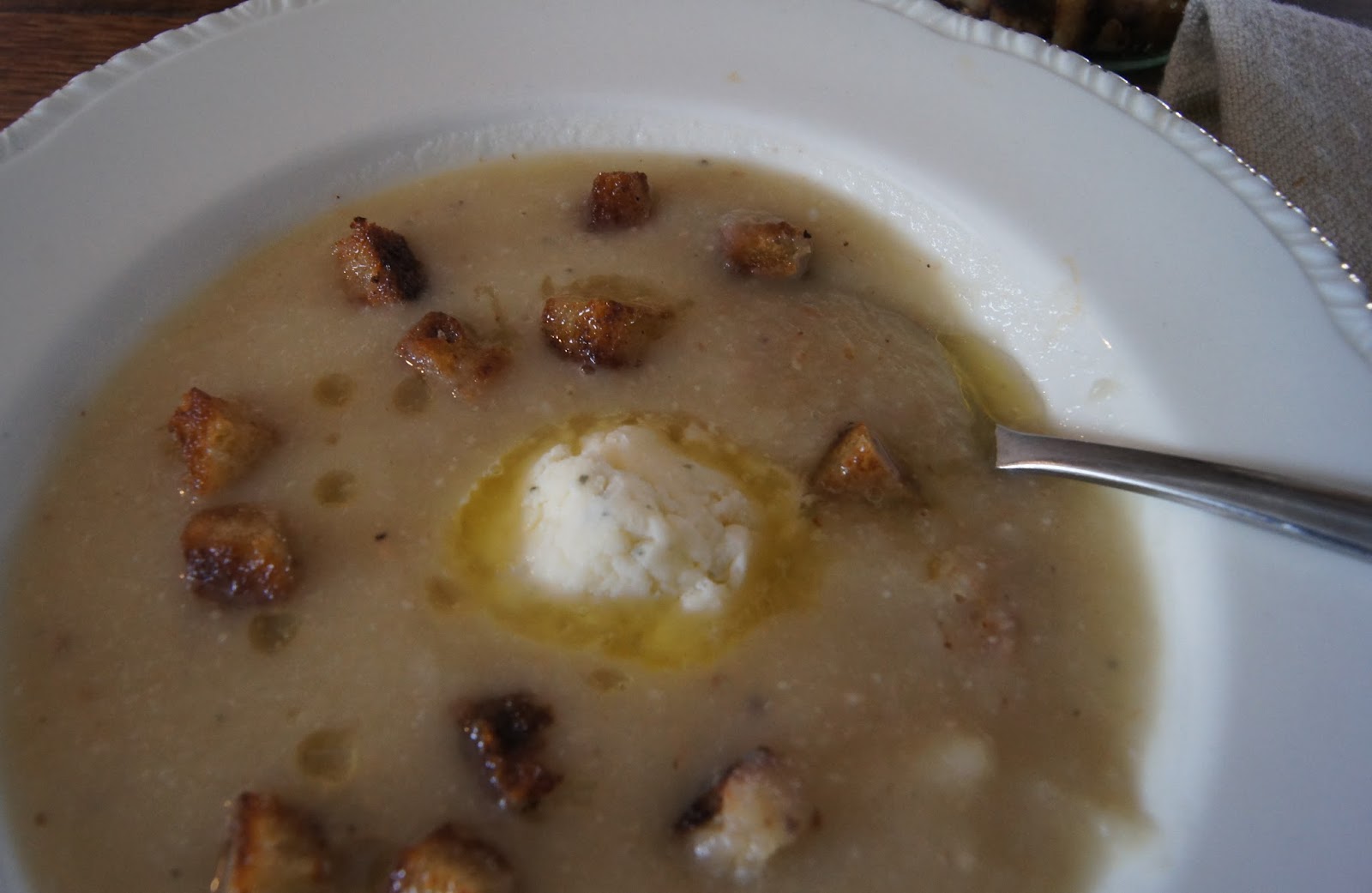
And get this:  it suffers not at all from being made a day ahead and reheated just before serving.  On Christmas Eve I added a little crunchy garnish, chopped goose skin cracklings—yeah, I happened to have some lying around; don’t hate me because I’m beautiful—from the goose we cooked for our first solstice celebration.  When I made it again for lunch I toasted some small croutons in olive oil—it’s really about the textural contrast, that crunch to perk up the creamy soup.  (See:  "It's all about the garnish".)


Coming back around to my earlier point and seasonal eating and the winter larder:  this is a fabulous dish that you would never make in the summer, but which is perfect for the cold months when, you know, you have a lot of potatoes and cabbage around.  It also reminded me how absolutely lovely and civilized it is to start a meal with a soup, so elegant and yet so comforting.  A fading tradition I hope to start reviving in our house.


My adaptation of Madeleine Kamman’s recipe:

Creamy Bacon, Potato, and Cabbage Soup with Blue Cheese Butter

Serves four as a first course, two to three as a main course—add salad and crusty bread to make it a meal

2 ounces bacon or pancetta, preferably in one chunk
1 tablespoon duck confit fat or butter
1 medium or 2 small potatoes, 6-7 ounces total
1 large or 2 small cloves garlic
¼ of a green cabbage, about 12 ounces
1 tablespoon walnut oil, plus additional for garnish*
Salt and freshly ground black pepper

For the blue cheese butter:
2 ounces unsalted butter at room temperature
2 ounces blue cheese

Croutons or cracklings, optional but highly recommended

In a small bowl, mash the butter and blue cheese together with a fork until well blended.

Cut the bacon or pancetta in small dice, about ¼-inch.  Peel the potatoes and cut them into smallish cubes, about ¾-inch.  Shred the cabbage into ½-inch strips.

Heat a medium saucepan and add the confit fat or butter, then the bacon.  Cook over medium-low heat.  As the bacon renders its fat and begins to brown, add the potatoes, tossing them in the fat, then cook, stirring occasionally, until they become a little bit brown, 4 to 5 minutes (you’re just looking for a golden color, not deeply browned as for hash browns).  Stir in the garlic and cook for another minute or two, then add the cabbage, a couple generous pinches of salt, and several grinds of black pepper.

Turn the heat to low, cover, and let the cabbage sweat (“mellow” is the term M Kamman uses) until well wilted, about 5 minutes.  Add 3 cups water, bring to a boil, turn down to a simmer, and cook partly covered until the cabbage and potatoes are very soft, 15 to 20 minutes.

Let the soup cool for a few minutes before pureeing.  If using a food processor, separate the solid from the liquid parts of the soup and purée the solids first, then gradually add in the liquid.  When everything is in the FP, purée for about a minute.  At the end of the minute, drizzle in the walnut oil.  Return the soup to the saucepan.  Reheat just before serving.  (Note:  Kamman directs you to strain the soup back into the pot after puréeing; I did not bother with this step, finding the soup smooth enough to my taste without straining.  Straining would no doubt produce an even more velvety and elegant purée, if that's what you're after.)

To serve:  heat the soup and taste for salt; you will probably want to add another pinch or two.  Ladle the soup into bowls, and to each add about a tablespoon of the blue cheese butter.  Add croutons or cracklings, as you please, drizzle a small amount of walnut oil over the surface of the soup, and serve.

*If you don’t have/can’t find walnut oil, use a flavorful olive oil—or, perhaps pumpkin seed oil, such as Wisconsin’s own Hay River Pumpkin Seed Oil.  And, how about this—if using pumpkin seed oil, think about substituting butternut squash for all or part of the potatoes, then garnish with toasted pepitas instead of the croutons/cracklings.

Happy soupage!

Thursday, October 4, 2012

Fried Trout & Chowder


The Feast of the Fishes continues as we work our way through my catch of closing week.  It was a remarkably benign week of weather for the end of September--a bit of a disappointment, really, as I enjoy fishing at least one day at season's end in a chill rain, which clears the river of most other fisherfolk, and seems to pique the trout's appetite.  With clear, sunny skies and daytime highs pushing well into the 70s, the weather didn't really make one think of chowder--except that mornings started out in the low 30s, and sunset saw the temperature drop quickly into the 40s.  It was weather I'd associate more with a high, dry mountain climate than with valley life here in Near North Wisconsin.  The long story short: though the afternoon sun had me thinking of grilling, I knew that by suppertime we'd be pulling on the wool socks and sweatshirts; so I made chowder.


My first thought as I started to prep the dish was to do something a little fancy, a bit "deconstructed," if you will--with large pieces of bacon and thick slices of potato in a sort of "chowder sauce," the fish cooked separately.  That proved to be just too much to think about at the end of the day, so I made a fairly traditional chowder. The only divergence was that I fried the fillets of trout and served them atop the chowder, rather than simmering the fish in the soup; I like the crisp skin of a well fried trout very, very much.

Oh, and I did get a bit creative with the garnish, because (all together now!), "It's all about the garnish!"  I peeled and seeded a Green Zebra and a red tomato and chopped these roughly--a concasse, which is a nice French cooking word to know.  I also fried some shredded kale in the pan I cooked the trout in, cooked it quite crisp.


I've heard brook trout referred to as "northwoods bacon," and with these little babies the analogy is easy to see.  It's especially nice when you can have bacon with your "bacon."  That's actually a brown trout tidbit I'm holding.


If you're not starting with whole fish, and therefore don't have the frames to add flavor to the soup, use fish, chicken, or vegetable stock instead of water--or just don't worry about it, as the bacon and all the vegetables will provide quite a bit of flavor on their own.


Fried Trout & Chowder


2 ounces slab bacon, cut into 1/2-inch cubes
1/2 small red onion, sliced longitudinally
1 small leek, well washed and sliced, white and light green parts
1/4 cup fresh fennel bulb in 1/4-inch dice
1/4 celery root in 1/4-inch dice
1 small jalapeno chile seeded and chopped fine
1 heaping tablespoon flour
1 1/2 cups water
1 1/2 cups whole milk
fresh thyme
salt and pepper
2 small trout, about 8 ounces each, filleted, save the frames
2 medium red potatoes, in 1/2-inch cubes
1 medium Green Zebra tomato, peeled, seeded, chopped
1 medium red tomato, peeled, seeded, chopped
6 leaves kale, thick stem removed, sliced into 1/2-inch ribbons


Start to render the bacon slowly in a medium saucepan over medium heat.  If the bacon is lean and not giving up much fat, add a bit of cooking oil.  Add the onion and leek as the bacon begins to brown.  Cook a few minutes until the onion is translucent.  Add the fennel, celery root, and jalapeno, and cook, stirring, for two minutes.  Sprinkle the flour over the vegetables and stir it in to the fat in the pan.  Cook, stirring, for about a minute.

Combine the water and milk and gradually add it to the pan, scraping with a wooden spatula to dissolve the flour into the liquid.  When all the liquid is added, add the fish frames--bones and heads--to the pan, bring to a boil, and simmer for 15 minutes.  Fish out the fish frames; save the cheeks for garnish.  Add the potatoes and a couple sprigs of fresh thyme.  Add a couple generous pinches of salt.  Simmer another 15 minutes or so, until the potatoes are tender.  Taste for salt and add a few grinds of black pepper.

Season the fillets with salt and pepper.  Fry them in just a bit of oil--or bacon or duck fat--over medium-high heat, skin side down, for about three minutes, until the skin is nicely browned.  Flip them and finish cooking flesh side down for about two minutes.  Add a little more oil or fat to the pan, and fry the kale until it is crisp.

Serve a ladle or two of the chowder out into wide soup plates, top with the fried fish, garnish with the cheeks, both tomatoes, and kale, and serve.

Thursday, May 10, 2012

Savage Soupage


I also like the sound of potage sauvage, but I'm trying to wean myself from always running to the French.  That one will go in the title pantry, though, and I'm sure it will find its way out.  This is one of the most foraged dishes I've ever made, although, wild as it is, it did not require a lot of foraging far afield.  Indeed, much of it--morels, nettles, dandelion greens--came from our yard or near outskirts.


We had a nice, surprising fruiting of morels twenty feet from the house, near some cottonwoods.  Stinging nettles encroach at every edge of the yard, and our dandelion crop is amazing--not just the sheer number of plants, but the size of the leaves, and their mildness.  I haven't done enough with them this year.


As I was putting this soup together I worried that it might turn out to be a bit challenging, might lean toward the medicinal or excessively "healthy" side.  Ramps, nettles, dandelion greens, and fiddleheads all have distinctive flavors, which I had never tried to incorporate in one recipe before.  The morels were there to lend their musky mellowness, modulate the highs (bitter dandelions) and lows (earthy fiddleheads); and then, there's just the magic of soup--and of cream (which I may have mentioned recently...).  I needn't have worried, not a bit.  This weedy wild soupage was far more comforting than challenging, though the textures of all the wild greens still intrigued.  A garnish of dandelion petals brightened things up and removed at least one of those darned weeds from my yard.   One down, 600 trillion to go....

Stinging nettle tips left, wood nettles right.

A big part of the greenery in the soup was wood nettles, the lesser known cousin (sort of) of stinging nettles. These are at a lovely size in our woods now, and not terribly threatening, yet.  I'll have more to say about these in my next dispatch.

I had some cress I could have thrown in, but with four kinds of greens already, I refrained.  I cooked up some wild rice, thinking I might need something to give the soup more body, but there was no room for it, and it would have diluted this full-on forager's feast.


Savage Soupage
serves four

6 ostrich fern fiddleheads, each with about 6 inches of stalk, cut into 1/2-inch pieces
1 good handful of nice big dandelion greens, coarsely chopped
3/4 cup chopped ramp bulbs and stems
Greens from the ramps, sliced
3 ounces fresh morels
1 1/2 tablespoons cooking fat--butter, bacon or duck fat, or olive oil
4 cups (loosely packed) young wood nettles
1 1/2 cups (loosely packed) stinging nettle tips
3 1/2 cups chicken or vegetable stock
1/2 cup heavy cream
salt

Blanch the fiddleheads in salted boiling water for 5 minutes.  Drain and refresh in ice water.  If your dandelion greens seem quite bitter, blanch them for 1 minute, drain and refresh, and drain well.

Chop most of the morels, reserving a couple of caps to cut in rings and fry for garnish.  In a large saucepan or dutch oven, heat the cooking fat and add the ramp bulbs and stems.  Sauté for a minute or two, until they start to shrink a bit, then add the morels and a good pinch of salt.  Cook until the morels shrink and start to brown a bit, 3 to 4 minutes.  Add the dandelion greens and stir them in for a minute.  Add the wood nettles and ramp tops (save a bit of the greens for garnish) and stir to wilt them.  Add the stock and a couple of pinches of salt.   Add the stinging nettle tips and fiddleheads.  Bring to a boil and turn down to a simmer.  Simmer, partly covered, for 20 minutes.  Add the cream and taste for salt.  Simmer for 10 minutes.

Just before serving, fry the reserved rings of morel caps in a bit of butter until browned.  Garnish the soup with these, a few bits of ramp greens, and some dandelion petals, if you like.

Text and photos copyright 2012 by Brett Laidlaw

Wednesday, September 28, 2011

Roasted Squash and Apple Soup ("It's All About the Garnish")


It's a stalwart cook indeed who can look upon autumn's bounteous offering of bright, appealing squashes and pumpkins, and refrain from making soup.  I've failed that test again, but with a purpose.

The problem with squash soup...well, where to start?  Too sweet, too gloppy, too monotonously...squashy.  To cut into that imposingly bland flavor (which I like, don't get me wrong), strong spices are often employed, but the curried squash soup, for instance, is by now such a tired cliché, some people must think that squash naturally tastes like curry powder.  Sometimes squash soup gets the Thai treatment:  lemongrass, coconut milk, bird-eye chiles.  I think that's trying a little too hard.

And the texture, what to do with the texure:  add too little liquid, in the form of stock, milk or cream, and you've got baby food rather than soup; too much, and the result doesn't taste much like squash (I hear some of you saying, "And what's wrong with that...?").

This preparation is a step in the direction of a corrective to this gnarly dilemma.  Better cooks than I have ventured down that path, I'm sure, but here's my stab at it.  I don't think this is the end of the road, but it's good (a cup of Cedar Summit cream will tip most anything in the "good" direction).  Another autumn will bring more wagonloads of autumn's most recognizable vegetables, their colors nostalgically mimicking the turning leaves; and once again we won't be able to not make soup.

I counter the sweetness and blandness issues in one blow, by adding tart apple and fresh apple cider.  These are both highly seasonal ingredients, as well, so we're keeping with the autumnal soup spirit.  Roasting the ingredients until they are slightly browned brings up the flavor, too.  And why add maple syrup, if we're worried about the soup being too sweet?  Well, the maple has a different sort of sweetness, very complementary to the tart apple and cider, I think, and a little sharpness of its own, and a roundness.  To achieve a pleasant texture and deepen the flavor, I use good chicken stock to simmer the soup, and that good cream to finish it.


And: I garnish the hell out of it.  This is the "secret" to excellent creamy soups, I think, especially those that threaten to overwhelm the palate with sameness if not carefully disciplined with the application of fresh, complementary and contrasting flavors and textures at the table.  You could almost look at the soup per se as a blank canvas, and take on the role of the Jackson Pollock of soup in your extravagent garnishings.

We actually have a saying around here (you can ask Mary, she'll back me up):  "It's all about the garnish," is what we say.  Have a try. (If I seem to be damning this soup with faint praise, well, that's just how I am; in fact it is a very satisfying dish on a cool autumn evening; a piece of crusty bread and a green salad will make it a meal.)


Roasted Squash and Apple Soup
serves four as a main course, six to eight as a starter

2 pounds squash (trimmed weight), peeled, cut into 1 1/2- to 2-inch pieces, 7 to 8 cups--butternut would be ideal
1 tart apple, peeled, cored, and quartered
4 large cloves garlic, peeled
3 shallots (each the size of a small egg, about 3 ounces total), peeled and halved, divided
2 tablespoons olive oil
Salt and freshly ground black pepper
1/4 cup sweet apple cider
4 cups chicken stock (unsalted or low-salt)
Sage and thyme
1/8 teaspoon espelette pepper or a couple pinches of cayenne, optional
1 cup heavy cream
4 teaspoons maple syrup

Preheat oven to 425.  Toss the squash pieces with the olive oil and a couple good pinches of salt, and place them on a baking sheet.  Roast for 20 minutes.  Set aside one half of a shallot--to be used later as garnish.  Add the apple, garlic, and remaining shallots to the baking sheet, toss to coat with oil, and roast for 20 minutes more, until the squash and apples are soft and a bit browned--they may even be quite mushy at this point, depending on the produce.

In a large saucepan combine the roasted vegetables and apple, the stock, cider, 1/4 teaspoon salt, and few grinds of black pepper, 1 teaspoon of fresh thyme leaves (or 1/2 teaspoon dried), and 4 sage leaves, chopped (or 1/2 teaspoon dried).  Bring to a simmer and cook, partially covered, for 30 minutes.  Allow the soup to cool to lukewarm, then either pass it through a food mill, or puree it in a blender; return the resulting puree to the saucepan. 

The soup can be made a day or two ahead up to this point.  When you are ready to serve the soup, add the cream, maple syrup, and the optional espelette or cayenne.  Bring to a simmer and cook very gently for 5 minutes.  Taste and adjust for salt.  If the soup seems too thick, thin it to where you want it by adding a little more stock, water, or cream, as you prefer.

Serve with any or all of these garnishes:

--Finely diced apple tossed with a pinch of salt and a squeeze of lemon juice to keep it from browning.
--Grated sharp white cheddar.
--The reserved shallot, minced, lightly browned in butter or olive oil: drizzle in a swirl over the top of the soup.
--Butter- or bacon fat-toasted small croutons or coarse bread crumbs from a good country or sourdough loaf.
--Crumbled bacon (or a fine dice of it; our homemade bacon doesn't tend to crumble).


Text and photos copyright 2011 by Brett Laidlaw

Thursday, March 31, 2011

Winter's Last Soup

  Sometimes I plan my cooking, and sometimes I just cook what's thrown at me. Case in the latter point: carrot apple soup. Things turned rather hectic around here last fall, and organization of the root cellar sort of fell by the wayside. We store our root vegetables in a large crawlspace cum dirt-floored cellar, separate from the rest of the basement. We call it "The Dungeon," kind of a creepy place, lots of spider webs, dank. But it keeps a temperature in the mid-40s through the winter, pretty much ideal.

Into this dungeon/root cellar last fall I unceremoniously shoved a couple of boxes containing potatoes, garlic and shallots, and a bin of carrots. When I needed any of these things, I would go down with a flashlight and rummage around, quickly, for the required vegetables. I don't like spending more time in there than I have to. If I wanted a carrot, I would just grab one off the top of the bin, and vamoose. At a certain point, a few weeks back, I noticed the carrots becoming kind of...grotty, I think is the word. Some were sprouting, some rotten at the core, some generally slimy. But there seemed to be a lot left, and quite a few still good, so I eventually had to screw up my courage and address the situation.

I pulled the whole bin out into daylight. I regarded it a bit askance, one eye half closed, pretty sure I was not going to like what I saw. And...

...And it wasn't that bad. I probably deserved to punished for my poor management of root cellar resources, but I dodged the bullet on this one. It took a good half hour to trim and clean up the salvageable carrots from the bin, and when I was done I'll bet I had around fifteen pounds of nice, sound, sweet carrots. And since the weather here continues soup-worthy, that is what I did.

I was afraid of the soup becoming too sweet, so I paired the carrots with some tart apples we had in storage (those are just about done, and the apple trees will soon be blooming). I had also thought to finish it with buttermilk, but the carrots were not ultra-sweet, the apple tartness really came through, and it wound up needing rounding off more than tarting up. So I stirred in a little cream at the end.

I’m not sure if it’s a  positive or negative that the finished soup looks and tastes remarkably like a luxe version of Campbell’s tomato soup. The sweet carrots and tart apples create an amazing trompe-bouche tomato effect. The garnishes are inspired, if I say so myself. The carrot and shallot shreds reprise flavors already in the soup, the cheese and garlic bring different depth and richness. I'd recommend using one of the other. Both would be over the top, I think, but maybe that wouldn't be a bad thing. If you don’t want to make it fancy that way, just drop some croutons in--or crumble on some saltines.


Carrot Apple Soup
Serves four as a starter, two as a main course

1 shallot sliced
4 1/8-inch slices ginger
2 cloves garlic crushed
1 ½ teaspoons canola or grapeseed oil
3 ½ cups excellent chicken or vegetable stock
2 small tart apples, peeled, cored, and chopped (1 1/2 cups)
3 medium carrots(12 ounces), peeled and chopped (1 ½ cups)
¼ teaspoon salt
3 sprigs thyme
1 small clove garlic, minced
1 teaspoon minced fresh ginger
Freshly ground black pepper
¼ cup heavy cream

Garnish #1:

½ a small carrot, cut into fine shreds or grated
1 small shallot, sliced very thin
2 tablespoons olive oil

Garnish #2:

1 clove garlic, minced
¼ cup grated swiss or gruyere cheese

Cook the sliced shallot, ginger slices, and crushed garlic in the canola oil over medium heat until they take on a good bit of color, four to five minutes. Be careful that the garlic does not burn. Add the stock and bring to a boil. Simmer partly covered for 30 to 40 minutes. Strain the stock and discard the vegetables. You should have at least 2 ½ cups of liquid left. Add stock or water to make up the difference if too much has simmered away.

Return the stock to the saucepan. Add the carrots, apples, thyme, minced garlic and ginger, salt, and a few grinds of black pepper. Bring to a simmer and cook covered until the carrots are very tender, 40 to 45 minutes. Let the soup cool for ten minutes or so, then puree it in a blender or food processor until it is very smooth. Pass it through a sieve or food mill back into the saucepan. Add the cream, and reheat gently just before serving. Taste for salt.

For garnish #1: Heat two tablespoons olive oil in a small saucepan. Add the shredded carrots and cook until they become shrunken and a bit brown. Remove them from the oil. Add the sliced shallot and cook until lightly browned. Remove from the oil, reserving the oil. Place a spoon of the carrots on top of the soup, and a spoon of shallots on top of that. Drizzle some of the olive oil around the edges.

For garnish #2: Place a half teaspoon of minced garlic and a couple tablespoons of grated cheese in the bottom of each bowl. Place the bowls on the table, and--carefully!--ladle the very hot soup into the bowls. The aromas of garlic and cheese released by the hot soup will make your guests swoon.


Text and photos copyright 2011 by Brett Laidlaw

Tuesday, March 15, 2011

Slowly


This is the kind of dish at which our Haggis woodstove excels. Do not ask Haggis to stir-fry--that is not in the Haggis genes. Haggis will sear a steak only reluctantly. Haggis is a phlegmatic creature; sudden changes in mood do not suit Haggis. Haggis can cook an egg, or an assemblage of eggs, like a frittata, very well, slowly brown a piece of meat or fish, render bacon solicitously.


But where Haggis really shines is in the long, slow simmer. On a winter afternoon still deep in the white but leaning toward spring, Haggis emanates a gentle heat for hours, coddling a pot of chicken and vegetables flavored with homesmoked bacon. The pot never comes to a boil--it's kind of a backwoods half-assed sous vide, if you like. In the end the broth is deeply, beautifully imbued with the flavors of all the components, yet the meat and vegetables retain their integrity--the vegetables are still a bit crisp, the chicken is not stringy or washed-out tasting.

This is the kind of simple food I love, and I think one grows to appreciate this kind of cooking over time. It's a good thing that some benefits come with age.


Chicken Bacon Hot Pot

Very slow cooking produces a succulent broth and meat and vegetables that retain excellent flavor and texture.

2 ounces slab bacon, in 1-inch chunks
4 chicken thighs or a small chicken quartered
1 large carrot, quartered the long way, cut into 2-inch lengths
1 medium onion, sliced
1 rib celery, halved the long way, cut into 3-inch lengths
4 small potatoes
3 cloves garlic, whole, unpeeled
1 turnip, peeled and quartered
¼ cup white wine or dry vermouth
2 sprigs thyme
Salt
Mustard
Cornichons
A light vinaigrette
 
Brown the bacon in a heavy dutch oven. As it starts to render fat add the chicken and brown well on both sides. Remove the bacon and chicken from the pot. Drain off excess fat, leaving about one tablespoon in the pot. Add the onion, carrot, celery, and garlic cloves. Sauté until lightly browned. Deglaze the pan with the wine. Return the chicken and bacon to the pot. Add four cups of water, the thyme, and ¼ teaspoon of salt.

Cook at the lowest simmer, the surface just shivering, for 60 minutes. Do not let the liquid boil. Add the potatoes and turnip. Simmer 60 minutes more, or until the vegetables are tender. Serve with dijon mustard, cornichons, and a bowl of vinaigrette on the side, if you like.


Text and photos copyright 2011 by Brett Laidlaw

Monday, February 14, 2011

A Sunny Soup for Winter; The Redemption of Dead Bread


One good thing about the dry indoor air of a northern home in winter: bread does not tend to get moldy. One bad thing: it dries out faster than you can say pain au levain. I throw away a certain amount of bread, I have to admit. Not proud of it, but there you go. I love the crust too much, so I will not plastic-bag my bread. Comes a time, then, that the last quarter of a batard, or a good-sized heel of a boule, becomes absolutely petrified, slicing is out of the question, you'd need a sledge hammer to penetrate the crust.

So a certain amount of dead bread hits the trash can here, but last week I found myself with an entire large batard of what had been delicious mixed-grain levain that had made the trip to Bide-A-Wee and back, then languished on our Saint Paul counter for a few days. When I finally took it out of the bag it was more suitable for inflicting blunt-force trauma than for sandwiches or toast.

But I couldn't toss it--a whole uncut loaf of bread? Not a chance. I recalled something I had read, I think it was from a Madeleine Kamman book, how in mountainous regions of France they do a massive baking after the wheat harvest in the autumn, and those loaves are then dried in the cool, dry mountain air, and then used through the winter. On top of that, it just so happened that Mary had encountered a similar account in the book she's now reading, Emilie Carles's memoir, A Life of Her Own (the original French title is way better: Une Soupe aux Herbe Sauvages). She writes:

This bread was meant to last the whole winter, and we carried it to the hayloft where we spread it out on the huge hanging trestles, and we'd go fetch it up there as needed. Obviously, it was as hard as wood; to soften it ahead of time, we'd hang a few loaves in the sheep pen, just above the sheep. The heat and humidity softened it to a point, but it was a far cry from fresh bread and from one end of winter to the other, we ate it stale. We used a special knife, yet it was so hard to cut that it shattered into fragments that scattered to the four corners of the kitchen. But it was good: that bread had an extraordinary smell, and what a taste! My sisters and I fought over the crusts, sucking on that bread with as much delight as if it had been cake. Dunked in café au lait, it was a feast.

Can we even begin to imagine that kind of life, that kind of approach to food and eating? It seems quaint and charming, appealing in a way, a bit repulsive in another (could that "extraordinary smell" and the fact that the loaves were softened in the sheep pen be at all related...?). Well, I love the idea of making something wonderful from what seem unpromising ingredients--that's the magic of good, simple cooking.


Dry bread immediately makes me think of soup, but I needed to treat the bread some way first, lest it empty the soup bowl of all liquid like a sponge. I took my rock-hard loaf and rended it into pieces with bread knife, cleaver, and brute force. I put the pieces in a big mixing bowl, and poured in some water, let it absorb. I checked back a couple of times, broke up the larger chunks, added a bit more water. When it somewhat resembled bread again, rather than rubble, I fried the pieces in a lot of olive oil with a couple of crushed cloves of garlic--this would be the richest part of my soup, along with the cheese. And now, I bet some of you are nodding and smiling right now, because you know what I'm going to say next: That old dead bread, shredded to raggedy pieces and fried, was uncommonly delicious. I had to stop myself snacking on it, or there would be none left for lunch.

In honor of the bare-bones salvage simplicity of my croutons, the soup itself had to be equally spare--just some oven tomatoes* from the freezer, stock, and a grating of cheese.

Salut! A splendid result. I won't be throwing away much dead bread from now on.


Winter Tomato Soup with Fried Bread
Serves two

6 ounces stale bread, preferably a whole grain levain type—something with character
12 ounces oven tomatoes (or excellent canned)
1 1/2 cups stock
¼ cup olive oil
2 cloves garlic, crushed
1 small onion, sliced
Salt & freshly ground black pepper
Grated gruyere or similar

If your bread is merely stale, just cut or tear it into chunks roughly 2 inches square. If the bread is very, very dry, break it into large pieces and toss it in a bowl with ¾ cup of water and cover the bowl with a plate. Let stand 2 hours, mixing occasionally. If the bread soaks up all the water before it’s soft, add a bit more. If it gets waterlogged squeeze it like a sponge to extract excess water. When you have something workable, cut or tear it into 2 inch pieces.

Heat the olive oil in a heavy skillet and add the bread and crushed garlic cloves. Fry the bread until nicely golden and a bit crisp. Remove garlic add the sliced onion. Cook until the onion wilts a bit.

Divide the bread into 2 soup bowls. To the skillet add the tomatoes, stock, salt and pepper. Simmer 10 minutes. Taste for salt. Spoon the tomatoes over the bread and top with grated cheese.

_____________________________________________
* Here's my method for those, for future reference; won't do you much good right now, but the pictures are pretty. I've altered the recipe somewhat; I now peel the tomatoes prebaking, and I don't cook them down quite so much, to leave distinct chunks.

Here's
a little ode to heirloom tomatoes from a while back, too.


Text and photos copyright 2011 by Brett Laidlaw

Sunday, November 21, 2010

Seasonal Soupage: Potato-Shallot-Sorrel


I "tweeted" recently that I was a-fixin' ta put some fine fresh root vegetables, picked up from some of our Bide-A-Wee neighbors, together in a soup with "snow-kissed" sorrel from our garden. When I came to examine the sorrel bed, I found that I was guilty of a bit of food-blogger poetic license. "Snow-kissed" turned out to be more a case of "glacially-encased." I pried back the lid of crusted snow to reveal the beautiful bed of green above. What about that does not make one think of spring--except the snow, I mean...? In fact sorrel, a hardy perennial related to rhubarb, is at its best in early spring and late fall. It's one of the first plants to emerge in the spring, and then its young leaves add delightful zing to salads.

Through the summer it grows tall and leggy, bolts at a sidewise glance. I cut back the flower heads when I think of it, but that's a purely cosmetic operation. Whether you deadhead or not, when the cold weather comes in, sorrel comes back in style. It's a classic in rich sauces for fish, like this one I made with brown trout. It's also lovely paired with starchy things in soup. After a few frosts the leaves of sorrel become more tender, and also more tart, it seems to me, its lemony quality pronounced. Yet it's a delicate, vegetal acidity these autumn leaves impart. I'm not even sure if you can find sorrel reliably in the stores. This would be another gardener's dish, or friend-of-the-gardener's. Ask around if you don't grow it and can't find it. It grows abundantly, and a little goes a long way, and any sorrel aficionado you find will surely be eager to share.

You could substitute watercress for the sorrel--a different, but kindred taste and concept.

Oh, and the source of all the great roots we picked up last weekend--carrots, parsnips, and potatoes from Kay and Ric in Prairie Farm, shallots, fingerling potatoes, and garlic from Evan near Turtle Lake, gorgeous braids of shallots and onions, and more potatoes, from Morgan and Ben, west of Ridgeland--we found these folks (some of whom it turned out we already knew)through the Hay River Transition Initiative, a fantastic group of people keeping the western Wisconsin countryside alive and lively. As part-time rural residents, we haven't done much with this group yet, but we're really looking forward to getting more involved in the future. It's the sort of grass-roots effort that really gives one hope.

A delicious bowl of soup is another thing that bucks me up:


Sorrel-Shallot-Potato Soup
Serves two

2 shallots, each the size of a small egg, chopped fine
2 large cloves garlic, sliced thin
12 ounces waxy potatoes (two medium), peeled, quartered, sliced 1/2-inch thick
2 Tbsp (1 oz.) unsalted butter
2 cups unsalted chicken stock, preferably homemade
1 whole clove
1 small allspice berry
1 small bay leaf
6 whole black peppercorns
salt
1 small bunch sorrel leaves (about 3 oucnes), thick stems removed, chopped (about 2 cups chopped)—hold back a few leaves to chiffonade for garnish
1 small carrot, shredded very fine or grated, for garnish, optional

In a medium saucepan, melt the butter over low heat, and add the chopped shallots and a pinch of salt. Cook gently, without browning, until they shrink and become translucent, about 5 minutes. Add the garlic and cook for 3 minutes more. Add the stock, the sliced potatoes, the spices, and 1/8 teaspoon salt. Bring to a boil over medium heat, and simmer gently for 30 minutes, until the potatoes are very tender—falling apart somewhat, not totally disintegrated.

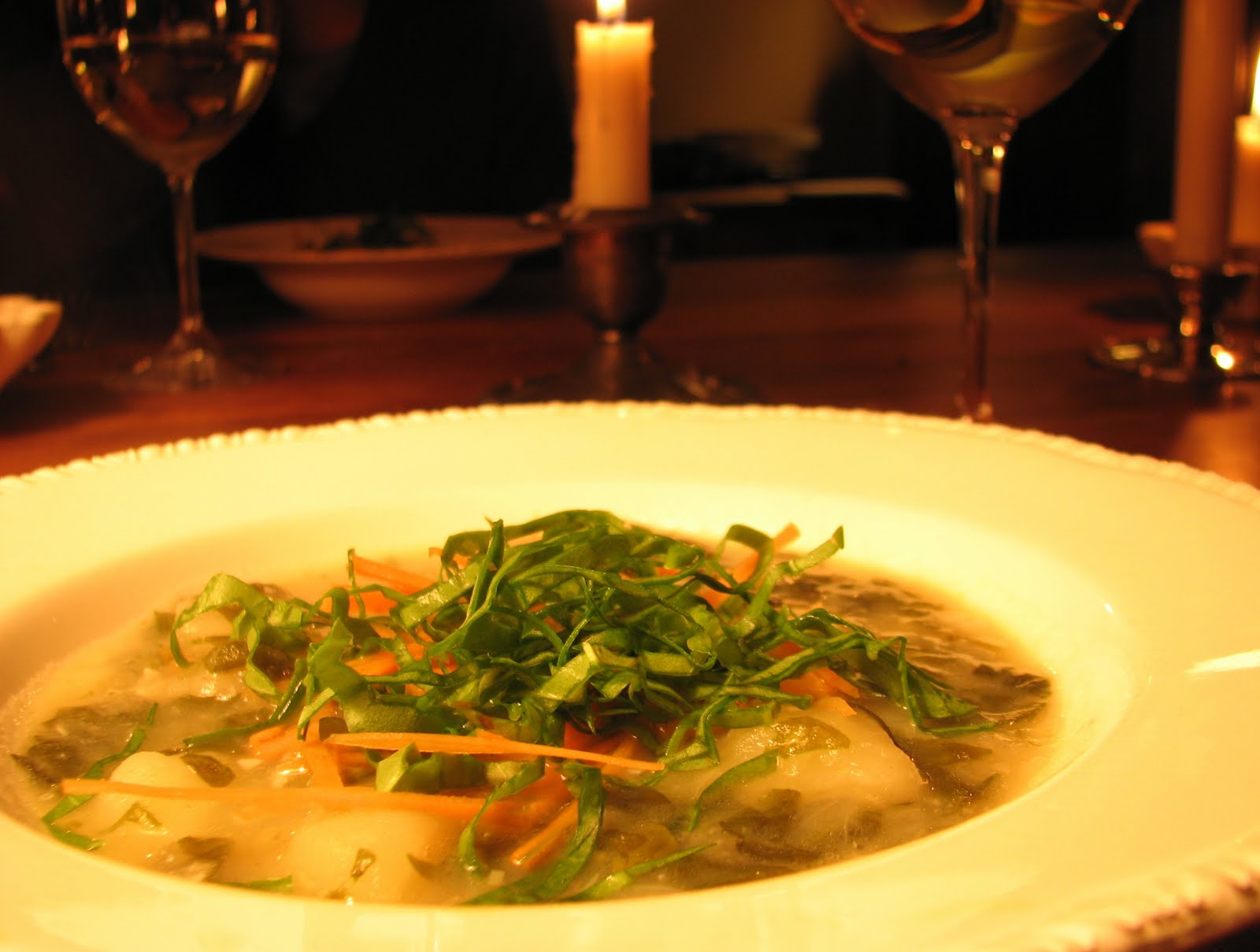
The soup can be made to this point several days in advance. Just before serving, bring the soup to the simmer, add the chopped sorrel, and simmer for 10 minutes. Taste for salt. Serve garnished with the reserved sorrel chiffonade, and the carrots if you like.

Note: Mary didn't care for the raw carrot garnish, but I did.

This kind of soup often gets a creamy finish, and a swirl of heavy cream, dollop of sour cream or creme fraiche certainly wouldn't hurt. But this au naturel version would be my preference when you've got really good potatoes and homemade stock.

Tuesday, November 16, 2010

Snow Soup Story


Saturday, 13 November, 2010

The first snow of the season came in last night, continuing through the morning in fits and starts, and on into the afternoon. It's extremely heavy snow, carrying twice as much moisture as an average snowfall--heart attack snow, its grisly nickname from the extra exertion required to shovel it. The kind of snow that also takes out tree limbs, hence power lines, and we heard on our battery-powered radio that thousands of homes were without power in the Twin Cities. We are at Bide-A-Wee, and so have no worries about losing power, as no wires connect us to the grid here. But we had our own concerns.


The original predictions said we’d only get an inch or two here, so I la-di-dahed it and didn’t bother moving the car to the top of our very steep driveway last night. Looking out in the morning, then, it was a rude awakening to see a good three or four inches of this very wet, slushy stuff turning the gravel drive into a quagmire. By that time it was nearly too late; fortunately I can stress the nearly. It took a good twenty minutes of up and downing it in the front-wheel-drive Jetta, strategic snow removal and gravel placement, and finally just gritting my teeth, gripping the wheel for dear life, and gunning it until the car surmounted the steepest pitch and I made it to the top.


With the snow rarely ceasing all day, we might have been there till spring.... Well, we didn’t really have anywhere we needed to be, but we were nearly out of candles, our main source of light, and also a friend had called to say he had some fresh eggs for us. I was eager to get those, so I did drive out in the afternoon, and only our town road was at all treacherous by then, the main roads clear. I got the eggs and had a cup of tea with Don, then proceeded into the town of Bloomer, about a 20-minute drive from the cabin. Bloomer has a couple of full-size grocery stores, but those stores yielded all of five white tapers, or tapers of any color, for that matter. I could have stocked up on scented jar candles, however.

With our oil lamp, a propane camp lantern, and strategically placed tea lights we’re sitting in romantically rustic lighting, a picture from more than a century back in technology, except that I am writing this on an Asus netbook, and Mary is reading Huckleberry Finn on her brand new Kindle, the electronic reader.

At least dinner will be a decidedly low-tech affair. Soup on the Haggis, our very basic woodstove, is on the menu, with some Wisconsin cheese and homemade levain bread. I took a downright peasant approach to the soup, and I hope it won’t offend any real peasants out there to learn that I didn’t even start with a clean pot. Last night I cooked up a batch of sauerkraut--choucroute, to give it a tonier Alsatian turn--that made a bed for legs of duck confit. I put some bacon rind in with the fermented cabbage, some carrot, onion, garlic, thyme, and we steamed some potatoes in there, too.


We ate pretty much all of it, but in the morning I saw that there were some odd bits of carrot, scraps of cabbage, and a couple pieces of potato left in the pot, along with the squares of bacon rind. Though we moved the pot to the side of the stove, it started to sizzle once I’d stoked the Haggis, and it smelled so good, well, I just couldn’t bear to toss the remnants out. In China there’s a tradition of master stocks, broth pots that are never emptied but merely added to in perpetuity. Our dutch oven didn’t have that sort of provenance, but I figured reusing that carried-over patina of ‘kraut and bacon fat would get my soup off to a running start.


So as the afternoon light faded, which never had glowed very brightly all day, a leaden November sky right through, we put some more sticks on the fire, gathered an armload of vegetables from the cooler and larder, and slid the soup pot back on the heat. The bacon rind began to sizzle again, and I added another strip of rind and a fat rasher diced. Then carrot, onion, leek, celery root tops and some of the root itself; kale, tomato, garlic, a dried red chili, and a couple of good forkfuls of ‘kraut straight from the jar, unrinsed. A splash of dry vermouth, water, salt and pepper, and last, a few slices of acorn squash.


And there it simmers, while the woodstove chimney ticks, the dogs doze, and sleety snow now and then scrapes at the windows. The radio just turned itself off; it was tuned to Mountain Stage, an excellent music variety show from West Virginia that we listen to on WOJB radio 88.9, “Woodland Community Radio” from the Lac Court Oreilles Ojibway reservation in Reserve, Wisconsin.


So that’s been our day, the first white one of the winter. Oh, add in a nice walk around the newly snow-draped hills, during which our young dog, Lily, covered a hundred times as much ground as the rest of us; senior griff Annabel, now 12, was also rejuvenated by the snow day. That soup, it won’t be any sort of culinary triumph, except that I know it will be perfectly delicious, and exactly what we want to eat. Great food doesn’t have to be complicated, or require too much thought or effort--that's the beauty of wonderful, seasonal ingredients. Sometimes, it doesn’t even have to start with a clean pot....


Text and photos copyright 2010 by Brett Laidlaw