Showing posts with label eggplant. Show all posts

Monday, September 10, 2012

这 些不是中国菜 / Ceci n'est pas un repas chinois / This is not a Chinese meal


I honestly feel that the most important tool in my cook’s virtual knife kit is not any twist of technique, nor depth of knowledge gained from reading about cuisines around the world and avidly eating from Strasbourg to Roanoke, Tofino to Chengdu, nor skill attained from picking up the chef’s knife every day to slice, dice, mince, chop, julienne, chiffonade, and brunoise. No, the number one weapon in my kitchen arsenal these days is the ability to go with the flow.  ‘Twas not always so.  Back in the day I’d get a notion in my head—lobster-stuffed potstickered wontons with black bean sauce, say, or a salad of peaches and beets—and doggedly pursue the wildest hare to the bitter end, no matter if that involved blood, sweat, tears, and a disappointing dinner.  Well, often that approach yielded good results—the wontons were excellent (the peach-beet salad, less so).  But it was stressful, and if affairs in the kitchen went amiss, the evening could go completely off the rails.  Nowadays, when I let ingredients lead my cooking more than any overwrought conceit, things tend to turn out better, perhaps because I’m more willing to enjoy how things turn out.  It’s a culinary version of the old, “Wherever you go, there you are.”  Maybe I’ve embraced the zen of cooking, and maybe my standards have just slipped.  Whatever.
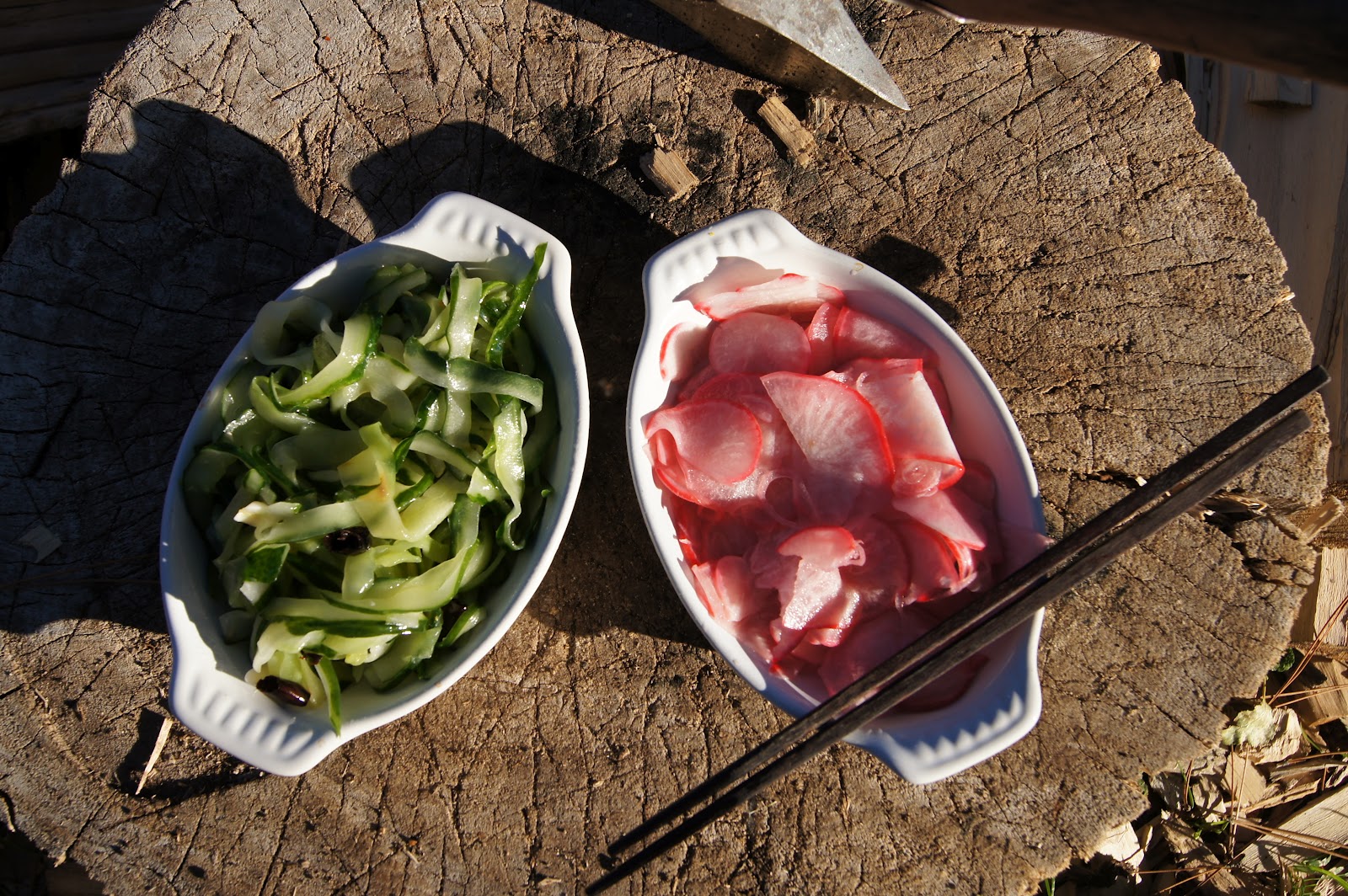

A case in point was last night’s dinner, which was supposed to be brunch, which might have become Chinese supper, which it was not, although it was eaten with chopsticks and rice bowls.  That might require a little bit of explanation. 

We had friends visiting at the farm and Bide-A-Wee this past weekend, and Sunday morning I started preparing some salads to have on a brunch buffet.  I was thinking of something a bit smorgasbord-ish:  there would be corn pancakes as the main event, and homemade herbed yogurt cheese, pickled beets, that sort of thing.  Maybe open a can of kippers. I found a couple of overgrown radishes in the garden which nonetheless were still firm and not too strong, and which sliced up into beautiful pink-and-white coins on the Benriner.  A couple of lovely Suyo Long cucumbers I also shaved into thin planks, and then sliced into veggie noodles, tossed those with a pretty hot chile-garlic oil, with just a splash of cider vinegar.  This could have been a Sichuan dish, except for the context.  Things were coming together nicely in my head for a delightful brunch.


But when Tim and Melinda came down the hill from Bide-A-Wee, it turned out they’d already had some yogurt and granola for breakfast, had enjoyed a walk around the Bide-A-Wee meadows, and were just about ready to head back to town.  No time or belly space for brunch.  No problem.  The salads could chill ‘til dinner.  We saw our friends on their way back home, then hopped in the car to do some shopping errands in Rice Lake.  On the way we stopped at the Crossroads Café in Cameron for Sunday dinner—Mary had the country fried steak, and I had chicken dinner (dark meat).  Both dinners came with a scoop of decent mashed potatoes, kind of soggy but still very tasty stuffing, and niblets corn (or you could have had Jell-O).  Mary’s gravy was white and specked with pepper; mine was chicken-dinner yellow.  Service was friendly and brisk.  My chicken was good, but not as good as the fall-off-the-bone version at the Sand Creek Café.  Mary’s country-fried steak was better, and she let me sample a generous portion.  After lunch we headed to Menard’s well-fed and content.  On the way to the checkout we were drawn to the looming Salted Nut Roll display, thinking that Nut Goodies would be nearby, but there were none to be found.  We settled for a Snickers (Mary) and Hershey’s Milk Chocolate with Almonds (me).   Why am I telling you this?


Okay.  Back home, little nap, some minor chores, a walk.  Radishes and cucumbers do not a supper make, but as lunch had been substantial, we didn’t want anything heavy.  Indeed, with our counters constantly covered in produce, and more, so much more in the gardens coming ripe, we think of vegetable centerpieces to our meals more than meat.  So some of the lovely corn we picked ourselves from a field near Sand Creek (with the farmer’s permission and supervision, of course!), which was originally going to garnish pancakes, that I simmered with onion, jalapeno, garlic, ginger, sage, lemon, and plenty of butter.  I had some eggplants from the market, and a big basket overflowing with patty pan squash from the garden.  My only thought with those was to grill them, toss them with minced shallots.  The thought evolved:  add some Hay River  pumpkin seed oil,* garlic, then a couple pinches of quatre-épices, cumin, and finally some piment d’espelette.  This turned out to be the star of the show.  A recipe worth writing down, passing on, repeating very soon.


And we served it all with rice, and ate with chopsticks, because that seemed elegant and appropriate, although this was not a Chinese meal.  But why not?  The cucumbers, as I say, could easily have passed on a Chinese table, and the radishes too; the eggplant-squash dish, with its mild heat and cumin fragrance, would have drawn compliments but raised no eyebrows as part of a meal in northwest China, along the silk road, where the food can seem Middle Eastern, Indian, or even Mexican.  And the corn was pretty much the same combination of ingredients that I stir-fry together for yumi chao lajiao—corn with chiles—and happily serve in Sichuan meals.  Only the butter—and maybe the sage—took it away from Chinese territory.  And yet, the combination of dishes, and the overall context, made this seem more French than Chinese.  Although it started out Scandinavian.  And it occurred to me in the course of the meal that it was a bit like the banchan dishes—kimchi, salads, and other little bites—that precede and accompany a Korean meal.


Scandinavian-French-Chinese-Korean-American tapas.  That’s what I’d call it.  With chopsticks.**

We drank a French vouvray from Champalou, a longtime favorite wine; always beautifully aromatic, ranging from dry to slightly sweet depending on the vintage.

Good things happen when you go with the flow.


Grilled Eggplant and Summer Squash with Pumpkin Seed Oil and Exotic Spice

Serves two as a side or part of a SFCKAT meal

2 Asian eggplants
2 small zucchini, same size as the eggplant, or a medium patty pan or yellow summer squash
Olive oil
Salt
1 ½ tablespoons pumpkin seed oil
1 tablespoon sunflower oil
1 small garlic clove, minced fine
1 small shallot, minced
2 small pinches quatre-épices 
2 generous pinches ground cumin
1/8 teaspoon piment d’espelette (or another aromatic, mildly hot ground chile that you like)
Good squeeze of lemon juice
Freshly ground black pepper

Remove the peel from the eggplants on two sides, remove stem and trim bottom, then slice the eggplants in half the long way, through the skin, so you have planks with the flesh exposed on the broad sections and strips of skin on the sides.  If that makes sense.  Slice the squash how you like to do for grilling.  Toss both eggplant and squash with a generous amount of olive oil, and salt generously as well.

Grill the vegetables until nicely brown, perhaps a bit charred, and very soft.  Chop them into ¾-inch chunks.  Mix the remaining ingredients, along with another pinch of salt and a few grinds of pepper, and toss with the vegetables.  Garnish with a few very thin shallot slices, if you like.
_____________________________________________________
* This dish turned out to be my favorite-to-date use for our Ken and Jay's wonderful Hay River pumpkin seed oil.  Though the oil's flavor took a backing role to the fragrant spices, the oil's texture gave a real depth and heft to this all-veggie dish.  I don't know why unctuous often has negative connotations; this dish, which actually used three different oils, had a savory unctuousness that was extremely appetizing.


**All of which made me think of  this excellent article by (Dear) Dara Moskowitz Grumdahl on the sense of the authentic in contemporary cuisine, "culinary imperialism", and the Twin Cities Asian restaurant boom--which is much more the real deal than the so-called Scandinavian restaurant boom, which consists of one high-end restaurant and a lunch spot in the American Swedish Institute....


Tuesday, August 21, 2012

Consider the Eggplant


Here’s another vegetable that we sophisticated eaters now take for granted, but which was rarely seen on the tables of our youth.  In fact, I cannot remember my mother cooking eggplant, ever.  Not once.  Really.  Eggplant parm on the menus of the local Italian-American restaurants, that was pretty much the extent of my acquaintance with eggplant until sometime in the early ‘80s.  Not that I ever ordered it.  And you know, you can’t really blame American cooks for approaching eggplant a bit leerily.  After all, here was a vegetable for which all the recipes instructed you to first slice it and salt it, maybe press it, to draw out the bitter juices.  Can you blame a guy if he wondered:  Can’t we just start with something that doesn’t have bitter juices?  And while many vegetables are perfectly lovely in their raw state—tomatoes, sweet peas, green beans, sweet corn, even kale—no one’s going to be snacking on raw eggplant while prepping dinner at the cutting board.


What's great about eggplant, of course, is the way it combines with other flavors, and the creamy texture it attains when properly cooked.  I think it was ratatouille that first interested me in eggplant, then baba ganouj, but where the purple fruit really shines is in Chinese cooking, and when I say Chinese cooking I mean Sichuan food, and when I say Sichuan food I mean yu xiang qiezi, and when I say…that, I mean:  Fish Fragrance Eggplant, one of my favorite Sichuan dishes, which puts it well up there among my favorite things to eat, period.  Where the fish in the title comes from, we will probably never know.  There are theories:  that the seasonings in the dish are the same commonly used to cook fish (but I had fish prepared many different ways in Sichuan); that in land-locked areas this preparation was somehow meant to mimic seafood (but even where there are not oceans, there are lakes and rivers).  


What’s certain is that there is nothing remotely fishy about the dish.  The eggplant is first fried to soften and brown it, then a sauce is prepared, of garlic and ginger, hot bean paste, soy, vinegar, and sugar, then the eggplant is anointed with this fragrant mélange, and the result is a really quite humble dish which nonetheless bursts with a complex interplay of flavors, aromas, and textures.  Zhen hao chi!

You can make this with the larger, Italian type of eggplant, but the skinny Asian kind is best.  I really like the pale lavender-and-lilac varieties, but I've only seen the dark versions this year.  I don't have them in my garden this year; the couple of plants I purchased failed to thrive.  It has been my experience that really fresh eggplant, whether of the Italian or Asian type, isn't bitter.  I think it's the long-haul, far-from-fresh eggplant we find in grocery stores in winter, dull-skinned and soft, that tend toward bitterness, and should be avoided.    Look for eggplant that is firm and shiny-skinned.  Don't let it sit around too long; it does not keep well.


The height of vegetable season--i.e., now--is a great time to dive into Chinese cooking.  Meat is often used more or less as a seasoning in many Chinese dishes, and the multi-plate format of a Chinese meal is a wonderful way to enjoy the amazing variety of produce available right now.  Sweet corn and chiles, cucumbers, and eggplants were the stars of a recent dinner chez Ecklaw.  Since our new house has an electric range, doing a proper stir-fry is difficult.  The wok doesn't get hot enough; a big sauté pan works okay, but it's really not the same.  So on this recent evening I decided to try the live-fire method.


A hunk of old metal we found in the woods at Bide-A-Wee made an adequate wok burner cooktop.  Things were off to a good start with the corn and chile stir-fry:


But we were racing against time:


And we lost.  We got one dish done on the fire, then made a mad dash back into the house to finish cooking in the kitchen.  It turned out okay.


Sichuan "Fish-Fragrance" Eggplant (Yu Xiang Qie Zi)


If you can’t find the long, thin Chinese or Japanese eggplant, this dish can be made with regular eggplant.  If you use regular eggplant:  Trim the ends and cut the eggplant in half the long way; use a spoon to scoop out the seediest part of the center, then cut the rest into bite-size wedges.  Chopped pickled chiles are usually used in China; sambal is a more than adequate substitute.

A little bit of ground pork is often added to vegetable dishes in Sichuan.  You can omit it for a vegetarian version, but the well-fried, slightly crunchy pork makes a wonderful textural contrast to the creamy eggplant.

1 pound Chinese eggplant    
1 cup cooking oil

Trim the stem from the eggplants, cut them in half the long way, then cut on the diagonal into 2- to 3-inch pieces.  Heat a wok or heavy saucepan, then add the oil.  When the oil is hot deep-fry the eggplant slices, in two or three batches, until they are soft and just a little bit brown on the cut ends.  Drain them on a paper towel.  Pour out the deep-frying oil (you can save it to use again) and wipe out the wok.


1 tablespoon sugar       
1 tablespoon dark Chinese vinegar* (see note)
2 tablespoons soy sauce          

Mix the sugar, vinegar, and soy sauce together, and stir well to dissolve the sugar.


¼ pound ground pork  
1 ½ tablespoons minced garlic
1 ½ tablespoons minced ginger
1 tablespoon chile paste (such as sambal oelek)
1 tablespoon broad bean paste with chile
2 tablespoons cooking oil         
½ teaspoon ground roasted Sichuan pepper
2 scallions, minced

Heat your wok or fry pan and add 2 tablespoons oil.  When the oil is very hot add the ground pork and stir-fry until the pork is cooked and slightly browned,  2 to 3 minutes.   Add the garlic, ginger, and and both chile and chile bean paste, and stir fry for 1  minute.

Now add the eggplant and stir-fry for about a minute to coat the eggplant with oil.  Then stir up the soy-vinegar-sugar mixture and add it to the pan.  Stir-fry for 1 minute and then remove everything to a serving plate.  Sprinkle the scallions and Sichuan pepper over it, and serve.


* Chinese dark vinegar is not at all the same as "black vinegar," as I was reminded yesterday when I mistakenly purchased the black kind, which tastes almost like Worchestershire sauce.  The dark vinegar I usually buy has a yellow label and is called "Chinkiang Vinegar": picture of the bottle in this post from last summer. 

Text and photos copyright 2012 by Brett Laidlaw

Tuesday, August 9, 2011

Bide-A-Wee Caponata (With Reflections on Unexpected Influences)


I find it amusing and instructive to look back over the years, think of how I cook today, how I cooked back when, and consider how I got from there to here.  I can see now a whole pile of  extremely various factors: Mom & Dad influences; my late-teen swing into vegetarianism; time spent on the east coast, and in Virginia; certainly my year in China, and travels in France, but also time spent on the shores of Lake Superior, and a bike trip in Nova Scotia.  People I met influenced me greatly, as well, and so did television cooking shows (I've mentioned Jacques Pépin's Today's Gourmet more than once, but I also fell in love with Madeleine Kamman through her long-ago cooking series), and books.

Among the books that have had the biggest impact on how I approach cooking, I'd love to be able to say that it was conscientious study of the methods of Escoffier and Careme that formed my culinary thinking, with peripheral influences of Basques, Tuscan, and Catalan gastronomy--but, you know, I'd be lyin'.  And while I've had Mastering the Art... on my shelf for many years, I mostly pick it up to put it down again.  I used to own a Joel Robuchon book written by Patricia Wells, Simply French that was so absurdly misnamed, it got me all rankled every time I picked it up--the recipes therein are simple if you own a truffle farm, and a flock of fattened fowl to harvest foie gras, and then there's the caviar....  I finally had to get rid of it.


But there's one modest, unassuming cookbook that I first purchased decades ago, and that has stayed relevant to me all that time.  I've mentioned it here before, The Country Gourmet, by Gil and Sherril Roth.  The Roths were New York chefs transplanted to North Carolina, where they set about growing most of their food, and procuring what they couldn't produce from local sources.  In other words, they anticipated the whole local-seasonal eating trend, with a strong strain of self-sufficiency in the mix.  The book is arranged more or less by the seasons, and it ranges from the stalwart basics to the oddly idiosyncratic--there's a chapter devoted to a dinner of Indian dishes, for instance, which still strikes me as odd when I'm flipping through the book, though I've tried some of those recipes, and they're good.

I suppose I just found The Country Gourmet at exactly the right time in my development as a cook; it amazes me to think of all the things I learned from it.  The bread recipes with variations expanded my bread baking horizons, and the homemade pasta section is still a go-to source for me, both for basic recipes and excellent rustic preparations like pasta with cabbage and onions--this book also introduced me to pasta alla carbonara.  Here's where I learned how to make sauerkraut in jars, picked up a winter-time staple that is Portuguese kale soup, and even a dog biscuit recipe that I used in our Real Bread years, and which earned a devoted following (right, Jen --or should I ask Lily...?). 

The personal tone of the Roths writing is utterly engaging.  They're not pushing any agenda or working some tricksy angle--they just share their enthusiasm for good, honest food and the joys of connecting with the seasons through gardening, preserving, and cooking.  Amazingly, you can pick up a copy for one red cent, plus shipping, of course.  I recommend you do so.


All of this is a (typically) roundabout introduction to a sweet and sour eggplant and green apple relish I whipped up this weekend, Bide-A-Wee caponata.  My first exposure to caponata was through a recipe in The Country Gourmet.  Caponata is a Sicilian dish made with eggplant, tomato, olives, capers, often raisins or currants.  Having not been to Sicily, I'm not exactly sure how it's served there.  I see numerous references to it as a component of an antipasti platter, and it's more often referred to as a relish than a vegetable side dish, from rather brief research.  It's often referred to as "Italian ratatouille," but I think that's misleading, as rataouille can be a meal in itself, and I don't think caponata would ever be served thay way.

The Bide-A-Wee caponata recipe presented here is very much my own interpretation, a Mediterranean-meets-Dunn County deal, fer sure.  To start with, I omitted two of the constant ingredients in every caponata recipe I've seen--tomatoes and olives.  My capers were salted milkweed flower buds, and the fruit component, chopped green apples. My vinegar was not balsamic but apple cider, and the sweetness to match the sour:  maple syrup, of course.

For the green apples I looked for ones that were starting to ripen--not the kind so tart and astringent you have to spit it out before you've even chewed.  In fact, I used three kinds of apples: one that was becoming sweet, but had little complexity; one still quite tart but developing interesting flavors; one tart and extremely aromatic, with the smell of excellent apple cider.  That said, you could make this with one kind of really firm, tart-sweet apple.

Otherwise it's pretty straight-forward.  Everything cooks in one pan; it's best if made a bit ahead to let the flavors blend, and served at room temperature.  Given that we had already strayed very far from the traditional preparation of caponata,  we served it idiosyncratically, as well:  first on tacos of flash-fried thin-sliced boneless beef short ribs; then on chicken sandwiches; finally, the last few bites, on crackers.  It's great stuff, complex in flavor and texture, silky and crunchy by turns, tart, sweet, smoky--compelling, I dare say.  I'm planning to make a big batch soon, freeze portions for the winter.  It's a vibrant taste of summer that I know will be welcome come January.

I'd love to hear about what cookbooks, or other sources of inspiration, have stayed with you over the years, unexpectedly, or not.


Bide-A-Wee Caponata: Sweet & Sour Eggplant, Green Apple, Salted Milkweed Relish
Makes about a cup

3 tablespoons olive oil, divided
1/2 cup chopped onion
1 hot Hungarian chile, chopped (about 1/2 cup)
1 rib celery, chopped
3/4 cup eggplant, skin on, in 1/3-inch dice
3/4 cup green apple or crisp tart-sweet apple (see above), skin on, in 1/3-inch dice
2 cloves garlic, minced
2 tablespoons cider vinegar
1/4 cup water
1 tablespoon maple syrup
1 tablespoon salted milkweed buds, rinsed (or use small capers, prefereably salt-packed)
salt and pepper

In a medium saucepan heat 2 tablespoons of olive oil.  Add the onion, celery, and chile, and cook over medium-high until wilted.  Add the eggplant, apple, and a good pinch of salt.  Cook until the eggplant is soft, 3 to 4 minutes.  Add the garlic and cook for one minute.  Add the vinegar, 1/4 cup water, and the maple syrup.  Simmer gently, uncovered, for 5 minutes, until most of the water is gone.  Remove the pan from the heat and add another good pinch of salt, a few grinds of pepper, and the milkweed buds or capers--save a few buds back to garnish the top.  Set aside at room temperature until you're ready to serve; if you'll be serving it a day or more later, refrigerate, then bring to room temp before serving.  Drizzle one tablespoon olive oil over the top just before serving.

Text and photos copyright 2011 by Brett Laidlaw